


























Views
Downloads


Essential Modeling Fractions with Circles Worksheet
Paste this activity's link or code into your existing LMS (Google Classroom, Canvas, Teams, Schoology, Moodle, etc.).
Students can open and work on the activity right away, with no student login required.
You'll still be able to track student progress and results from your teacher account.
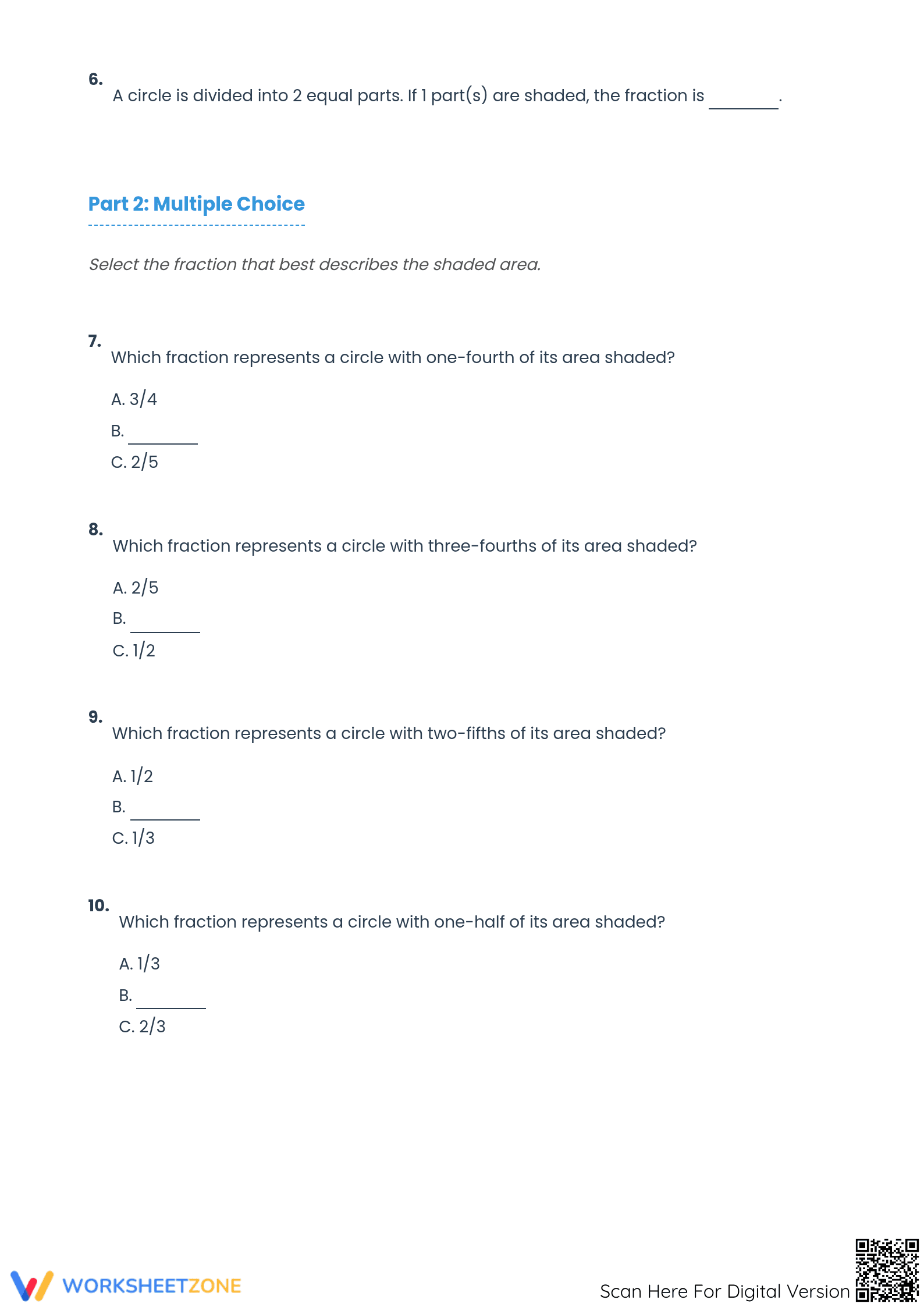
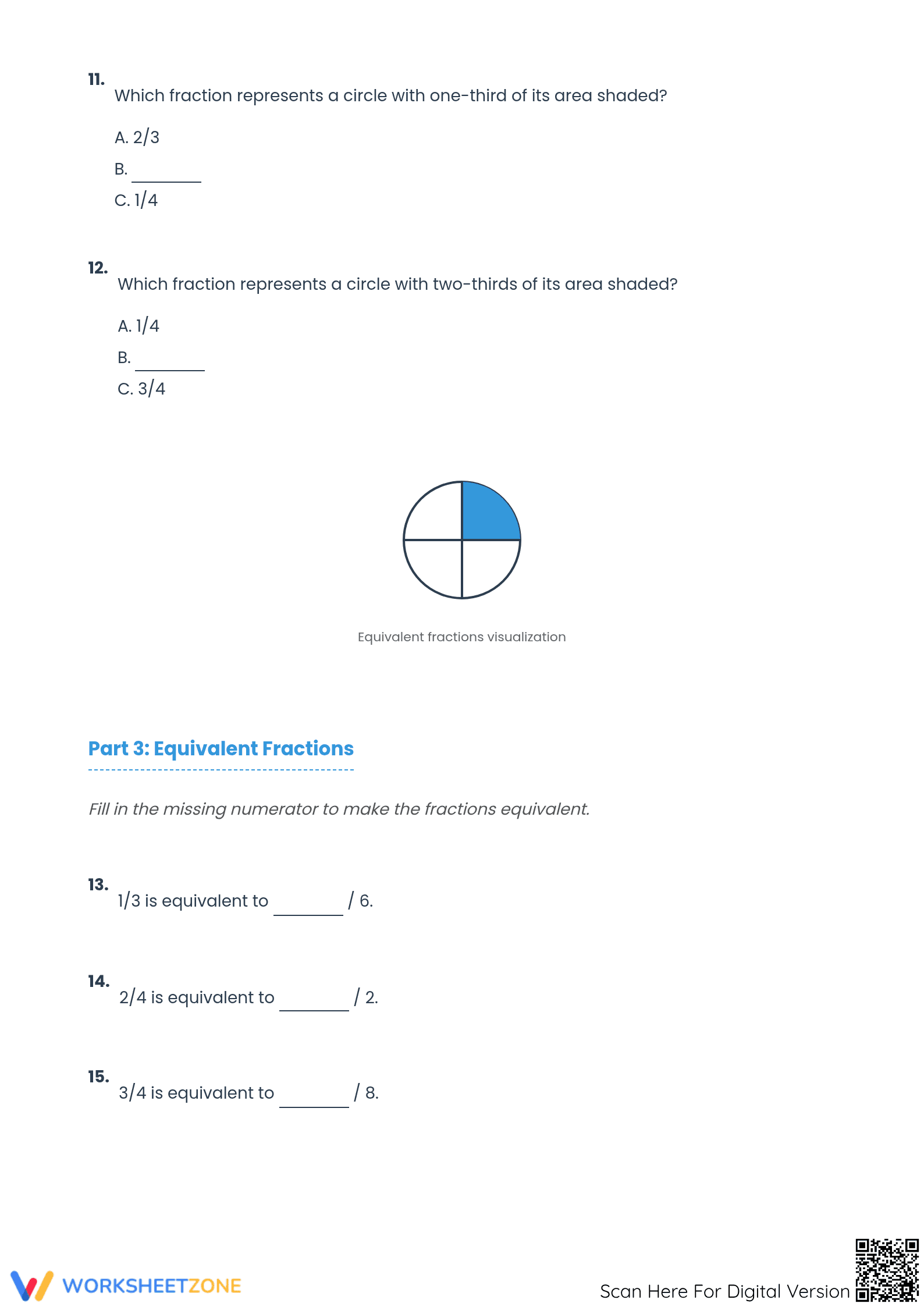
Mastering fraction notation starts with clear visual models. This 5-page worksheet uses circle diagrams to help students bridge the gap between abstract numbers and tangible parts of a whole. By working through various representations, learners build a robust foundation for naming fractions, recognizing equivalents, and solving real-world word problems with confidence.
At a Glance
- Grade: 3 · Subject: Math
- Standard:
CCSS.MATH.CONTENT.3.NF.A.1— Understand a fraction 1/b as the quantity formed by 1 part when partitioned.- Skill Focus: Visual Fraction Modeling
- Format: 5 pages · 24 problems · Answer key included · PDF
- Best For: Independent practice or small group review
- Time: 30–45 minutes
This comprehensive 5-page PDF contains 24 structured tasks divided into four distinct sections. It includes descriptive fill-in-the-blank modeling, multiple-choice identification, equivalent fraction calculations, and contextual word problems. A complete 5-page answer key is provided for immediate feedback and grading efficiency.
- Guided practice: Part 1 provides 6 descriptive prompts where students identify the numerator and denominator based on written partitioning and shading instructions.
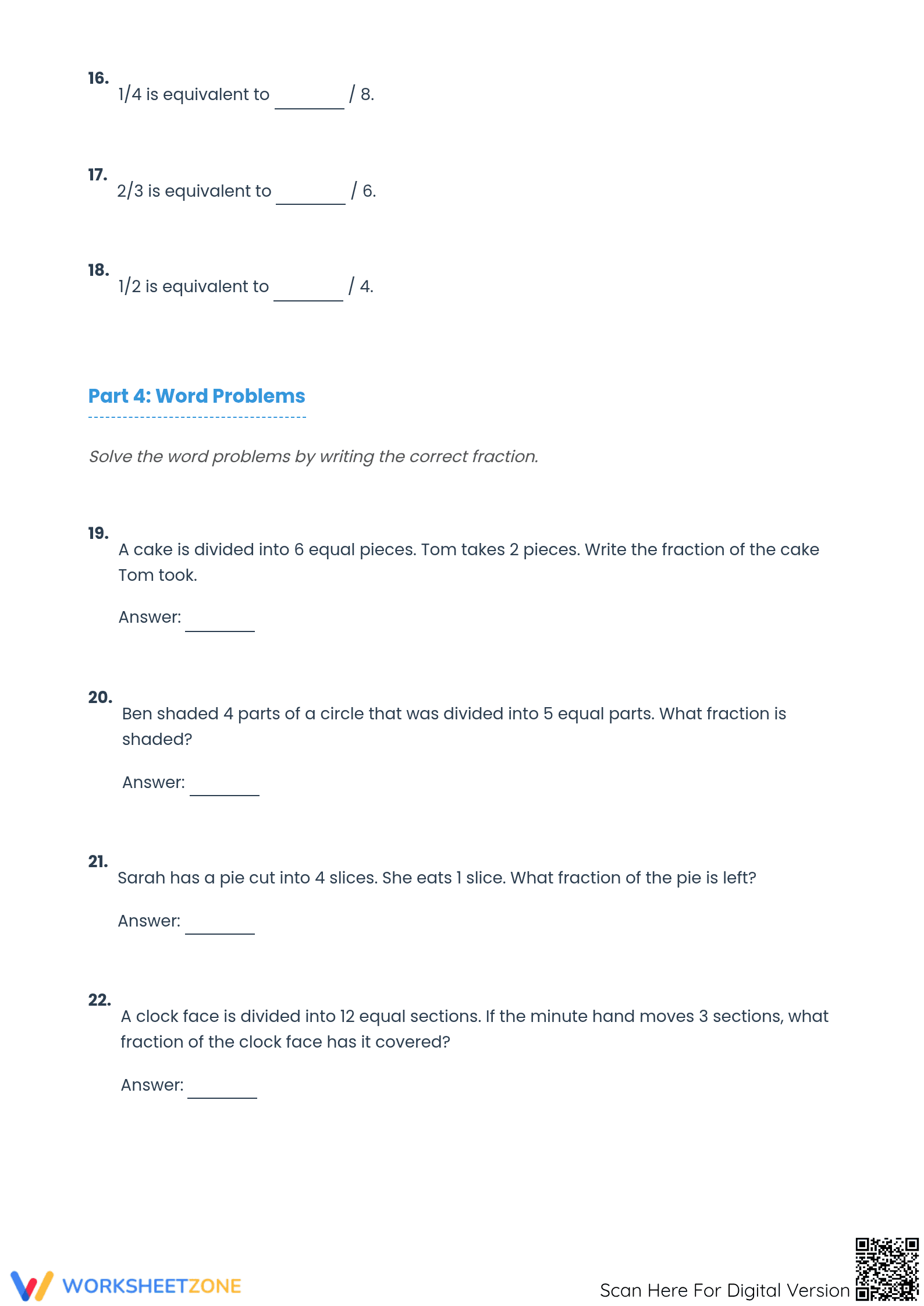
- Supported practice: Part 2 and 3 offer 6 multiple-choice items and 6 numeric equivalence problems to reinforce visual-to-symbolic conversion.
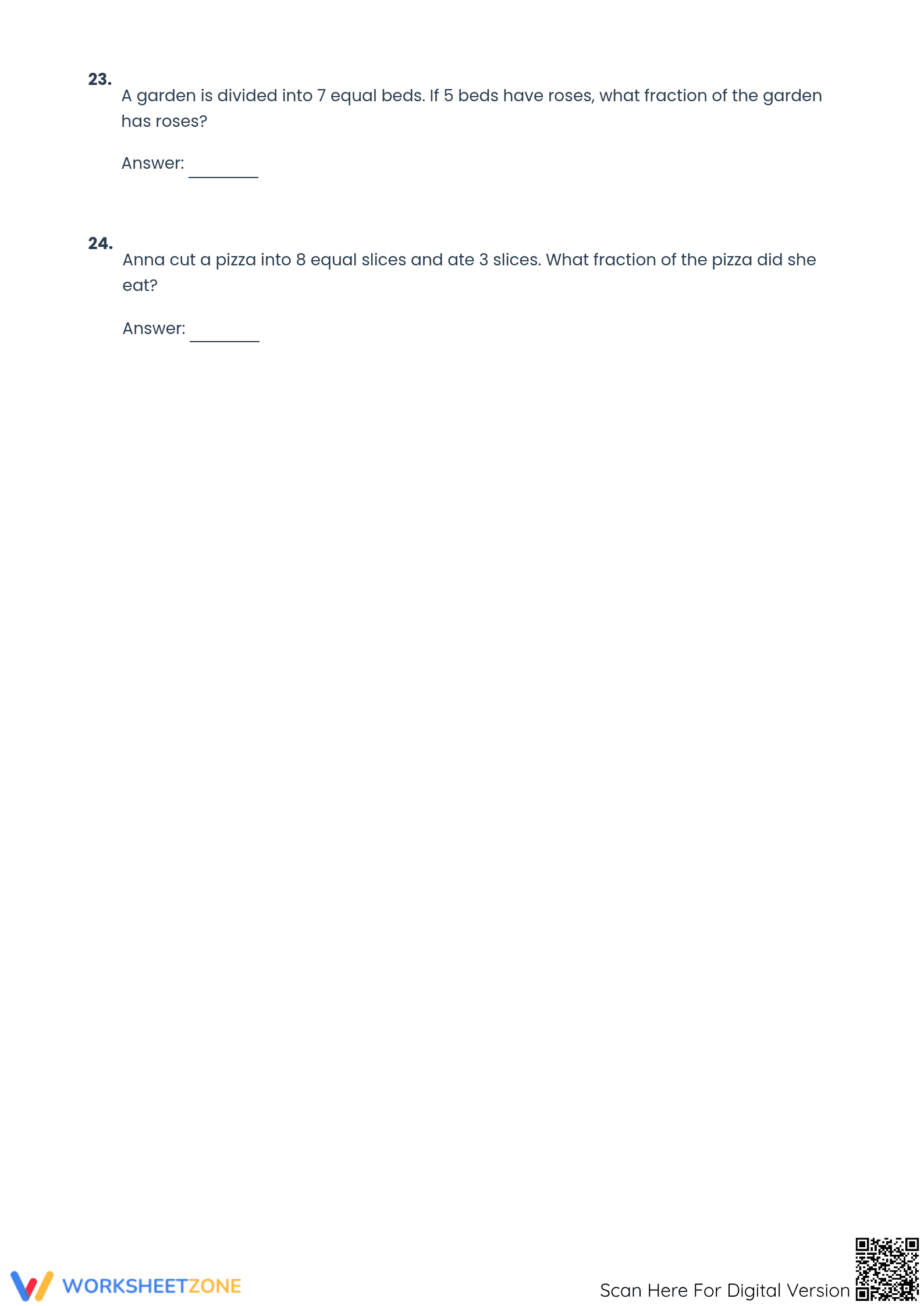
- Independent practice: Part 4 presents 6 multi-sentence word problems that require students to apply fraction concepts to real-world scenarios like cakes, pies, and gardens.
This sequence follows a gradual-release model, moving from scaffolded identification to independent application.
This resource is primarily aligned with CCSS.MATH.CONTENT.3.NF.A.1, which requires students to understand a fraction as the quantity formed by parts of a partitioned whole. Students demonstrate mastery by identifying a/b as a parts of size 1/b. The inclusion of equivalent fractions also supports CCSS.MATH.CONTENT.3.NF.A.3. Both standard codes can be copied directly into lesson plans, IEP goals, or district curriculum mapping tools.
Assign this worksheet as a summative review after introducing circle models in direct instruction. During use, circulate and observe if students are counting the "total parts" correctly for the denominator—a common area for formative correction. Expected completion time is 30 to 45 minutes depending on student familiarity with word problems.
This is designed for Grade 3 students but serves as an excellent intervention tool for Grade 4 or 5 learners needing visual remediation. It pairs naturally with physical fraction circles or digital manipulatives to provide a multisensory approach to partitioned wholes.
According to the RAND AIRS 2024 report on mathematics instructional materials, visual models are foundational for developing proportional reasoning in elementary learners. By utilizing the CCSS.MATH.CONTENT.3.NF.A.1 standard as an anchor, this worksheet ensures students move beyond rote memorization of numerators and denominators. Fisher & Frey (2014) emphasize that scaffolded practice, such as the transition from identification to word problems seen here, is critical for cognitive load management during new skill acquisition. This 24-task set provides the necessary repetition required for students to internalize circle-based representations as a reliable mental model. Educators can rely on this resource as an evidence-based tool for building the fraction fluency needed for more advanced middle school ratios and geometry.


