


























Views
Downloads



Essential Fractions with Circles Worksheet for Grade 3
Paste this activity's link or code into your existing LMS (Google Classroom, Canvas, Teams, Schoology, Moodle, etc.).
Students can open and work on the activity right away, with no student login required.
You'll still be able to track student progress and results from your teacher account.
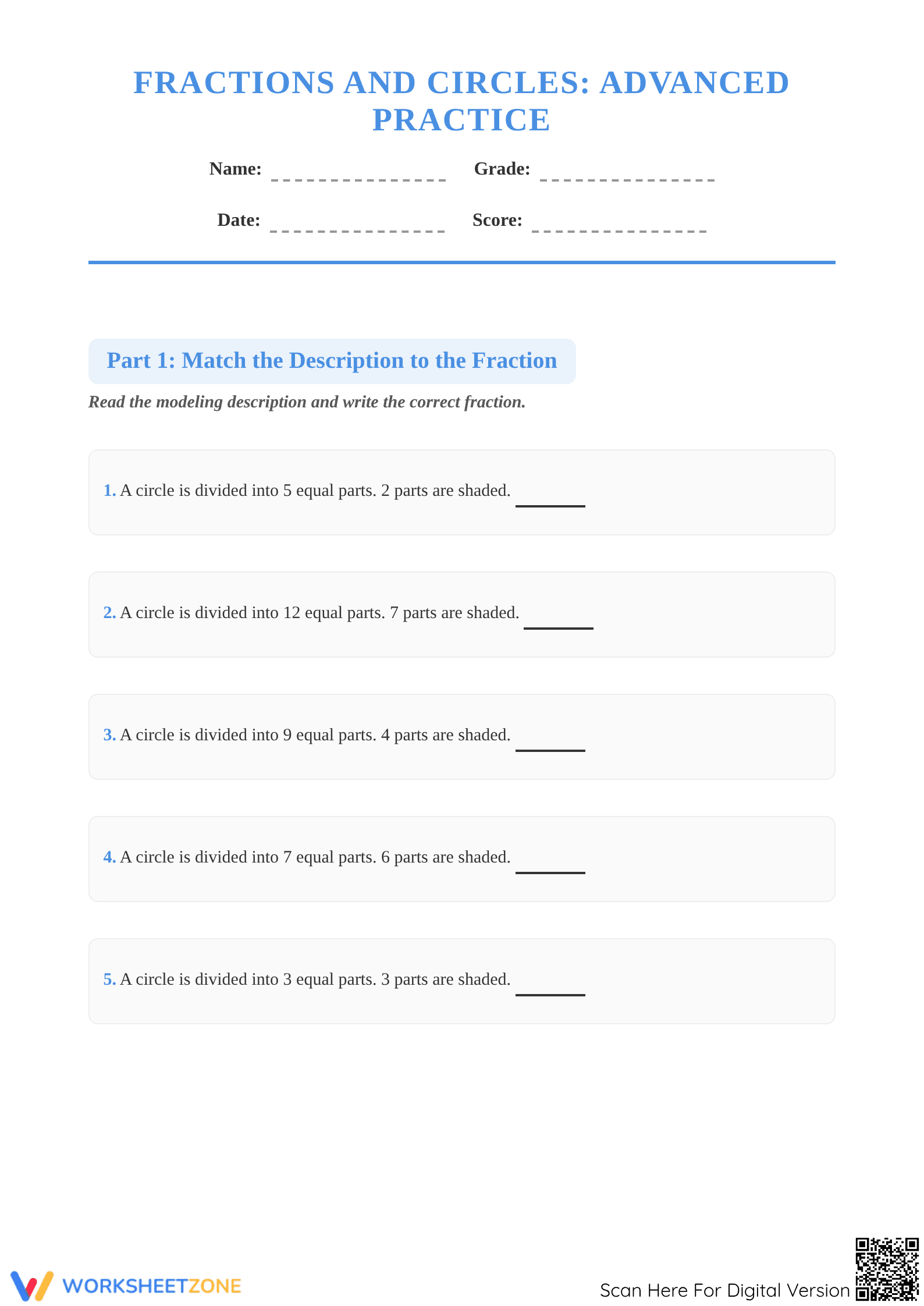
This Grade 3 fractions and circles worksheet provides a comprehensive pathway for students to master modeling fractions using visual area models. By engaging with 32 structured problems, learners transition from matching descriptions to identifying equivalent fractions and solving real-world word problems. This ensures a robust understanding of part-whole relationships through intentional circular modeling.
At a Glance
- Grade: 3 · Subject: Math
- Standard:
3.NF.A.1— Understand fractions as quantities formed by partitioning a whole into equal parts- Skill Focus: Modeling fractions with circles
- Format: 5 pages · 32 problems · Answer key included · PDF
- Best For: Independent practice and skill reinforcement
- Time: 30–45 minutes
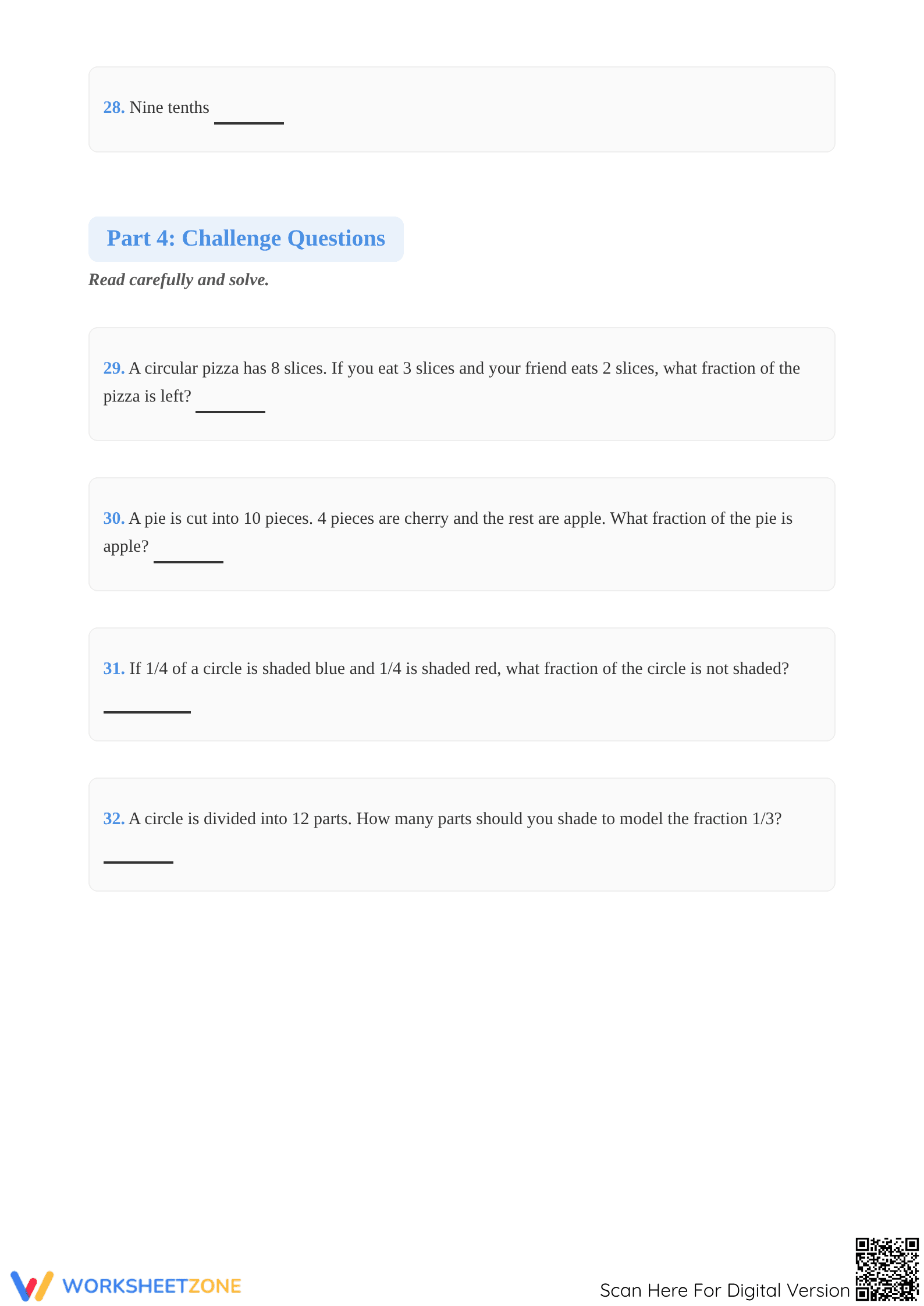
This five-page PDF resource includes four distinct sections designed to build mastery. Part one features matching tasks between verbal descriptions and numerical fractions. Part two introduces equivalent fraction identification. Part three focuses on converting word forms to numerical notation. Finally, part four provides challenge word problems. A full answer key is included for rapid teacher grading and student self-correction.
The streamlined design of this resource minimizes instructional overhead, allowing for a direct integration into any math block. Teachers can print and distribute the packet in under two minutes, providing a ready-made independent practice session or a quality substitute lesson plan. Because instructions are self-explanatory and visual cues are embedded, students can complete the 32 tasks with minimal teacher intervention or prior setup.
Standards Alignment
The primary focus of this worksheet is CCSS.MATH.CONTENT.3.NF.A.1. Students will understand a fraction 1/b as the quantity formed by 1 part when a whole is partitioned into b equal parts; understand a fraction a/b as the quantity formed by a parts of size 1/b. This standard code can be copied directly into lesson plans, IEP goals, or district curriculum mapping tools.
How to Use It
Use this worksheet as a summative assessment following a unit on visual fraction models or as a guided practice tool during small-group instruction. Teachers should observe students during Part 2 to identify misconceptions regarding area equivalence before moving to the challenge word problems. Expect students to spend approximately 30 to 45 minutes completing the full set of 32 problems across the five pages.
Who It's For
This resource is optimized for Grade 3 students but serves as an effective remediation tool for Grade 4 and 5 learners who require additional support with visual modeling. It pairs naturally with circular fraction manipulatives or an anchor chart displaying common denominators. The "Advanced Practice" designation makes it particularly suitable for high-achieving second graders ready for introductory fractional concepts.
Fractions are the cornerstone of middle-level mathematical fluency, yet many students struggle to bridge the gap between visual partitioning and numerical representation. According to Fisher & Frey (2014), the use of intentional visual scaffolds, such as circular area models, is critical for developing a conceptual understanding of part-whole relationships. This 5-page worksheet directly addresses this need by transitioning students from descriptive modeling to the identification of equivalent fractions and the resolution of complex word problems. By explicitly aligning tasks to CCSS.MATH.CONTENT.3.NF.A.1, this resource ensures that Grade 3 learners can accurately describe a fraction 1/b as the quantity formed by one part when a whole is partitioned into equal parts. This structured approach facilitates a gradual release of responsibility, moving from guided matching to independent problem-solving. This ensures students build the cognitive endurance required for higher-order algebraic thinking while maintaining high levels of instructional accuracy and pedagogical alignment with current state standards.


