


























Views
Downloads
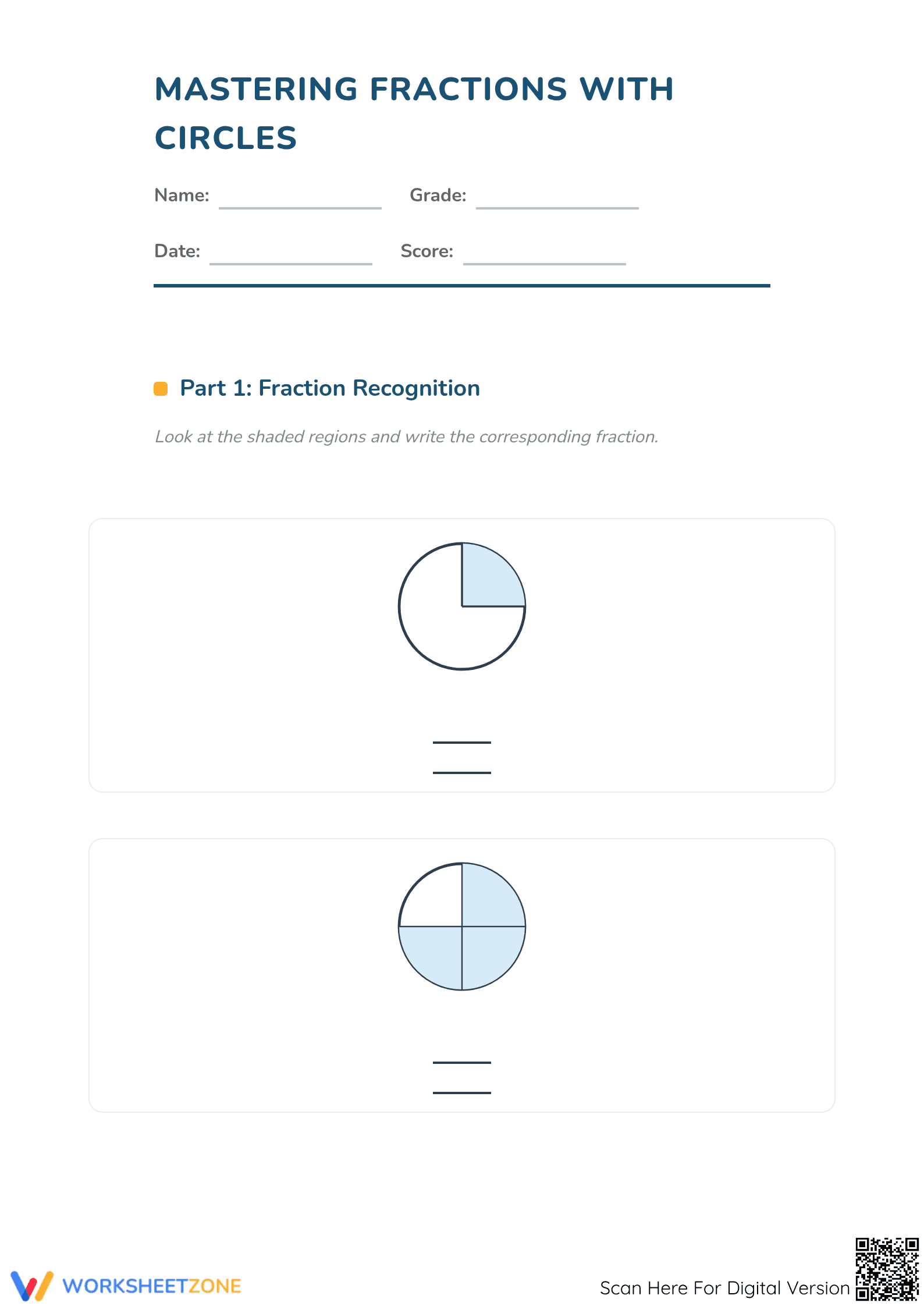
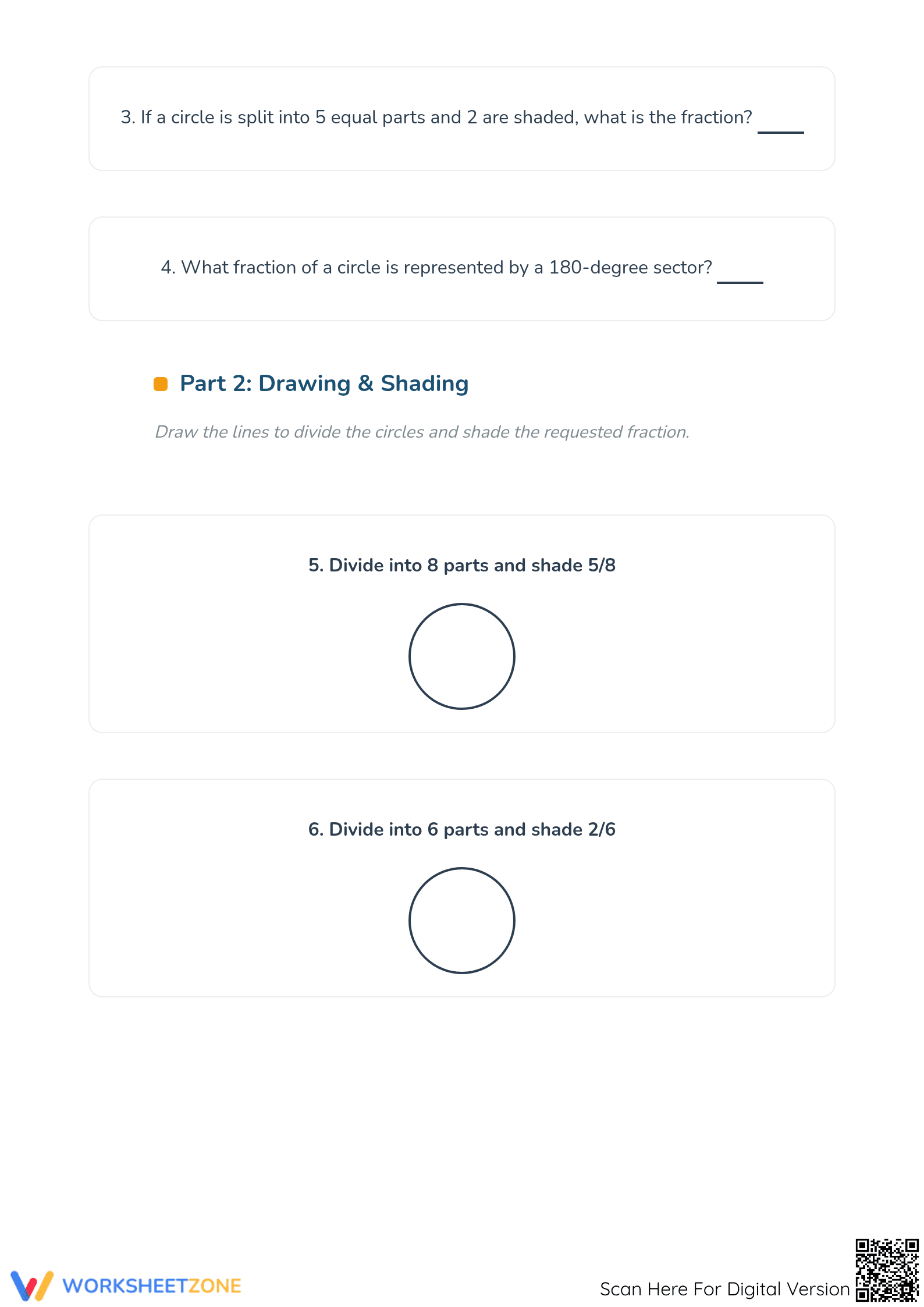
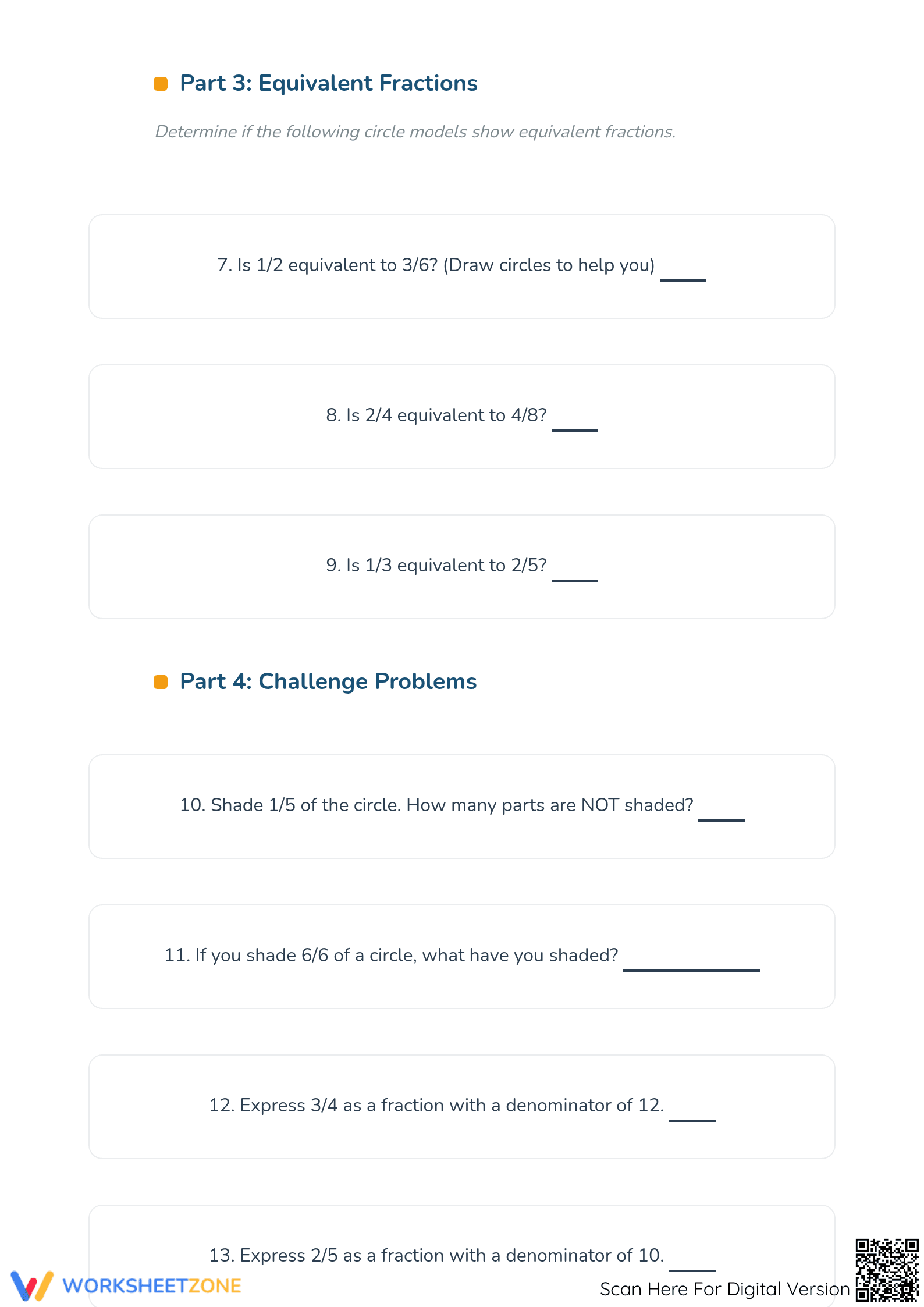
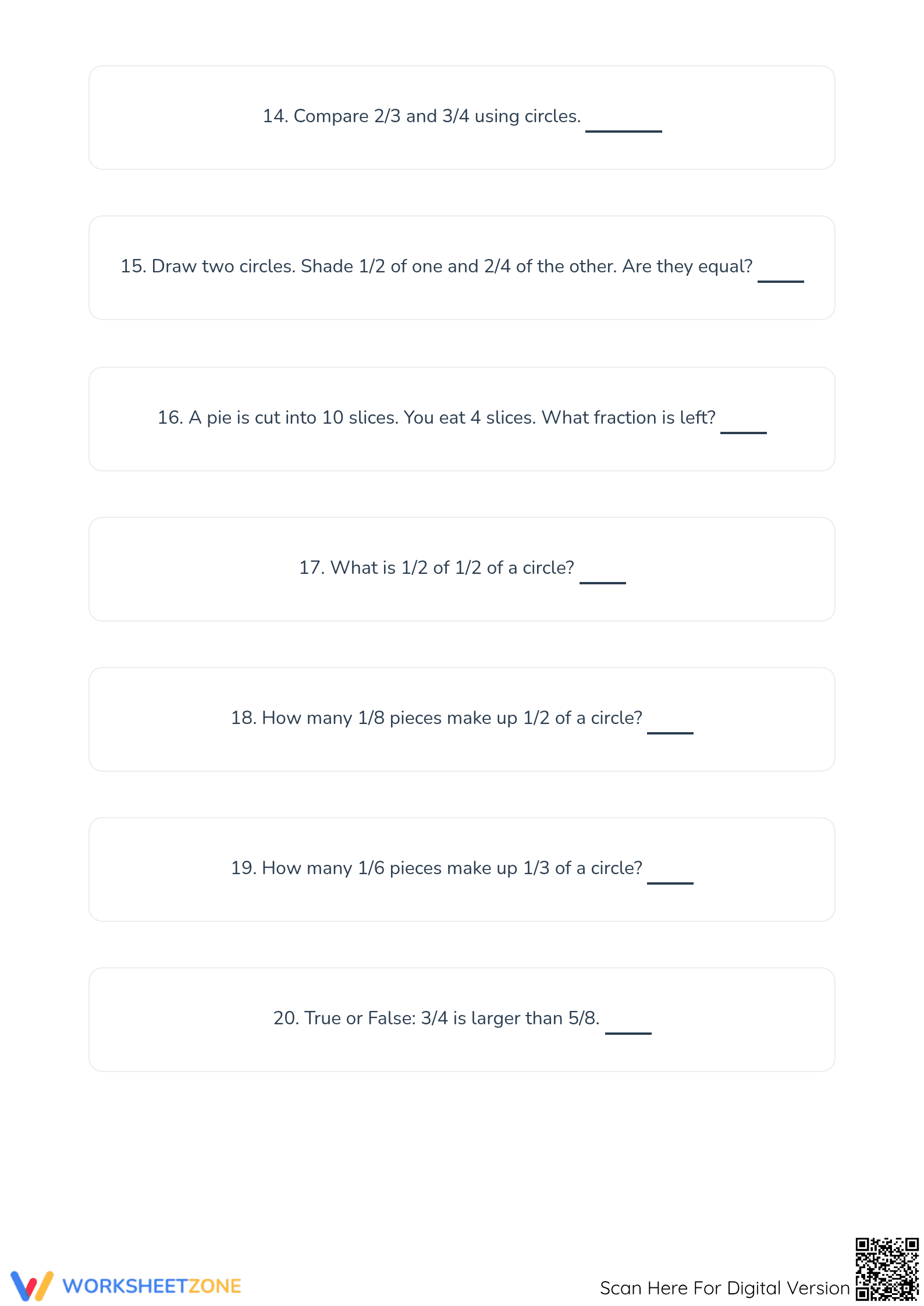

Printable Fractions with Circles Worksheet | Grades 3-5
Paste this activity's link or code into your existing LMS (Google Classroom, Canvas, Teams, Schoology, Moodle, etc.).
Students can open and work on the activity right away, with no student login required.
You'll still be able to track student progress and results from your teacher account.
Master fraction concepts through visual representation. This worksheet uses the circle model to help students bridge the gap between abstract numbers and concrete parts of a whole. By partitioning circles, learners develop a deep conceptual understanding of numerators and denominators across various complexity levels.
At a Glance
- Grade: 3–5 · Subject: Math
- Standard:
3.NF.A.1— Understand a fraction 1/b as the quantity formed by 1 part when partitioned- Skill Focus: Visual Fraction Modeling
- Format: 5 comprehensive pages · 27 varied problems · Full answer key included · Printable PDF
- Best For: Small group instruction, independent practice, and formative assessment
- Time: 30–45 minutes
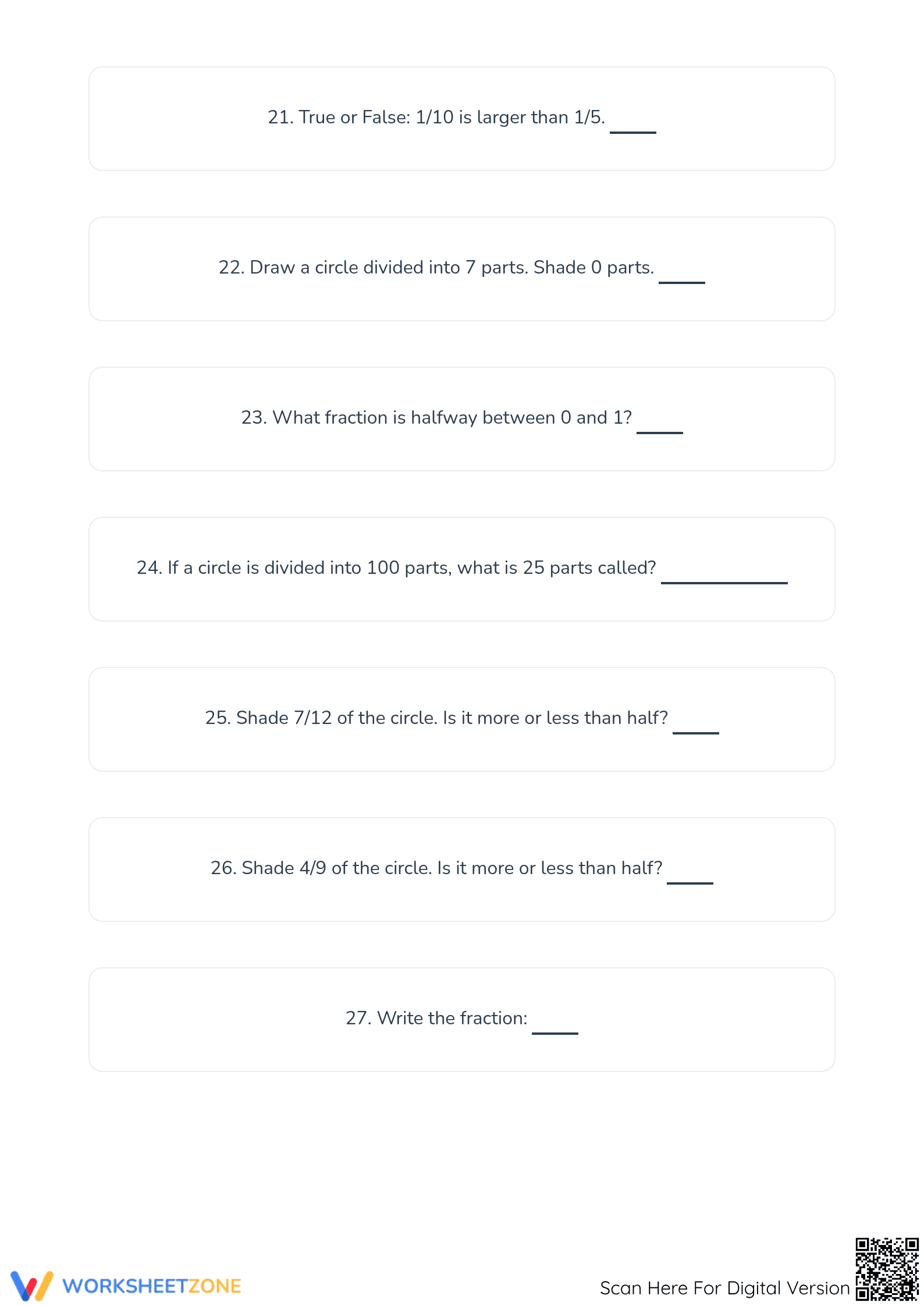
This 5-page PDF contains 27 tasks divided into recognition, drawing, equivalence, and challenge sections. It includes variety, from visual identification to complex word problems and logic checks. A complete answer key is included for immediate feedback.
- Guided Practice: 4 recognition tasks where students identify shaded regions of pre-partitioned circles, establishing the basic relationship between parts and the whole.
- Supported Practice: Students take an active role by drawing lines to divide blank circles and shading specific fractions like 5/8 based on verbal prompts.
- Independent Practice: 20+ problems transitioning to abstract application, requiring students to compare fractions, determine equivalence, and solve real-world word problems.
This sequence follows a gradual-release model, moving from "I Do" modeling to "You Do" independent mastery.
Standards Alignment
This resource is directly aligned to CCSS.MATH.CONTENT.3.NF.A.1. Students will understand a fraction 1/b as the quantity formed by 1 part when a whole is partitioned into b equal parts; understand a fraction a/b as the quantity formed by a parts of size 1/b. It also supports 4.NF.A.1 by providing a visual foundation for generating equivalent fractions.
How to Use It
Use during the "You Do" portion of a lesson. Best after manipulatives but before number lines. For assessment, observe students during Part 2; struggling to partition into odd numbers indicates a need for instruction on equal parts. Completion time: 40 minutes.
Who It's For
Designed for Grade 3-5 students and RTI Tier 2 intervention. Pairs naturally with fraction circle manipulatives or anchor charts showing the relationship between sectors and degrees.
According to Fisher & Frey (2014), visual modeling is a critical bridge for developing mathematical fluency. This worksheet leverages the "circle model"—one of the three most effective representations for fractional thinking—to ensure students internalize the concept of partitioning. By moving from recognition (low cognitive load) to partitioning blank circles (high cognitive load), the resource adheres to research-based scaffolds for student success. Standard 3.NF.A.1 emphasizes the part-whole relationship, and this 5-page packet provides the necessary volume of practice to move students toward mastery. The inclusion of challenge problems ensures that students who reach the standard early are pushed into higher-order analysis, such as comparing 2/3 and 3/4. This structured approach is essential for building the prerequisite skills required for later operations with fractions. By providing 27 varied tasks, this resource addresses the "practice gap" identified in recent ScienceDirect TpT Analysis of educational materials and standard-aligned curricula.


