


























Views
Downloads

Essential Fraction Models Worksheet | Grade 3 Math
Paste this activity's link or code into your existing LMS (Google Classroom, Canvas, Teams, Schoology, Moodle, etc.).
Students can open and work on the activity right away, with no student login required.
You'll still be able to track student progress and results from your teacher account.
Mastering fractional concepts starts with strong visual representation. This comprehensive math resource helps students transition from concrete circle models to abstract numerical notation, ensuring a deep understanding of parts-to-whole relationships. By identifying, comparing, and solving real-world scenarios, learners build the proportional reasoning skills necessary for long-term mathematical success in later grades.
At a Glance
- Grade: 3 · Subject: Math
- Standard:
CCSS.MATH.CONTENT.3.NF.A.1— Understand a fraction 1/b as the quantity formed by 1 part when a whole is partitioned into b equal parts- Skill Focus: Modeling and comparing fractions with circles
- Format: 4 pages · 17 problems · Answer key included · PDF
- Best For: Targeted fraction practice and conceptual review
- Time: 25–35 minutes
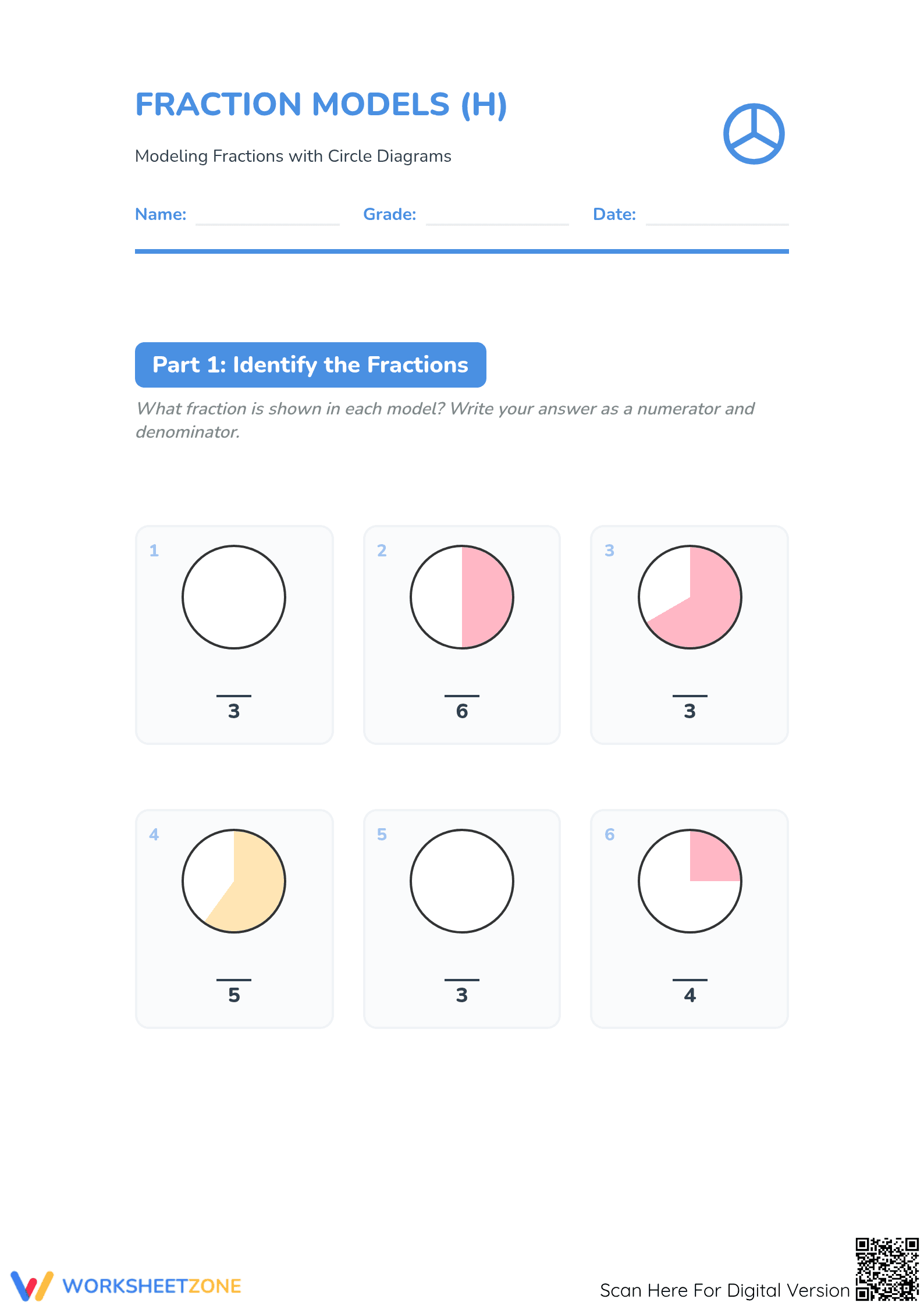
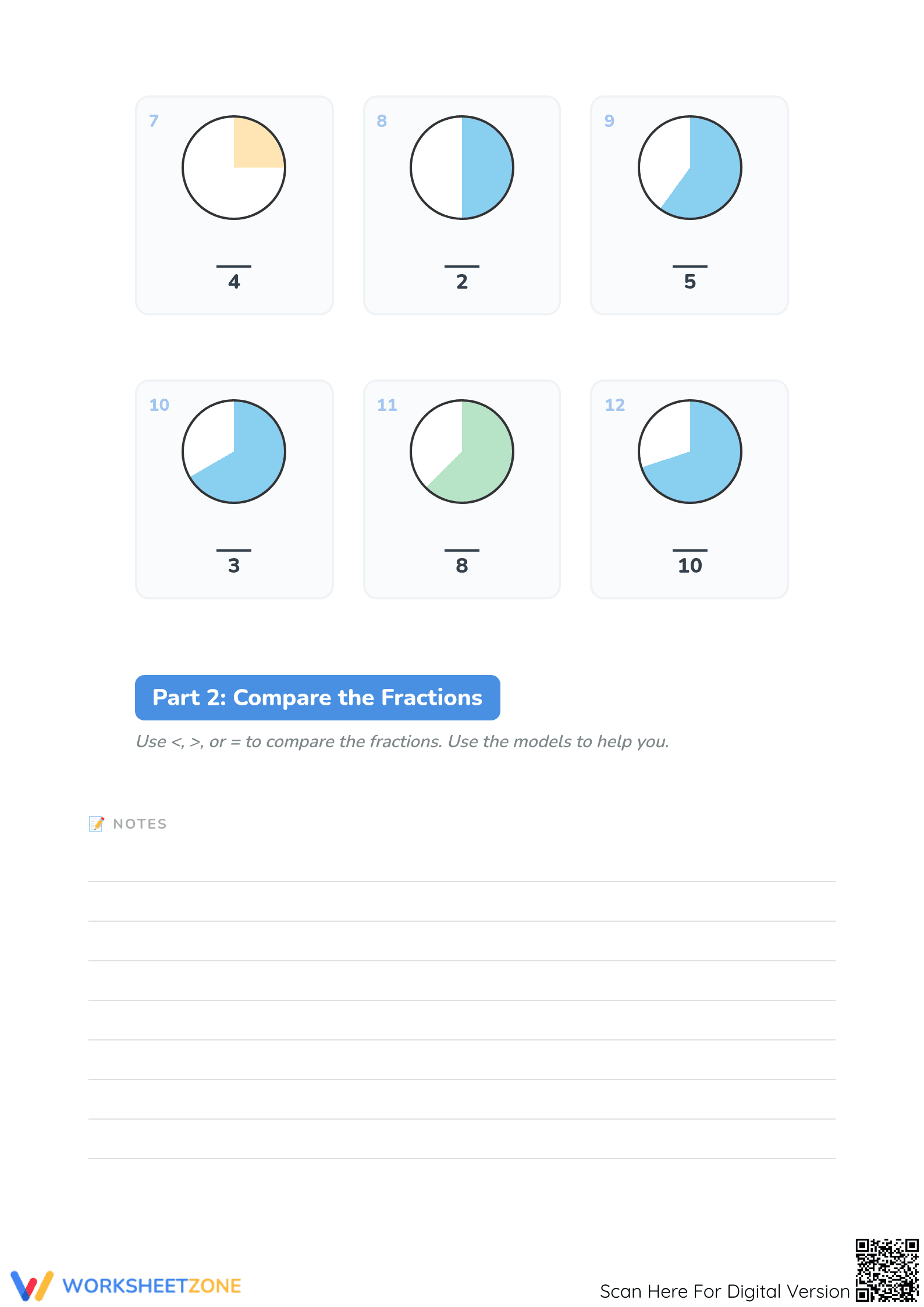
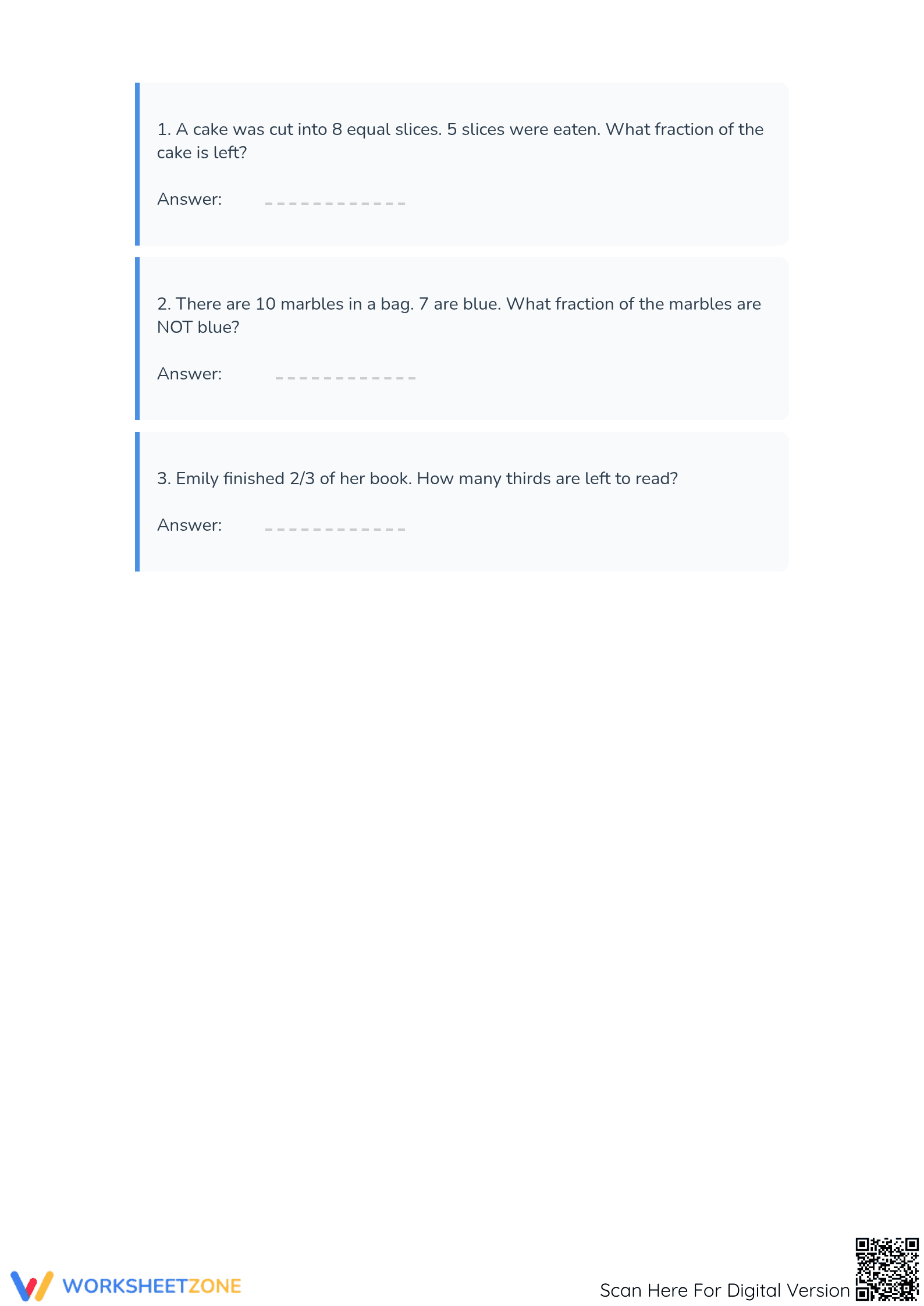
This four-page instructional packet is designed for maximum clarity and student engagement. It features 12 identification tasks where students must determine the numerator for a given denominator based on a shaded circle. Following this, students engage in comparison activities and three complex word problems that require applying their knowledge to practical, everyday situations. The layout includes dedicated note sections for scratch work.
- Guided Practice (12 tasks): Students observe circular models with pre-filled denominators and write the corresponding numerator, reinforcing the relationship between shaded segments and the total number of equal parts in a whole.
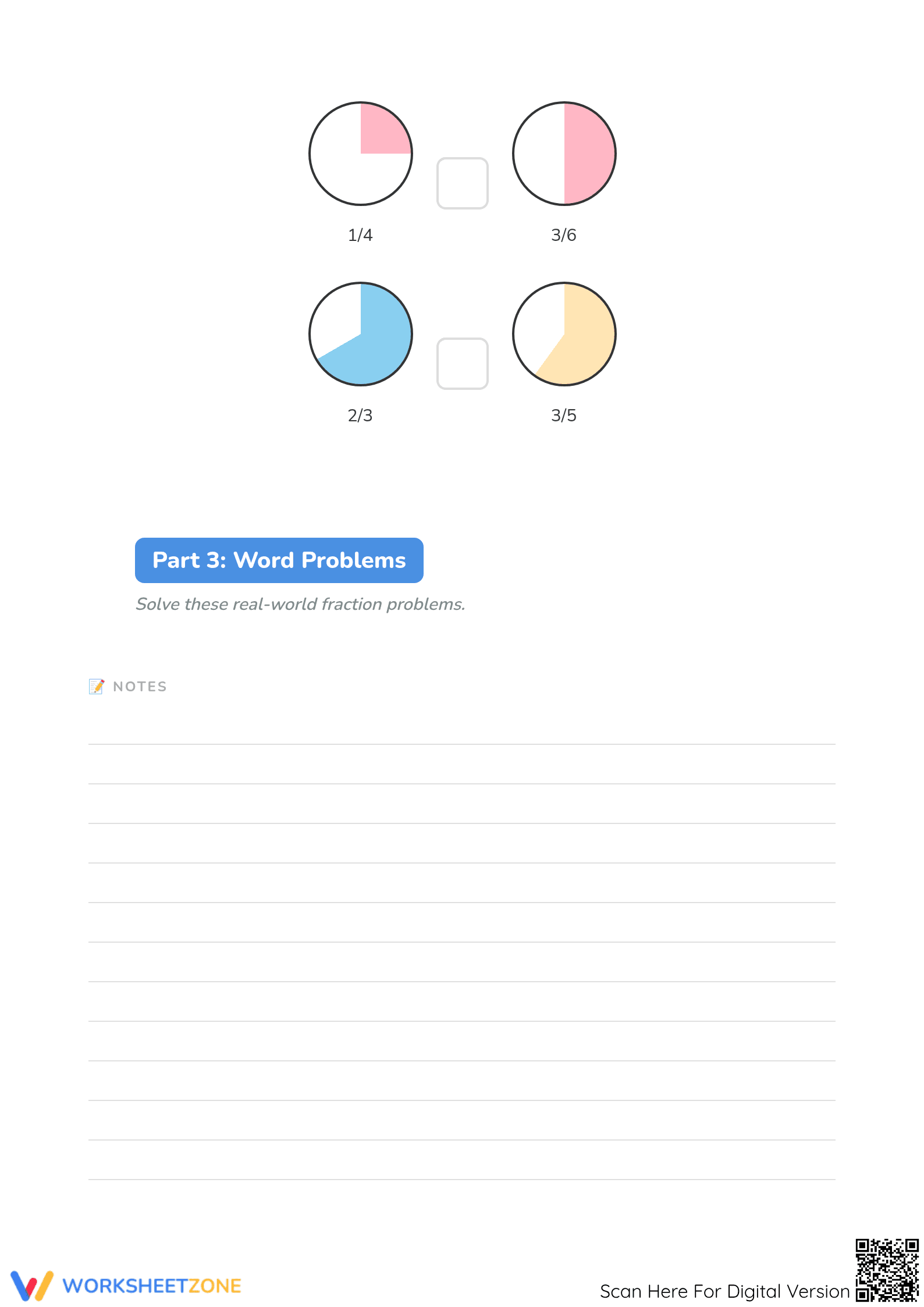
- Supported Practice (2 comparisons): Learners utilize visual cues to compare different fractional amounts, identifying which value is greater, lesser, or equal, which bridges the gap between visualization and logical inequality.
- Independent Practice (3 word problems): The final section presents multi-step scenarios, such as sharing a cake or counting marbles, requiring students to extract data and represent it as a correct fraction without visual aids.
This worksheet is strictly aligned to CCSS.MATH.CONTENT.3.NF.A.1, which focuses on developing an understanding of unit fractions and their multiples. It also supports CCSS.MATH.CONTENT.3.NF.A.3.D by providing a visual basis for comparing two fractions with the same numerator or denominator. Both standard codes can be copied directly into lesson plans, IEP goals, or district curriculum mapping tools.
Educators should use this resource during the "independent practice" phase of a lesson or as a formative assessment after introducing circle manipulatives. A key instructional tip is to observe whether students count all segments or just the shaded ones; this reveals if they truly grasp the role of the denominator. Expected completion time for the entire packet is approximately 30 minutes.
While primarily designed for Grade 3 students, this resource is an excellent intervention tool for Grade 4 and 5 learners who require a visual refresher. It pairs naturally with physical fraction tiles or a digital interactive whiteboard lesson on partitioning. The clear, uncluttered design makes it highly accessible for students with processing needs or those who benefit from structured white space.
Fractions represent a critical hurdle in elementary mathematics, often serving as the primary predictor for later success in algebra and higher-level STEM coursework. According to the NAEP data and the RAND AIRS 2024 report, students who master visual partitioning—the specific skill of relating a shaded region to its numerical numerator and denominator—demonstrate significantly higher retention of proportional reasoning. This Grade 3 worksheet aligns with CCSS.MATH.CONTENT.3.NF.A.1 by requiring students to decode circle diagrams into abstract mathematical symbols. By moving from identification to comparison and finally to contextual word problems, the resource ensures that learners do not merely memorize procedures but develop a robust conceptual framework for parts of a whole. This evidence-based progression supports the gradual release of responsibility model, providing the necessary scaffolding for diverse learners to achieve fluency in fractional representation and comparison tasks within standard instructional timelines.


