


























Views
Downloads



Printable Advanced Modeling Fractions with Circles Worksheet
Paste this activity's link or code into your existing LMS (Google Classroom, Canvas, Teams, Schoology, Moodle, etc.).
Students can open and work on the activity right away, with no student login required.
You'll still be able to track student progress and results from your teacher account.
This essential Grade 4 math resource provides a comprehensive approach to mastering fractional concepts through visual representation. By utilizing high-resolution circle models, students move beyond basic recognition to analyze parts of a whole with precision. This worksheet ensures learners develop the mental flexibility required for more complex operations, yielding immediate improvements in conceptual clarity and mathematical confidence.
At a Glance
- Grade: 4 · Subject: Math
- Standard:
CCSS.MATH.CONTENT.4.NF.A.1— Explain why a fraction is equivalent to another fraction by using visual models- Skill Focus: Advanced Circle Modeling & Equivalence
- Format: 4 pages · 8 problems · Answer key included · PDF
- Best For: Independent Practice or Small Group Remediation
- Time: 25–35 minutes
What's Inside
The packet includes four distinct sections designed to scaffold student learning. From equivalent fraction review to high-resolution models featuring up to 16 partitions, the variety of tasks prevents rote memorization. Students will engage with mixed numerators, critical thinking word problems, and a creative drawing task. Each page is formatted for clarity, providing ample space for student work and numerical notation.
Skill Progression
- Guided Practice: Section A reviews simplest forms using familiar visual prompts to ground students in fundamental fractional identification (2 problems).
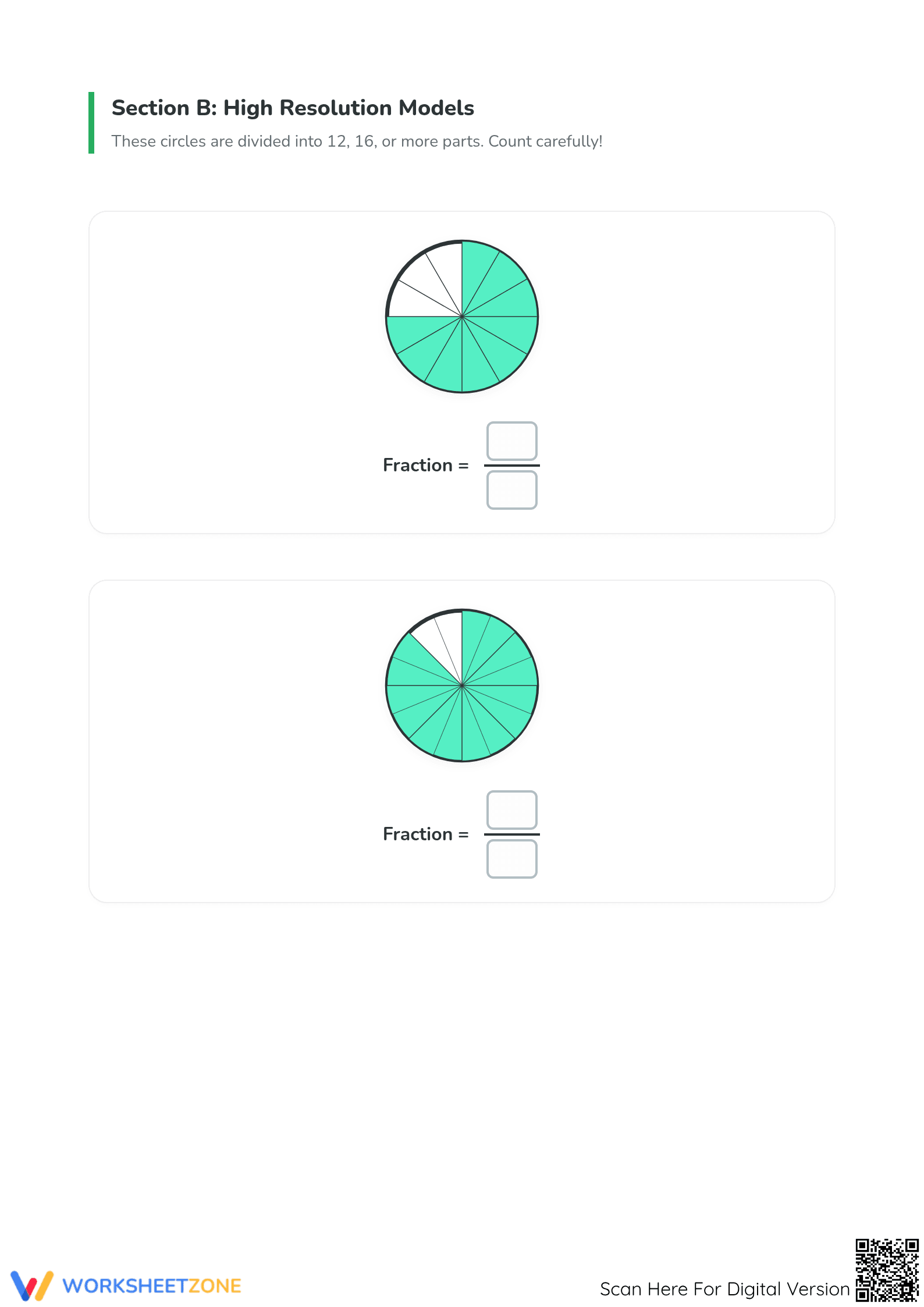
- Supported Practice: Section B introduces high-resolution circles divided into 12 or 16 parts, requiring careful counting and precise symbolic representation (2 problems).
- Independent Practice: Sections C and D challenge students to represent shaded models independently and solve abstract word problems that require conceptual application (4 problems).
This structure follows the gradual-release model, ensuring students build a solid foundation before tackling higher-order application tasks.
Standards Alignment
This worksheet aligns primarily with CCSS.MATH.CONTENT.4.NF.A.1, focusing on the use of visual models to demonstrate fractional equivalence and partitioning. It also supports 3.NF.A.1 by reinforcing the understanding of a whole partitioned into equal parts. Both standard codes can be copied directly into lesson plans, IEP goals, or district curriculum mapping tools.
How to Use It
Use this resource during the independent practice phase of a lesson on fractional parts or equivalence. Teachers should observe students during Section B to ensure they are counting partitions accurately without skipping segments. For a formative check, review the Critical Thinking answers to gauge if students can translate visual models into abstract reasoning. Completion typically takes 30 minutes, making it ideal for a focused classroom session.
Who It's For
This resource is designed for Grade 4 students but serves as an excellent extension for Grade 3 or a review for Grade 5 learners. It is particularly effective for visual learners who benefit from concrete representations. Pair this worksheet with physical fraction tiles or a digital circular geoboard to provide a multi-sensory learning experience for struggling students.
The use of circular area models is a cornerstone of effective mathematics instruction, as emphasized by NAEP (National Assessment of Educational Progress) frameworks. Research indicates that students who master visual modeling in early elementary grades are significantly more likely to succeed with rational number operations in middle school. This Grade 4 worksheet leverages high-resolution visual cues to reduce cognitive load while increasing the precision of student observations. According to the NAEP 2024 mathematics assessment criteria, the ability to translate between visual partitions and symbolic notation is a key indicator of mathematical fluency. By providing structured practice across four pages, this resource addresses the fractional understanding gap identified in recent EdReports 2024 findings. Educators can use the included 8 problems to collect data on student mastery of CCSS.MATH.CONTENT.4.NF.A.1, ensuring that instructional interventions are evidence-based and aligned with rigorous national expectations for elementary mathematical proficiency.


