


























Views
Downloads

Essential Mixed Percent Calculations Worksheet | Grade 7
Paste this activity's link or code into your existing LMS (Google Classroom, Canvas, Teams, Schoology, Moodle, etc.).
Students can open and work on the activity right away, with no student login required.
You'll still be able to track student progress and results from your teacher account.
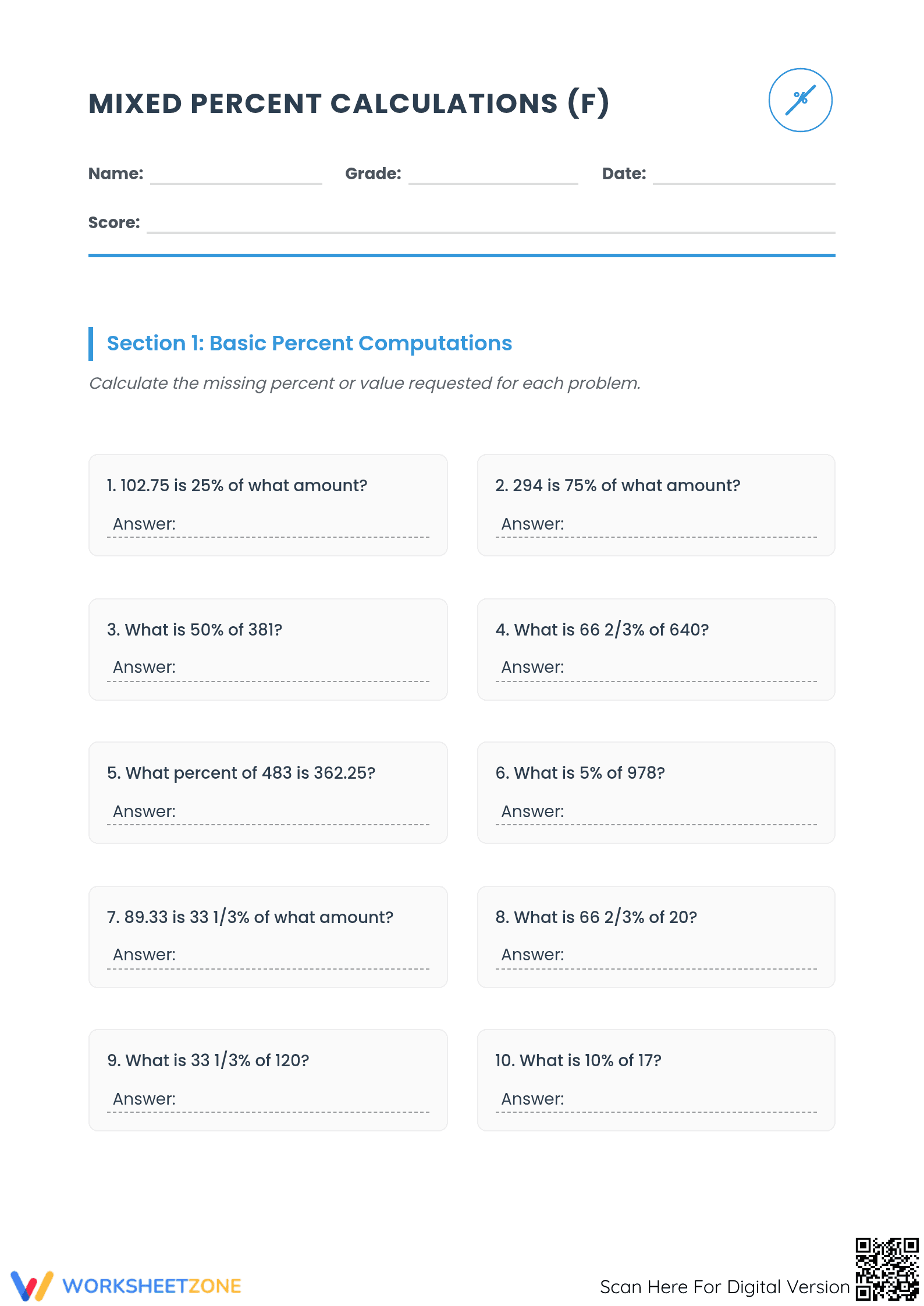
This comprehensive mixed percent calculations worksheet provides middle school students with rigorous practice in mastering percentage operations. Students solve a variety of problems ranging from basic computations to complex real-world applications involving tax and tips. By engaging with these diverse task types, learners build the procedural fluency and conceptual depth required for high-school mathematics.
At a Glance
- Grade: 7 · Subject: Math
- Standard:
CCSS.MATH.CONTENT.7.RP.A.3— Use proportional relationships to solve multistep ratio and percent problems.- Skill Focus: Percent change and multi-step word problems
- Format: 3 pages · 24 problems · Answer key included · PDF
- Best For: End-of-unit review or mid-summative practice
- Time: 45–60 minutes
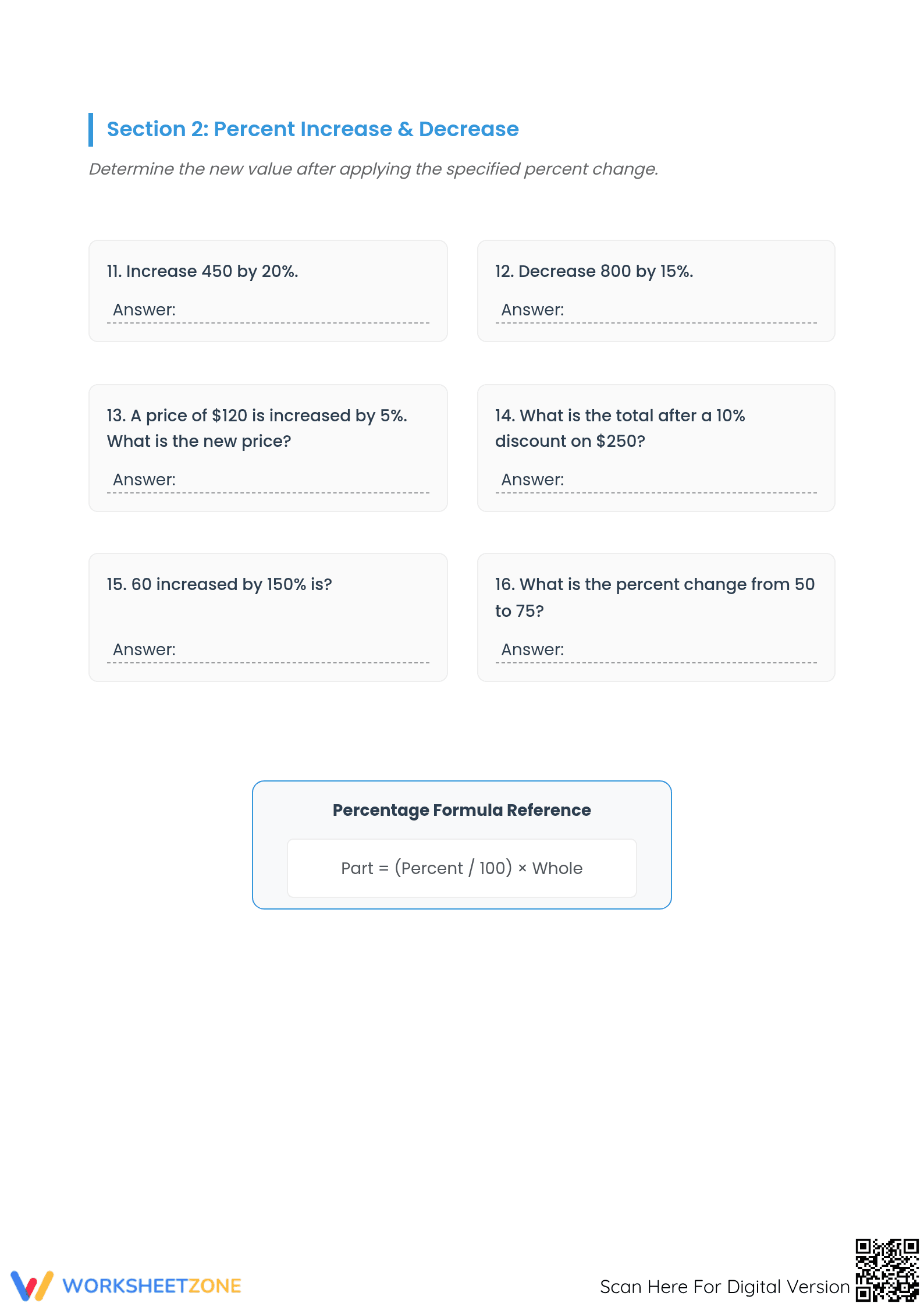
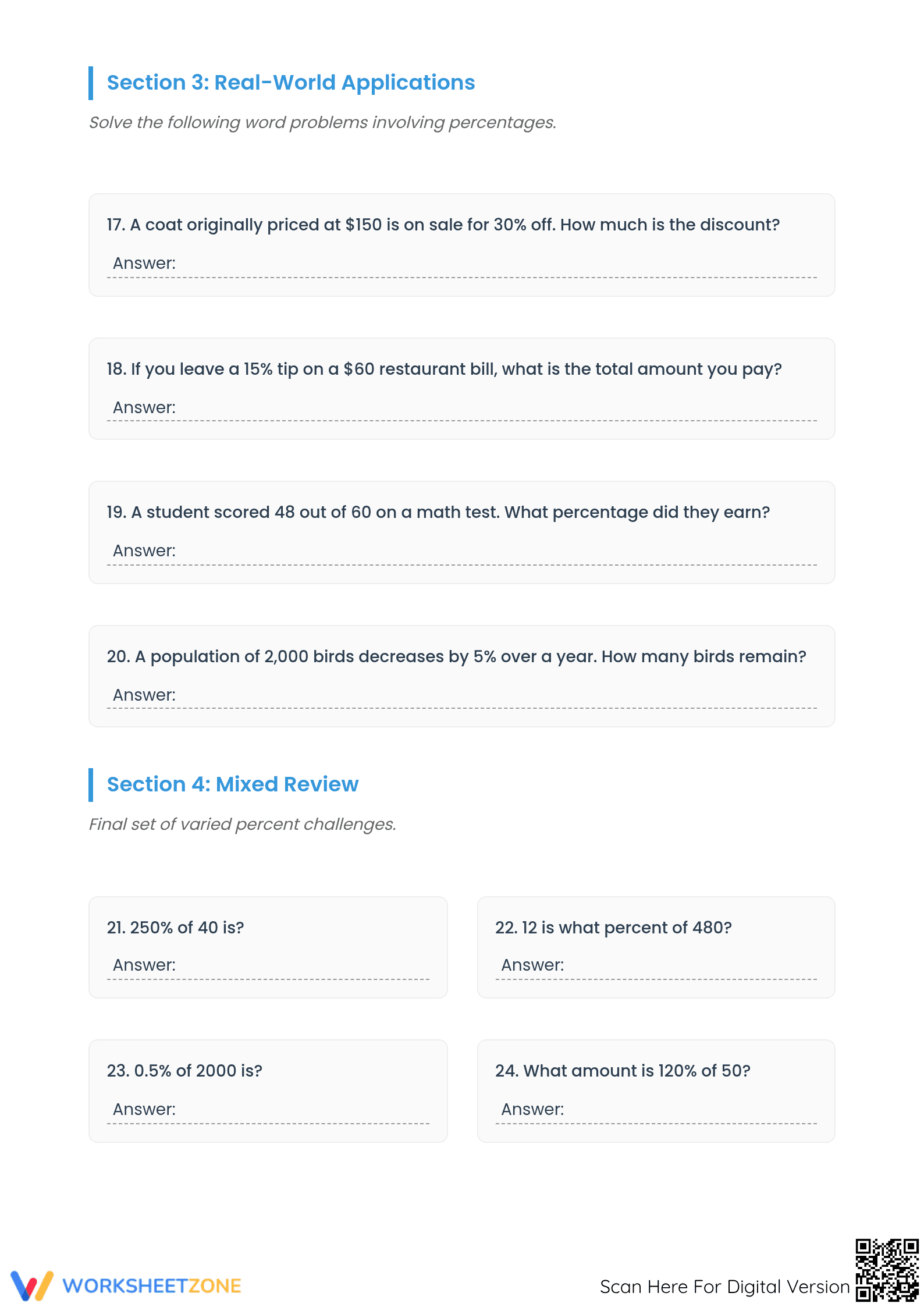
This three-page instructional resource is organized into four logical segments designed to scaffold student learning. It begins with ten basic percent computations, followed by six problems focused on percent increase and decrease. The third section contains four real-world word problems, and the final page offers a mixed review. A built-in percentage formula reference box is provided on the second page to support independent student work.
Skill Progression
- Guided practice (10 problems): Students identify the part, whole, or percent in isolated equations, establishing the basic mechanics of proportional reasoning.
- Supported practice (6 problems): The worksheet introduces percent change, requiring students to apply multiple steps to determine new values after increases or decreases.
- Independent practice (8 problems): Learners synthesize their knowledge by solving word problems and a final mixed-review set that mimics the format of standardized test questions.
This gradual release of responsibility ensures that students transition from rote calculation to meaningful application through a structured I Do, We Do, You Do workflow.
Standards Alignment
The primary focus of this worksheet is CCSS.MATH.CONTENT.7.RP.A.3, which requires students to use proportional relationships to solve multistep ratio and percent problems. The tasks specifically address tax, tips, and percent change. This standard code can be copied directly into lesson plans, IEP goals, or district curriculum mapping tools.
How to Use It
Use this worksheet as a culminating activity after direct instruction on the three main types of percent problems. It serves as an excellent formative assessment tool; teachers should observe students during Section 2 to see if they are correctly adding or subtracting the change from the original amount. The expected completion time is 50 minutes during a standard math block.
Who It's For
This resource is designed for seventh-grade math students but is also appropriate for eighth-grade remediation or advanced sixth-grade learners. It is particularly effective for students who require structured layouts and explicit formula reminders. Pair this with a guided passage on retail math or an anchor chart showing the Part-to-Whole proportion.
The transition from basic percent calculation to multi-step problem solving is a critical juncture in middle school mathematics, as highlighted in Fisher & Frey (2014). This worksheet is meticulously aligned with CCSS.MATH.CONTENT.7.RP.A.3, ensuring students move beyond simple part-to-whole relationships to master complex percent increase and decrease scenarios. Research indicates that when students can fluidly navigate between these different computational models, they develop a more robust foundation for algebraic thinking and real-world financial literacy. By providing 24 targeted problems across four distinct sections, the resource offers the repetition necessary for mastery while introducing the contextual nuances of tax and gratuity. Educators can utilize the included answer key to provide immediate feedback, a strategy proven to close achievement gaps in procedural math. This self-contained PDF is an essential tool for teachers seeking to align daily classroom practice with the rigorous demands of 21st-century educational frameworks.


