


























Views
Downloads

Mixed Percent Calculations Worksheet | Essential Grade 6-8 Math
Paste this activity's link or code into your existing LMS (Google Classroom, Canvas, Teams, Schoology, Moodle, etc.).
Students can open and work on the activity right away, with no student login required.
You'll still be able to track student progress and results from your teacher account.
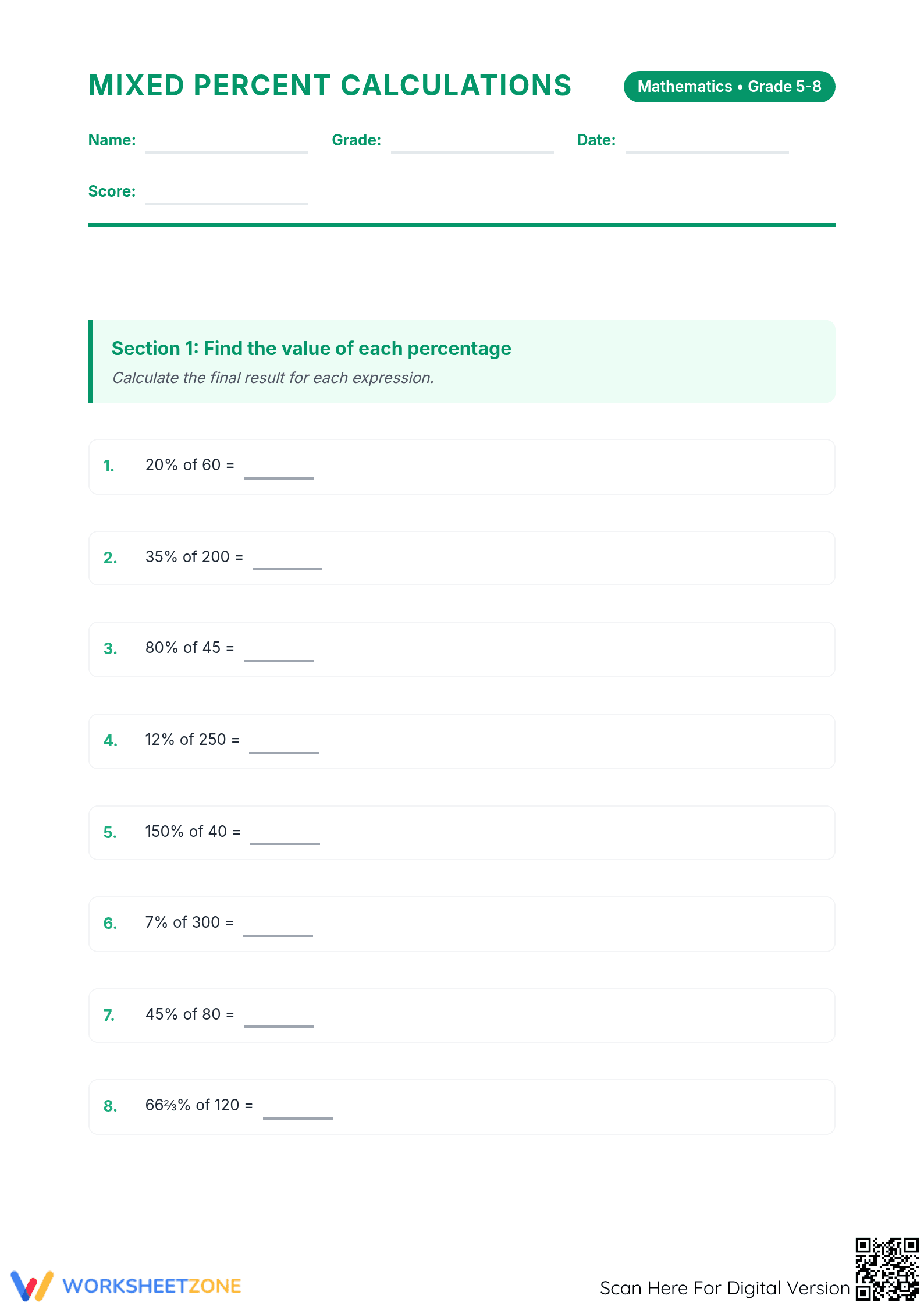
This mixed percent calculations worksheet provides a comprehensive practice suite for middle school students to master fundamental percentage problems. By working through diverse calculation formats and real-world scenarios, students build the fluency required to recognize and solve percent of a number, missing totals, and percentage rates with accuracy.
At a Glance
- Grade: 6–8 · Subject: Math
- Standard:
6.RP.A.3.C— Find a percent of a quantity as a rate per 100- Skill Focus: Multi-type Percent Calculations
- Format: 4 pages · 35 problems · Answer key included · PDF
- Best For: End-of-unit review and mastery check
- Time: 45–60 minutes
What's Inside
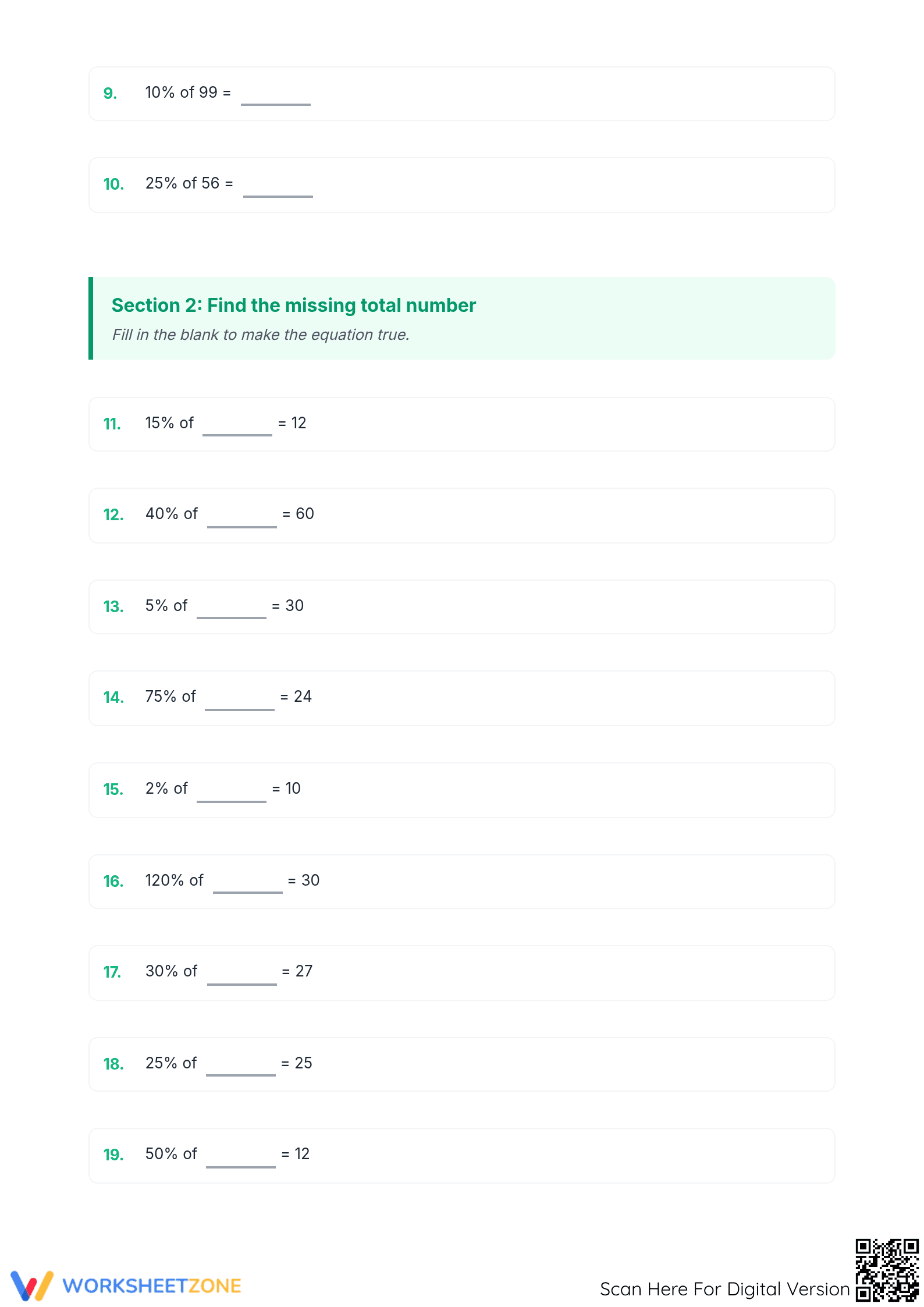
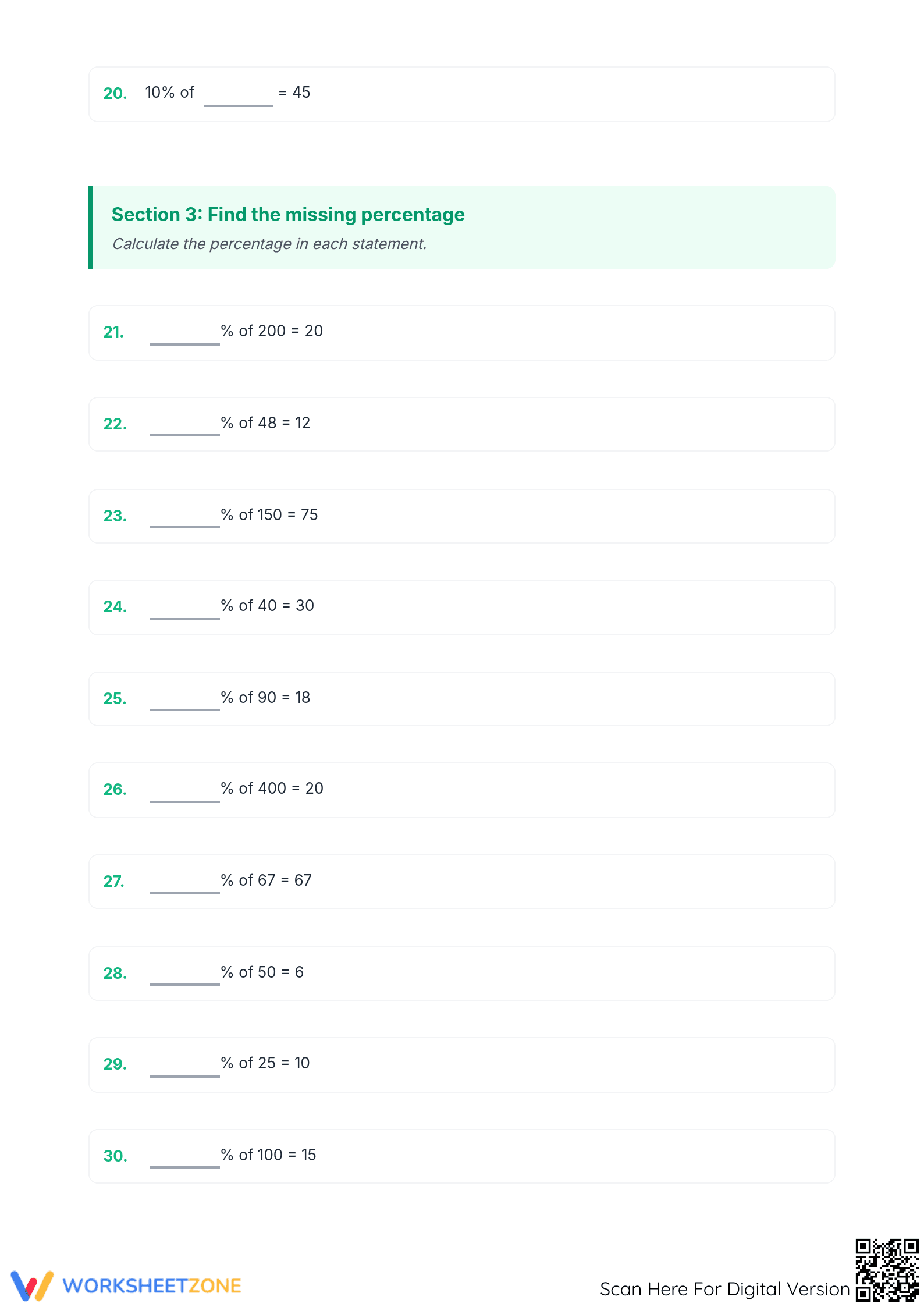
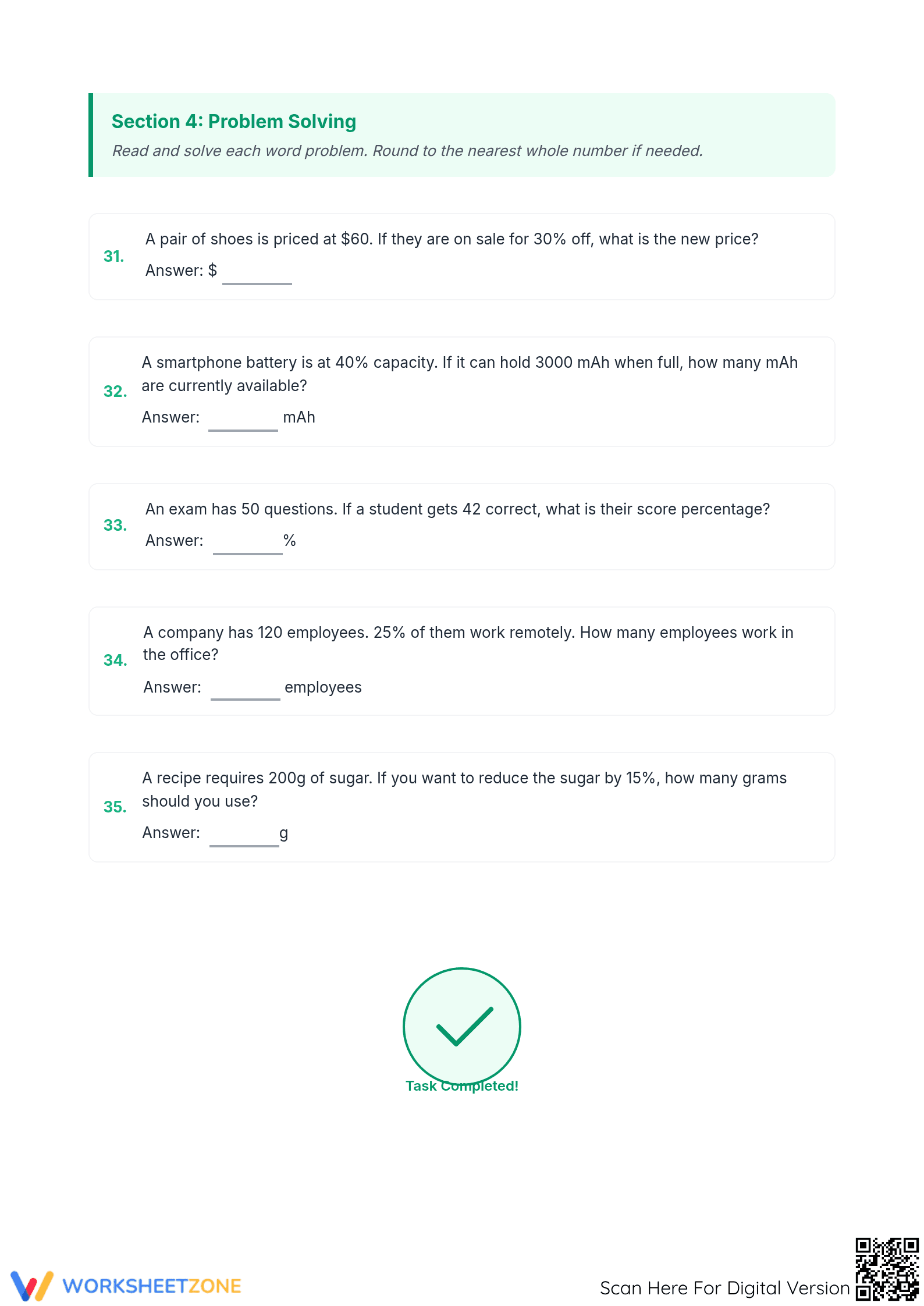
This extensive 4-page PDF contains 35 targeted mathematical tasks. The structure begins with direct calculation of values from percentages, transitions into solving for the missing total amount, and then requires students to determine the missing percentage. The final section integrates these skills into five multi-step word problems involving real-world contexts like sales, battery life, and recipes.
Skill Progression
- Guided Practice: The first 10 problems provide direct expressions where students find a specific percentage of a given number, such as 35% of 200, allowing for immediate application of the base formula.
- Supported Practice: Tasks 11-30 increase complexity by requiring students to solve for missing variables (the whole or the percent), necessitating algebraic rearrangement of the standard percent proportion.
- Independent Practice: The concluding word problems challenge students to extract data from narrative text and apply the correct calculation strategy independently to solve practical scenarios.
This gradual release model ensures students move from rote calculation to conceptual flexibility across different problem structures.
Standards Alignment
This resource is meticulously aligned to `6.RP.A.3.C`: "Find a percent of a quantity as a rate per 100 (e.g., 30% of a quantity means 30/100 times the quantity); solve problems involving finding the whole, given a part and the percent." Both standard codes can be copied directly into lesson plans, IEP goals, or district curriculum mapping tools.
How to Use It
Use this worksheet as a summative assessment at the conclusion of a percentages unit to gauge student proficiency across all calculation types. Alternatively, it serves as an excellent rotation in a math station for classroom practice time. While students work, observe their ability to switch between solving for a part versus solving for the whole; difficulty here indicates a need for more visual bar modeling instruction. Expected completion time is 50 minutes.
Who It's For
This packet is designed for Grade 6 through Grade 8 students who are solidifying their understanding of ratios and proportional relationships. It is particularly effective for learners needing repetitive, structured practice to internalize decimal-percent conversions. It pairs naturally with a percentages anchor chart or a brief informational passage on how sales tax and discounts are calculated in retail environments.
According to the RAND AIRS 2024 analysis, the integration of multiple problem types within a single practice session—known as interleaved practice—significantly enhances long-term retention of mathematical procedures. This mixed percent calculations worksheet leverages this research by requiring students to identify whether they are solving for the part, the whole, or the percentage rate in every problem. By addressing the 6.RP.A.3.C standard through varied numerical and contextual tasks, the resource ensures students do not simply apply a pattern but must actively engage with the mathematical structure. This approach builds the cognitive flexibility required for higher-order algebra and real-world financial literacy. This comprehensive 35-problem set provides the necessary volume of practice to move students from procedural knowledge to true mastery of proportional reasoning and percentage calculation.


