


























Views
Downloads

Essential Mixed Percent Calculations Worksheet | Grades 6-8
Paste this activity's link or code into your existing LMS (Google Classroom, Canvas, Teams, Schoology, Moodle, etc.).
Students can open and work on the activity right away, with no student login required.
You'll still be able to track student progress and results from your teacher account.
This comprehensive mixed percent calculations worksheet provides middle school students with rigorous practice in identifying and solving the three fundamental types of percentage problems. By working through Part, Percent, and Whole scenarios, learners develop the computational fluency and conceptual understanding required for higher-level mathematics. This resource ensures students can accurately translate between decimals, fractions, and percentages in practical contexts.
At a Glance
At a Glance
- Grade: 6–8 · Subject: Math
- Standard:
CCSS.MATH.CONTENT.6.RP.A.3.c— Find a percent of a quantity and solve problems finding the whole- Skill Focus: Percent, Part, and Whole/Base Calculations
- Format: 5 pages · 38 problems · Answer key included · PDF
- Best For: Comprehensive unit review or cumulative practice
- Time: 45–60 minutes
What's Inside
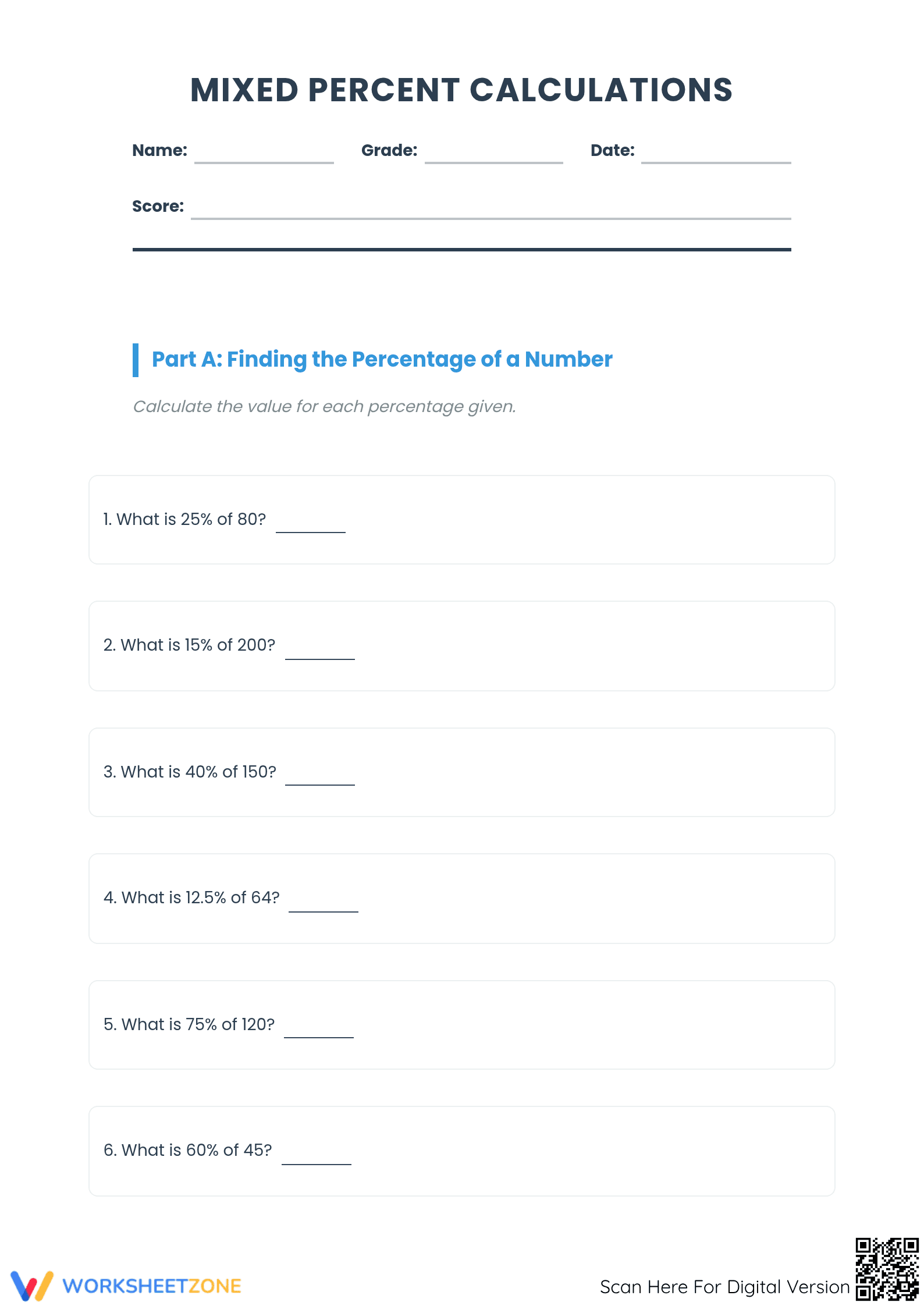
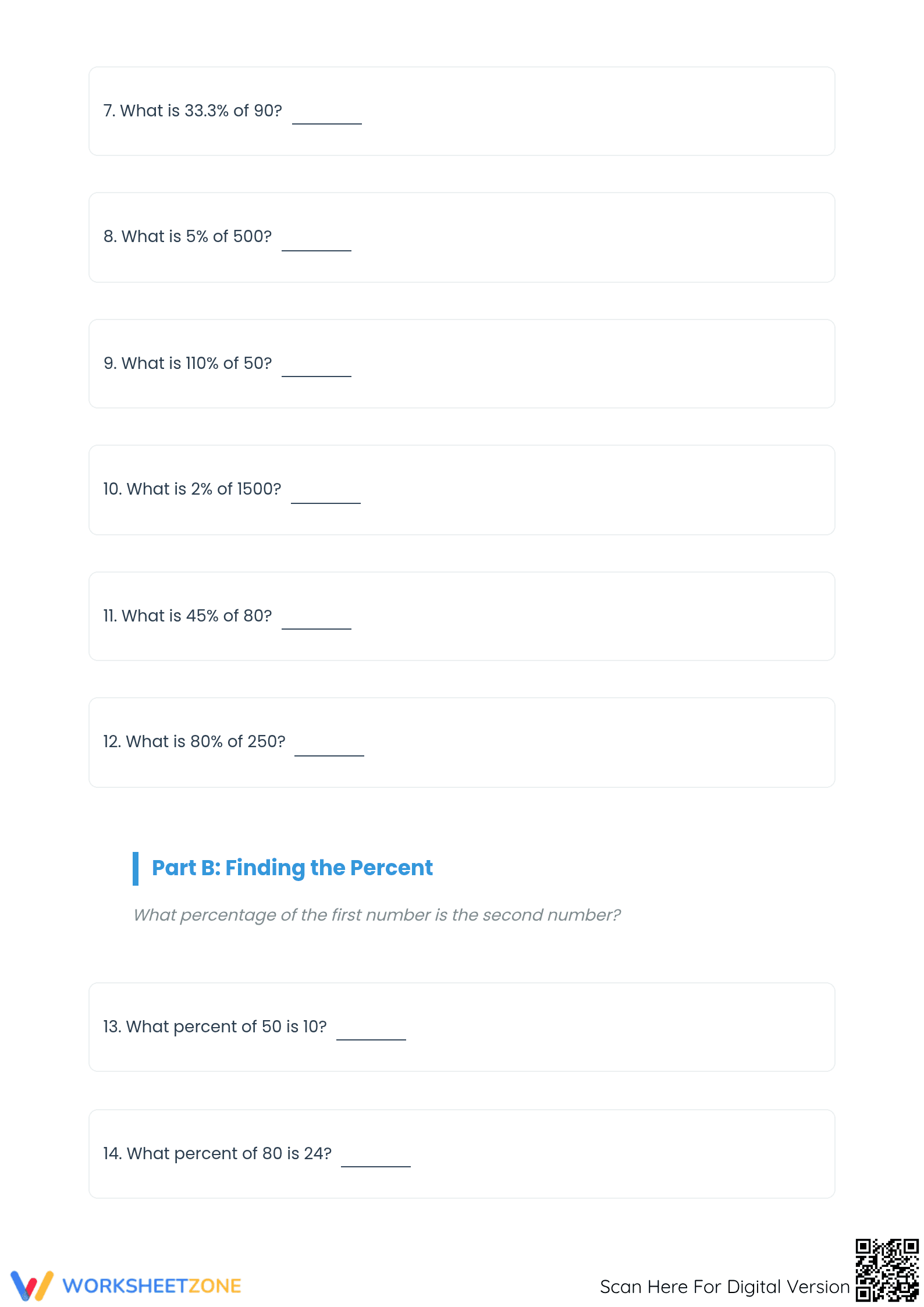
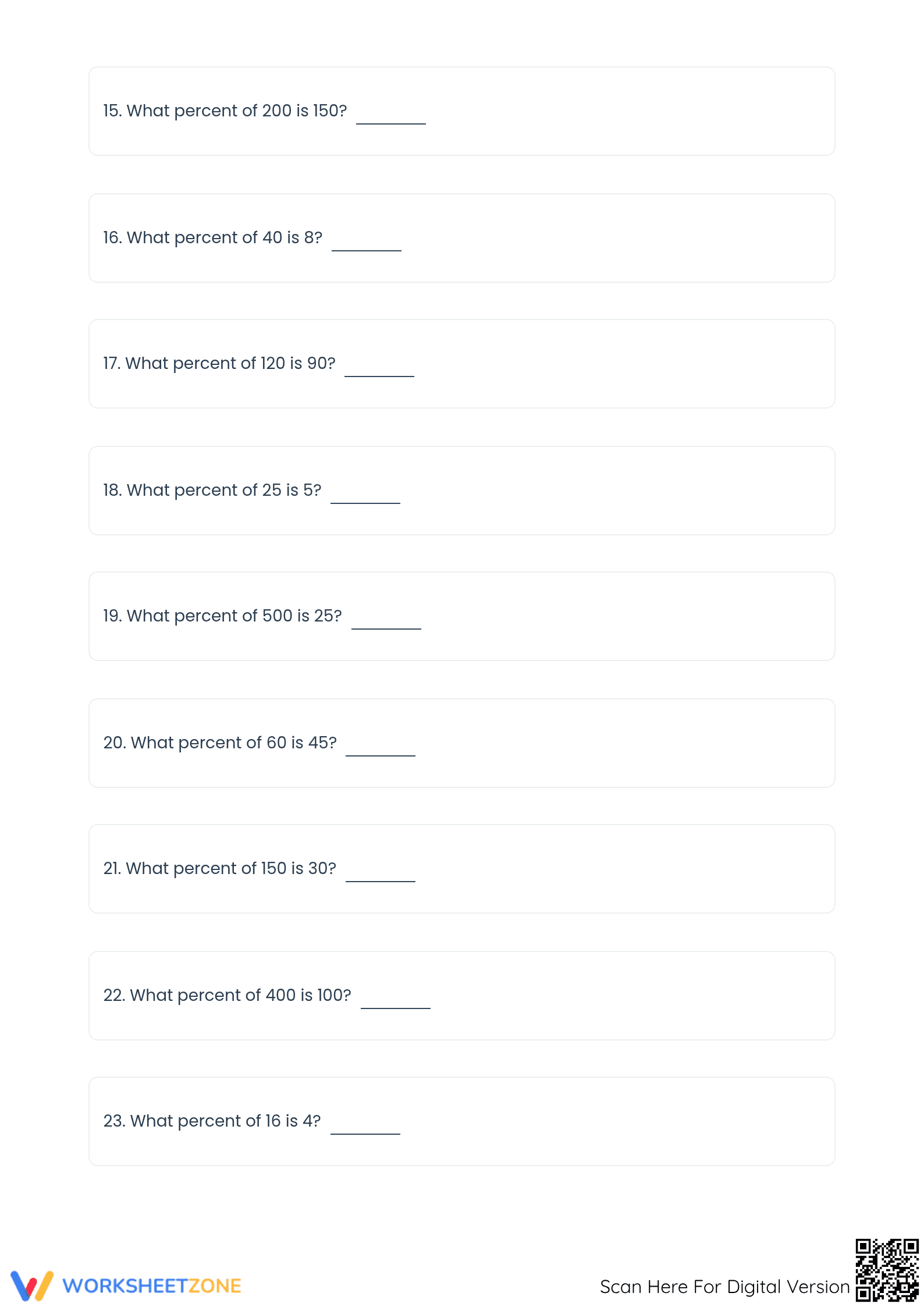
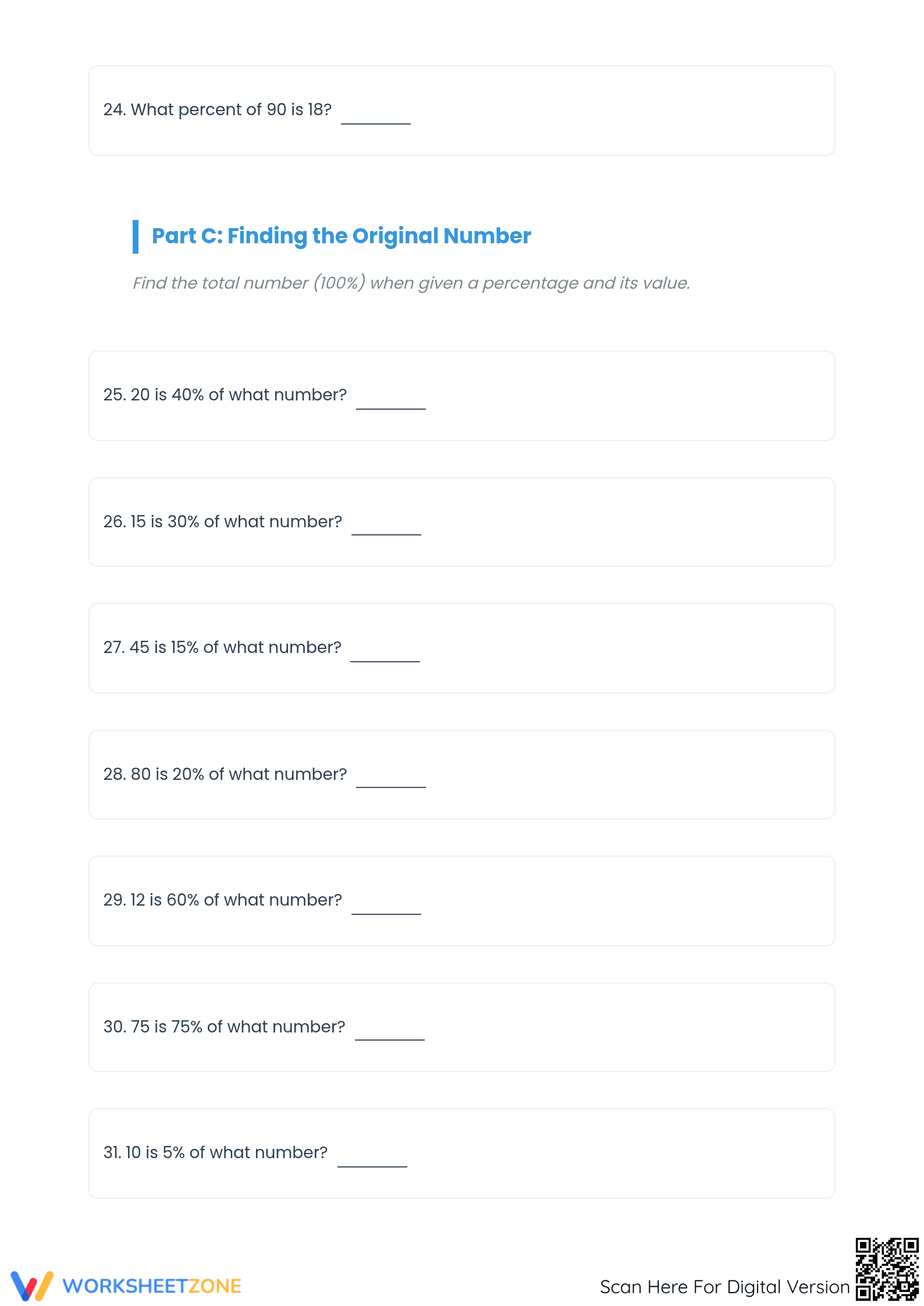
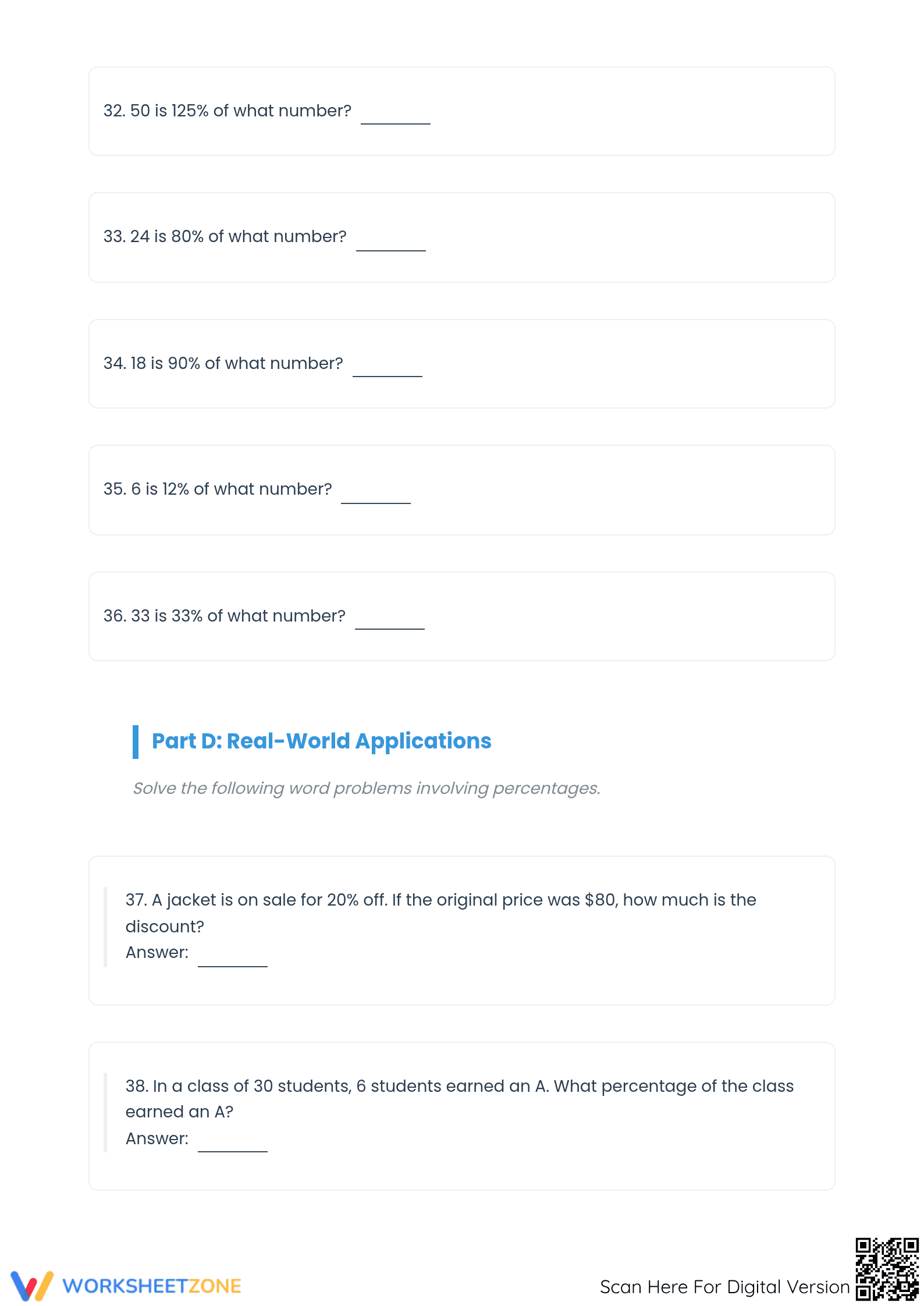
This five-page PDF collection features 38 structured problems divided into four distinct sections. Part A focuses on finding the value of a given percentage, Part B requires determining the percentage between two numbers, and Part C targets finding the original whole value. The final section, Part D, provides real-world application word problems. A full answer key is provided to facilitate rapid grading and student self-correction.
Skill Progression
- Guided Practice: The worksheet begins with 12 foundational problems in Part A, focusing on direct calculation of percentages (e.g., "What is 25% of 80?"). This section allows students to apply standard algorithms repeatedly to build procedural memory.
- Supported Practice: Parts B and C offer 24 intermediate tasks that challenge students to rearrange the percentage formula to solve for different variables. This phase transitions from simple computation to conceptual recognition of parts and wholes.
- Independent Practice: The final section features two multi-step word problems that require students to extract relevant data and apply percentage logic to realistic scenarios without explicit structural cues. This progression follows a gradual-release model, moving from highly scaffolded computation to complex situational analysis.
Standards Alignment
The primary alignment is CCSS.MATH.CONTENT.6.RP.A.3.c: "Find a percent of a quantity as a rate per 100 (e.g., 30% of a quantity means 30/100 times the quantity); solve problems involving finding the whole, given a part and the percent." This resource also supports Grade 7 and 8 requirements for proportional relationships. Both standard codes can be copied directly into lesson plans, IEP goals, or district curriculum mapping tools.
How to Use It
Use this worksheet as a cumulative summative assessment at the conclusion of a ratios and proportions unit. The 38-problem volume makes it an excellent choice for a collaborative "math relay" or a multi-day homework assignment. For formative assessment, observe students during Part B to see if they correctly identify which number serves as the denominator, as this is a common point of misconception.
Who It's For
This resource is designed for Grade 6, 7, and 8 students who are mastering rational number operations. It is particularly effective for students requiring extra repetition to solidify the relationship between percentages and their decimal equivalents. It pairs naturally with a visual anchor chart displaying the percentage triangle or a decimal-percent conversion table.
Research indicates that varied practice, like the 38 tasks in this resource, enhances procedural math skill retention. The worksheet's explicit separation into finding the part, percent, and whole helps students recognize underlying problem structures, aligning with CCSS.MATH.CONTENT.6.RP.A.3.c's emphasis on calculating percentages and solving for base values. Real-world applications bridge abstract calculation with functional numeracy, and the gradual release of responsibility from computation to word problems provides crucial scaffolding for proportional reasoning mastery.


