


























Views
Downloads

Printable Mixed Percent Mastery Worksheet | Grade 6 Math
Paste this activity's link or code into your existing LMS (Google Classroom, Canvas, Teams, Schoology, Moodle, etc.).
Students can open and work on the activity right away, with no student login required.
You'll still be able to track student progress and results from your teacher account.
Master the fundamentals of percentage calculations with this comprehensive 32-problem practice set. Designed for middle school students, this worksheet guides learners through the three core types of percent problems: calculating values, identifying percentages, and discovering base totals. Students will build computational fluency and apply their skills to realistic word problems.
At a Glance
- Grade: 6 · Subject: Math
- Standard:
6.RP.A.3.C— Find a percent of a quantity and solve for the whole or part- Skill Focus: Percentage Calculation & Application
- Format: 4 pages · 32 problems · Answer key included · PDF
- Best For: Independent practice or formative assessment
- Time: 45–60 minutes
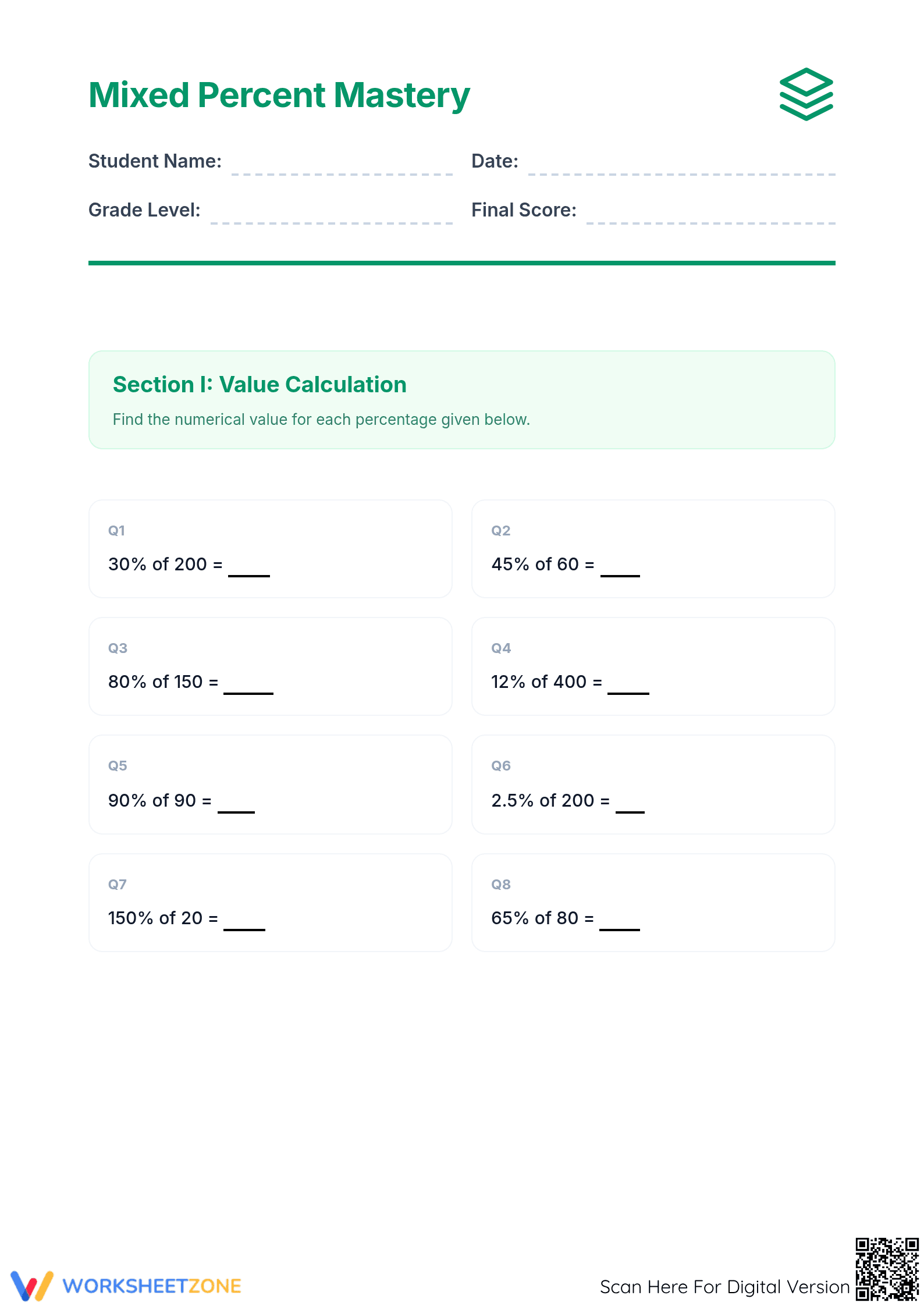
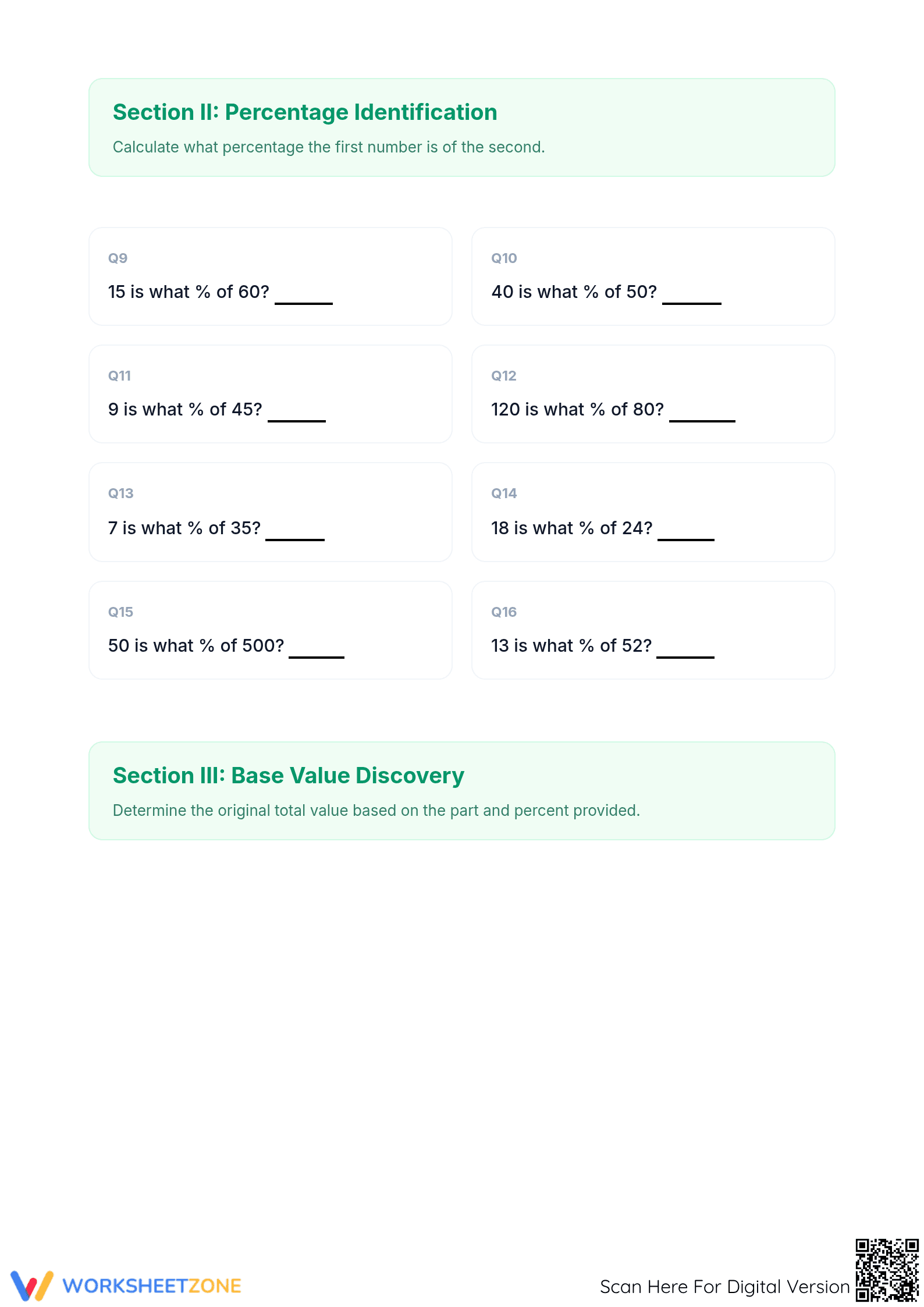
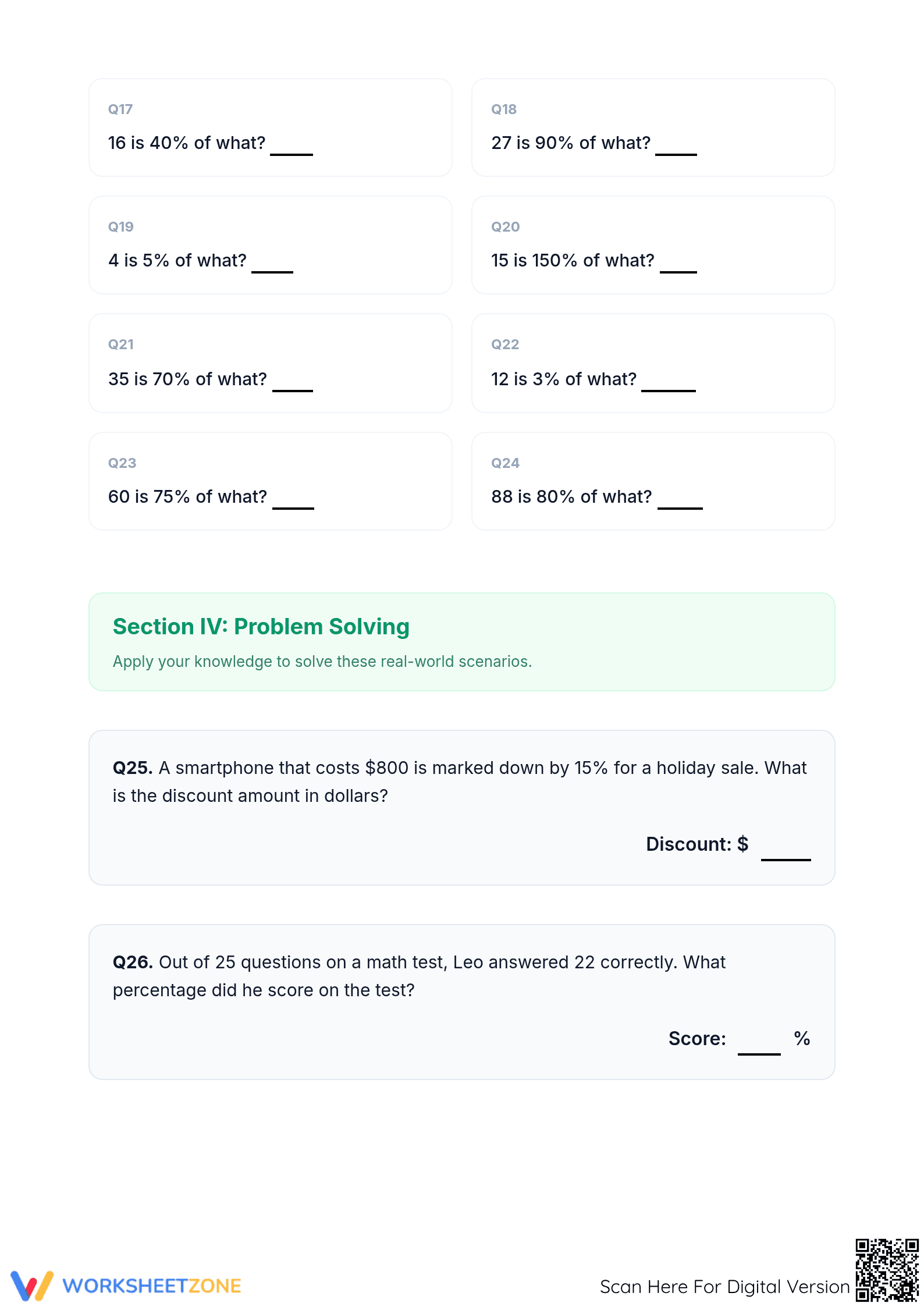
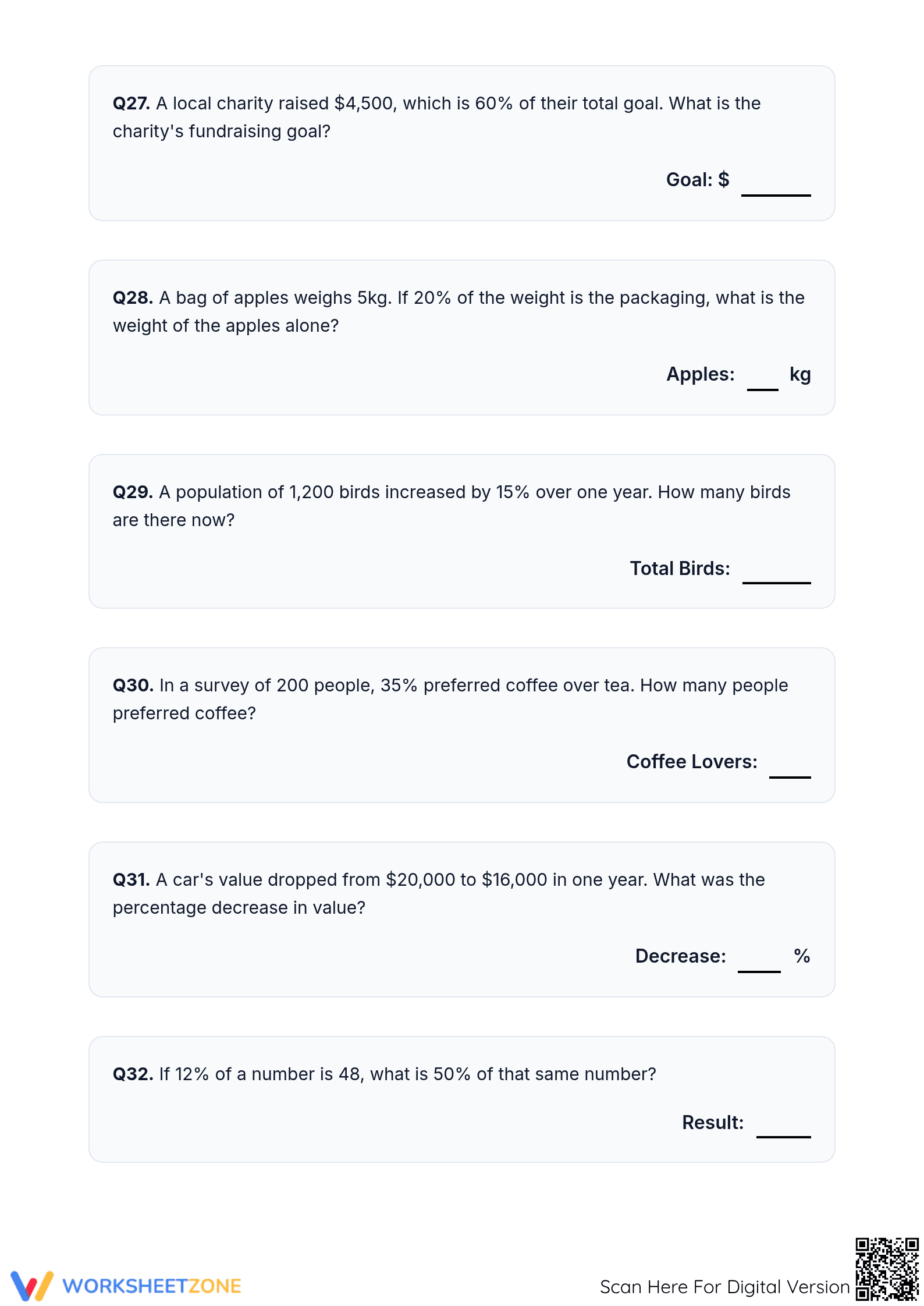
This 4-page PDF contains four distinct sections targeting specific computational steps. Section I focuses on finding values (e.g., 30% of 200). Section II requires identifying what percentage one number is of another. Section III challenges students to find the original base value. Finally, Section IV provides 8 real-world word problems involving discounts, fundraising, and percentage change. A full answer key is included for easy grading.
Skill Progression
- Guided Practice: The initial 8 problems focus on direct value calculation with whole numbers and friendly decimals, allowing students to anchor their understanding of "percent of" as multiplication.
- Supported Practice: Problems 9 through 24 shift the cognitive load, requiring students to rearrange the percentage formula to solve for the missing rate or base value across 16 varied tasks.
- Independent Practice: The final 8 word problems strip away the scaffolded equations, forcing students to interpret context and select the correct operation independently.
This gradual-release approach ensures that students master the mechanics before tackling the complexity of multi-step application problems.
Standards Alignment
Aligned to 6.RP.A.3.C: "Find a percent of a quantity as a rate per 100 (e.g., 30% of a quantity means 30/100 times the quantity); solve problems involving finding the whole, given a part and the percent." This standard code can be copied directly into lesson plans, IEP goals, or district curriculum mapping tools.
How to Use It
Assign this worksheet as a summative assessment after a unit on ratios and proportions to gauge student mastery of all three percentage types. Alternatively, use specific sections as exit tickets throughout the week. Teachers should observe whether students prefer using decimals or fractions for calculations to provide targeted support during small-group instruction. Expected completion time is 45 to 60 minutes.
Who It's For
This resource is ideal for Grade 6 and 7 students developing ratio reasoning, as well as Grade 5 learners ready for enrichment. It provides essential scaffolding for students on IEPs through clearly labeled sections. It pairs naturally with a "Percent, Fraction, Decimal" anchor chart or a direct instruction lesson on cross-multiplication strategies.
According to Fisher & Frey (2014), the gradual release of responsibility is essential for mathematical mastery, particularly when students transition from computational mechanics to abstract word problems. This worksheet embodies that research by segmenting 32 tasks into logical computational phases before introducing real-world scenarios. Students first establish a firm grasp of the 6.RP.A.3.C standard by calculating parts and wholes in isolation, which reduces the cognitive load when they eventually encounter complex situational variables like discounts or population increases. By providing a structured progression, this resource allows educators to identify exactly where a student's misunderstanding lies—whether in the initial translation of the word "of" or the more complex algebraic manipulation required to find a base value. Such precision in practice is a cornerstone of effective formative assessment, ensuring that middle school learners develop the fluency required for higher-level algebra and statistics.


