


























Views
Downloads

Essential Mixed Percent Calculations Worksheet | Grade 6-8
Paste this activity's link or code into your existing LMS (Google Classroom, Canvas, Teams, Schoology, Moodle, etc.).
Students can open and work on the activity right away, with no student login required.
You'll still be able to track student progress and results from your teacher account.
Master Percentage Calculations
Comprehensive practice for middle school students to master the three core types of percentage calculations. This 3-page resource moves from procedural fluency to real-world application, ensuring students can confidently calculate parts, wholes, and rates in any context. It provides a structured environment for students to apply proportional reasoning skills effectively.
At a Glance
At a Glance
- Grade: 6–8 · Subject: Math
- Standard:
CCSS.MATH.CONTENT.6.RP.A.3.C— Find a percent of a quantity and solve problems finding the whole- Skill Focus: Multi-step percent calculations and applications
- Format: 3 pages · 30 problems · Answer key included · PDF
- Best For: Homework, independent practice, or math centers
- Time: 45–60 minutes
Comprehensive Math Practice
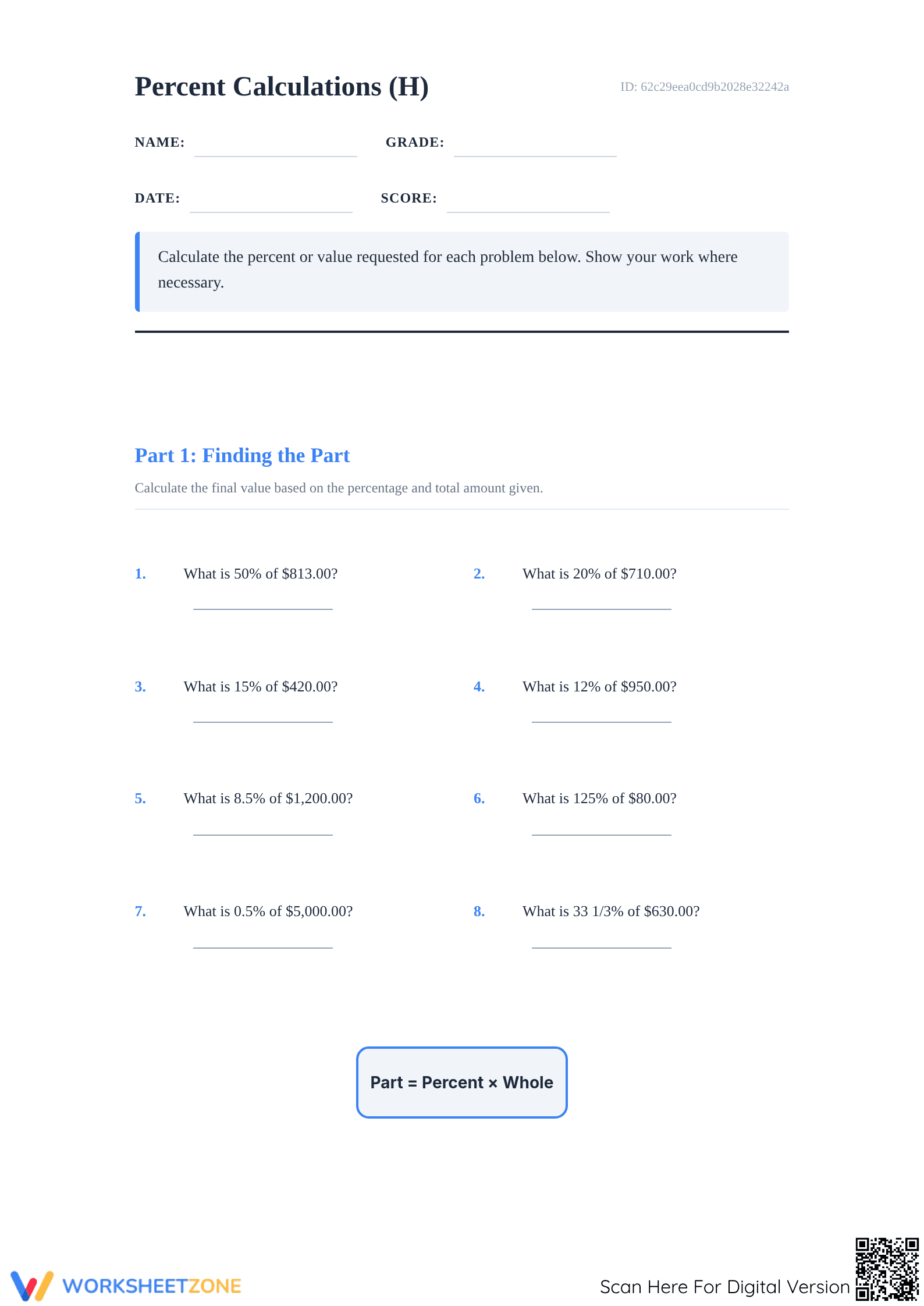
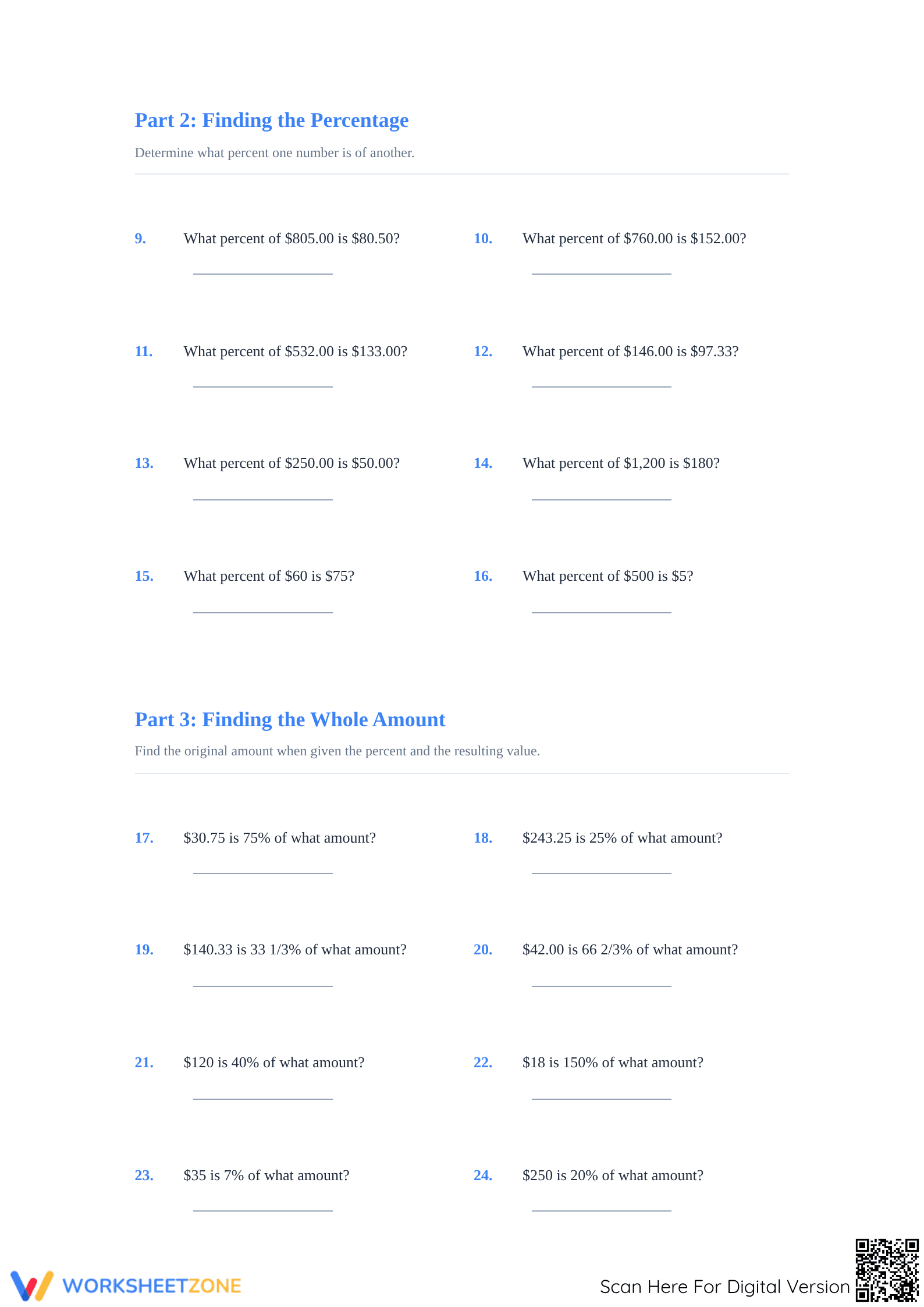
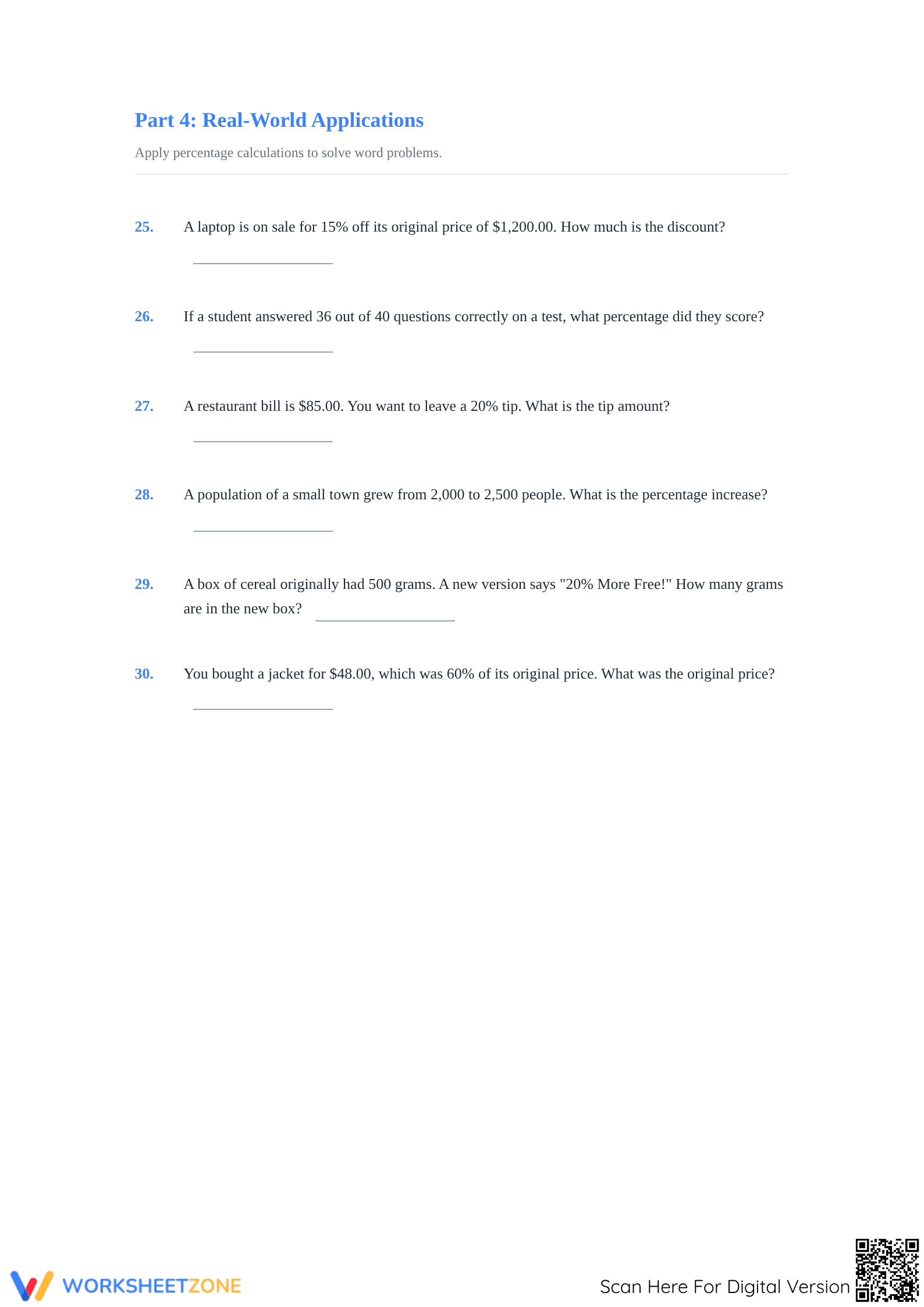
This collection includes 30 problems organized across four distinct sections to ensure total skill coverage. Students begin with 8 problems focused on finding the part, followed by 8 problems for determining the percentage, and 8 problems for finding the whole amount. The final section features 6 real-world word problems that challenge students to apply their knowledge to practical scenarios like sales, tips, and population growth.
Zero-Prep Classroom Workflow
- Print: Select all 3 pages for a full comprehensive lesson or individual parts for targeted practice during a shorter math block (30 seconds).
- Distribute: Students follow the clear headings to identify the required calculation type, utilizing the provided formula box for support (1 minute).
- Review: Use the detailed answer key to facilitate quick grading or allow students to self-correct their work during a plenary session (5 minutes).
Common Core Standards Alignment
This resource is aligned to the primary standard CCSS.MATH.CONTENT.6.RP.A.3.C: “Find a percent of a quantity as a rate per 100 (e.g., 30% of a quantity means 30/100 times the quantity); solve problems involving finding the whole, given a part and the percent.” This standard code can be copied directly into lesson plans, IEP goals, or district curriculum mapping tools for administrative tracking.
Effective Instructional Strategies
Best used as a summative practice after introducing the three types of percentage calculations. Teachers can observe student work in the Real-World Applications section to identify if students can correctly translate verbal scenarios into mathematical equations. This serves as an excellent formative assessment tool to gauge student readiness for more complex algebraic concepts involving ratios and proportions.
Targeted Student Population
Designed specifically for Grade 6, 7, and 8 students working on middle school ratio and proportion standards. It pairs naturally with a classroom anchor chart displaying the “Part = Percent x Whole” formula for supported practice. The clear layout and consistent problem structure make it an ideal choice for substitute plans or structured independent study sessions.
Fisher & Frey (2014) emphasize the importance of scaffolded practice in developing mathematical fluency. This worksheet aligns with the gradual release model by providing structured numerical practice before transitioning to complex real-world word problems. By covering all three variations of percentage problems—finding the part, the whole, and the rate—it ensures students meet the rigorous demands of CCSS.MATH.CONTENT.6.RP.A.3.C. Research from RAND AIRS 2024 indicates that frequent, high-volume practice with varied problem sets significantly improves long-term retention of proportional reasoning skills in middle school learners. This 30-problem set provides the necessary repetition to move students from basic recognition to procedural mastery, ensuring they are prepared for high school algebra and practical life skills like financial literacy and data analysis.


