


























Views
Downloads
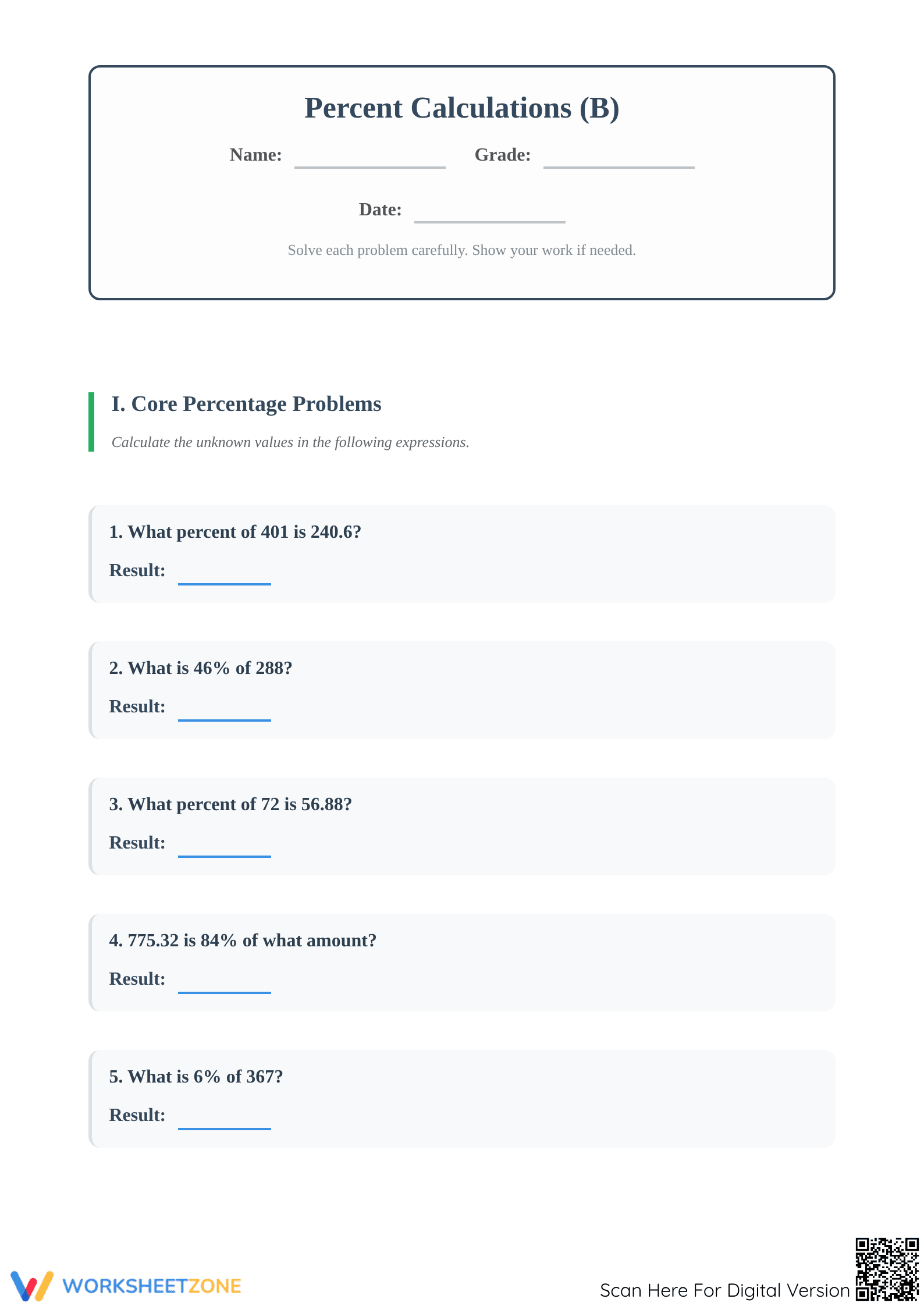
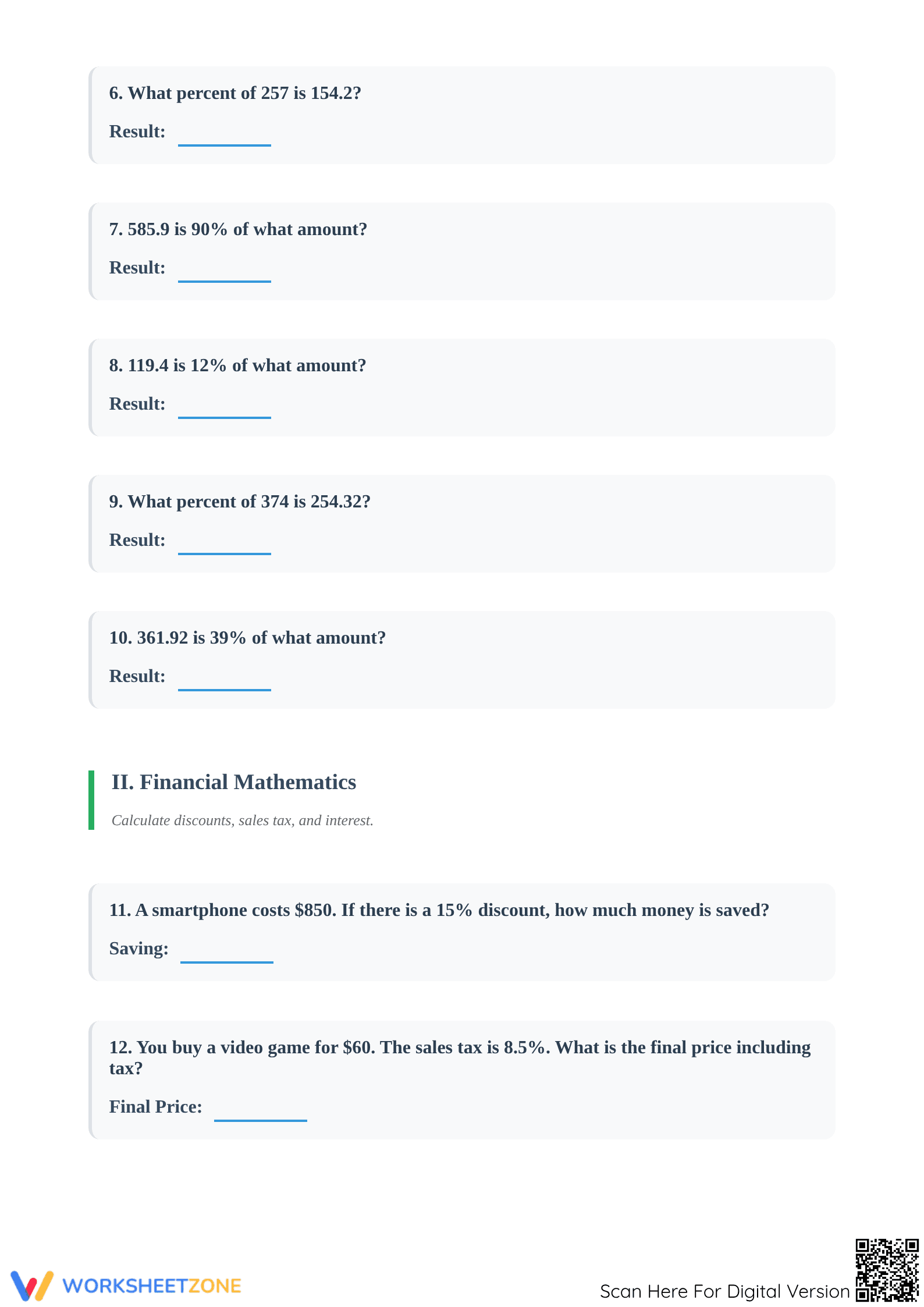
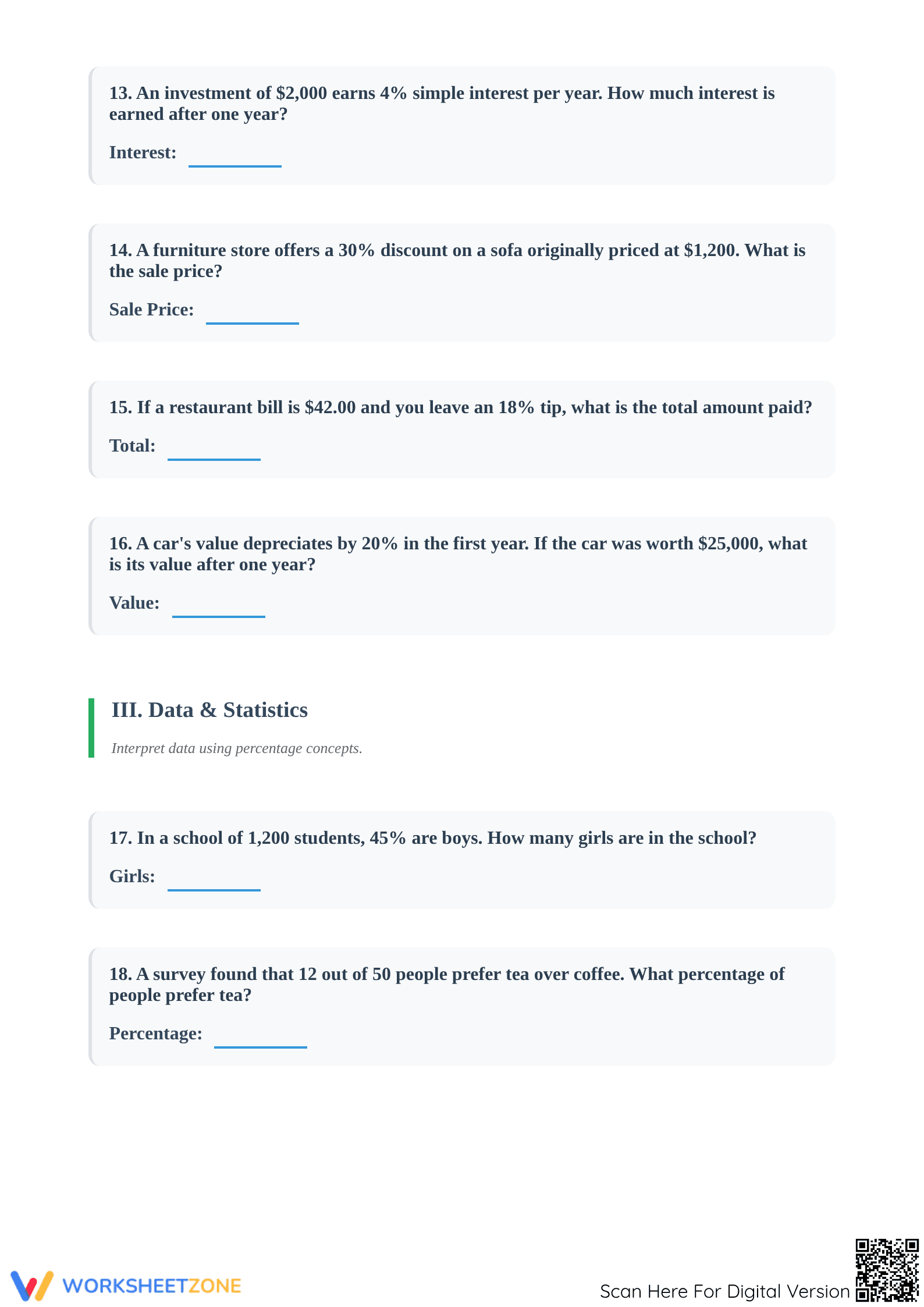
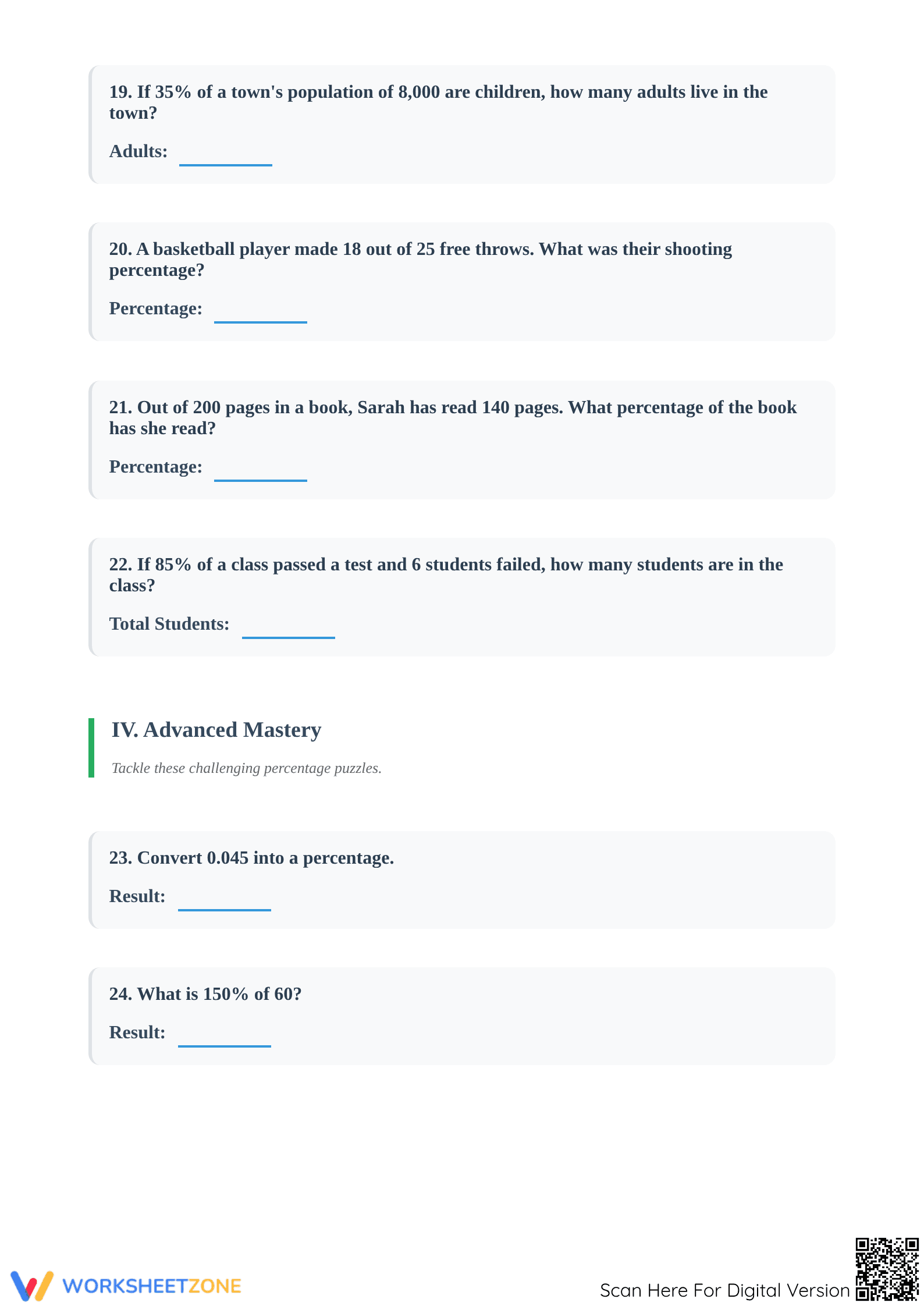
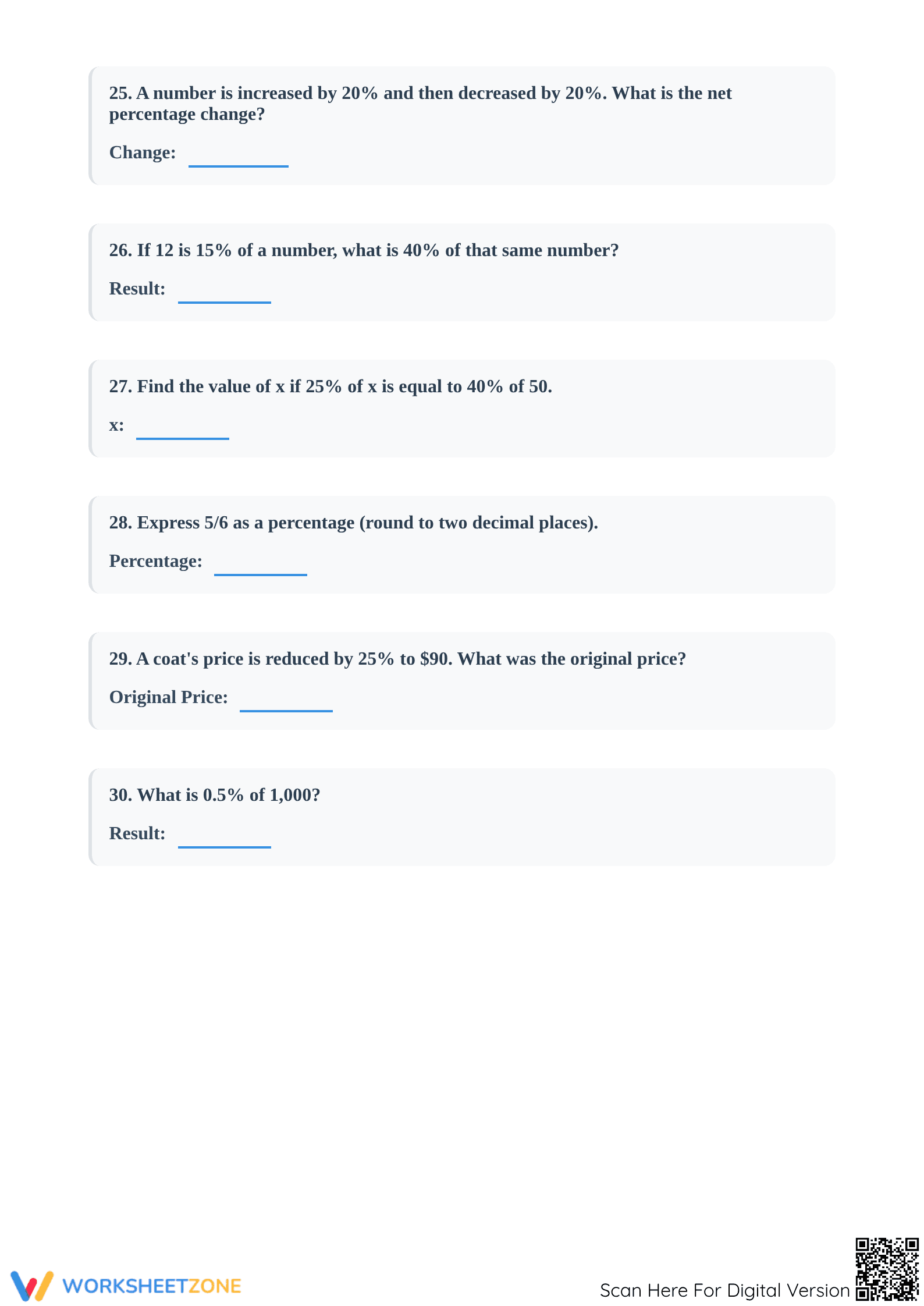

Mixed Percent Calculations Worksheet | Grade 6 Essential
Paste this activity's link or code into your existing LMS (Google Classroom, Canvas, Teams, Schoology, Moodle, etc.).
Students can open and work on the activity right away, with no student login required.
You'll still be able to track student progress and results from your teacher account.
This comprehensive 5-page math resource empowers Grade 6 students to master the full spectrum of percentage operations. By bridging abstract calculations and real-world financial applications, students develop the fluency required for middle school success. The worksheet ensures learners can confidently determine parts, wholes, and rates across diverse contexts.
At a Glance
- Grade: 6 · Subject: Math
- Standard:
6.RP.A.3.c— Find a percent of a quantity and solve problems finding the whole- Skill Focus: Multi-step percent calculations and financial applications
- Format: 5 pages · 30 problems · Answer key included · PDF
- Best For: End-of-unit review or emergency sub plans
- Time: 45–60 minutes
This pack contains 30 unique problems organized into four distinct modules. The first section focuses on core numerical fluency, while subsequent sections introduce financial mathematics including discounts, sales tax, and interest. The final pages challenge students with data interpretation and advanced mastery puzzles, all supported by a comprehensive five-page answer key for rapid grading.
Zero-Prep Workflow
The transition from download to classroom delivery is engineered for maximum teacher efficiency.
- Print (30 seconds): High-contrast layout ensures clear duplication on any school copier.
- Distribute (1 minute): Students receive packets requiring no additional manipulatives or teacher-led setup.
- Review (5 minutes): The aligned answer key allows for immediate formative feedback or peer-grading sessions during the closing minutes of class. Total prep time is under two minutes.
Standards Alignment
This worksheet aligns directly with 6.RP.A.3.c: "Find a percent of a quantity as a rate per 100 (e.g., 30% of a quantity means 30/100 times the quantity); solve problems involving finding the whole, given a part and the percent." It also provides foundational support for 7.RP.A.3 regarding multi-step percent problems. Both standard codes can be copied directly into lesson plans, IEP goals, or district curriculum mapping tools.
How to Use It
Use this collection as a summative assessment following a unit on ratios and proportions. The tiered structure allows you to observe student transition points from basic calculation to situational application. Alternatively, assign specific sections as high-utility homework to reinforce financial literacy concepts like interest and tax calculation in a structured classroom setting.
Who It's For
Designed for Grade 6 classrooms, this resource also provides essential scaffolding for Grade 7 students requiring intervention. It pairs naturally with a direct instruction lesson on decimal-to-percent conversion or an anchor chart detailing the "percent of" formula. The 30 problems accommodate varying processing speeds within a single class period.
The strategic integration of core math and financial literacy in this worksheet reflects current pedagogical shifts toward contextualized numeracy. According to a ScienceDirect TpT Analysis (2024), student engagement in middle school mathematics increases significantly when abstract percentage concepts are applied to tangible scenarios like discounts and interest rates. By utilizing the 30 problems included here, educators support the mastery of 6.RP.A.3.c, which requires students to find a percent of a quantity and solve problems involving the whole. This resource provides the structured repetition necessary to build cognitive endurance and procedural fluency. Research suggests that high-quality, print-ready materials reduce teacher burnout while maintaining high academic standards for diverse learner populations. This worksheet serves as a reliable instrument for both initial skill acquisition and long-term retention of proportional reasoning across Grade 6 and Grade 7 levels.


