


























Views
Downloads
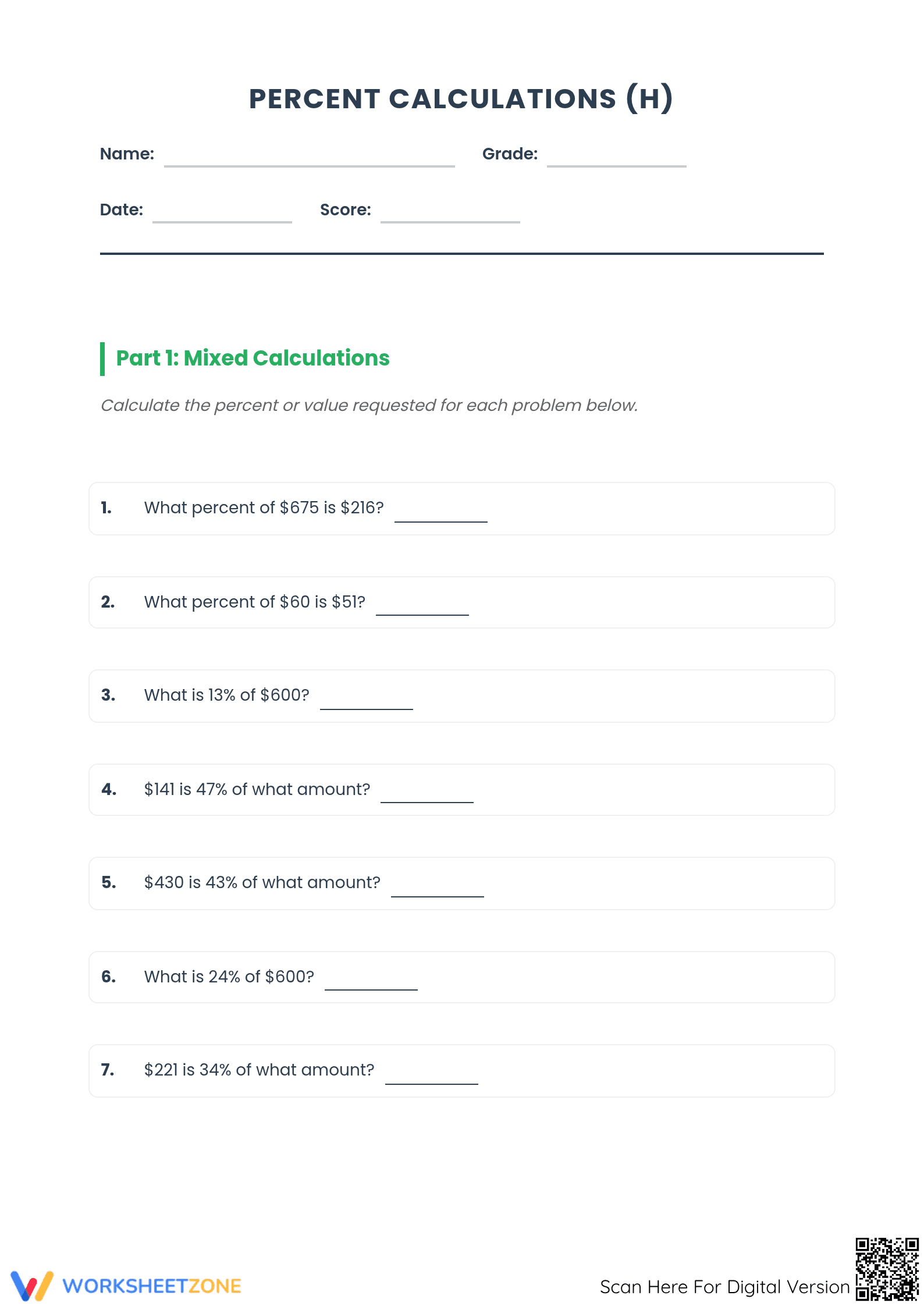
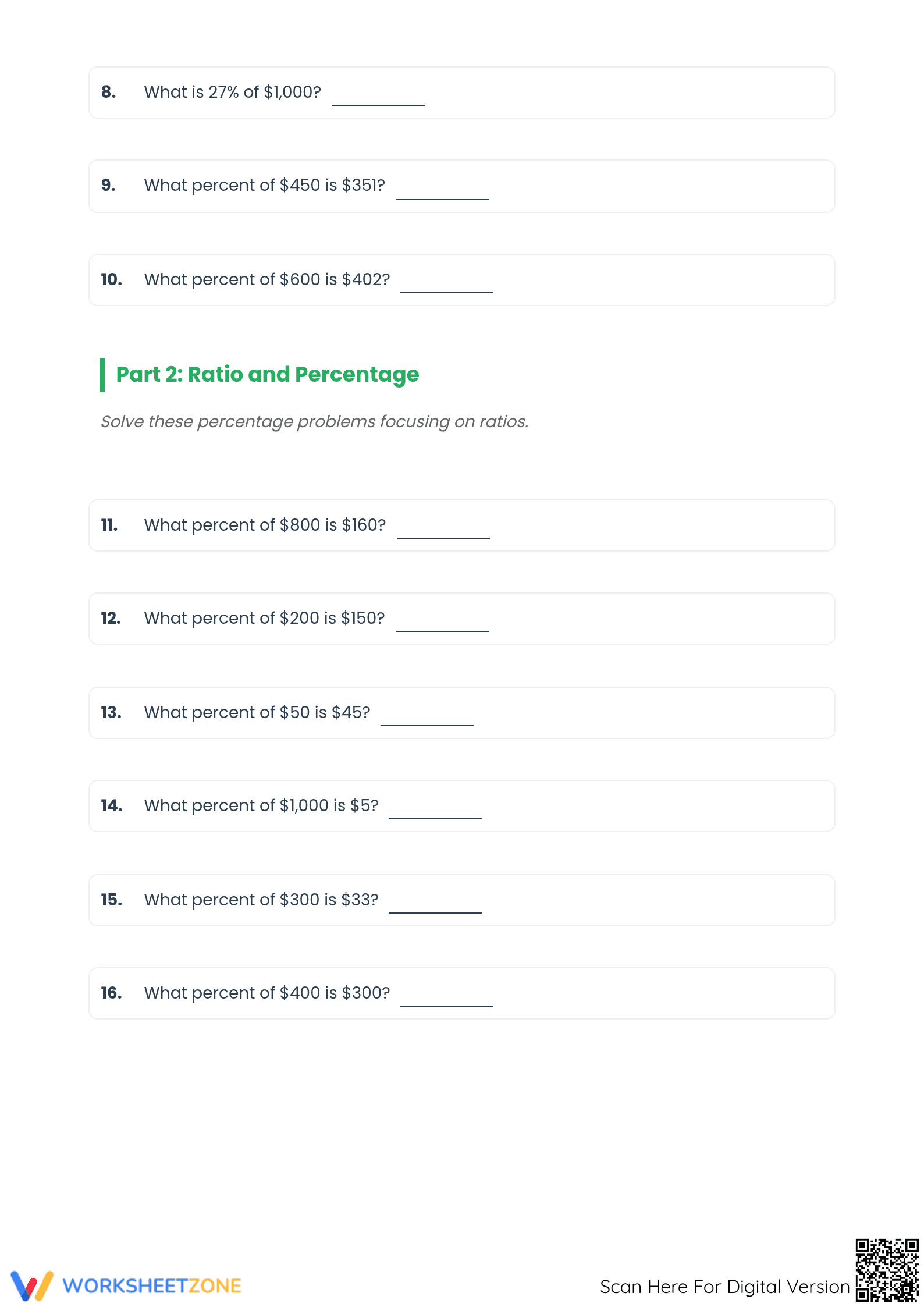
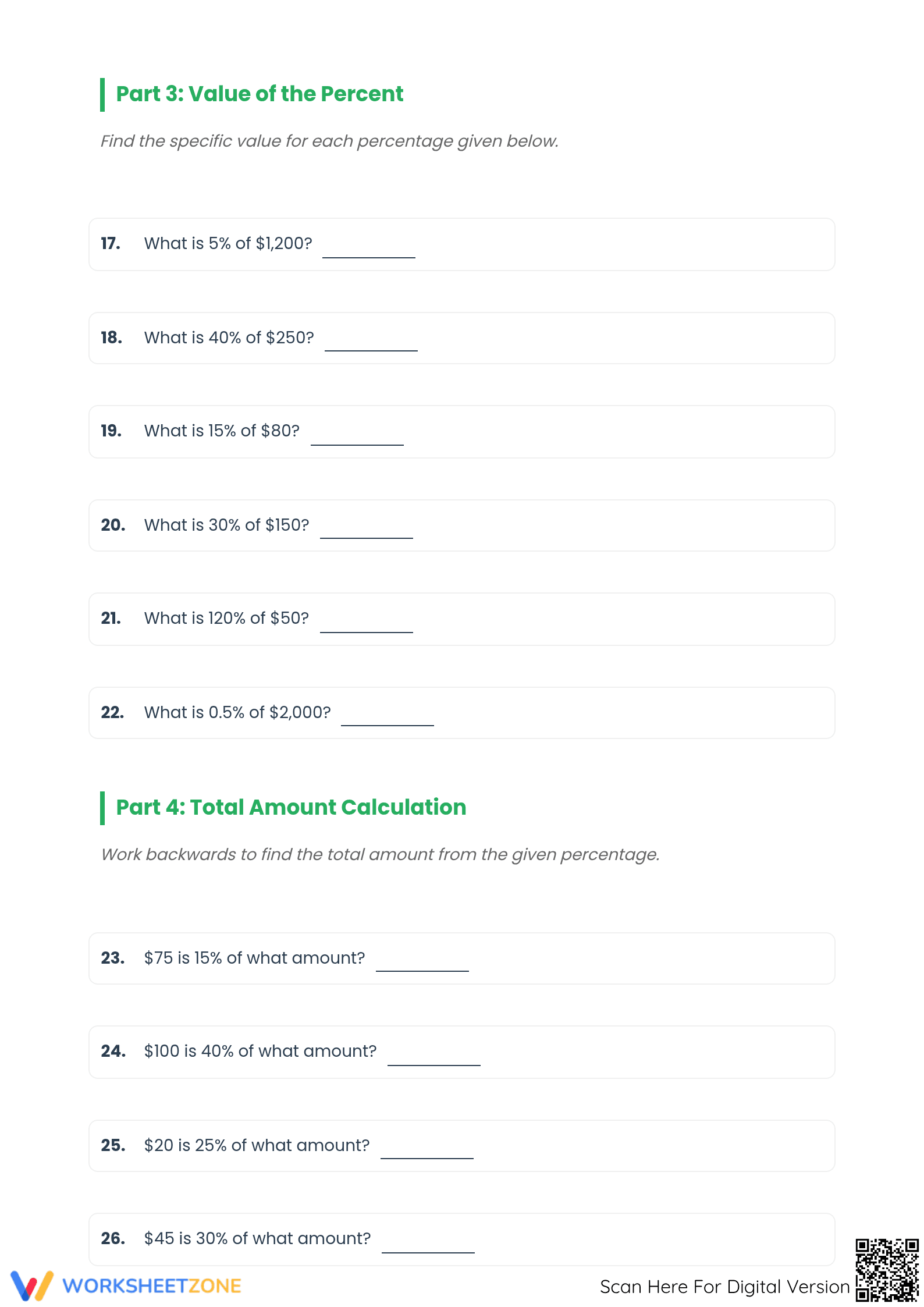
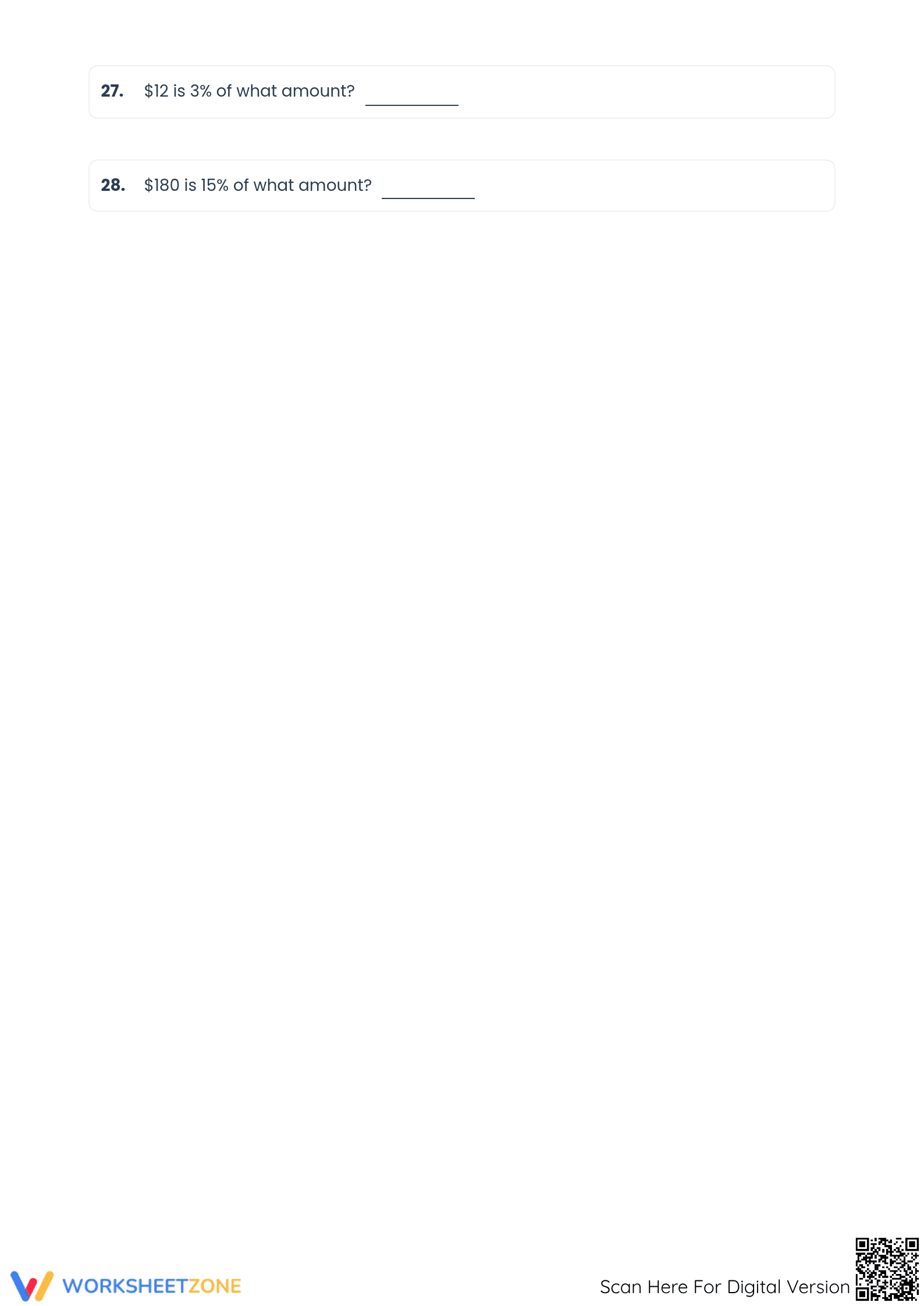

Mixed Percent Calculations - Essential Printable Worksheet
Paste this activity's link or code into your existing LMS (Google Classroom, Canvas, Teams, Schoology, Moodle, etc.).
Students can open and work on the activity right away, with no student login required.
You'll still be able to track student progress and results from your teacher account.
Mastering percent calculations is a fundamental requirement for middle school math success. This mixed percent calculations worksheet provides students with a comprehensive 28-problem practice set designed to strengthen their ability to navigate parts, wholes, and percentages. By engaging with these diverse problem types, learners build the computational fluency needed for real-world mathematical applications.
At a Glance
- Grade: 6–8 · Subject: Math
- Standard:
6.RP.A.3.C— Find a percent of a quantity as a rate per 100 and solve problems- Skill Focus: Mixed Percent Calculations
- Format: 4 pages · 28 problems · Answer key included · PDF
- Best For: Classroom practice or independent homework assignment
- Time: 45–60 minutes
This robust four-page PDF packet contains 28 distinct calculation tasks organized into logical sections. Students will work through identifying percentages of specific values, calculating what percentage one number is of another, and determining total amounts from a given percentage. The worksheet features clear, spacious layouts for each problem and includes a comprehensive answer key to streamline the grading process for busy educators.
The design of this resource prioritizes teacher efficiency with a simple three-step classroom workflow. First, print the four-page packet for your class (2 minutes). Second, distribute the materials as a standalone practice set or a sub-plan activity (1 minute). Finally, use the included answer key to conduct a quick peer-review or individual grading session (5 minutes). Total preparation time remains under two minutes.
This resource is explicitly aligned with 6.RP.A.3.C, which requires students to find a percent of a quantity as a rate per 100 and solve problems involving finding the whole, given a part and the percent. The varied problem set also supports foundational skills for Grade 7 proportional reasoning. Both standard codes can be copied directly into lesson plans, IEP goals, or district curriculum mapping tools.
Use this worksheet during the "You Do" phase of a gradual release lesson to assess individual student mastery of percent concepts. Alternatively, assign it as a low-stakes formative assessment at the end of a unit to identify specific areas where students struggle with finding the whole versus finding the part. Observe if students utilize visual models or direct multiplication during the 45-minute completion window.
This resource is ideal for Grade 6 students first encountering mixed percent types, as well as Grade 7 and 8 students requiring targeted intervention or spiral review. It pairs naturally with a percent bar model anchor chart or a direct instruction lesson on cross-multiplication. The structured layout provides excellent support for students who benefit from clear sectioning and consistent formatting.
Educational research emphasized in the RAND AIRS 2024 report highlights that high-quality, standards-aligned practice materials are essential for closing mathematical achievement gaps in middle school. This worksheet directly addresses 6.RP.A.3.C by requiring students to perform mixed percent calculations, a skill identified by the National Assessment of Educational Progress (NAEP) as a critical predictor of high school algebraic readiness. By providing 28 structured problems that move from finding parts to determining wholes, the resource facilitates the repetitive cognitive engagement necessary for long-term procedural retention. Studies suggest that structured practice packets of this length allow for deeper "productive struggle" than shorter, isolated tasks. Educators can rely on this tool as a evidence-based component of a comprehensive math curriculum, ensuring students meet rigorous state and national benchmarks for rational number operations while building the confidence needed for advanced financial literacy.


