


























Views
Downloads

Essential Percent Calculations Worksheet | Grade 6 Math
Paste this activity's link or code into your existing LMS (Google Classroom, Canvas, Teams, Schoology, Moodle, etc.).
Students can open and work on the activity right away, with no student login required.
You'll still be able to track student progress and results from your teacher account.
This essential Grade 6 math worksheet provides students with targeted practice in calculating percentages. By engaging with mixed problem types, learners develop the fluency needed to solve for parts, percentages, and whole amounts in various contexts. Students will successfully master the relationship between ratios and rates through structured mathematical reasoning and repetitive practice.
At a Glance
- Grade: 6 · Subject: Math
- Standard:
CCSS.MATH.CONTENT.6.RP.A.3.C— Find a percent of a quantity and solve for missing parts or wholes.- Skill Focus: Mixed Percent Calculations
- Format: 4 pages · 28 problems · Answer key included · PDF
- Best For: Fluency practice and skill reinforcement.
- Time: 30–45 minutes
What's Inside
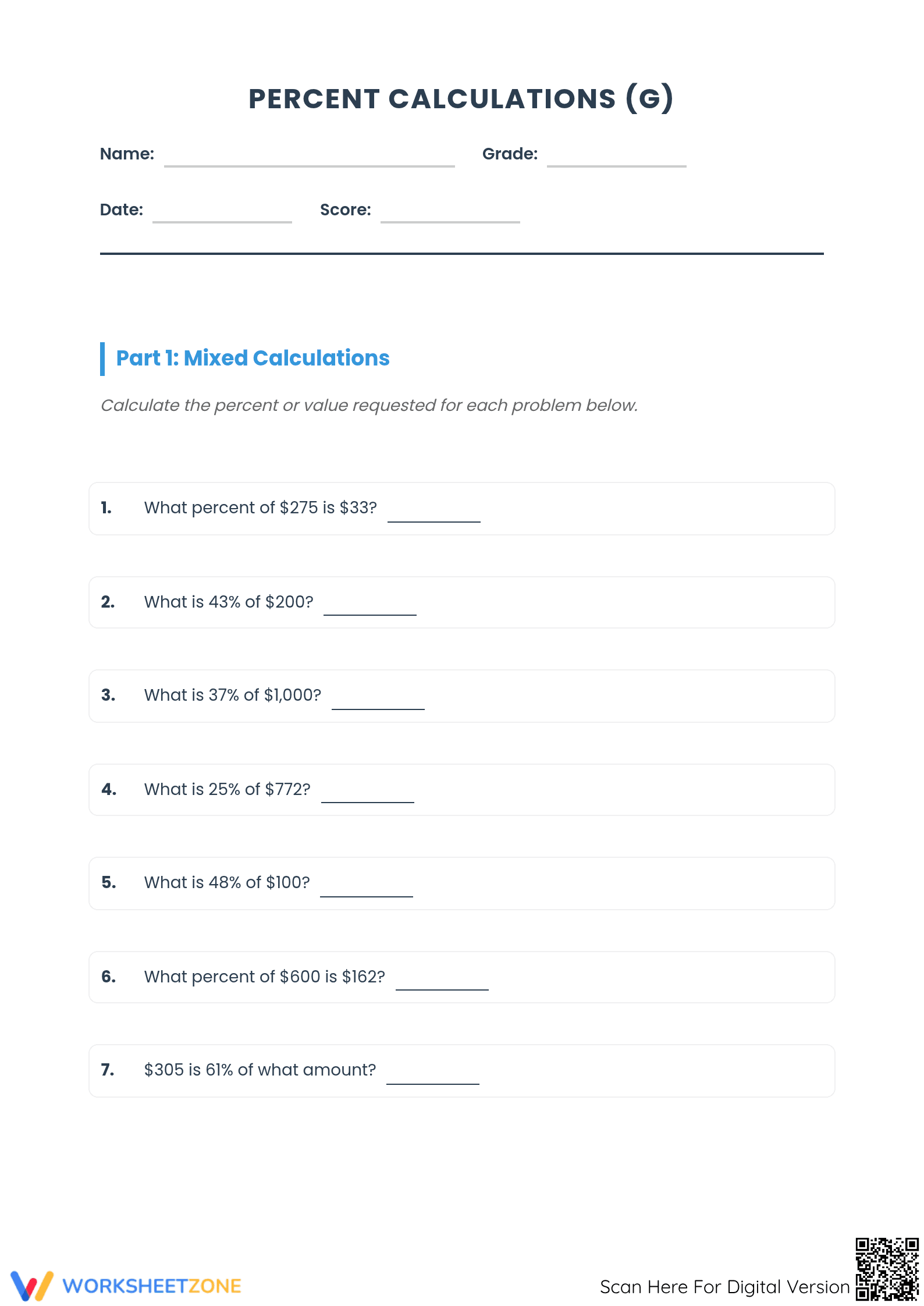
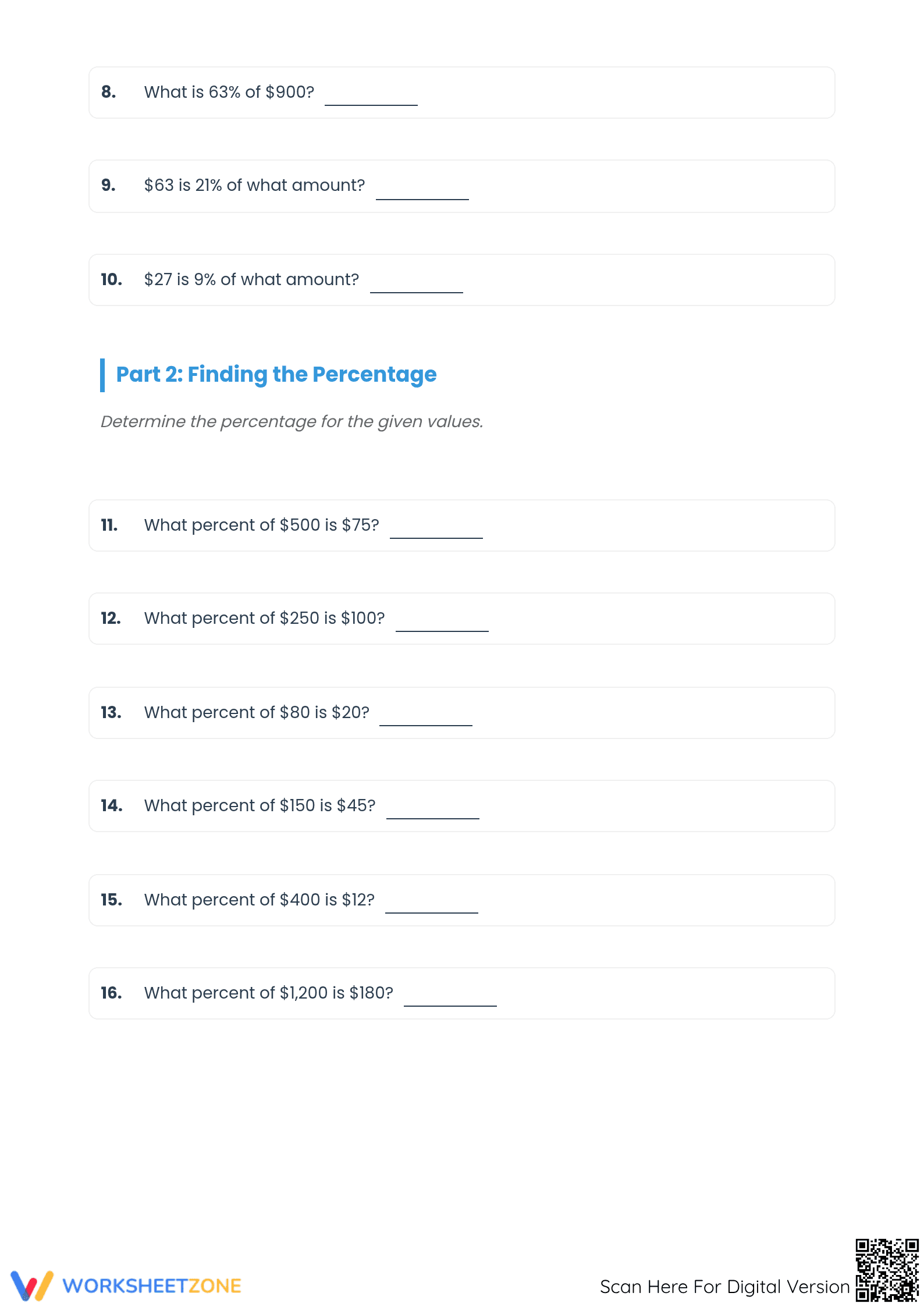
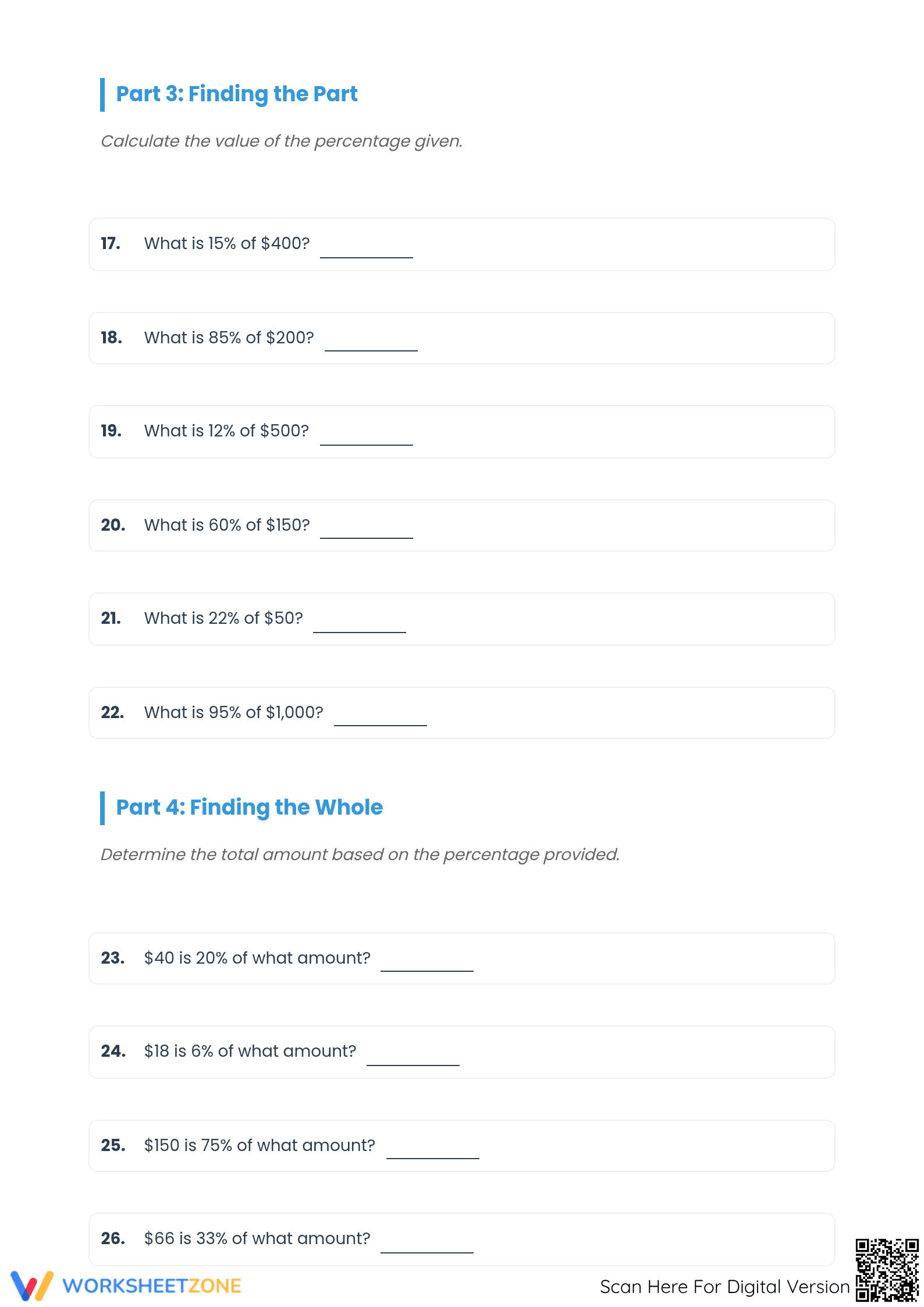
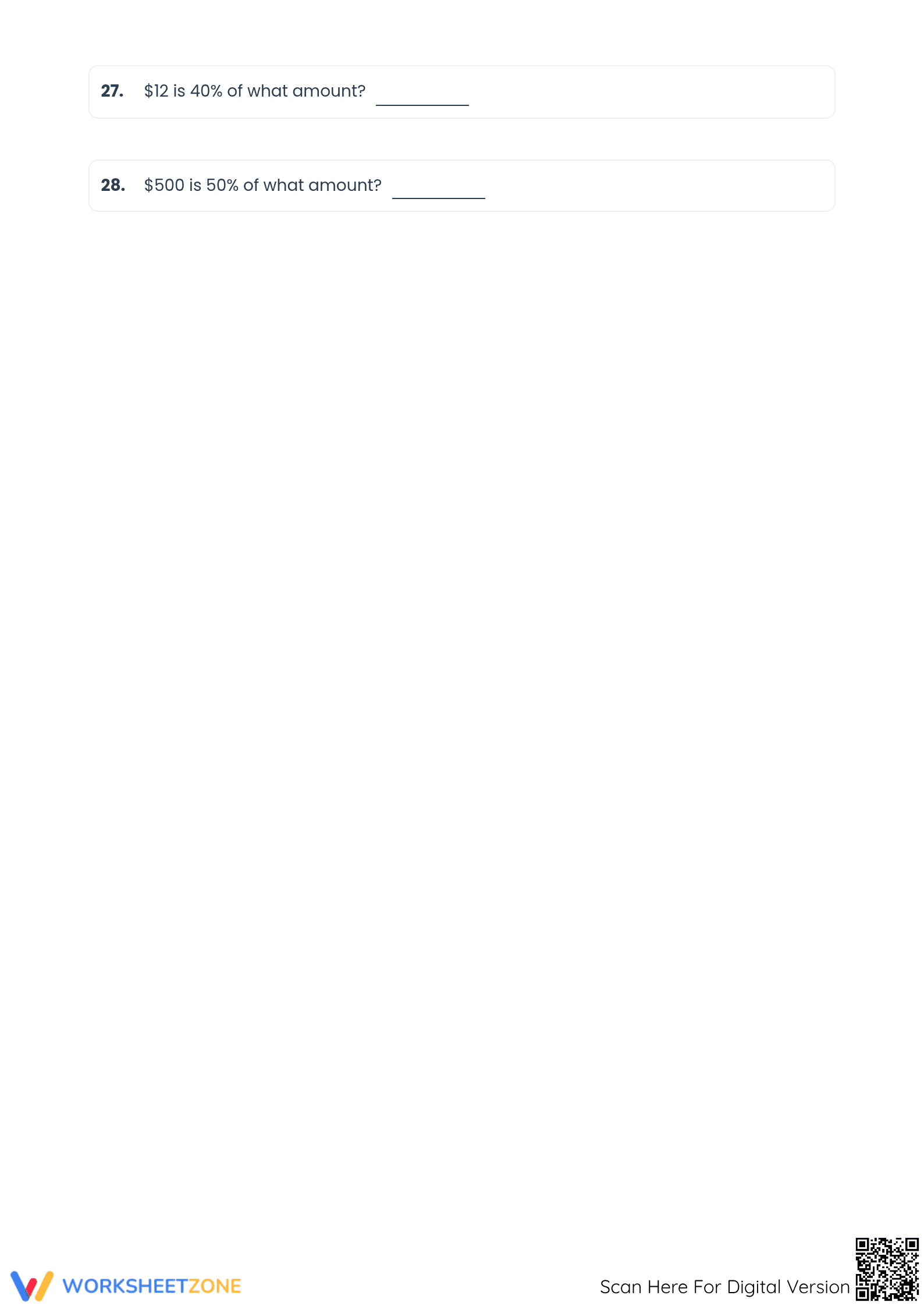
Inside this 4-page PDF, you will find four distinct sections comprising 28 problems. The worksheet is organized to transition students from mixed calculation reviews to focused sections on finding percentages, calculating specific parts of a value, and determining the whole amount when given a percentage. A comprehensive answer key is included for immediate feedback and grading efficiency.
Skill Progression
- Guided Practice: The first section contains 10 mixed problems that establish a baseline for identifying which part of the percent equation is missing.
- Supported Practice: Six problems focus specifically on "Finding the Percentage," requiring students to determine what percent one number is of another.
- Independent Practice: The final sections challenge students with 12 problems focused on finding the part and the whole, ensuring total mastery of proportional relationships.
This sequence follows a gradual-release instructional design to move students from recognition to independent application.
Standards Alignment
This worksheet is strictly aligned to `CCSS.MATH.CONTENT.6.RP.A.3.C`, which requires students to find a percent of a quantity as a rate per 100 and solve problems involving finding the whole, given a part and the percent. This standard code can be copied directly into lesson plans, IEP goals, or district curriculum mapping tools to ensure instructional compliance.
How to Use It
Use this worksheet during the "You Do" phase of a gradual release model. It serves as an excellent formative assessment tool after a unit on ratios and rates. Teachers should observe whether students consistently convert percentages to decimals or fractions correctly. The expected completion time for this 28-problem set ranges from 30 to 45 minutes depending on student proficiency levels.
Who It's For
This resource is designed for Grade 6 students but is equally effective for Grade 7 and 8 intervention groups needing extra support with decimals and percents. It pairs naturally with an anchor chart on the percent proportion. For differentiation, provide students with a calculator to focus on the conceptual setup rather than arithmetic computation if they are working below grade level.
According to recent findings from EdReports 2024, high-quality instructional materials must prioritize the development of procedural fluency alongside conceptual understanding in middle school mathematics. This worksheet specifically addresses `CCSS.MATH.CONTENT.6.RP.A.3.C` by providing a high volume of varied practice opportunities. Research indicates that students who master the tripartite relationship of part, percent, and whole are better equipped for algebra and real-world financial literacy. By isolating these specific calculation types across 28 tasks, the resource prevents cognitive overload while reinforcing the foundational logic of proportional reasoning. The inclusion of an answer key supports the "immediate feedback loop" essential for corrective learning. Educators can rely on this material to bridge the gap between initial direct instruction and independent application, ensuring that students can accurately find a percent of a quantity and determine the whole when given a part and the percent.


