


























Views
Downloads

Essential Mixed Percent Calculations — Grades 6-8 Math
Paste this activity's link or code into your existing LMS (Google Classroom, Canvas, Teams, Schoology, Moodle, etc.).
Students can open and work on the activity right away, with no student login required.
You'll still be able to track student progress and results from your teacher account.
Mastering percentages is a critical milestone in middle school mathematics, bridging the gap between basic arithmetic and real-world financial literacy. This comprehensive worksheet provides students with targeted practice in calculating missing values, determining percentages, and finding base numbers. By progressing from procedural operations to complex word problems, learners build the fluency needed for advanced mathematical success.
At a Glance
- Grade: 7 · Subject: Math
- Standard:
CCSS.MATH.CONTENT.6.RP.A.3.C— Find a percent of a quantity and solve problems finding the whole- Skill Focus: Mixed Percent Operations
- Format: 4 pages · 40 problems · Answer key included · PDF
- Best For: Classroom assessment or independent practice
- Time: 45–60 minutes
What's Inside
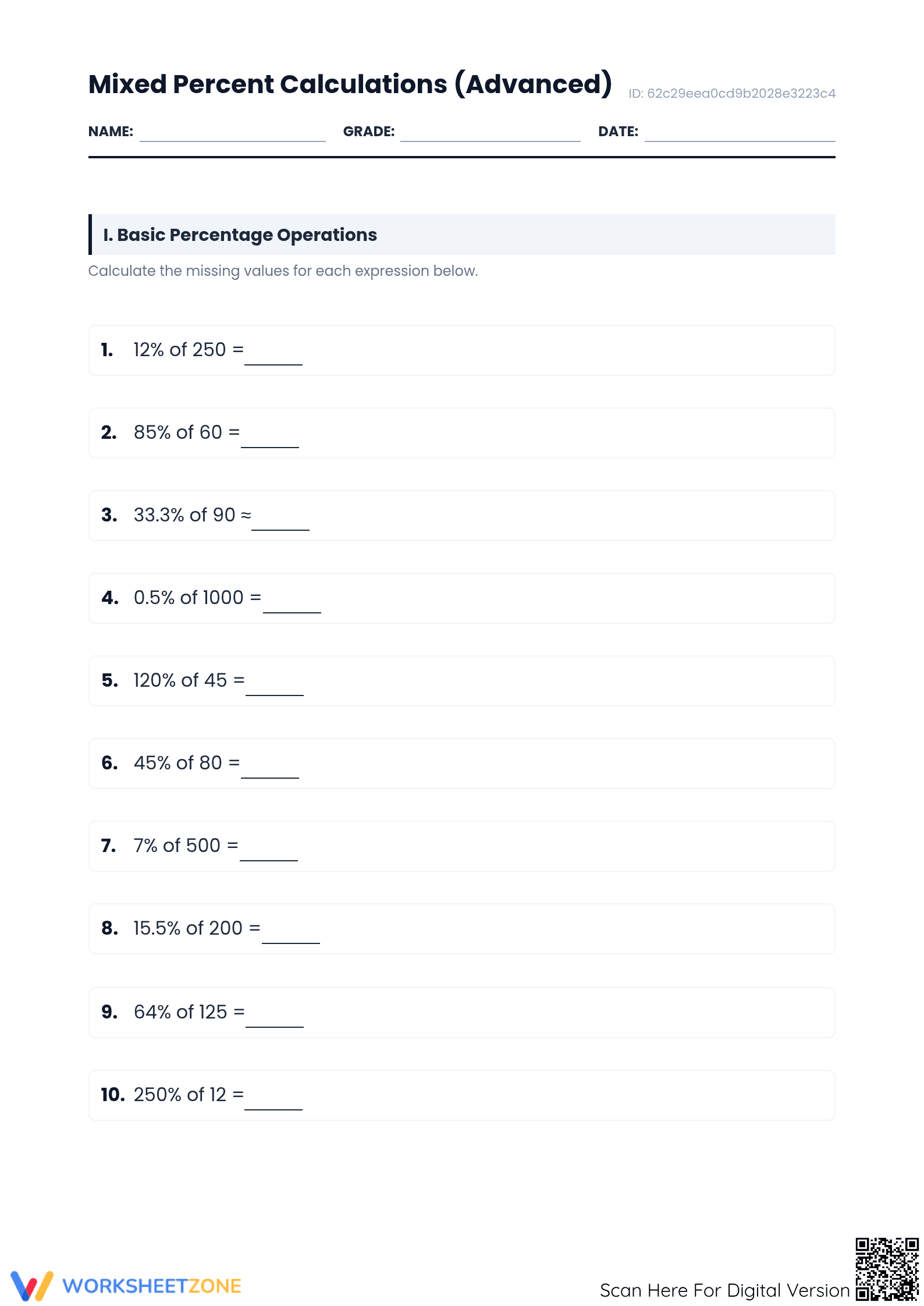
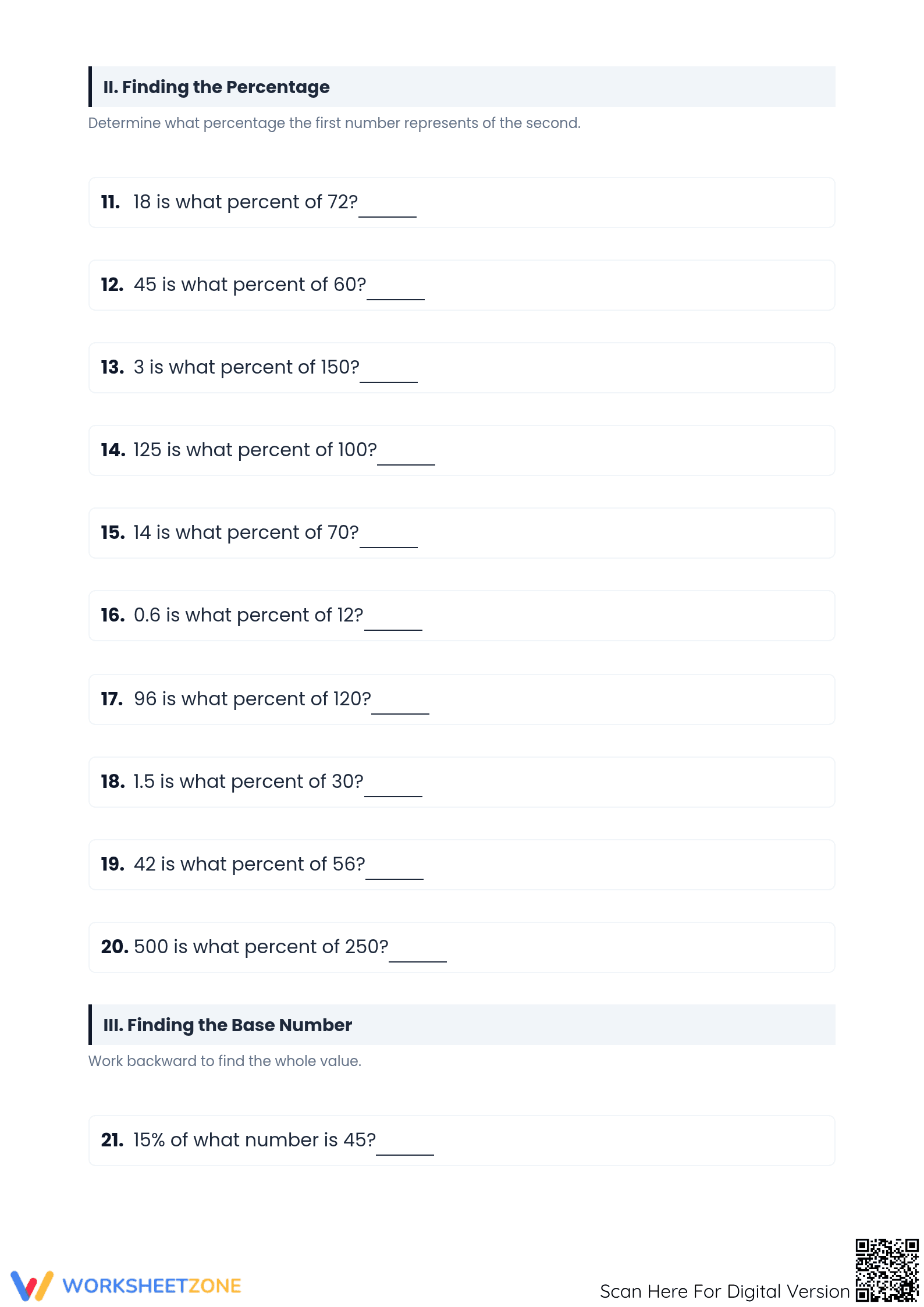
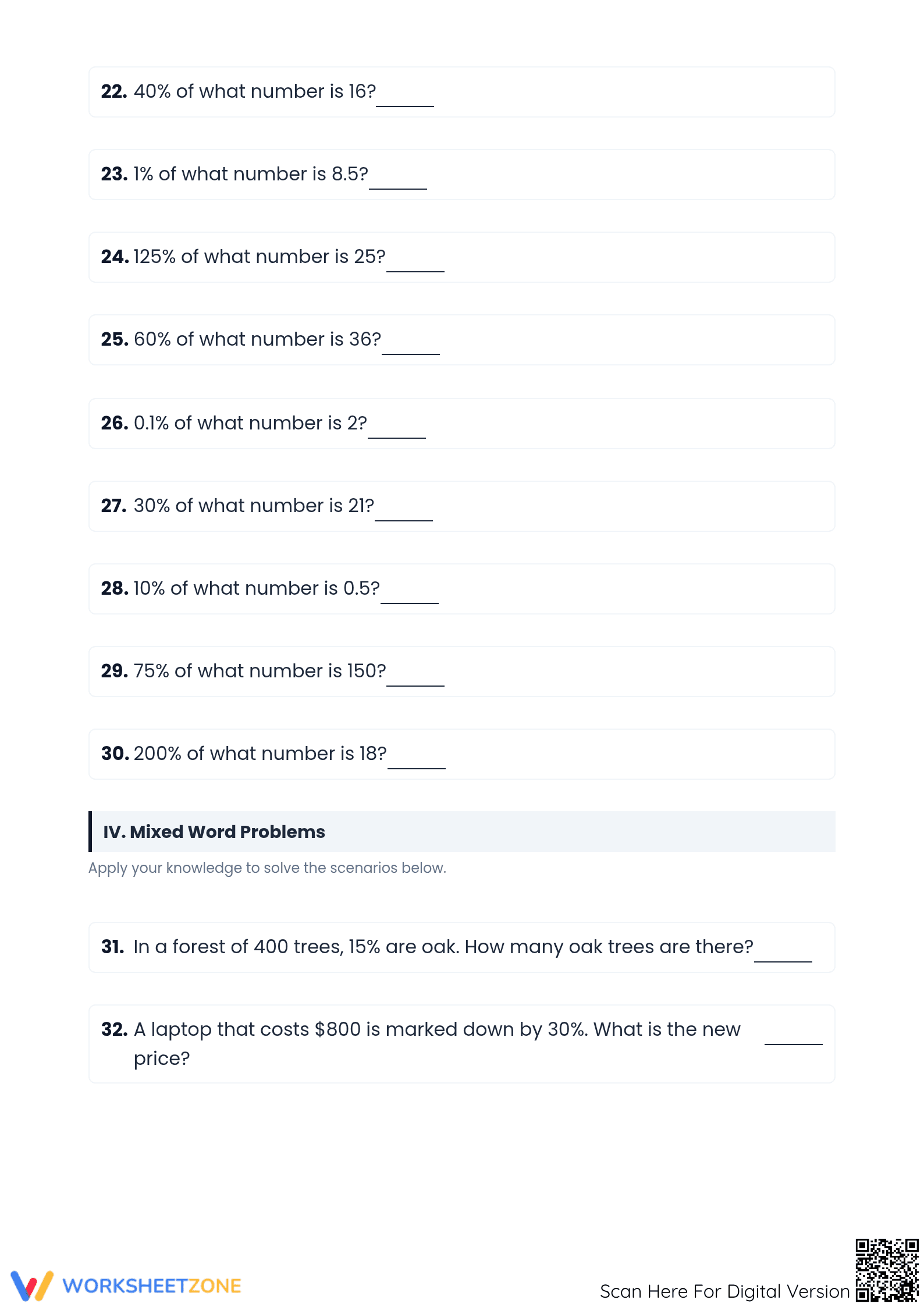
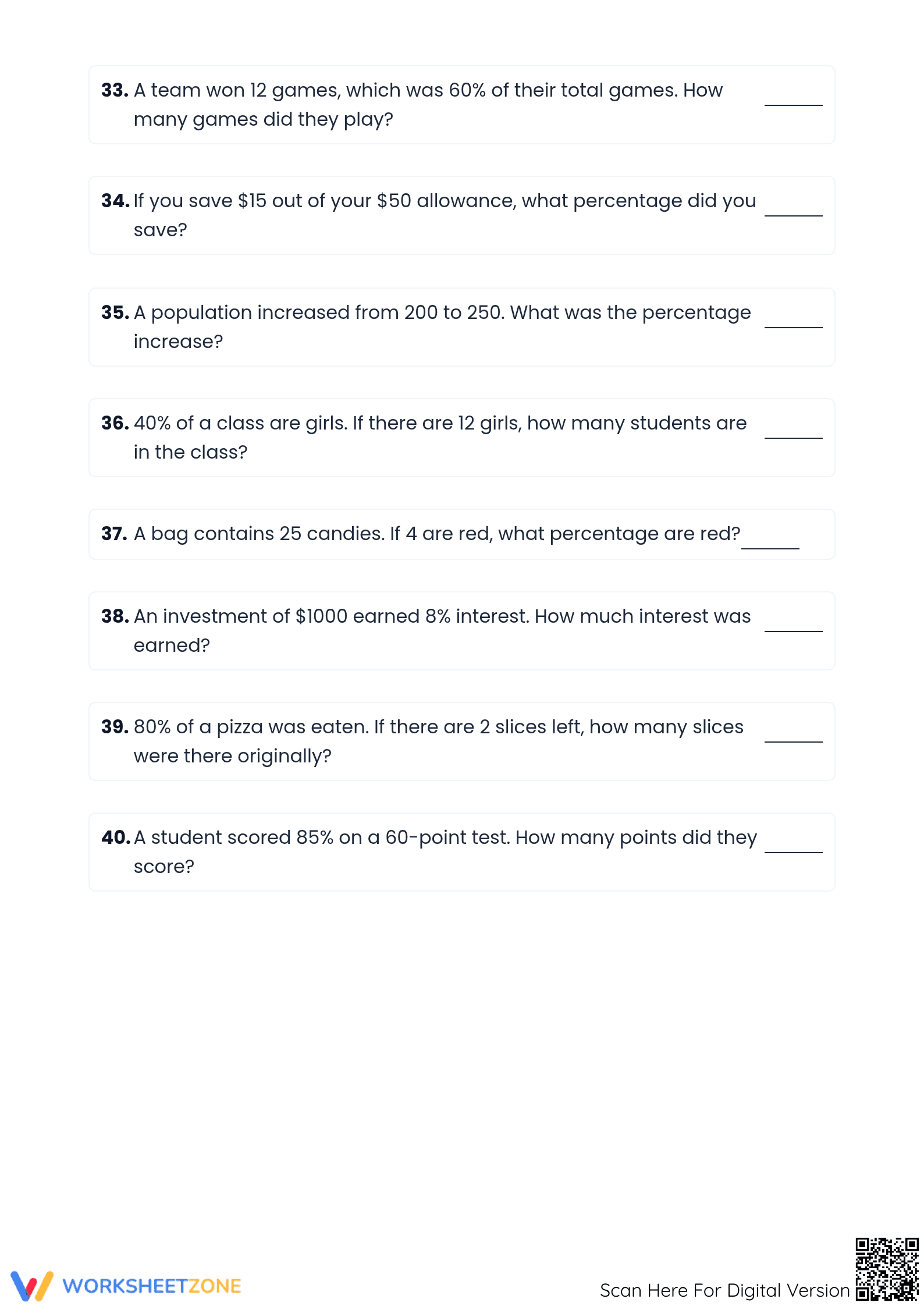
This four-page resource is divided into four logical quadrants to ensure a structured learning experience. It includes 10 basic percentage operations, 10 problems finding the percentage of a given number, 10 exercises finding the base number, and 10 mixed real-world word problems. The layout features clear section headers and ample whitespace for student calculations, accompanied by a full answer key for immediate feedback.
Skill Progression
- Guided Practice: The first 20 problems focus on procedural fluency, using round numbers to build student confidence.
- Supported Practice: Problems 21-30 require working backward to find base numbers, reinforcing inverse relationships.
- Independent Application: The final word problems involving populations and markdowns require students to choose the correct mathematical operation.
This gradual release approach ensures students master components before applying them to complex contexts.
Standards Alignment
The primary focus is CCSS.MATH.CONTENT.6.RP.A.3.C, requiring students to find percents of quantities and solve for the whole. It also supports CCSS.MATH.CONTENT.7.RP.A.3 via multistep problems. Both codes can be copied directly into lesson plans or curriculum mapping tools.
How to Use It
This worksheet is ideal for use during the practice phase of a lesson on ratios and proportions. After demonstrating the percent proportion or equation method, distribute this set as an in-class assignment. Teachers should circulate during the transition to Section III, as finding the base number often reveals conceptual gaps in part-to-whole relationships. Use the final word problem section as a formative assessment to gauge readiness for higher-level algebra.
Who It's For
Designed primarily for Grade 7 math students, this resource is also highly effective for Grade 6 acceleration or Grade 8 remediation. It serves as an excellent resource for Title I math intervention groups or as a comprehensive sub plan that requires zero teacher preparation. Pair this worksheet with a percentage anchor chart or a direct instruction lesson for students requiring additional scaffolds.
Percentage fluency is a significant predictor of later success in algebra. According to RAND AIRS 2024, students who engage in mixed-operation practice—alternating between finding the part, the whole, and the percent—demonstrate higher retention than those who practice sub-skills in isolation. This interleaved approach helps students recognize problem structures rather than relying on rote memorization. This worksheet facilitates this strategy by presenting 40 tasks requiring constant cognitive switching between different percent scenarios. By integrating real-world contexts like markdowns and interest, the resource aligns with EdReports 2024 findings regarding the importance of application-level tasks. Educators can confidently utilize the CCSS.MATH.CONTENT.6.RP.A.3.C and CCSS.MATH.CONTENT.7.RP.A.3 alignments to ensure instruction meets rigorous college and career readiness benchmarks.


