


























Views
Downloads
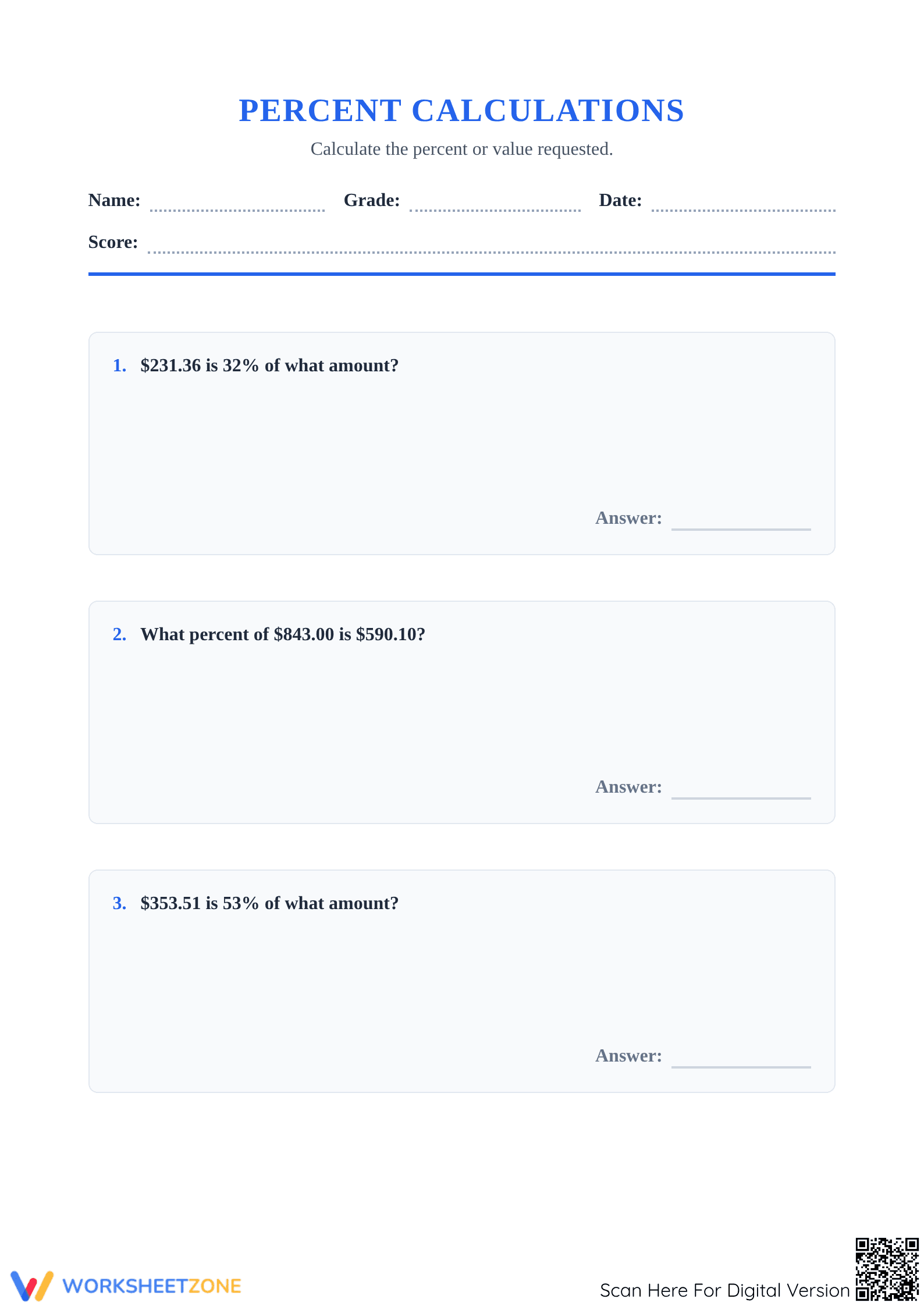
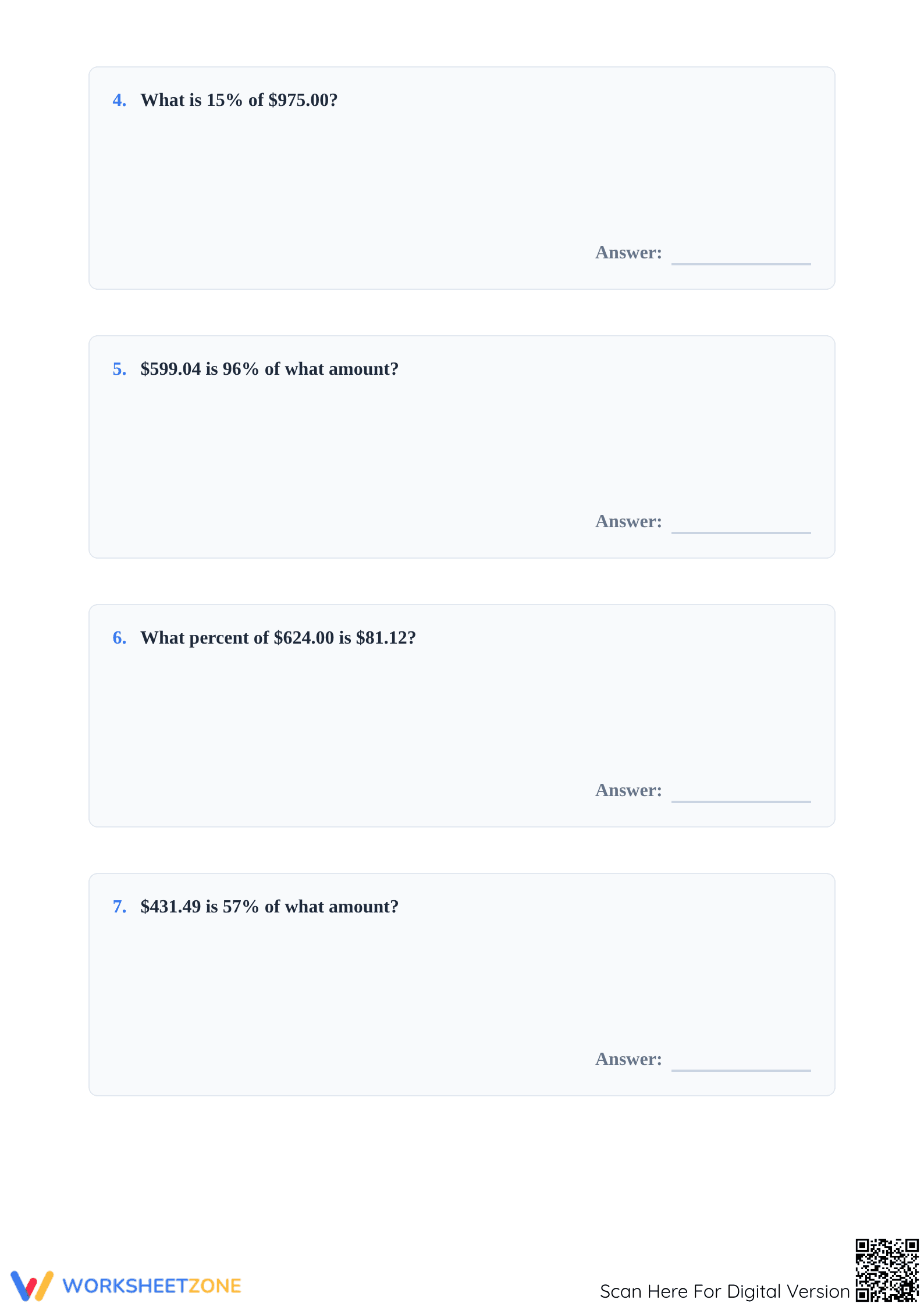
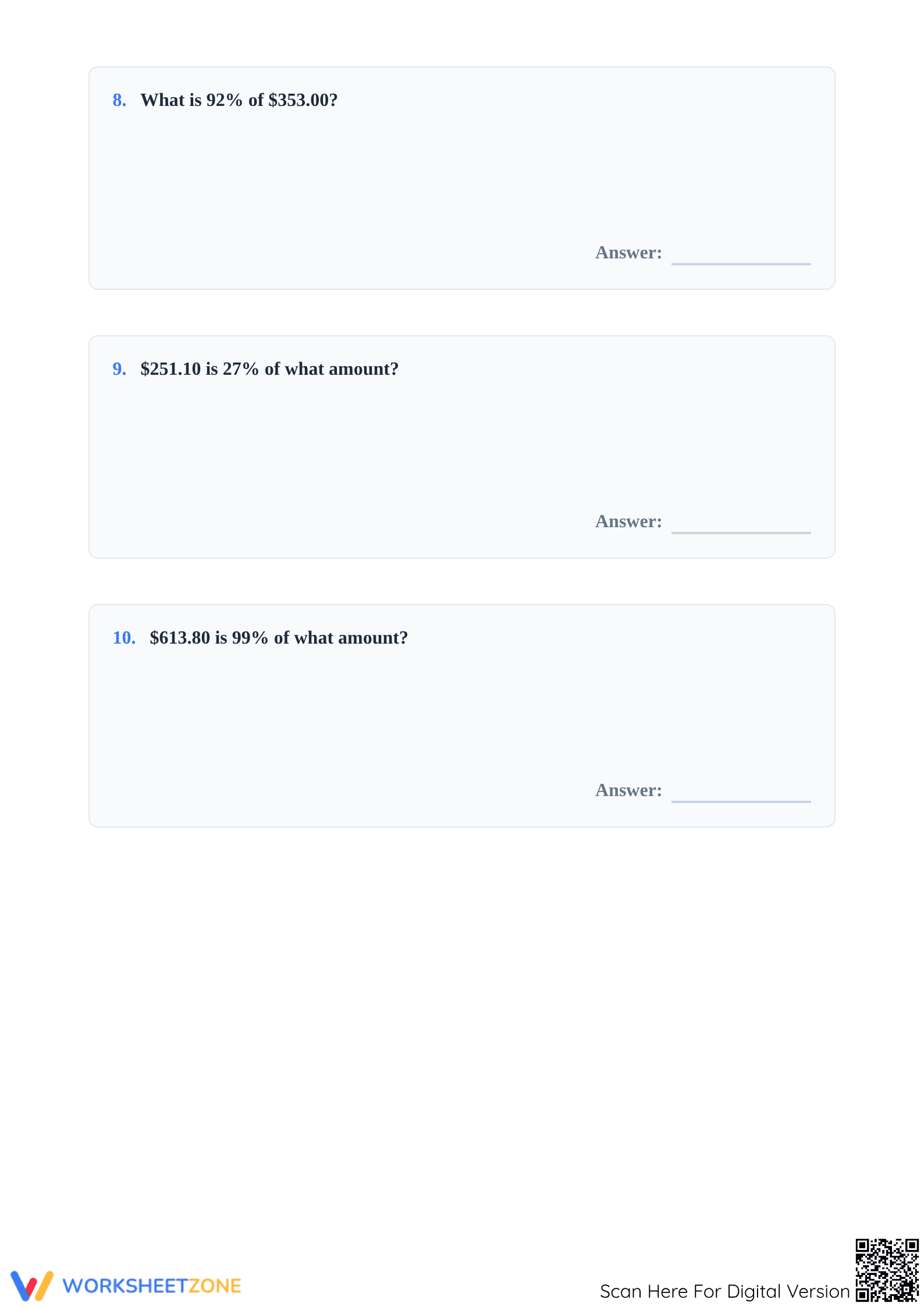

Essential Mixed Percent Calculations | Grade 6 Math
Paste this activity's link or code into your existing LMS (Google Classroom, Canvas, Teams, Schoology, Moodle, etc.).
Students can open and work on the activity right away, with no student login required.
You'll still be able to track student progress and results from your teacher account.
Solve part, whole, and percent problems with confidence using this comprehensive Math worksheet. Designed for middle school students, this resource focuses on mixed percent calculations involving decimal currency values. Students will improve their ability to recognize different problem types and apply correct mathematical procedures to find accurate solutions in real-world contexts.
At a Glance
- Grade: 6 · Subject: Math
- Standard:
CCSS.MATH.CONTENT.6.RP.A.3.C— Find a percent of a quantity and find the whole given part and percent.- Skill Focus: Mixed Percent Calculations
- Format: 3 pages · 10 problems · Answer key included · PDF
- Best For: Independent practice or formative assessment
- Time: 20–30 minutes
What's Inside
This 3-page PDF document contains 10 rigorous word problems focused on calculating percentages of monetary values. Each page features a clean, spacious layout with dedicated answer boxes, ensuring students have ample room for their work. The collection includes all basic types of percent calculations, such as finding the part, finding the percent, and finding the base amount. A full answer key is provided for quick grading and immediate feedback, making it an ideal choice for busy classrooms.
Skill Progression
- Guided Practice: Problems 1–3 introduce varied calculation types using currency amounts to build stamina and precision.
- Supported Practice: Problems 4–7 continue the mixed format, challenging students to identify which variable is missing from the equation.
- Independent Practice: Problems 8–10 provide a check for mastery with complex calculations.
This structure follows the gradual-release model, transitioning students from recognizing problem structures to independent mastery of multi-step percent operations without teacher intervention.
Standards Alignment
This worksheet is directly aligned with CCSS.MATH.CONTENT.6.RP.A.3.C, which requires students to find a percent of a quantity as a rate per 100 and solve problems involving finding the whole, given a part and the percent. The inclusion of decimal-based currency values also supports fluently dividing multi-digit decimals. Both standard codes can be copied directly into lesson plans, IEP goals, or district curriculum mapping tools for efficient tracking.
How to Use It
Use this resource as a mid-unit formative assessment to gauge student understanding of percent relationships before moving into percent increase and decrease. Alternatively, assign it as a targeted homework packet for students needing extra practice with decimal operations. While students work, observe their choice of method to identify who may need additional scaffolding with algebraic thinking. Expected completion time is 20 to 30 minutes, allowing it to fit into a standard class period.
Who It's For
This worksheet is ideal for 6th-grade students mastering introductory ratios and percentages, as well as 7th and 8th graders needing a skills refresher. It serves as an excellent differentiation tool when paired with a "Calculating Percents" anchor chart or a short direct instruction lesson. The currency context makes it particularly relevant for students interested in personal finance.
Aligned to CCSS.MATH.CONTENT.6.RP.A.3.C, this worksheet targets calculating part, whole, and percent values within a financial context. Research from the NAEP highlights that proficiency in percent operations is a significant predictor of success in high school algebra. By presenting problems that require students to switch fluidly between finding the percentage, the base, and the rate, this resource builds cognitive flexibility for complex proportional reasoning. Students who engage in varied practice are more likely to retain procedural knowledge required for standardized testing environments. Fisher & Frey (2014) emphasize the importance of independent practice in a gradual release framework, which is supported by the 10-problem structure here. Educators can use these tasks to build a robust foundation for future studies in probability and statistics.


