


























Views
Downloads

Complete Mixed Percent Calculations Worksheet | Grade 6-8
Paste this activity's link or code into your existing LMS (Google Classroom, Canvas, Teams, Schoology, Moodle, etc.).
Students can open and work on the activity right away, with no student login required.
You'll still be able to track student progress and results from your teacher account.
This comprehensive percentage mastery resource helps students develop absolute fluency in multi-directional calculations. By bridging the gap between simple rates and complex real-world applications, students learn to identify and solve for any missing variable in a percent equation. This worksheet transforms abstract numbers into actionable data through structured practice and rigorous problem-solving.
At a Glance
- Grade: 6–8 · Subject: Math
- Standard:
CCSS.MATH.CONTENT.6.RP.A.3.C— Find a percent of a quantity as a rate per 100- Skill Focus: Percent, Part, and Whole calculations
- Format: 4 pages · 32 problems · Answer key included · PDF
- Best For: Independent practice and summative assessment
- Time: 45–60 minutes
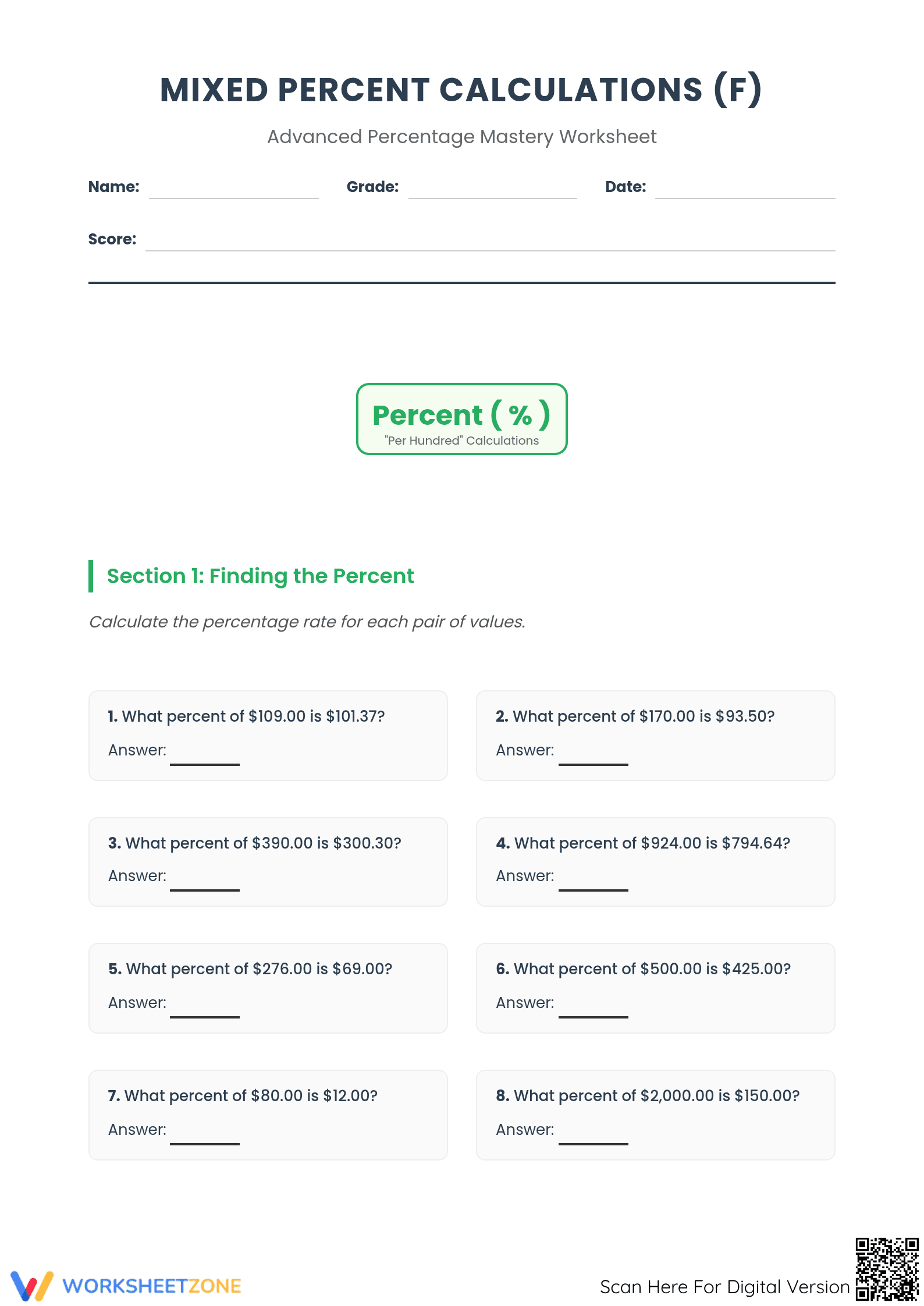
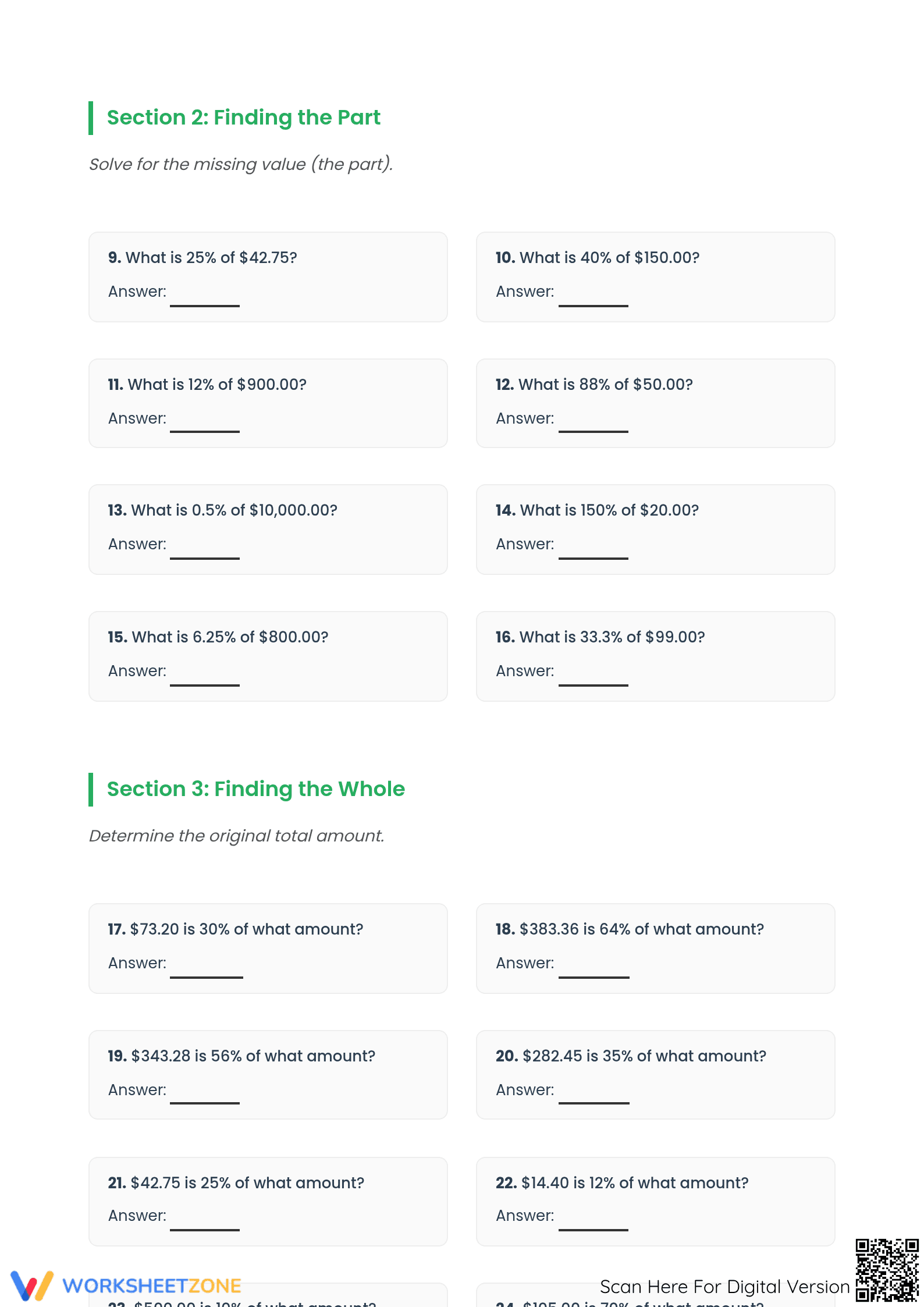
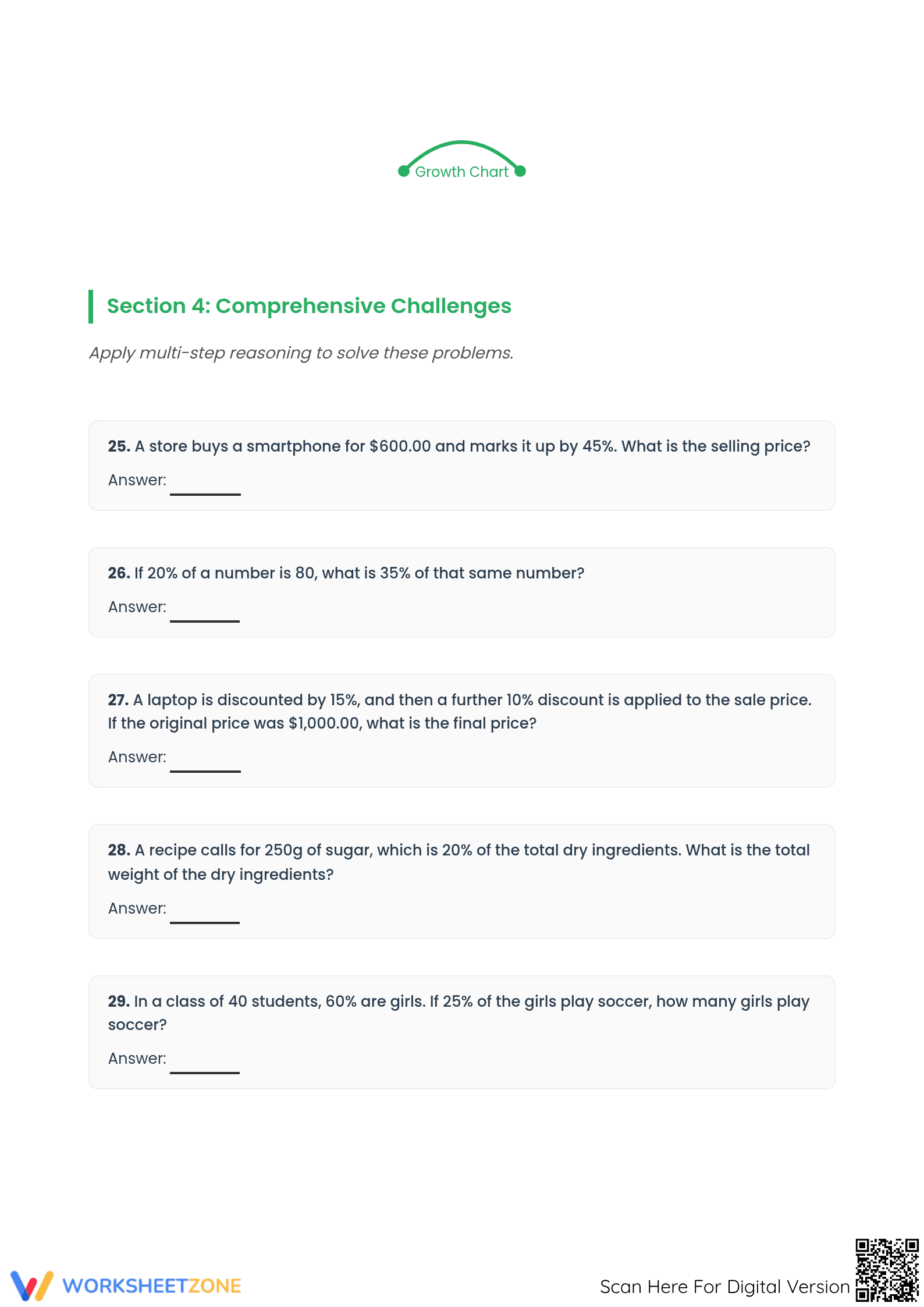
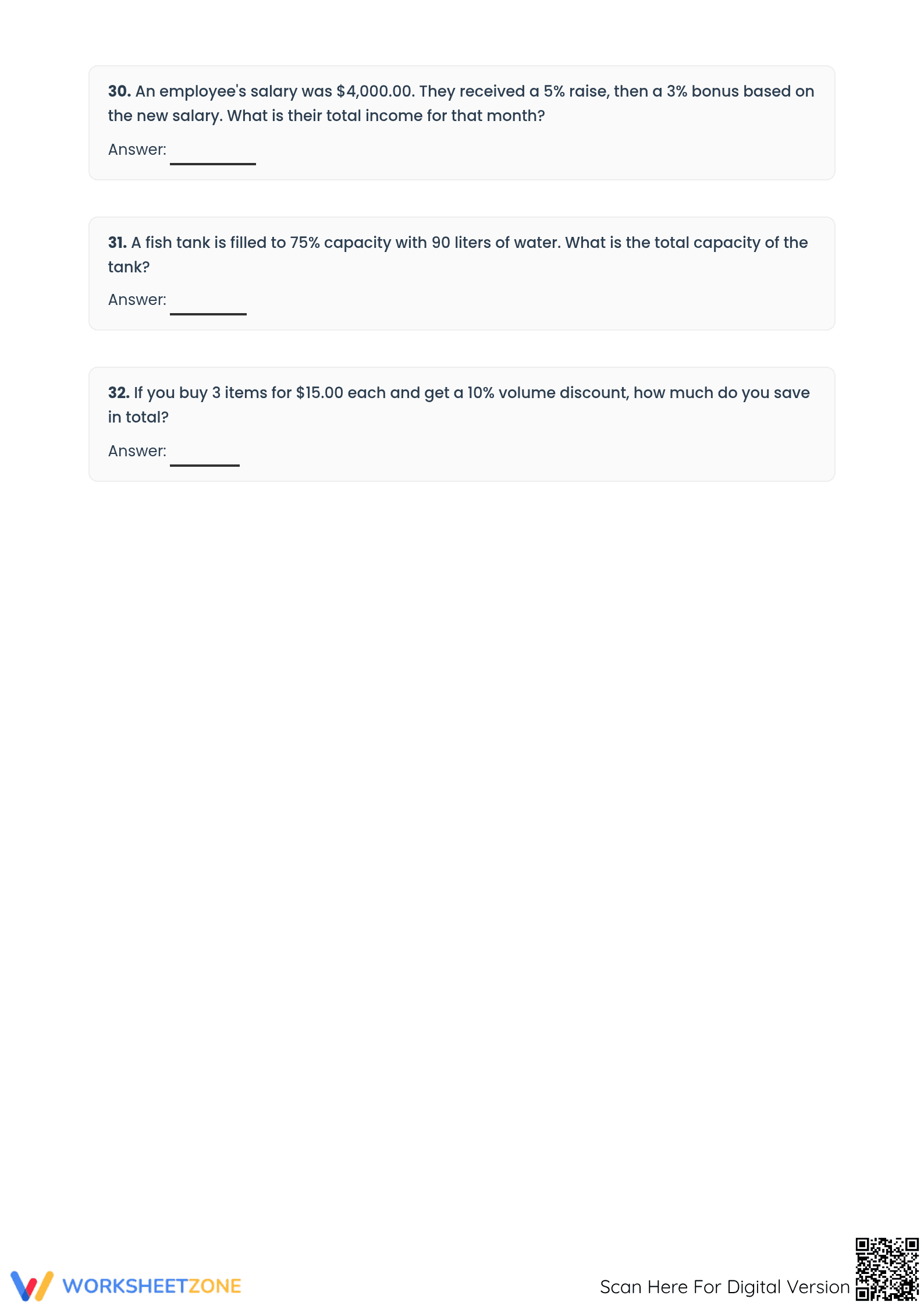
This 4-page collection features 32 distinct problems organized into four pedagogical sections. It includes 24 direct calculation tasks focused on finding the percent, the part, and the whole, followed by 8 high-level word problems. The resource provides dedicated workspace for each calculation and comes with a full answer key to facilitate rapid grading and student self-correction.
Each task in this resource maps directly to specific sub-skills required for proportional reasoning. The initial sections confirm student ability to manipulate the percent formula in isolation, while the final section tests the ability to apply these skills to markups, discounts, and multi-step scenarios. This tiered approach allows teachers to identify specific points of failure. Results can be recorded in gradebooks or used for IEP progress monitoring.
The primary focus is `CCSS.MATH.CONTENT.6.RP.A.3.C`: "Find a percent of a quantity as a rate per 100; solve problems involving finding the whole, given a part and the percent." This resource also supports Grade 7 standards regarding multi-step ratio and percent problems. Both standard codes can be copied directly into lesson plans, IEP goals, or district curriculum mapping tools.
Use this resource as a summative assessment after completing a unit on ratios and proportions. Alternatively, it serves as a robust homework packet to reinforce direct instruction. For a formative assessment tip, observe students as they transition to Section 3; students who struggle here likely need additional support identifying the "whole" in word-based prompts. Expect a 50-minute completion time.
This resource is designed for middle school students in grades 6 through 8 who are ready for advanced computation. It is particularly effective for students requiring extra practice with decimal-to-percent conversions. Pair this worksheet with an anchor chart on the "percent triangle" or a direct instruction lesson on financial literacy to maximize instructional impact and student retention.
This worksheet leverages the framework of CCSS.MATH.CONTENT.6.RP.A.3.C to ensure students build a robust understanding of ratios and proportional reasoning. By isolating the three core components of percentage calculations—finding the percent, finding the part, and finding the whole—it provides a structured pathway toward computational fluency. Research by Fisher & Frey (2014) emphasizes the importance of scaffolds in complex mathematical tasks, such as the multi-step word problems featured in the final section of this resource. These problems require students to synthesize their knowledge and apply it to authentic scenarios like markups, discounts, and population statistics. Such application is critical for moving beyond rote memorization toward deep conceptual mastery. Educators can use this 32-task collection to bridge the gap between initial instruction and independent application, ensuring that learners are equipped with the skills necessary for success in higher-level algebraic thinking and real-world financial literacy.


