


























Views
Downloads

Essential Percent Calculations Worksheet | Grades 5-8 Math
Paste this activity's link or code into your existing LMS (Google Classroom, Canvas, Teams, Schoology, Moodle, etc.).
Students can open and work on the activity right away, with no student login required.
You'll still be able to track student progress and results from your teacher account.
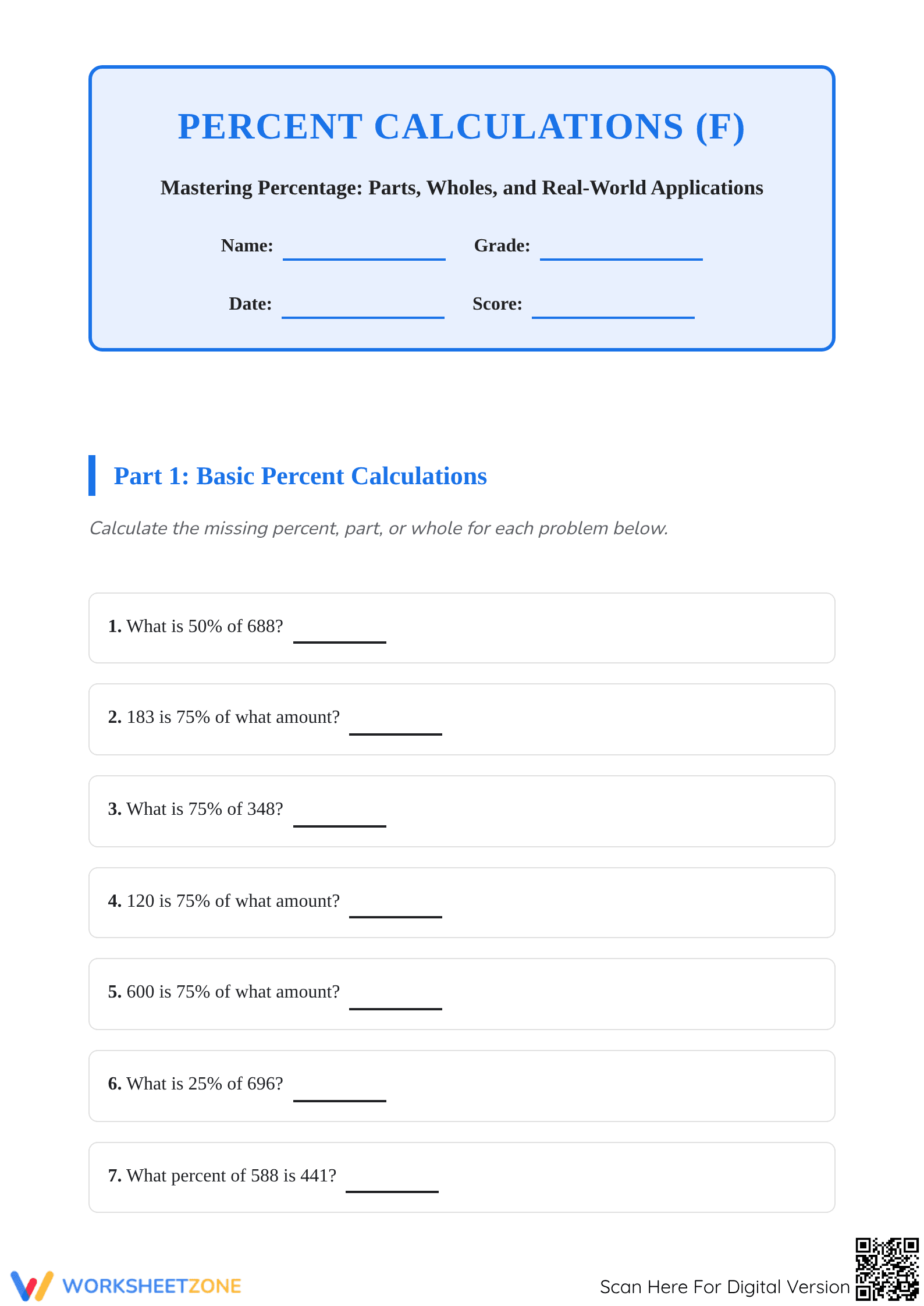
This comprehensive 5-page math worksheet provides a structured approach to mastering percentage calculations through a variety of problem types. Students will move from foundational arithmetic to complex real-world scenarios, ensuring they can identify and solve for missing percents, parts, or wholes in any context. It is designed to build procedural fluency and conceptual depth.
At a Glance
- Grade: 5–8 · Subject: Math · Decimals
- Standard:
CCSS.MATH.CONTENT.7.RP.A.3— Use proportional relationships to solve multistep ratio and percent problems- Skill Focus: Mixed percent operations and applications
- Format: 5 pages · 26 problems · Answer key included · PDF
- Best For: Independent practice or unit assessment
- Time: 45–60 minutes
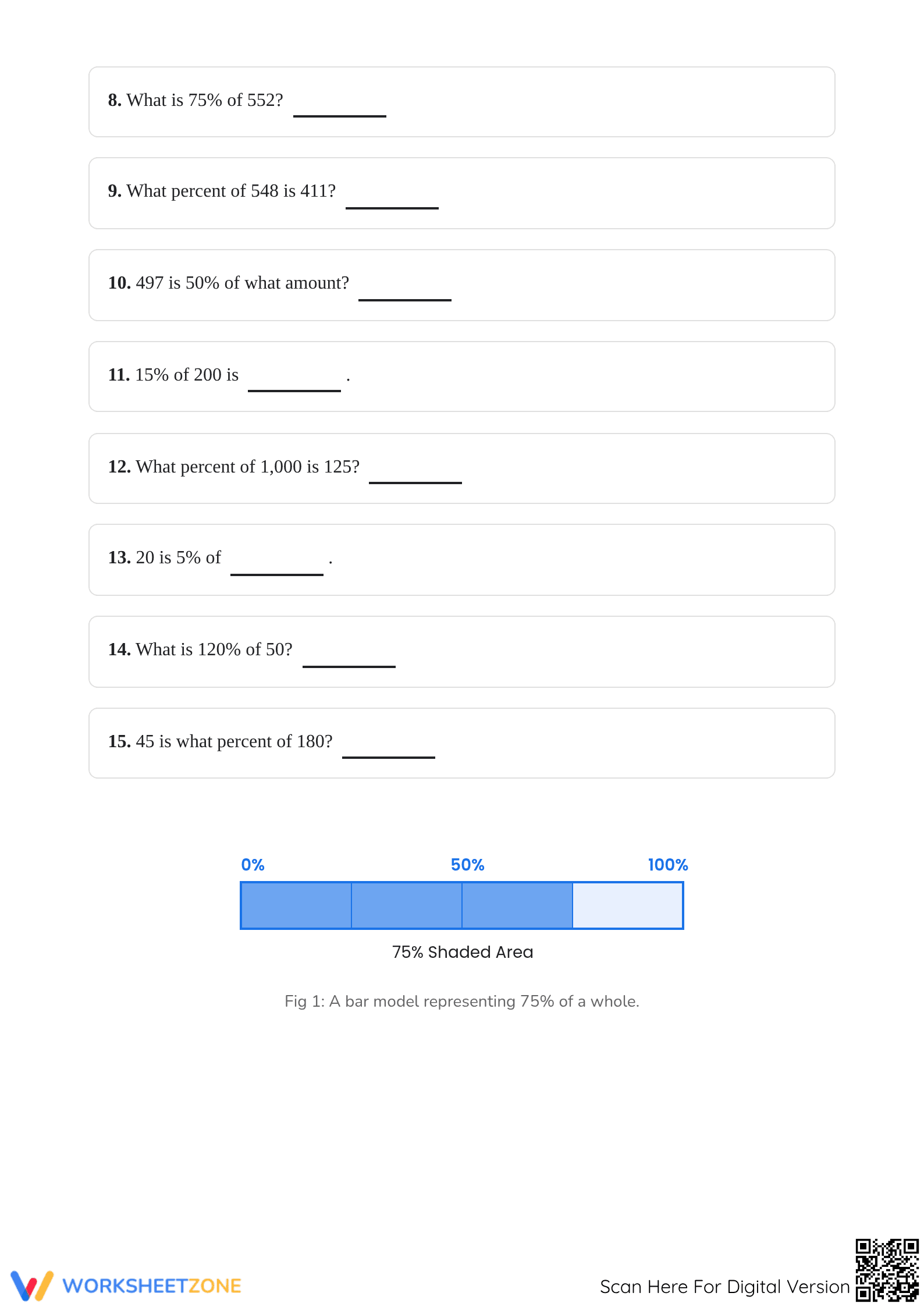
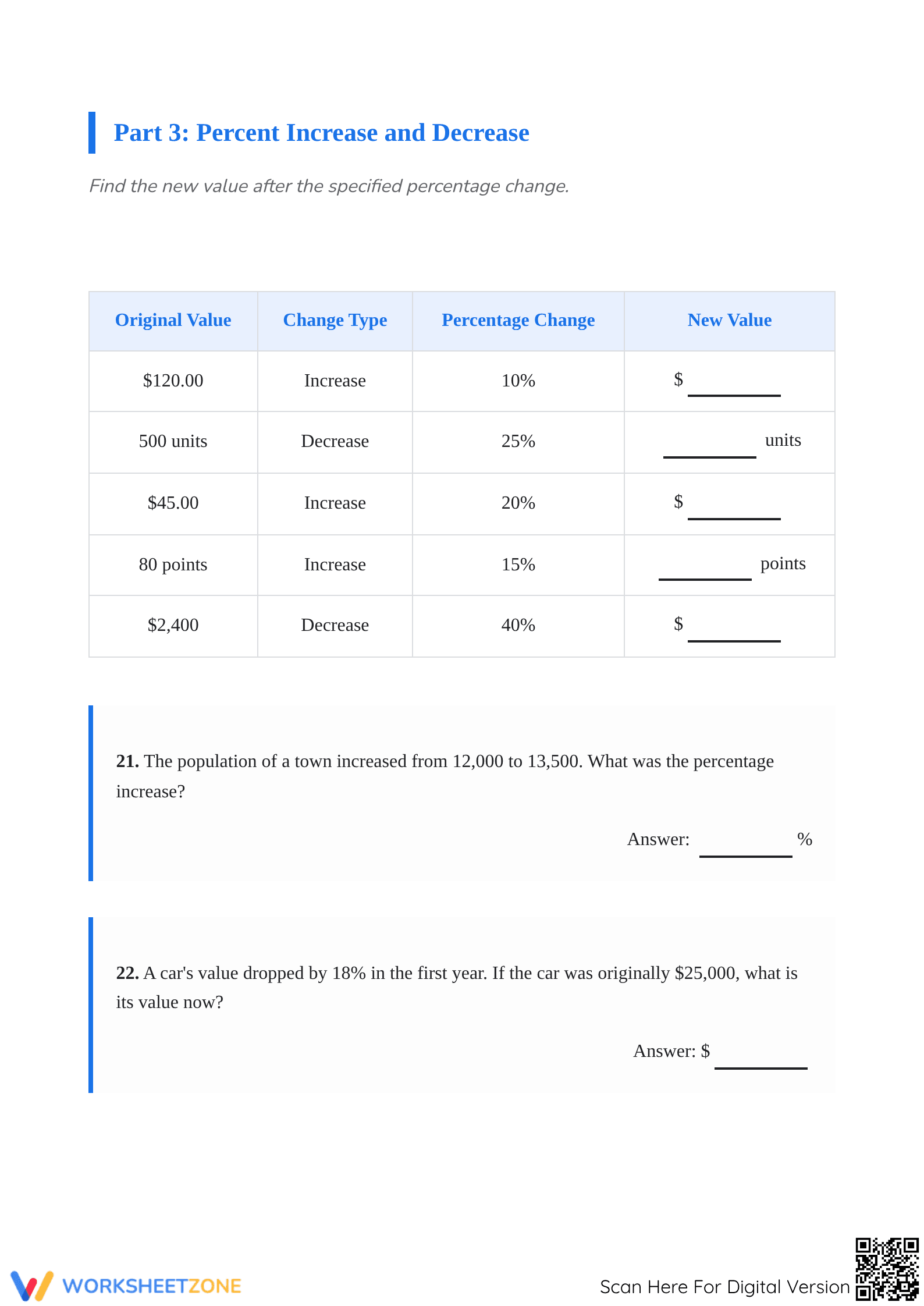
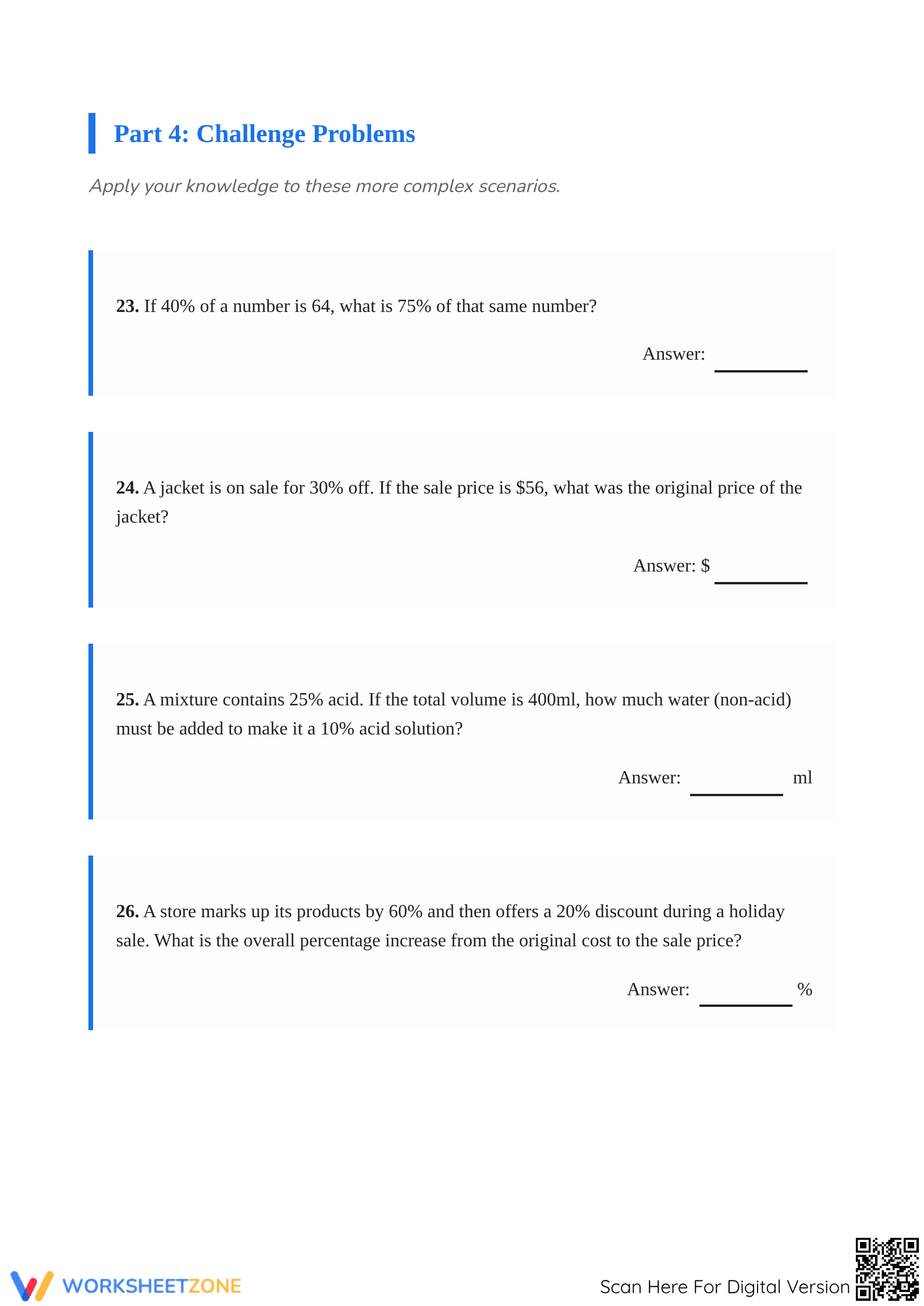
What's Inside: The packet features four distinct sections including 15 basic calculation drills, 5 word problems involving sales and tips, a detailed table for percent increase and decrease, and 4 high-level challenge problems. Visual aids like bar models are integrated to support student understanding of proportions. A full answer key ensures immediate feedback for learners.
Skill Progression
- Guided Practice: The first 15 tasks provide a clear template for finding the missing component of a percent equation, using simple integers to build confidence and accuracy in basic computation.
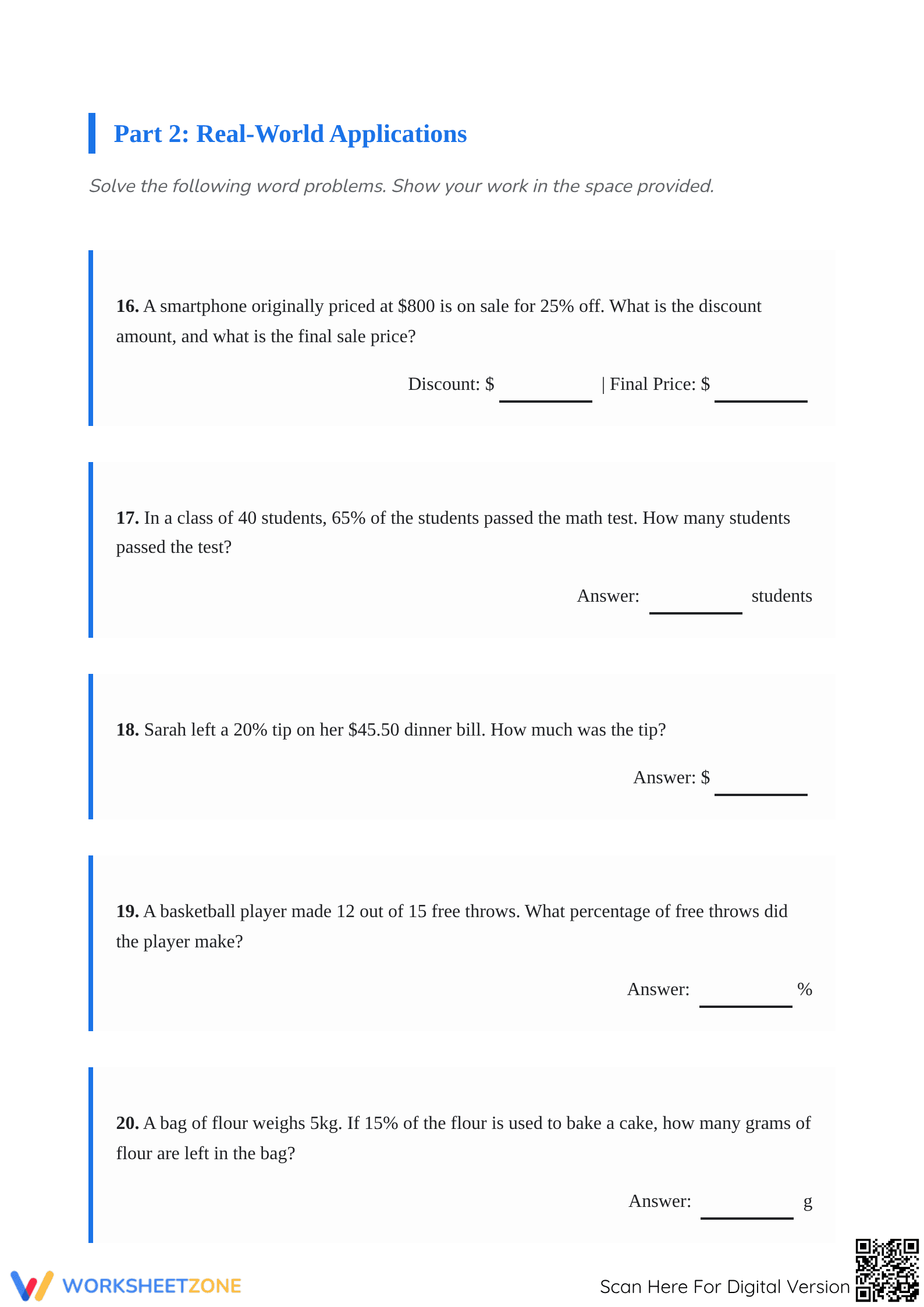
- Supported Practice: Five real-world word problems bridge the gap between abstract math and daily life, requiring students to translate text into solvable equations for discounts and service gratuities.
- Independent Practice: The final sections on percent change and the challenge problems demand higher-order thinking, as students must handle multi-step logic and varying units without scaffolding.
This sequence follows a gradual-release model, transitioning students from simple recognition to complex application across 26 unique items.
Standards Alignment
The primary focus is CCSS.MATH.CONTENT.7.RP.A.3: "Use proportional relationships to solve multistep ratio and percent problems." This includes markups, markdowns, and percent change. Additionally, it supports 6.RP.A.3.C by reinforcing the concept of percent as a rate per 100. Both standard codes can be copied directly into lesson plans, IEP goals, or district curriculum mapping tools.
How to Use It
Use this resource during the mid-point of a unit on proportions as a formative assessment to identify specific gaps in calculation logic. For a 50-minute block, assign the first two pages for direct practice and the remainder as a stretch goal. Teachers should observe whether students are correctly identifying the 'whole' in the word problems to ensure conceptual mastery.
Who It's For
This resource is ideal for middle school students in grades 5 through 8, particularly those requiring extra reinforcement with decimal-to-percent conversions. It serves as an excellent sub plan or a rigorous review for students preparing for state-level standardized testing. Pair this with a visual anchor chart on the 'is/of = %/100' formula for maximum impact.
According to the RAND AIRS 2024 report on mathematical literacy, student mastery of proportional reasoning is the strongest predictor of success in high school algebra. This worksheet targets that critical intersection by requiring students to move beyond rote memorization into the application of CCSS.MATH.CONTENT.7.RP.A.3. By presenting 26 problems that vary in linguistic complexity and mathematical depth, the resource aligns with the scaffolding recommendations found in Fisher & Frey (2014), which emphasize the necessity of diverse problem sets to ensure long-term retention. The inclusion of percent increase and decrease tasks specifically addresses a known area of student struggle identified by NAEP data. This ensures that the learner is not just calculating numbers but is developing the adaptive expertise required for higher mathematics and financial literacy. As a printable, zero-prep tool, it provides high-quality instructional material that maintains rigorous standards while reducing teacher workload.


