


























Views
Downloads
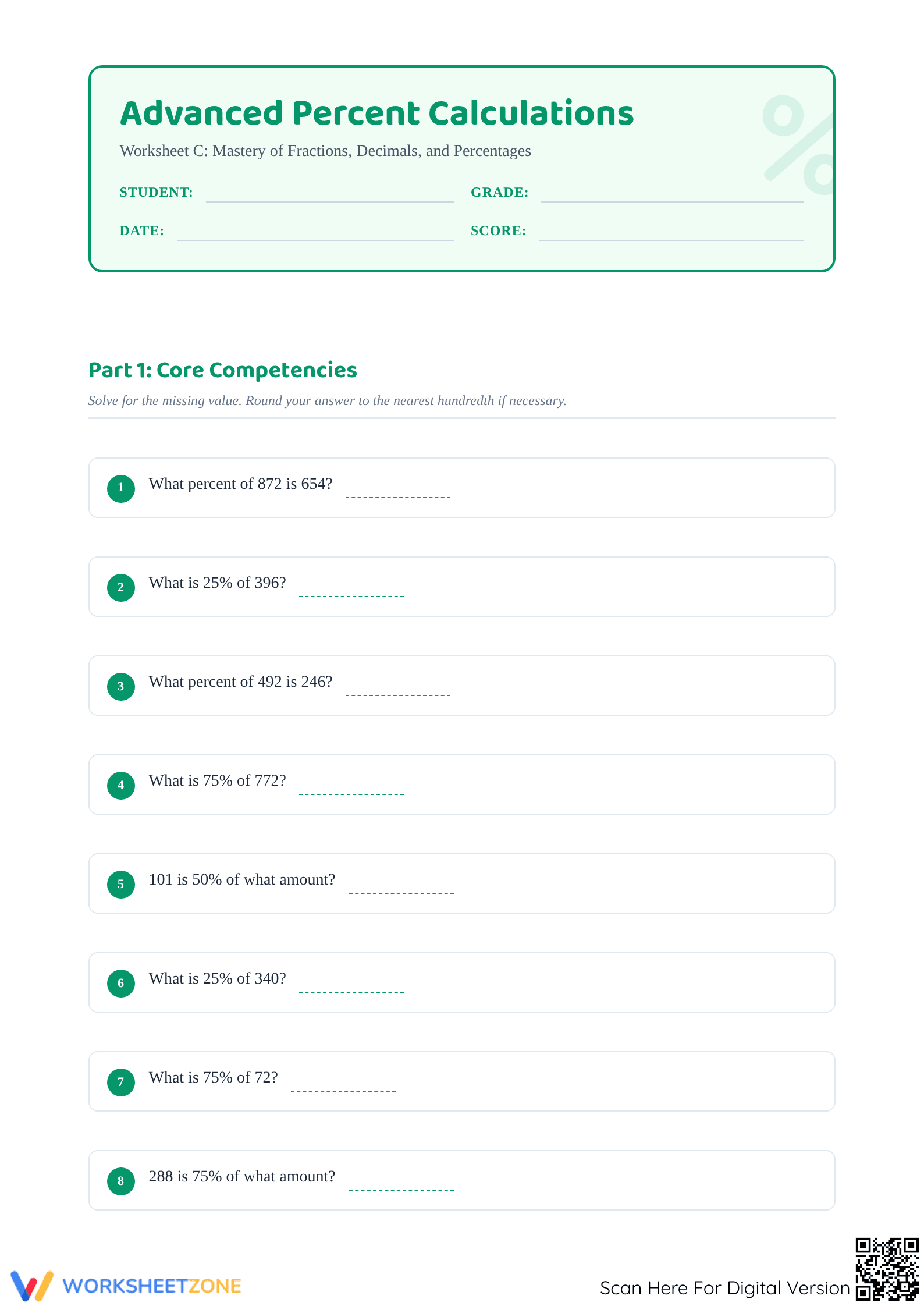
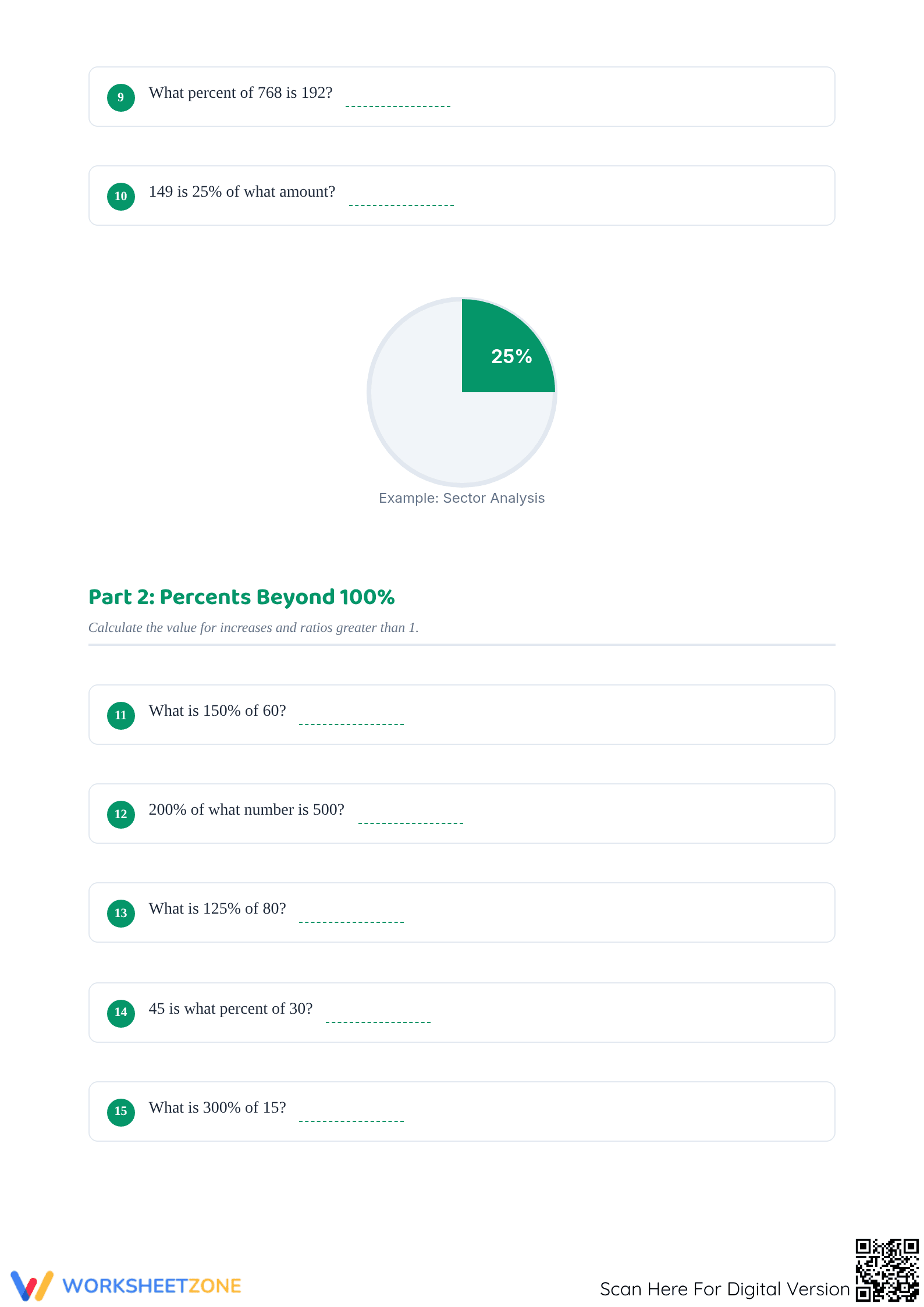
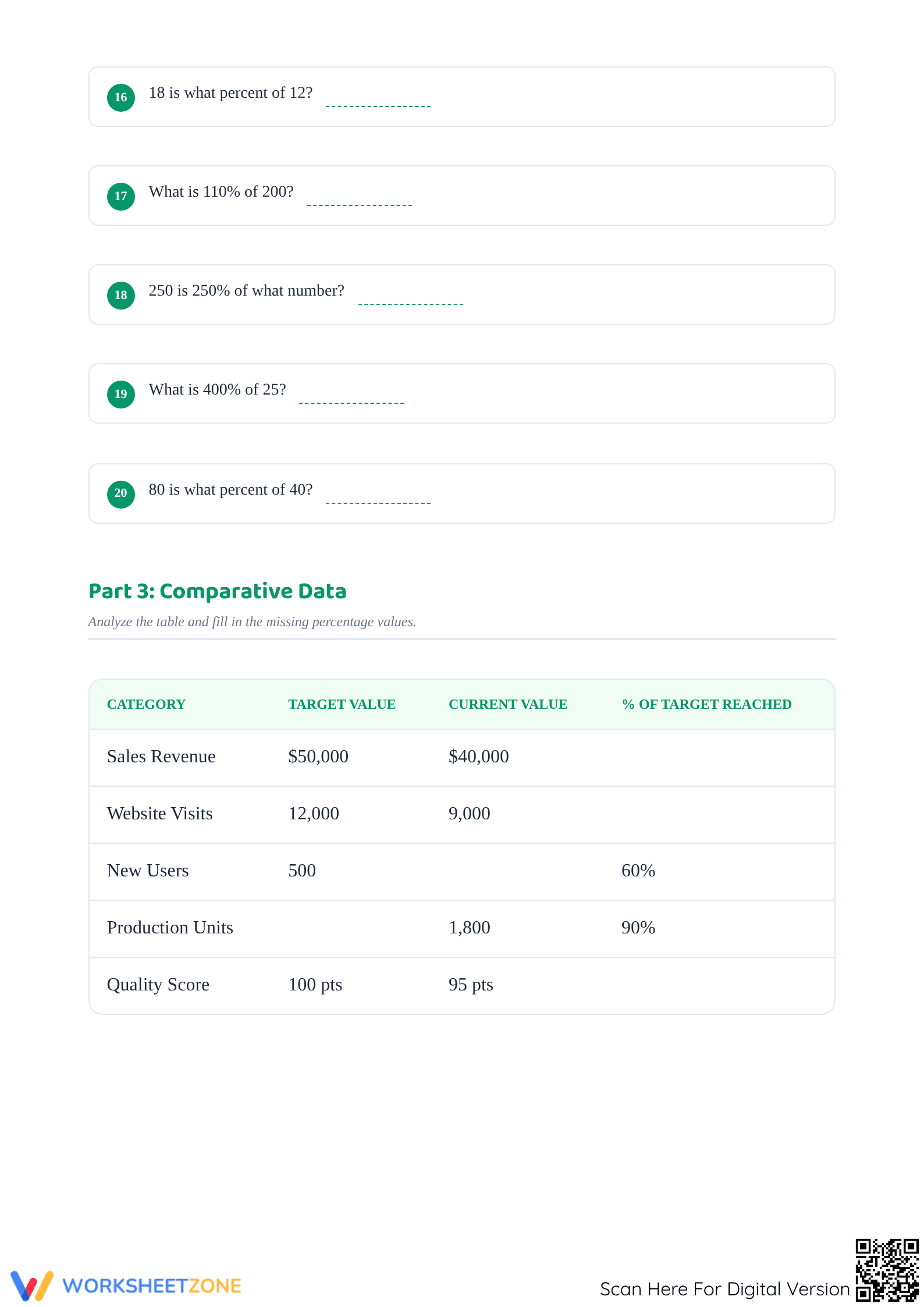
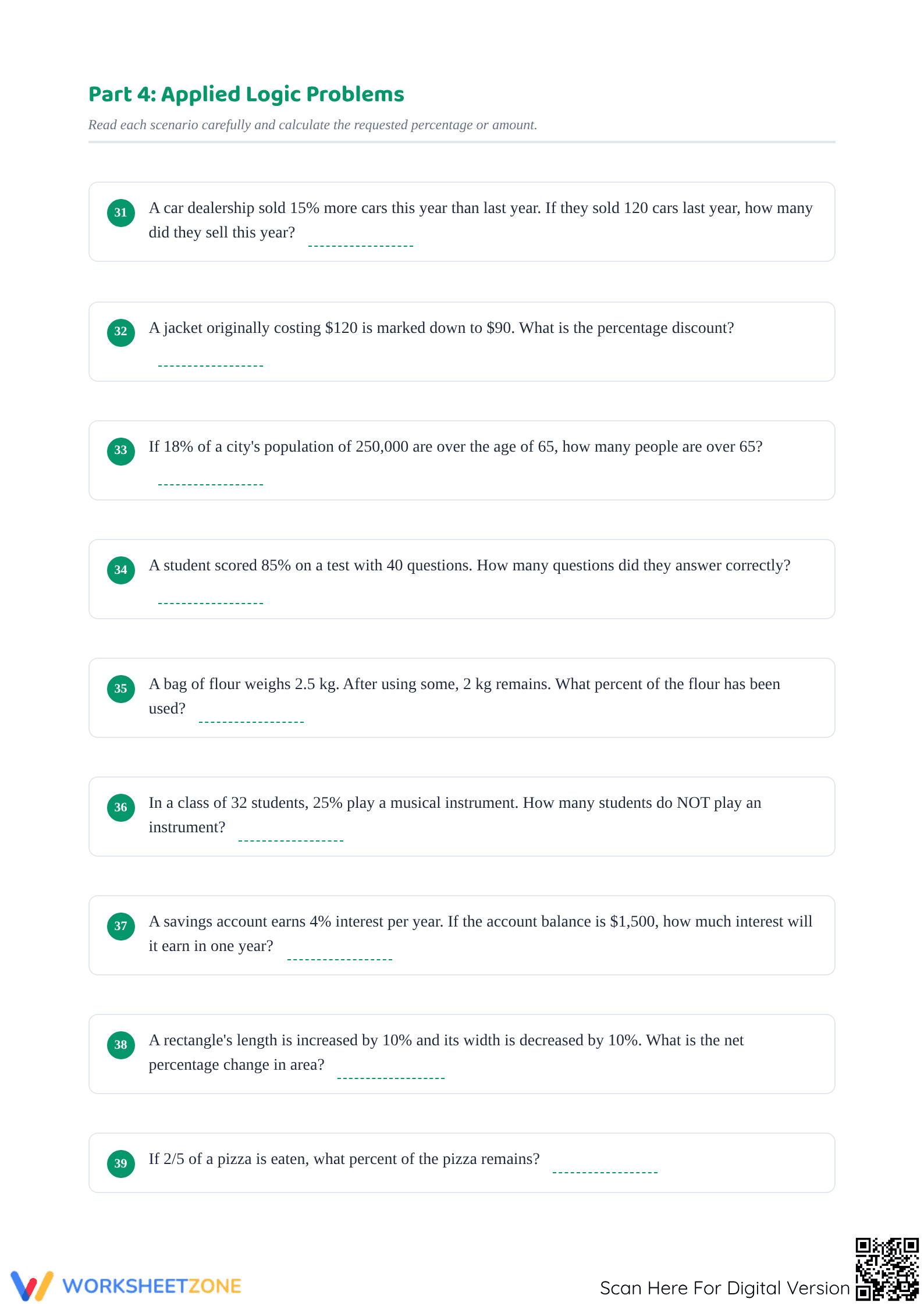


Advanced Percent Worksheet: Grade 7 CCSS.MATH.7.RP.A.3 Ready
Paste this activity's link or code into your existing LMS (Google Classroom, Canvas, Teams, Schoology, Moodle, etc.).
Students can open and work on the activity right away, with no student login required.
You'll still be able to track student progress and results from your teacher account.
Master complex percentage concepts with this comprehensive multi-page practice set. Designed to move students from basic computation to high-level data analysis, this resource ensures deep understanding of proportional relationships. Students will solve for missing values, calculate increases over one hundred percent, and apply their knowledge to challenging real-world logic scenarios with measurable accuracy.
At a Glance
- Grade: 7 · Subject: Math
- Standard:
CCSS.MATH.7.RP.A.3— Use proportional relationships to solve multistep ratio and percent problems- Skill Focus: Multi-step percent calculations
- Format: 5 pages · 40 problems · Answer key included · PDF
- Best For: Middle school mastery and assessment
- Time: 45–60 minutes
This five-page PDF features 40 targeted problems divided into four distinct sections. It begins with core competencies, moves into ratios greater than one, incorporates a comparative data table for analytical practice, and concludes with ten rigorous word problems. A full answer key is included to facilitate immediate feedback and student self-correction during independent work sessions.
Each task in this collection is specifically mapped to a sub-skill of the primary standard to provide clear evidence of mastery. Part 1 focuses on the mechanics of finding parts and wholes, while Part 2 challenges students with values exceeding 100%. Part 3 requires data interpretation, and Part 4 assesses logic applied to real-world financial changes. Educators can enter these scores directly into progress notes to track student growth toward benchmarks.
This resource is aligned with `CCSS.MATH.7.RP.A.3`, which requires students to use proportional relationships to solve multistep ratio and percent problems, including those involving simple interest, tax, and markups. The inclusion of percent increase and decrease problems also supports foundational work for `CCSS.MATH.7.EE.B.3`. Both standard codes can be copied directly into lesson plans, IEP goals, or district curriculum mapping tools.
Use this worksheet as a summative assessment following a unit on ratios and proportions or as a guided review during direct instruction. One effective strategy is to have students complete the comparative data table in pairs to observe how they handle multi-step calculations in a collaborative setting. Expect students to spend approximately 50 minutes completing the full 40-problem set.
This material is ideal for seventh-grade students ready for advanced percentage applications or eighth-graders requiring a rigorous refresher. It pairs naturally with an anchor chart on the percent proportion or a direct instruction lesson on financial literacy. The structured format allows for easy differentiation by assigning specific sections based on current student performance levels.
According to the NAEP 2024 mathematics framework, the ability to solve complex percentage problems is a critical indicator of readiness for algebraic reasoning in later middle school grades. This CCSS.MATH.7.RP.A.3 worksheet provides the rigorous practice needed to bridge the gap between computation and real-world application. By requiring students to calculate percents beyond 100% and analyze comparative data sets, the material reinforces the concept of proportionality as a fundamental mathematical relationship. Research from ScienceDirect TpT Analysis suggests that worksheets focusing on multi-step logic problems significantly improve student retention of percentage concepts compared to repetitive drill-style exercises. The structured sections of this resource allow educators to pinpoint specific areas of struggle, whether in finding the whole from a part or applying interest rates to financial scenarios. This comprehensive approach ensures that students develop a versatile skill set, enabling them to interpret and manipulate quantitative data with accuracy in diverse academic contexts.


