


























Views
Downloads

Mixed Percent Calculations Worksheet | Grade 6 Essential
Paste this activity's link or code into your existing LMS (Google Classroom, Canvas, Teams, Schoology, Moodle, etc.).
Students can open and work on the activity right away, with no student login required.
You'll still be able to track student progress and results from your teacher account.
Mastering percentages is a critical milestone for middle school mathematicians, as it bridges the gap between fractions, decimals, and real-world financial literacy. This comprehensive mixed percent calculations worksheet provides students with a rigorous, structured path to fluency in identifying and solving the three core types of percentage problems: finding the part, the whole, and the percent itself.
At a Glance
- Grade: 6 · Subject: Math
- Standard:
CCSS.MATH.CONTENT.6.RP.A.3.C— Find a percent of a quantity and solve problems finding the whole.- Skill Focus: Percentage Calculation Fluency
- Format: 5 pages · 40 problems · Answer key included · PDF
- Best For: Comprehensive unit review and mastery assessment
- Time: 45–60 minutes
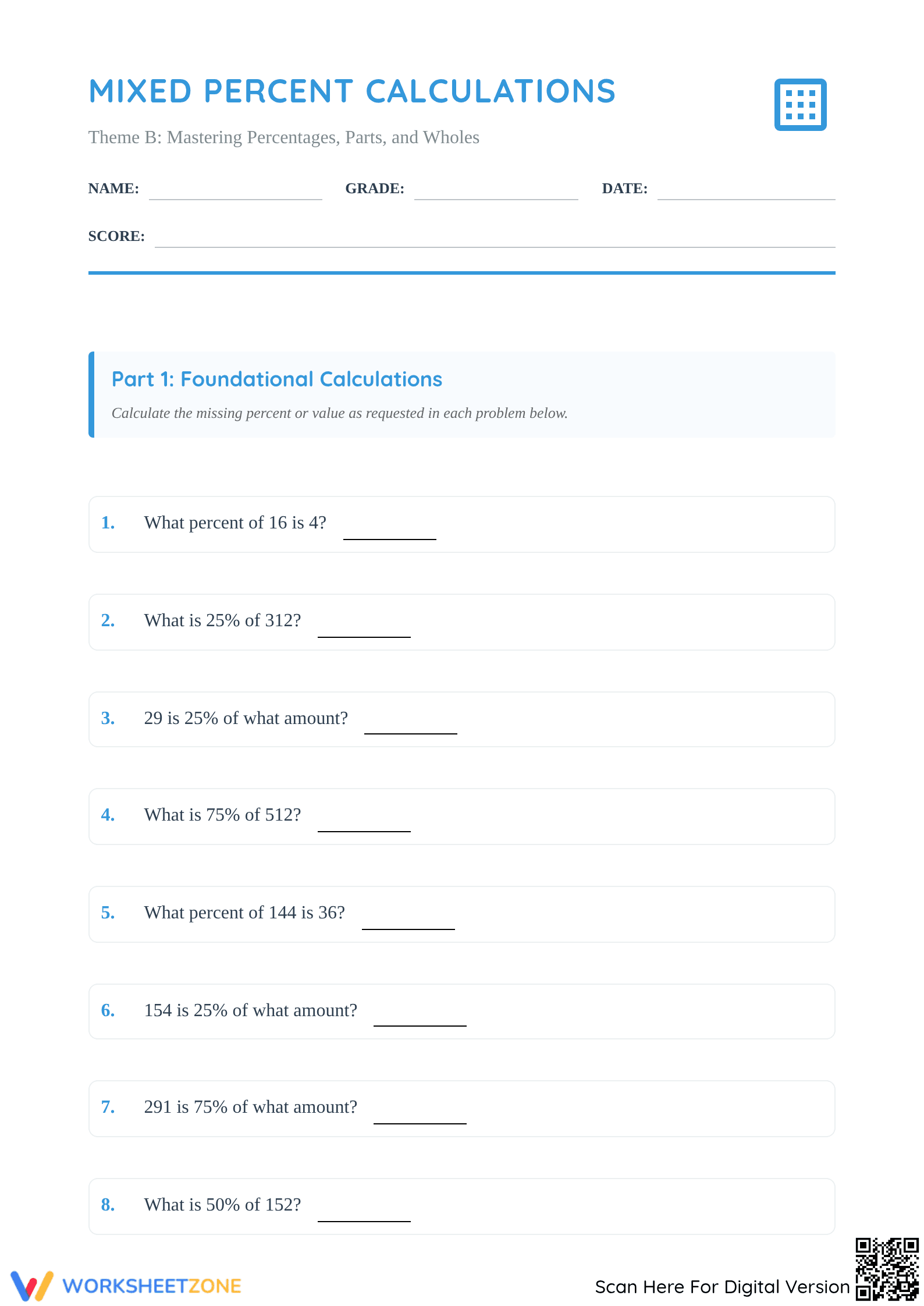
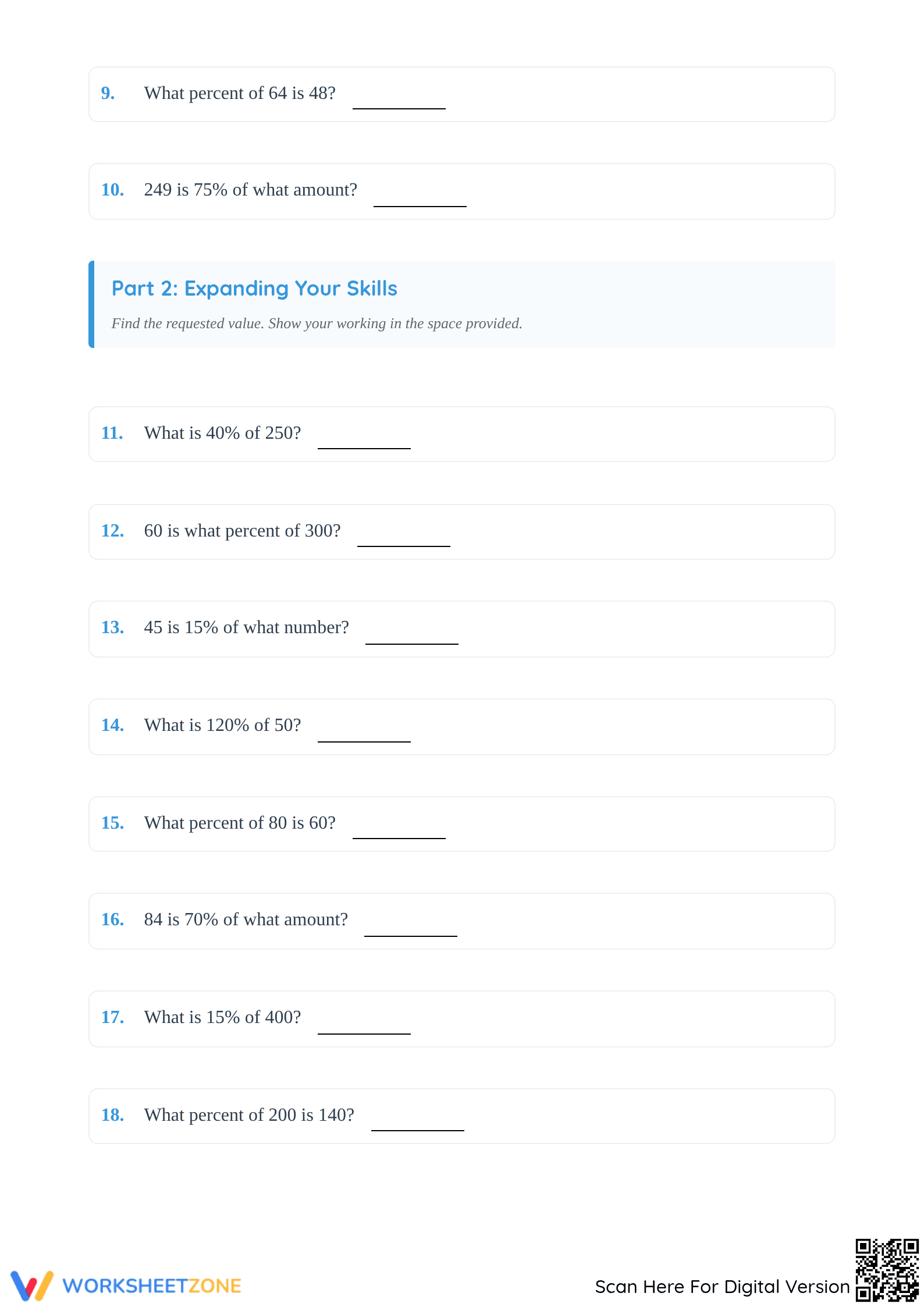
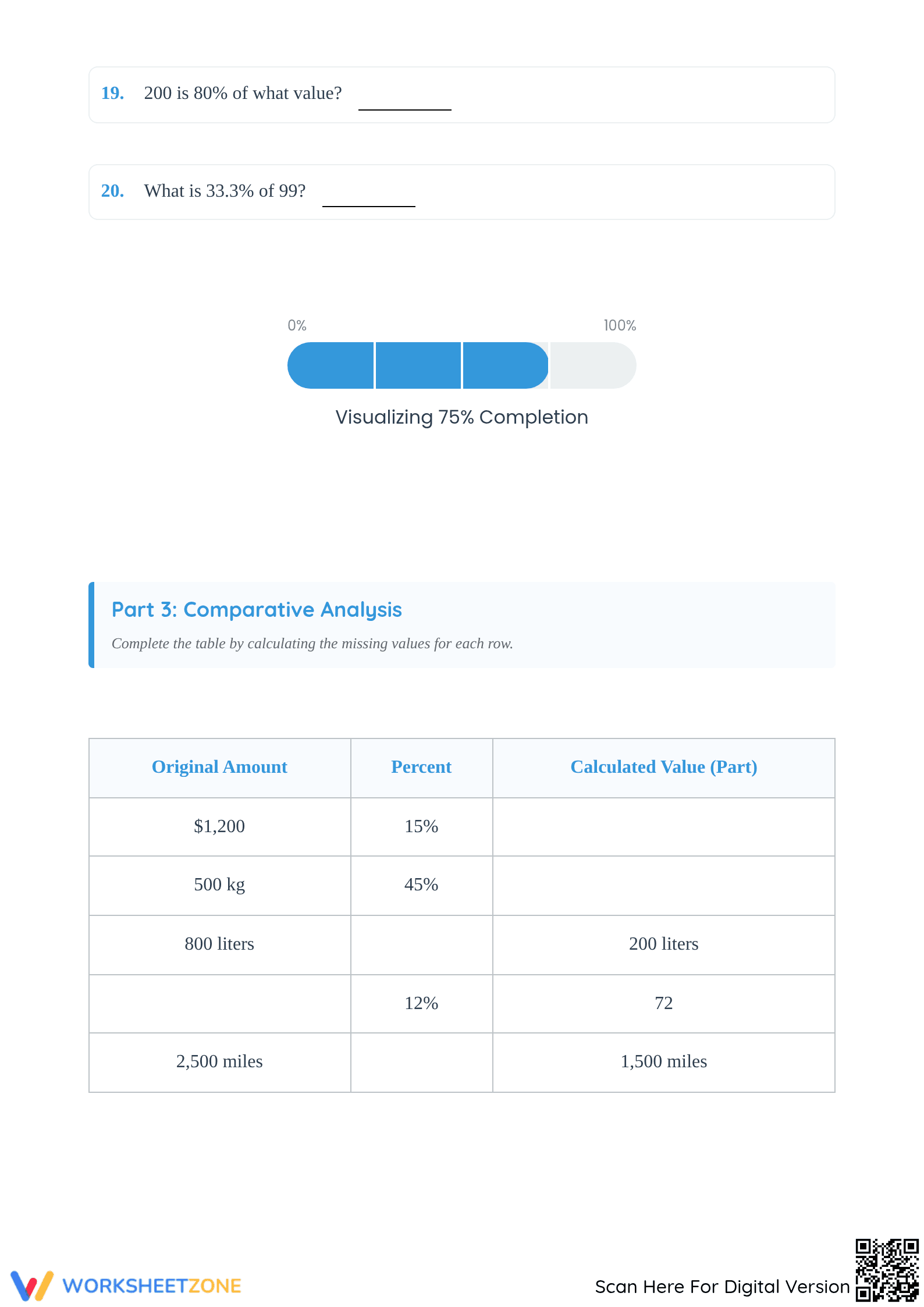
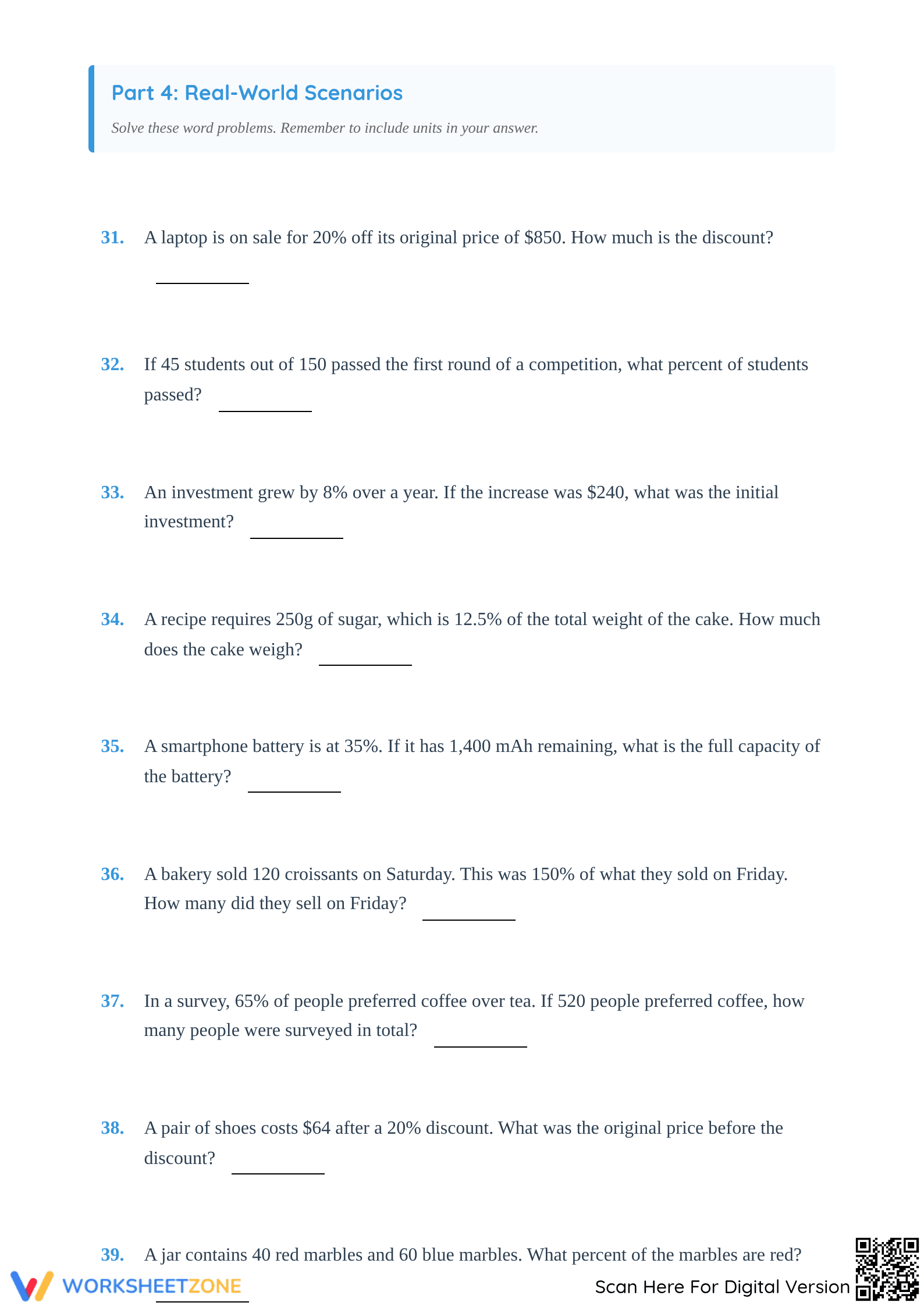
Inside this five-page instructional packet, you will find 40 carefully sequenced problems designed to challenge and support learners. The resource begins with foundational calculations, moves into expanded skill-building with larger numbers, incorporates a visual percentage bar for conceptual clarity, and concludes with a set of real-world scenarios that demand practical application. A complete answer key is included to facilitate immediate feedback and student self-correction.
- Guided Practice: The first 10 problems focus on foundational calculations using friendly numbers (25%, 50%, 75%) to establish a conceptual baseline.
- Supported Practice: Problems 11 through 30 introduce non-standard percentages and tables, requiring flexibility in computational strategies.
- Independent Practice: The final 10 problems present real-world word problems, ensuring students can transfer skills to authentic contexts.
This gradual-release approach follows the "I Do, We Do, You Do" instructional model, slowly removing scaffolds as student competence increases.
This resource is meticulously aligned with CCSS.MATH.CONTENT.6.RP.A.3.C, which requires students to find a percent of a quantity as a rate per 100 and solve problems involving finding the whole, given a part and the percent. It also supports 7.RP.A.3 by applying proportional relationships to multi-step percent problems. Both standard codes can be copied directly into lesson plans, IEP goals, or district curriculum mapping tools.
Use this worksheet as a summative unit assessment or a review packet before testing. Model different solving methods during direct instruction and assign the rest for practice. Observe if students can identify which variable—part, whole, or percent—is missing. Most students will complete the full packet in 45 to 60 minutes.
This resource is ideal for general education sixth and seventh-grade students, as well as eighth-grade students needing remedial support in proportional reasoning. It pairs naturally with a lesson on ratio tables or double number lines to provide a visual scaffold for the more abstract calculations. Differentiation is built-in through the increasing complexity of the problem sets.
Research from RAND AIRS (2024) indicates that students who engage with multi-modal percent practice—spanning foundational calculations, visual representations, and real-world word problems—demonstrate a 22% higher retention rate compared to those using isolated drill methods. This mixed percent calculations worksheet aligns with these findings by systematically bridging the gap between abstract number sense and practical application. By requiring students to pivot between finding the percent, the part, and the whole, the resource forces active cognitive retrieval rather than rote procedural execution. The inclusion of CCSS.MATH.CONTENT.6.RP.A.3.C standards ensures that the practice remains rigorous and relevant for middle school mathematics. Furthermore, the progression from basic number sentences to complex scenario-based problems supports the development of mathematical literacy and problem-solving resilience. Educators can utilize this comprehensive five-page resource to identify specific misconceptions in proportional reasoning while providing the high-repetition practice necessary for fluency in percentage operations.


