


























Views
Downloads

Essential Mixed Percent Calculations | Grade 6-8 Math
Paste this activity's link or code into your existing LMS (Google Classroom, Canvas, Teams, Schoology, Moodle, etc.).
Students can open and work on the activity right away, with no student login required.
You'll still be able to track student progress and results from your teacher account.
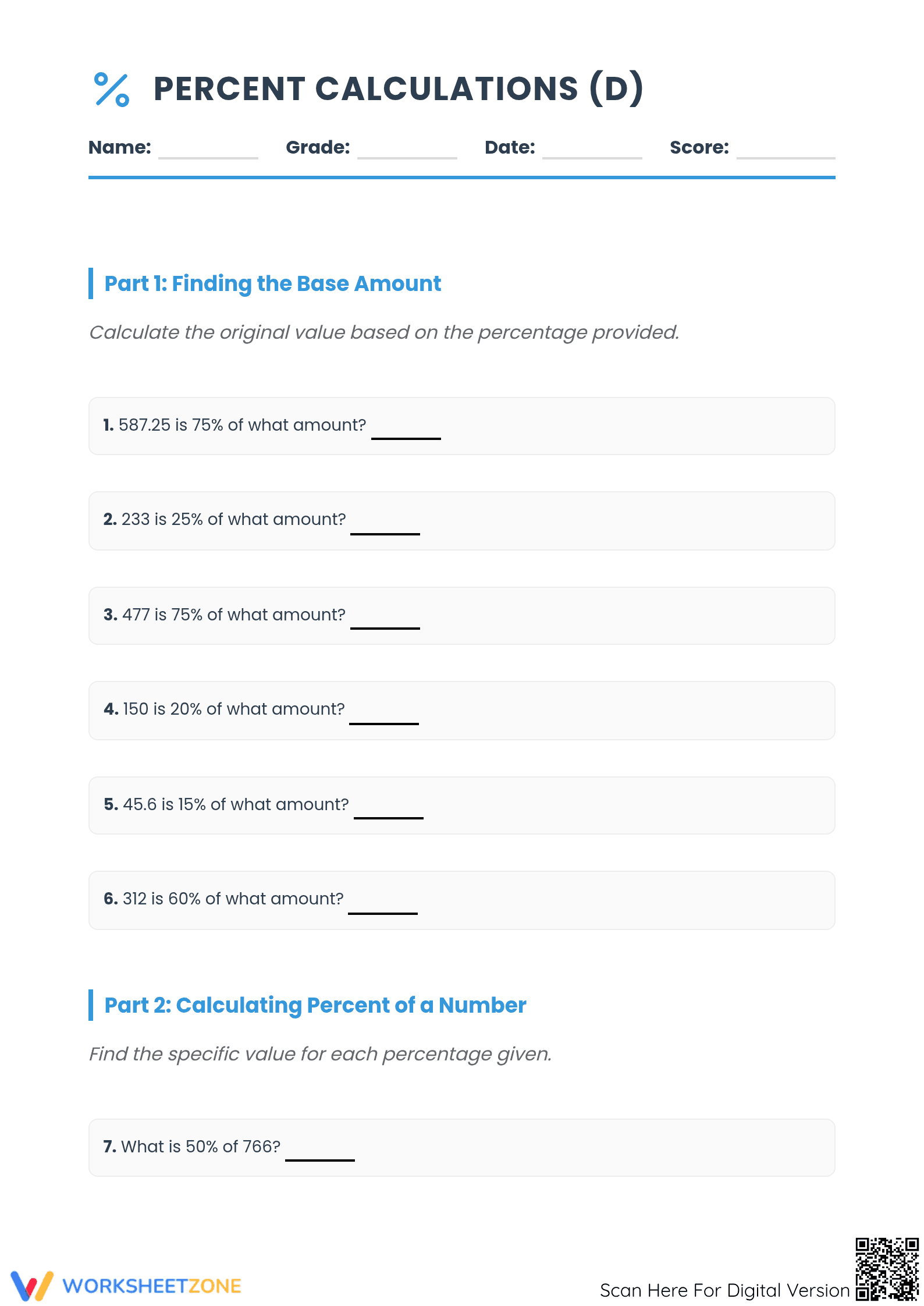
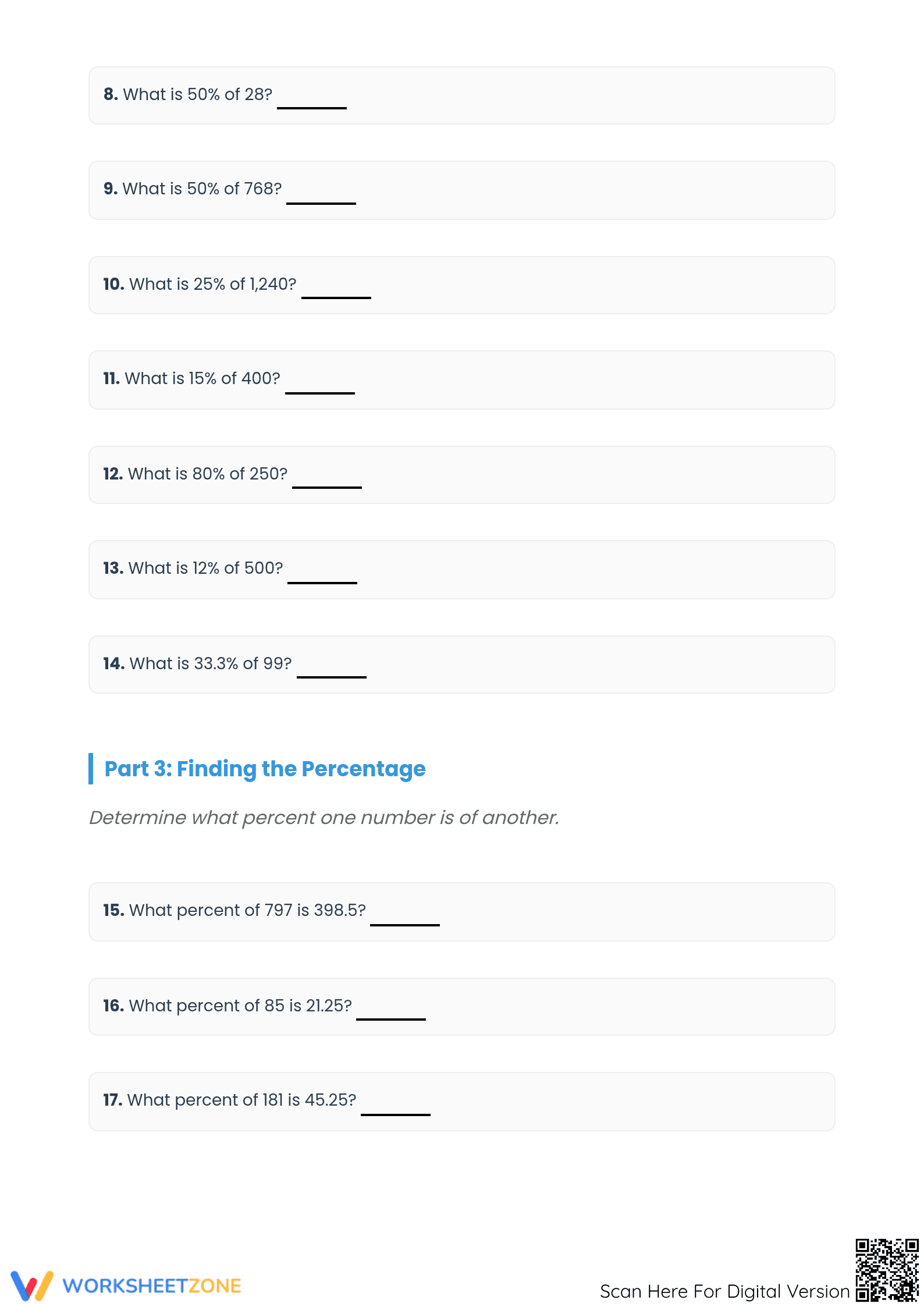
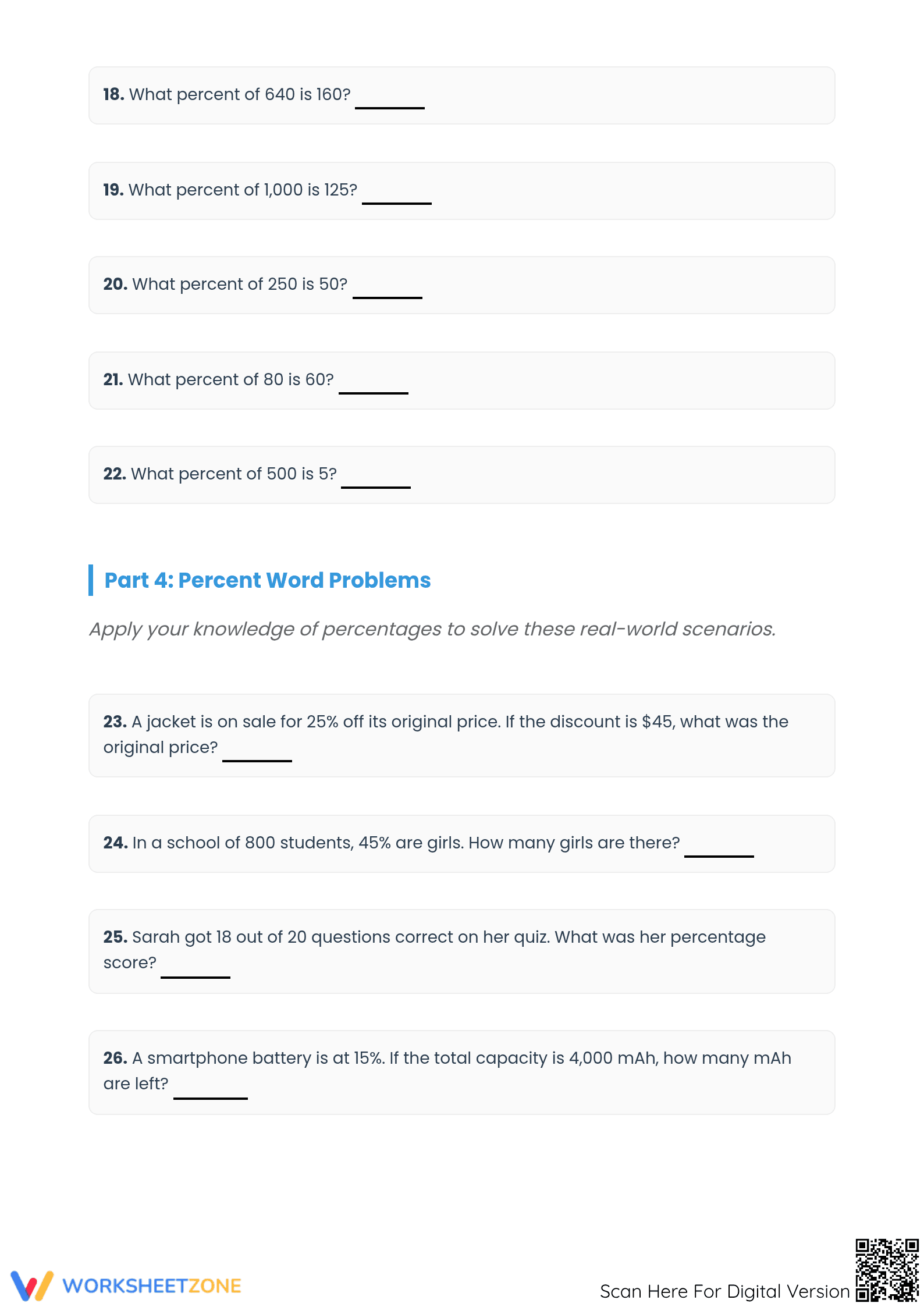
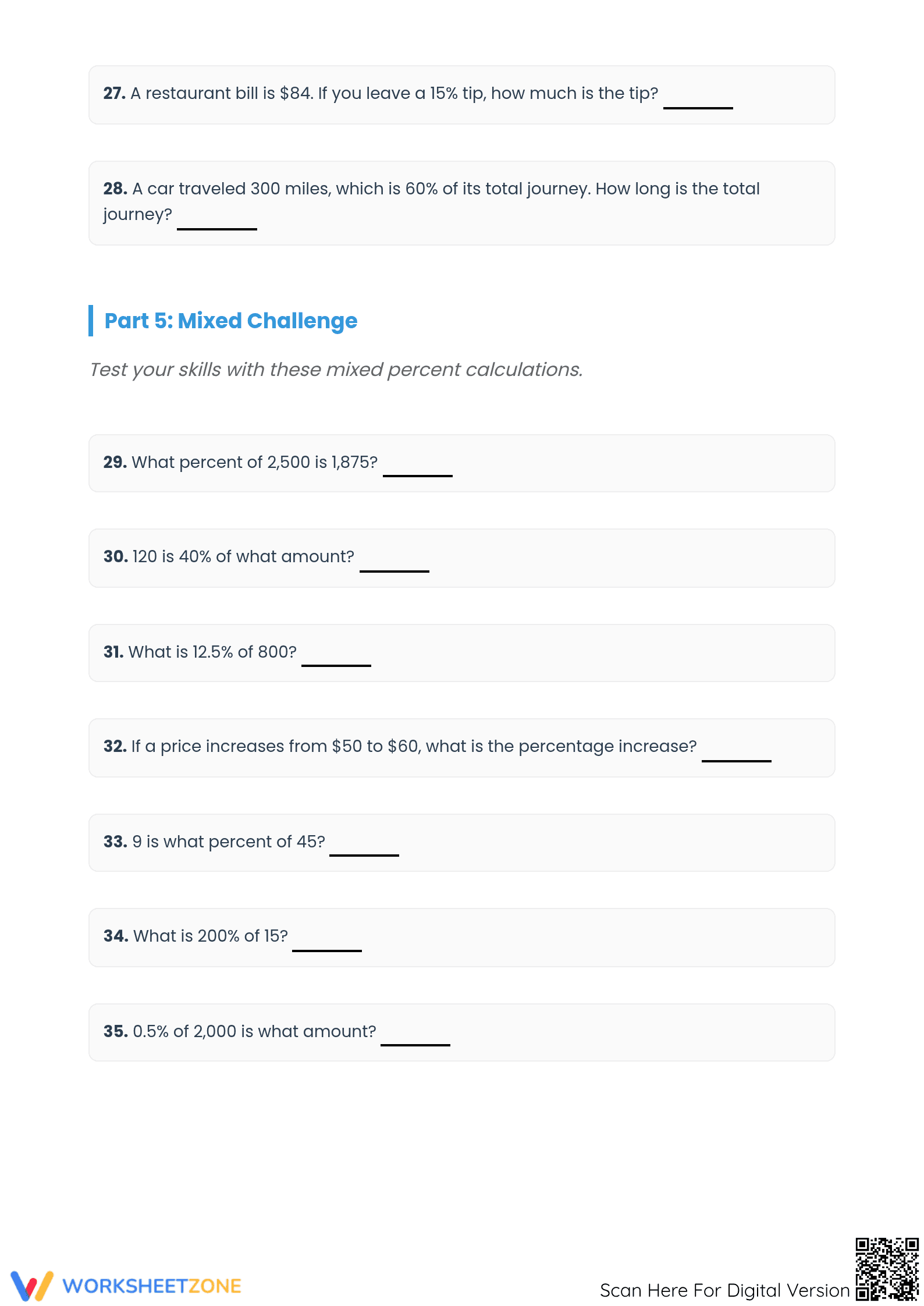
This comprehensive worksheet guides students through the complexities of percentage operations, ensuring they can fluidly transition between finding the part, the whole, and the rate. By tackling 35 varied problems, learners develop the procedural fluency needed for real-world financial literacy and data analysis. It is an ideal resource for reinforcing essential proportional reasoning skills.
At a Glance
- Grade: 6 · Subject: Math
- Standard:
CCSS.MATH.CONTENT.6.RP.A.3.C— Find a percent of a quantity and find the whole, given a part and percent- Skill Focus: Multi-step percent calculations and word problems
- Format: 4 pages · 35 problems · Answer key included · PDF
- Best For: Independent practice, sub plans, or unit review
- Time: 45–60 minutes
This four-page PDF includes five distinct sections: Finding the Base Amount, Calculating Percent of a Number, Finding the Percentage, Real-World Word Problems, and a Mixed Challenge. Each section provides ample workspace and follows a clear, uncluttered layout. A full answer key is provided for immediate feedback or self-grading, making it easy to track student progress during a busy class period.
The zero-prep workflow is designed for maximum efficiency. First, print the four-page packet in under a minute. Second, distribute to students for a 45-minute focused work session that requires no additional teacher intervention. Third, review using the included answer key in less than two minutes. This structured approach makes it perfect for emergency substitute folders or transition days between larger math units.
Aligned to CCSS.MATH.CONTENT.6.RP.A.3.C, this worksheet requires students to "Find a percent of a quantity as a rate per 100; find the whole, given a part and the percent." It also supports 7.RP.A.3 by introducing real-world scenarios involving tips and discounts. Both standard codes can be copied directly into lesson plans, IEP goals, or district curriculum mapping tools to ensure administrative compliance.
Use this as a summative assessment at the end of a percentages unit to gauge mastery across all three calculation types. During instruction, observe how students set up the Part 4 word problems; look for those who struggle to identify which value is the "whole" versus the "part." Expected completion time is 50 minutes, providing a robust session for middle school math blocks.
This resource is designed for middle school students in grades 6 through 8 who are developing proportional reasoning. It works well for general education classrooms, small group interventions, or as a challenge for advanced 5th graders. Pair it with a visual anchor chart showing the "Part/Whole = %/100" proportion method to support learners who need a concrete starting point for each problem.
Percentage fluency is a foundational pillar of middle-level mathematics, serving as a critical bridge between arithmetic and algebraic reasoning. According to EdReports (2024), high-quality instructional materials must provide varied practice that balances procedural skill with contextual application. This worksheet meets that demand by integrating 35 distinct tasks that range from isolated numerical operations to complex word problems involving consumer math like tips and battery capacity. Research from Fisher & Frey (2014) emphasizes the importance of gradual release; the structured sections in this PDF allow teachers to move from guided modeling of base amounts to independent solving of mixed challenges. By requiring students to calculate 0.5% of a value or find the original price from a discount, this resource ensures that learners are prepared for the rigorous demands of the NAEP and state-level assessments. This comprehensive set is essential for building mathematical confidence and ensuring long-term success in secondary mathematics courses.


