


























Views
Downloads

Printable Mixed Percent Calculations Worksheet | Grades 5-8
Paste this activity's link or code into your existing LMS (Google Classroom, Canvas, Teams, Schoology, Moodle, etc.).
Students can open and work on the activity right away, with no student login required.
You'll still be able to track student progress and results from your teacher account.
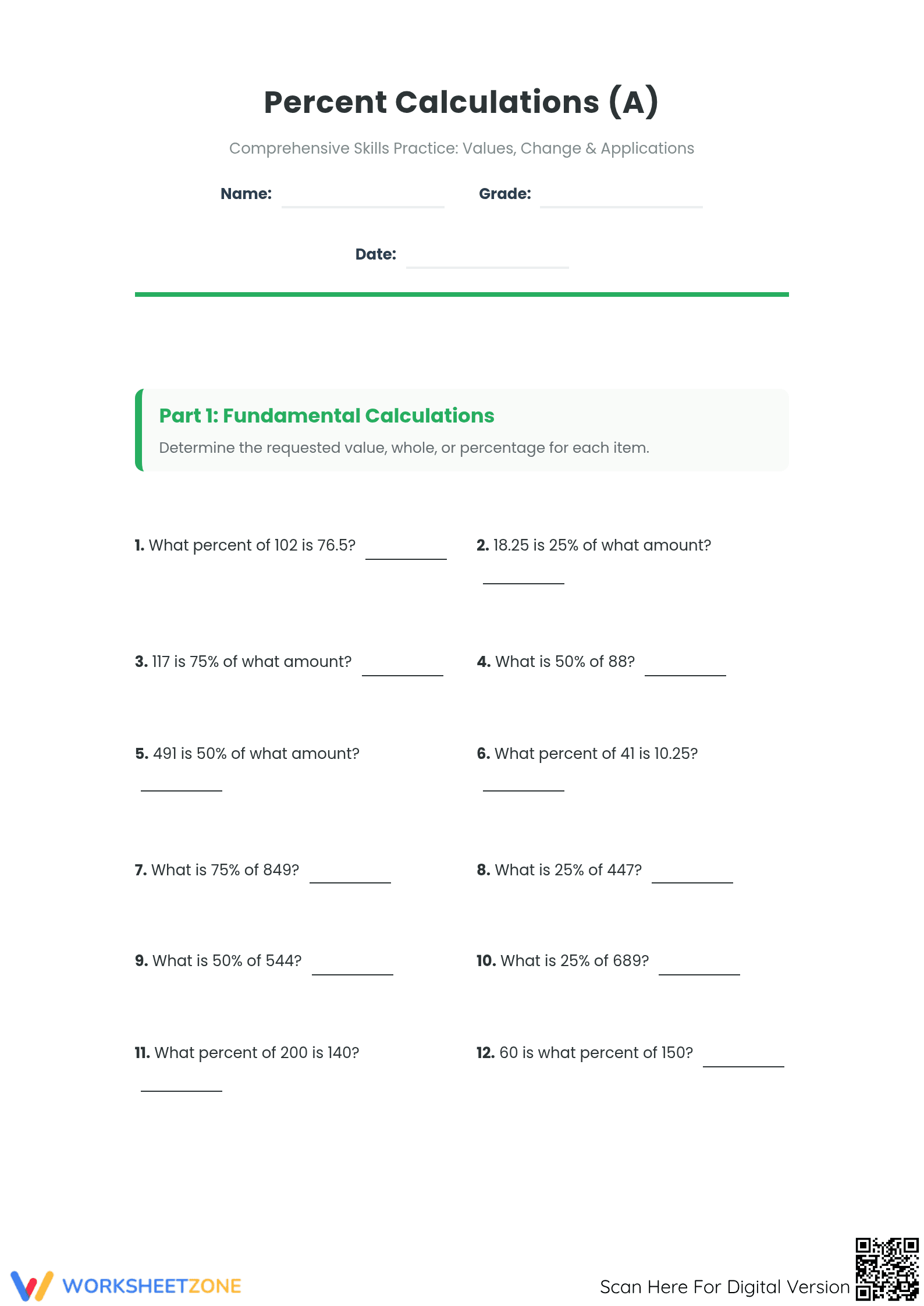
Solve complex percentage problems with confidence using this comprehensive 5-page practice set. Students will master finding values, calculating percentage of change, and applying math to real-world shopping scenarios involving tax and discounts. This worksheet provides a structured path from fundamental concepts to multi-step word problems, ensuring deep conceptual understanding and procedural fluency.
At a Glance
- Grade: 5–8 · Subject: Math
- Standard:
7.RP.A.3— Use proportional relationships to solve multi-step ratio and percent problems- Skill Focus: Mixed percent calculations and applications
- Format: 5 pages · 30 problems · Answer key included · PDF
- Best For: Independent practice or unit review
- Time: 45–60 minutes
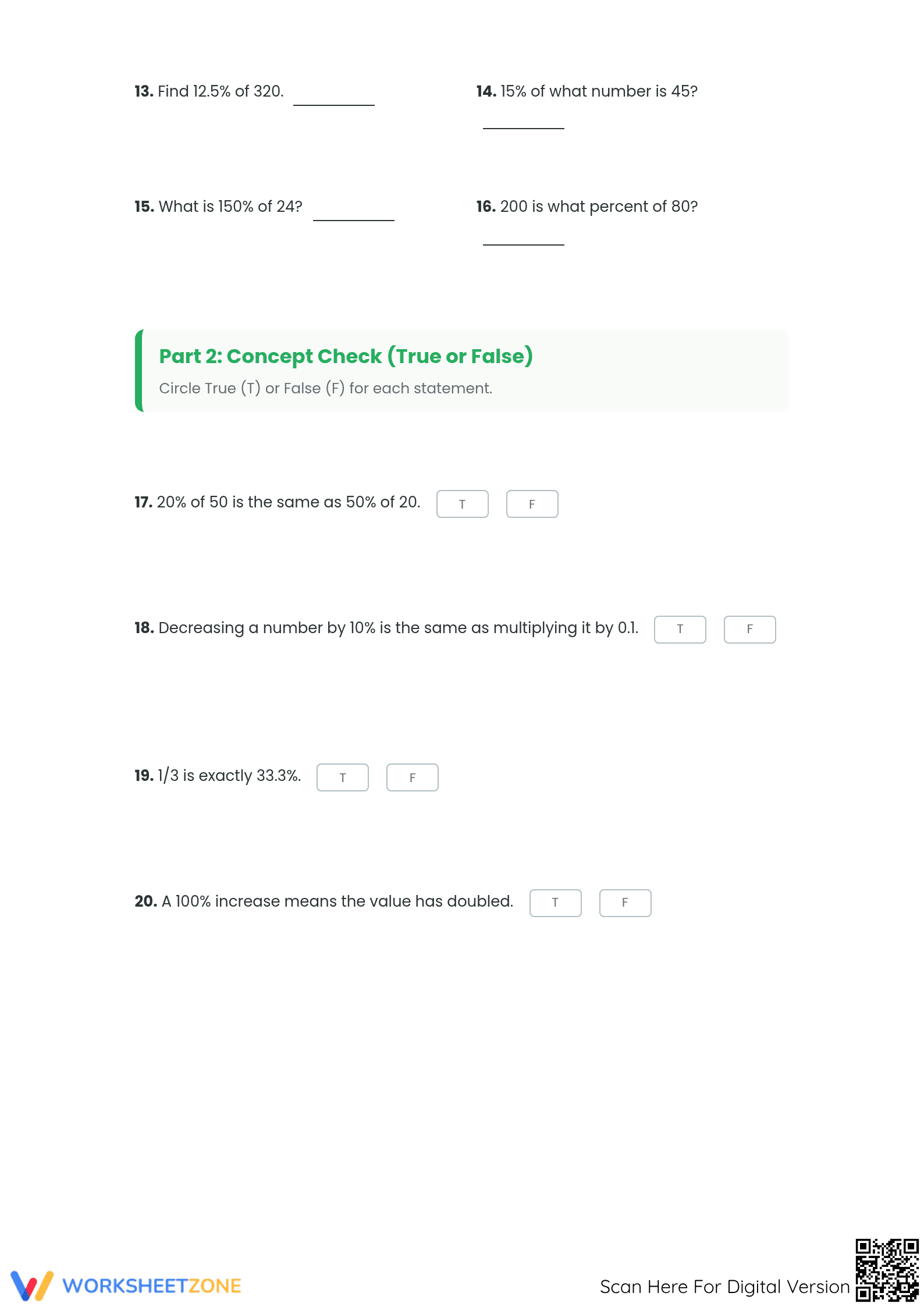
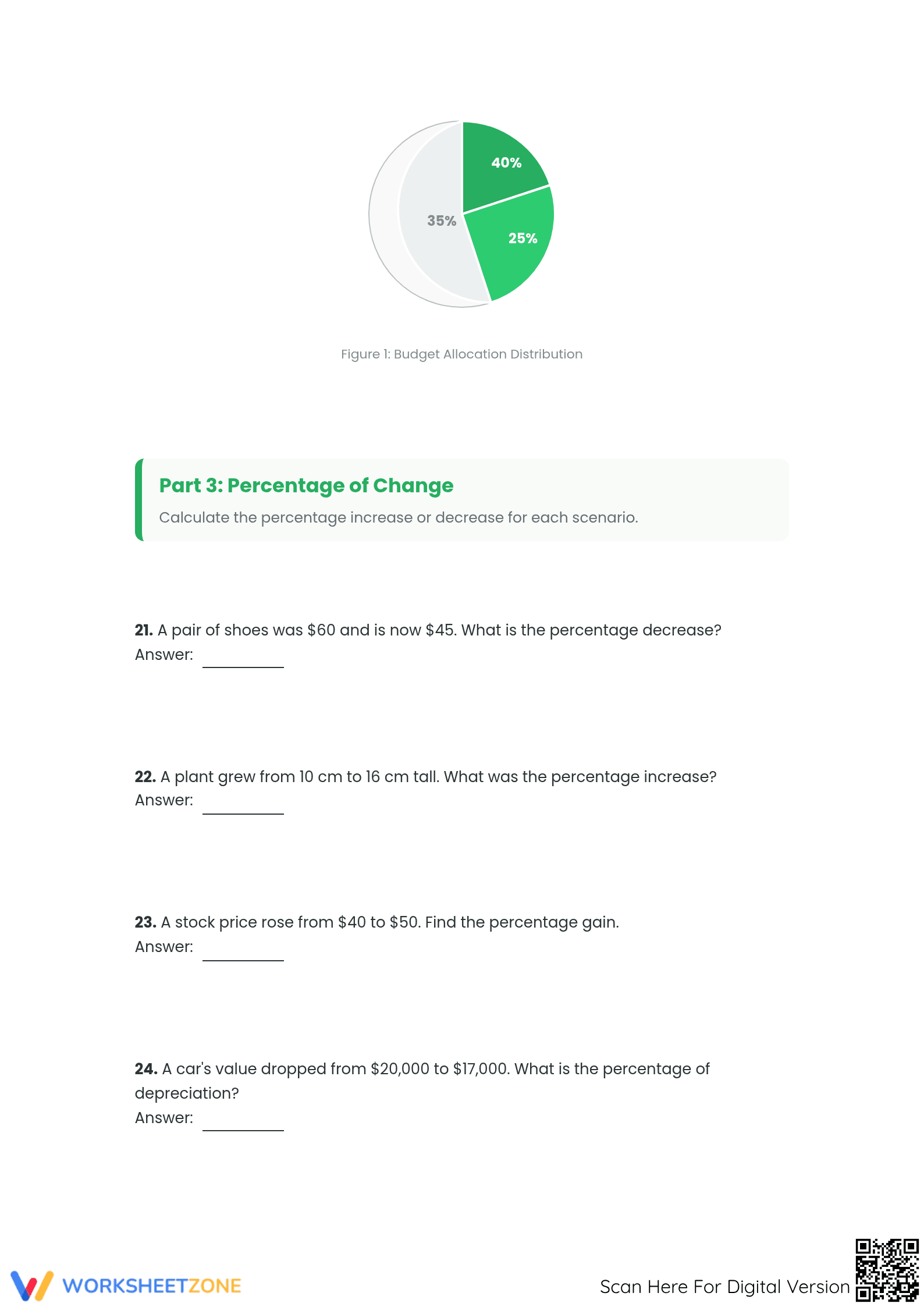
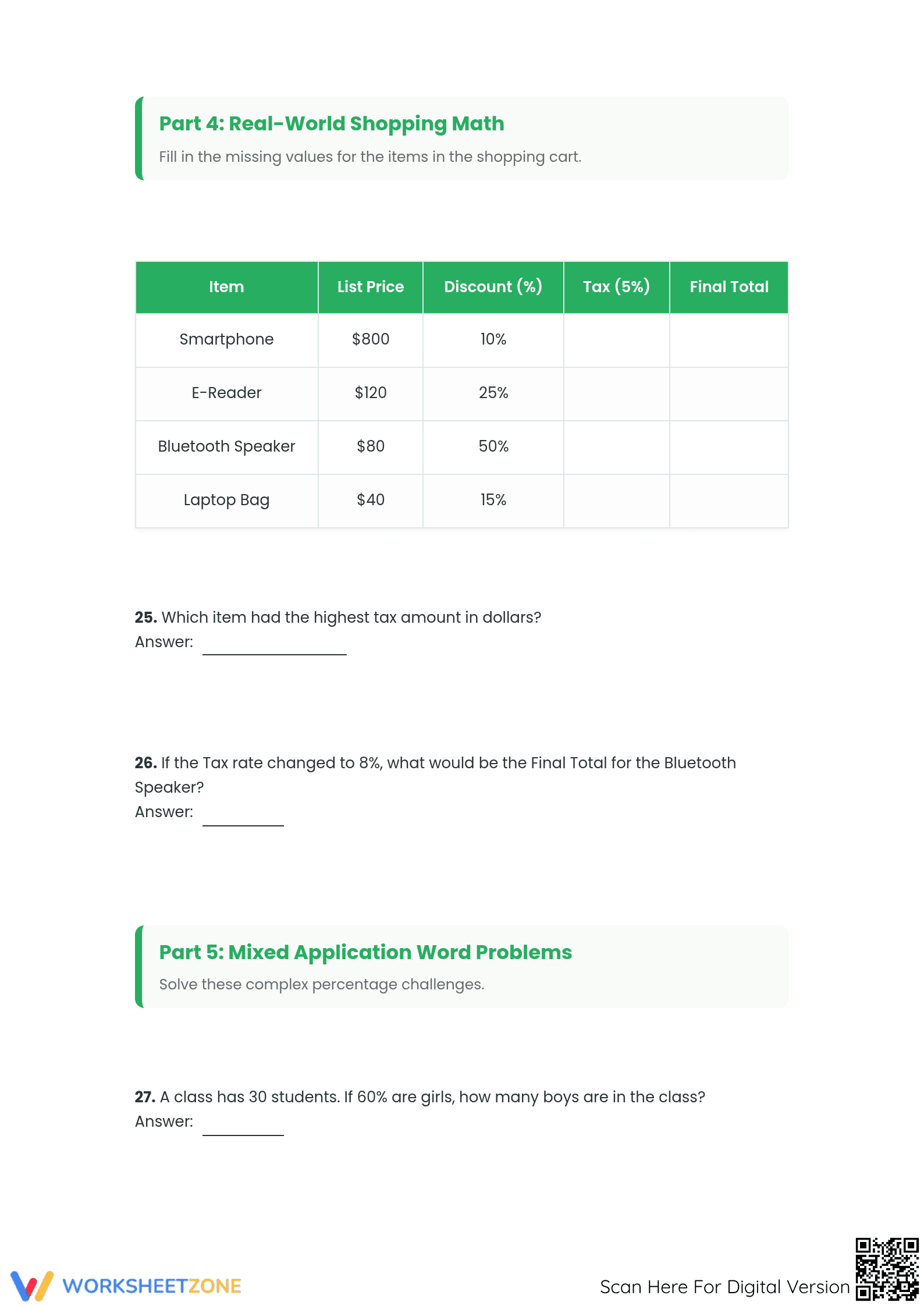
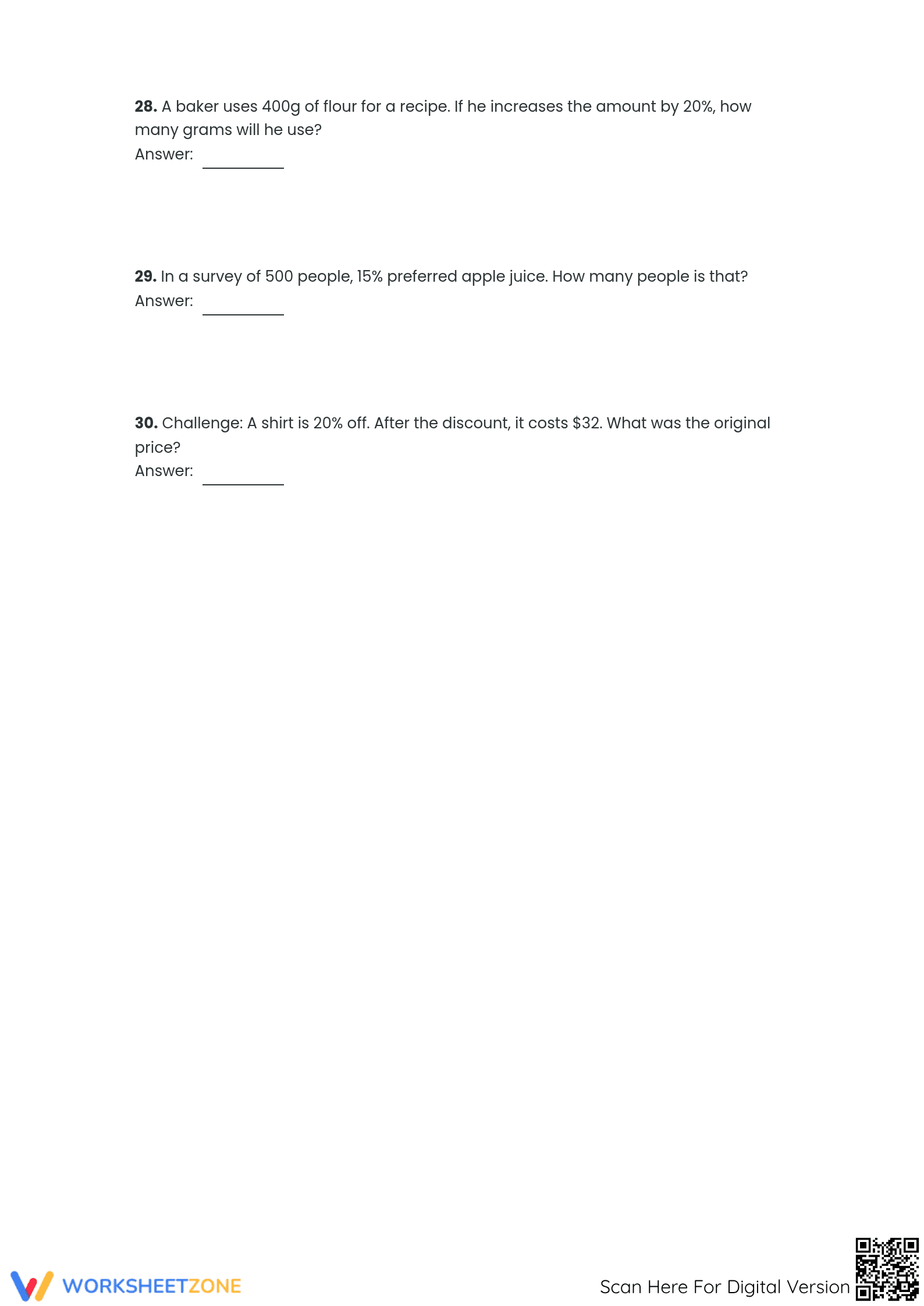
This five-page collection features 30 diverse tasks, including 16 fundamental calculation problems, 4 conceptual true/false questions, and 4 percentage of change scenarios. It also includes a real-world shopping math table for tax and discount practice, along with 4 complex word problems. A complete answer key is provided for immediate feedback and grading efficiency.
Teachers can implement this resource in under two minutes of total prep time. Simply print the five-page PDF and distribute it to students for a self-contained 45-minute lesson. The logical progression from Part 1 to Part 5 allows for easy pacing, making it an ideal choice for emergency sub plans or end-of-unit comprehensive reviews.
This resource is primary aligned to 7.RP.A.3, focusing on solving multi-step ratio and percent problems like tax and percent increase/decrease. It also supports 6.RP.A.3.C by reinforcing the relationship between parts, wholes, and percentages. Both standard codes can be copied directly into lesson plans, IEP goals, or district curriculum mapping tools.
Assign this worksheet as a summative assessment after completing a unit on ratios and proportions to gauge student mastery across multiple application types. For a formative approach, monitor student progress during Part 4 (Shopping Math) to identify misconceptions regarding tax and discount sequences. Expected completion time is approximately 60 minutes for most students.
Designed for middle school students in grades 6 through 8, this resource is particularly effective for those needing to bridge the gap between abstract calculations and practical applications. It pairs perfectly with a lesson on proportional reasoning or a digital spreadsheet activity exploring consumer math and financial literacy.
According to the Fisher & Frey (2014) framework for gradual release of responsibility, structured practice that transitions from fundamental skill-building to complex real-world application is essential for mathematical mastery. This worksheet facilitates that transition by moving students through five distinct levels of cognitive demand. By aligning directly with 7.RP.A.3, the resource ensures that Grade 7 students develop the specific proportional reasoning skills required for high school algebra readiness. Research from NAEP suggests that persistent difficulty with percent calculations often stems from a lack of exposure to varied problem contexts. This 30-problem set addresses that gap by presenting percentages in the context of budgeting, shopping, and growth measurements. Educators can cite this resource as a valid tool for documenting student progress toward meeting state-mandated standards in rational number operations and consumer mathematics.


