


























Views
Downloads


Mixed Percent Calculations Worksheet | Grade 7 Essential
Paste this activity's link or code into your existing LMS (Google Classroom, Canvas, Teams, Schoology, Moodle, etc.).
Students can open and work on the activity right away, with no student login required.
You'll still be able to track student progress and results from your teacher account.
Master percentage calculations with this comprehensive practice set designed for middle school students. This worksheet targets the core ability to recognize and solve various percent-based problems, from simple calculations to complex financial applications. Students will achieve fluency in ratios and proportions while tackling real-world scenarios involving markups, interest, and commissions.
At a Glance
- Grade: 7 · Subject: Math
- Standard:
7.RP.A.3— Use proportional relationships to solve multistep ratio and percent problems- Skill Focus: Mixed Percent Calculations
- Format: 5 pages · 34 problems · Answer key included · PDF
- Best For: Mid-unit practice and formative assessment
- Time: 45–60 minutes
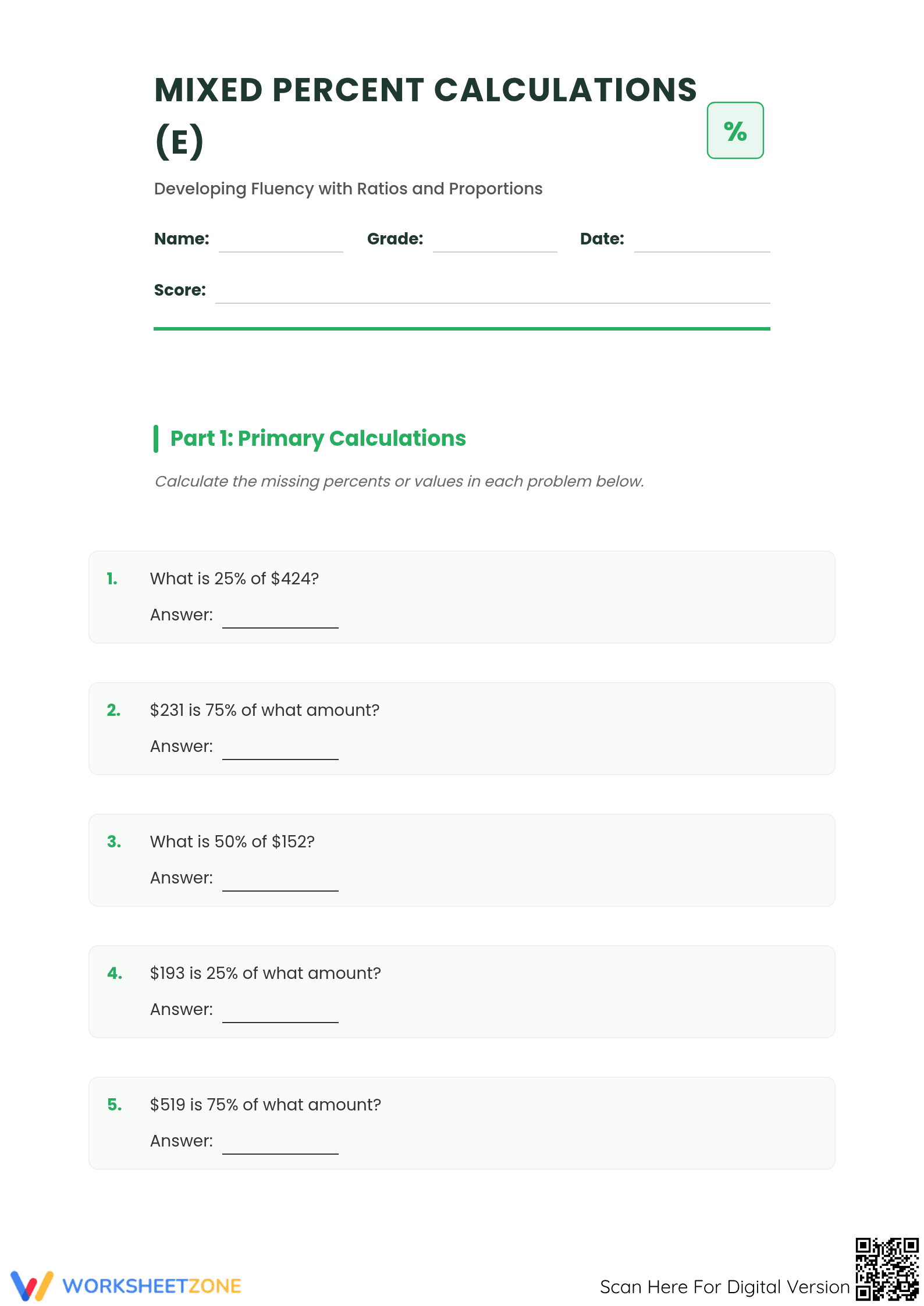
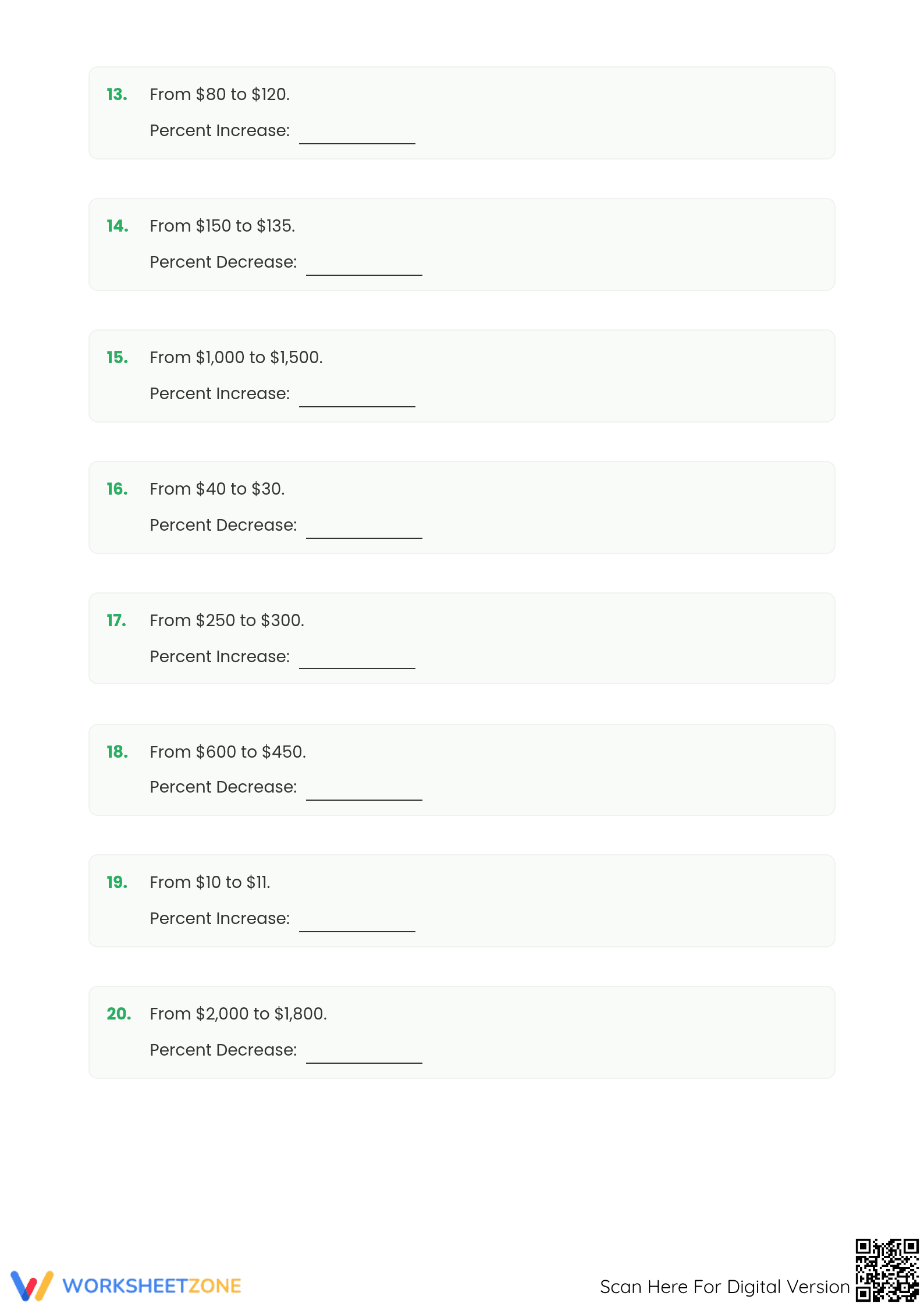
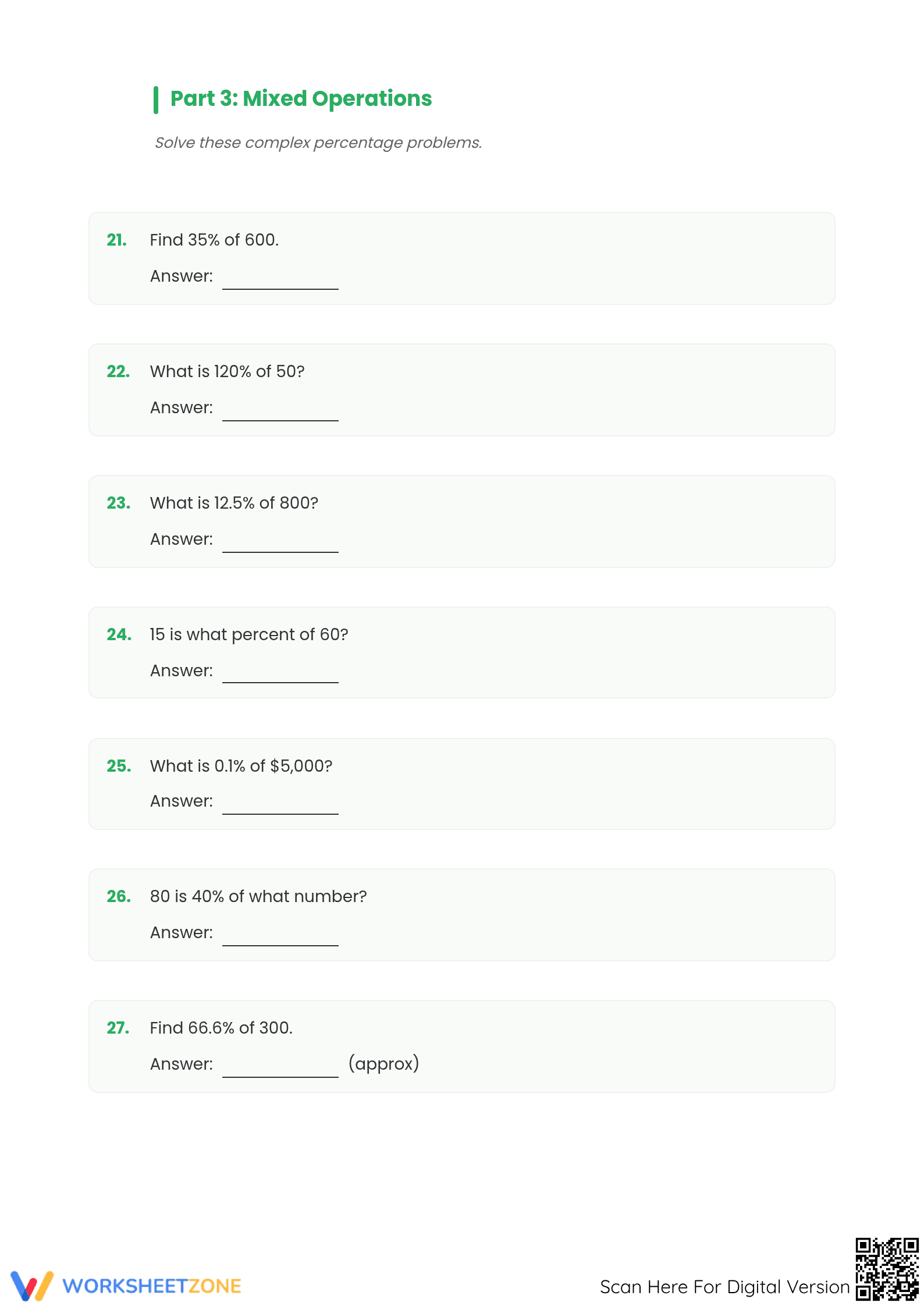
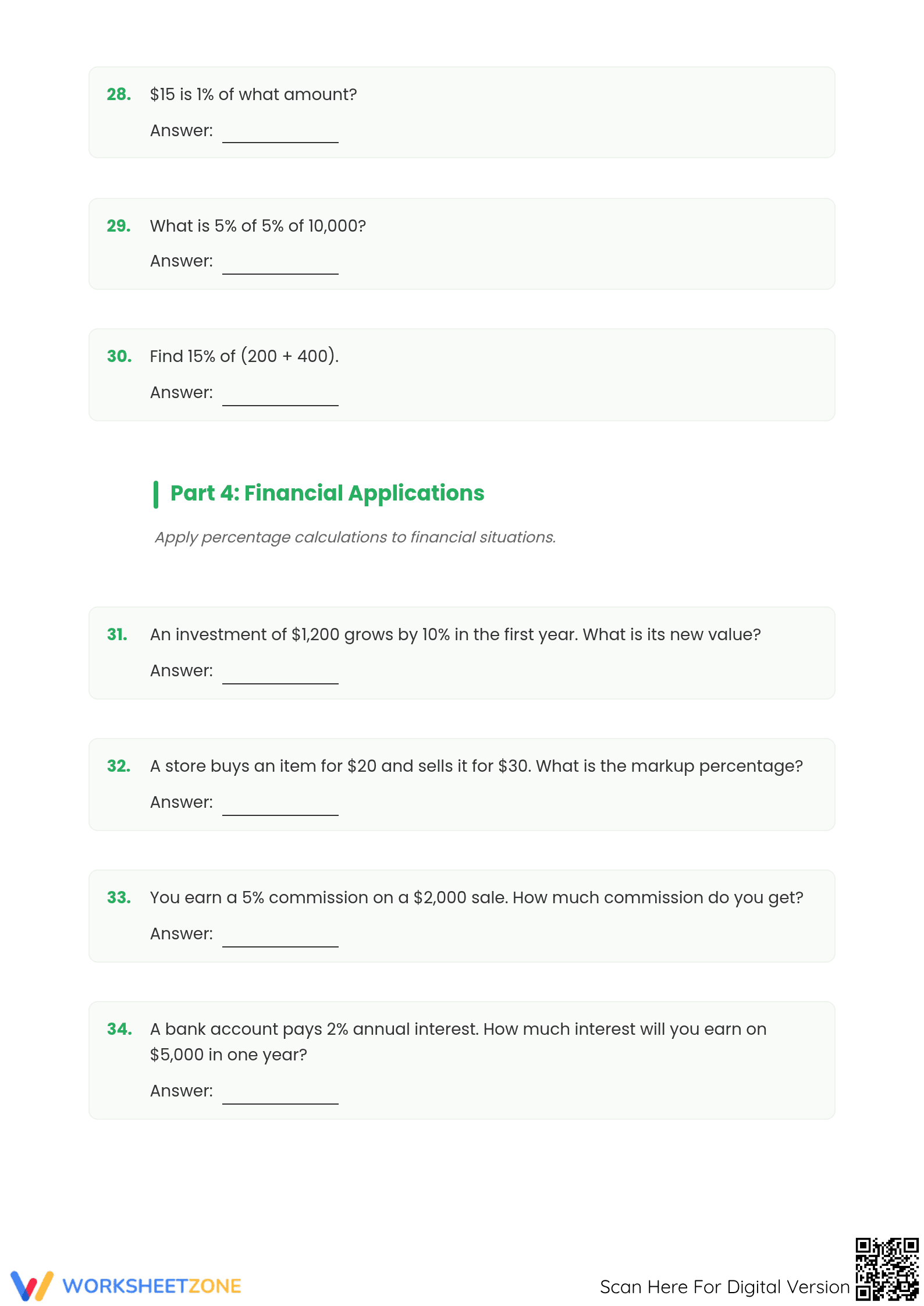
This five-page collection contains 34 structured problems divided into four distinct sections. Part 1 focuses on primary calculations, Part 2 explores percent change, Part 3 covers mixed operations with complex values, and Part 4 applies these skills to financial situations. The layout provides ample workspace for calculations and includes a full answer key for immediate feedback.
- Guided practice: The first ten problems provide a controlled environment for finding missing percents and values, helping students establish a baseline for proportional reasoning.
- Supported practice: Problems 11 through 20 introduce percent change, requiring students to calculate increases and decreases between specific values with clear prompts.
- Independent practice: The final sections challenge students with 14 complex operations and financial word problems, including markups and commissions, demanding independent application of learned strategies.
This sequence follows a gradual-release model, moving from basic computation to high-level problem solving using the I Do, We Do, You Do approach.
This resource is directly aligned with `7.RP.A.3`, focusing on using proportional relationships to solve multistep ratio and percent problems. It specifically addresses simple interest, markups, and commissions through the financial application section. Both standard codes can be copied directly into lesson plans, IEP goals, or district curriculum mapping tools.
Assign this worksheet during the middle of a unit on ratios and proportions to check for student understanding of different percent types. Use the financial application section as a separate formative assessment to observe how well students translate word problems into mathematical equations. Completion typically takes one full class period, approximately 50 minutes.
Designed for Grade 7 students, this resource is also suitable for Grade 6 extension or Grade 8 review. It pairs naturally with a direct instruction lesson on proportional reasoning or a financial literacy anchor chart. Differentiation is built into the increasing complexity of the four problem sets.
According to the NAEP (2024) mathematics framework, proficiency in percent calculations is a critical indicator of readiness for algebraic thinking and real-world financial literacy. This worksheet addresses the standard 7.RP.A.3 by requiring students to navigate mixed percent calculations across varied contexts. Research from Fisher & Frey (2014) emphasizes the importance of a gradual release of responsibility, which is reflected in the structural progression from basic Part 1 calculations to the complex multi-step financial applications in Part 4. By requiring students to solve 34 distinct problems, this resource provides the high-repetition practice needed to move from procedural knowledge to conceptual mastery of ratios and proportions. Educators can use these structured tasks to identify specific gaps in proportional reasoning, ensuring that students can accurately find percents, totals, and percent changes in both abstract and applied settings.


