


























Views
Downloads

Essential Mixed Percent Calculations Worksheet | Grades 6-8
Paste this activity's link or code into your existing LMS (Google Classroom, Canvas, Teams, Schoology, Moodle, etc.).
Students can open and work on the activity right away, with no student login required.
You'll still be able to track student progress and results from your teacher account.
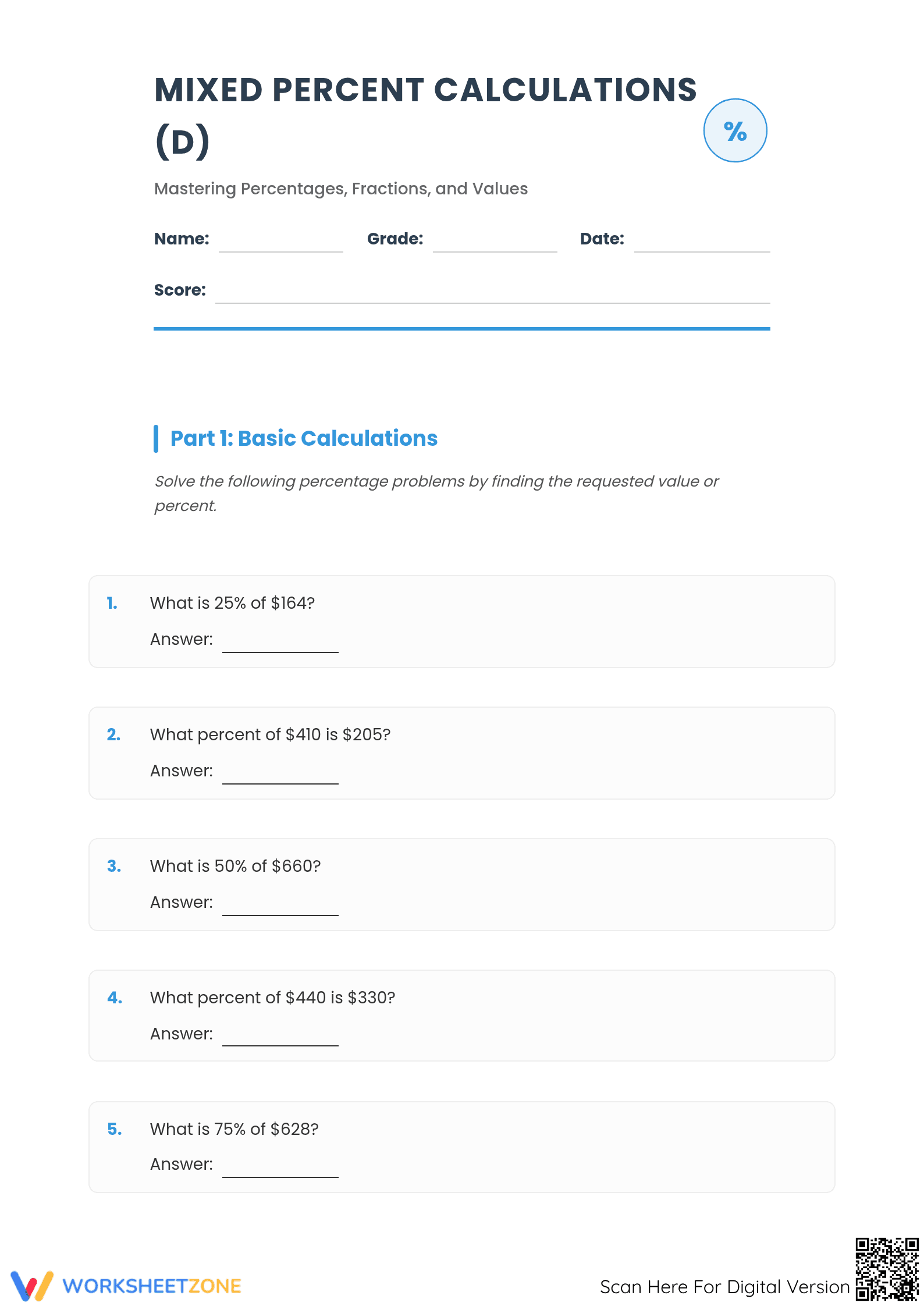
This comprehensive mixed percent calculations worksheet empowers Grade 6-8 students to master the relationship between parts, wholes, and percentages. By engaging with 34 diverse problems, learners develop the fluency needed to solve real-world mathematical scenarios. This resource ensures students can confidently calculate values, identify missing percentages, and apply their knowledge to practical word problems.
At a Glance
- Grade: 6-8 · Subject: Math
- Standard:
CCSS.MATH.CONTENT.6.RP.A.3.C— Find a percent of a quantity and solve problems finding the whole- Skill Focus: Percentage, part, and whole calculations
- Format: 5 pages · 34 problems · Answer key included · PDF
- Best For: Middle school math skill reinforcement
- Time: 45–60 minutes
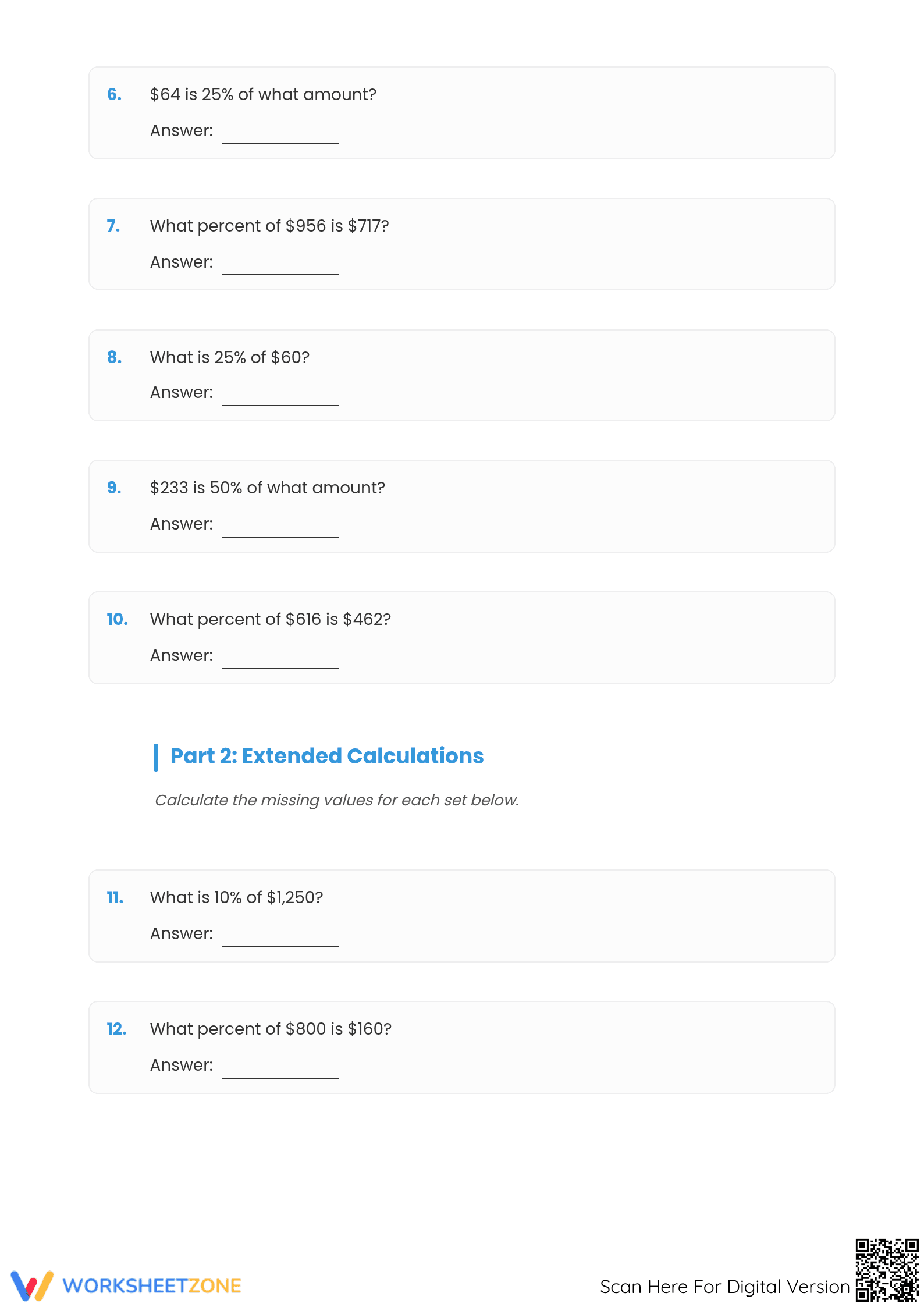
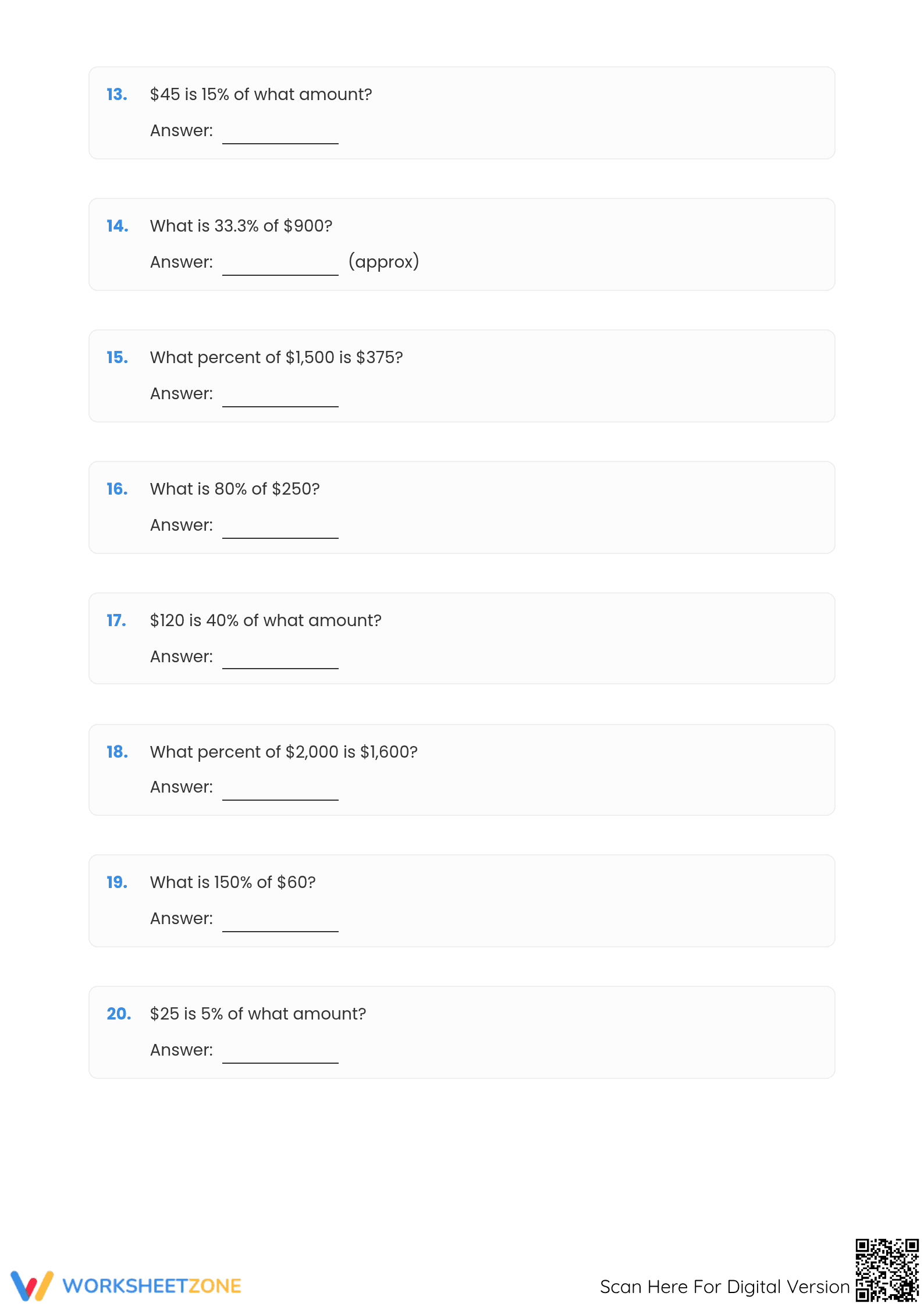
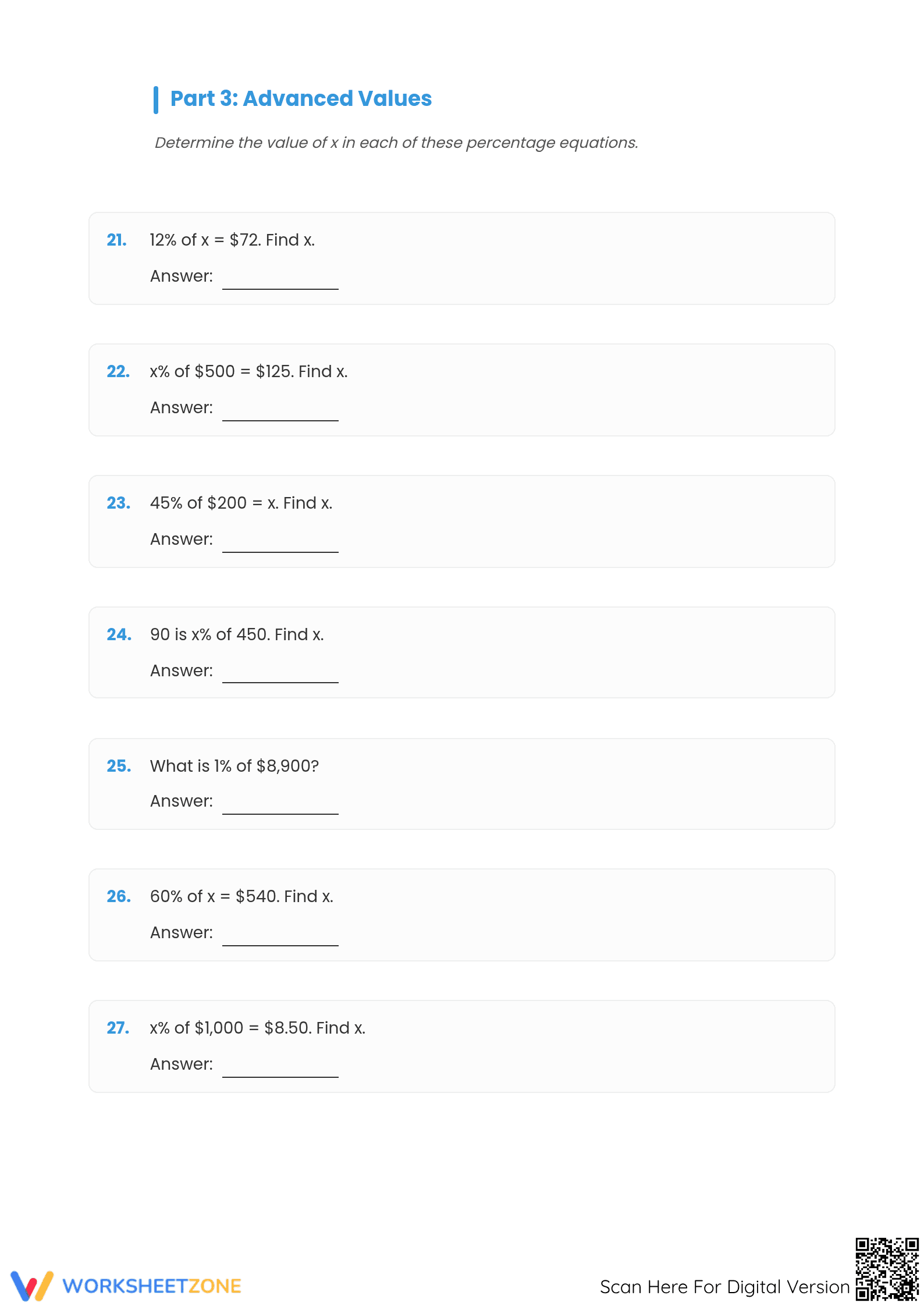
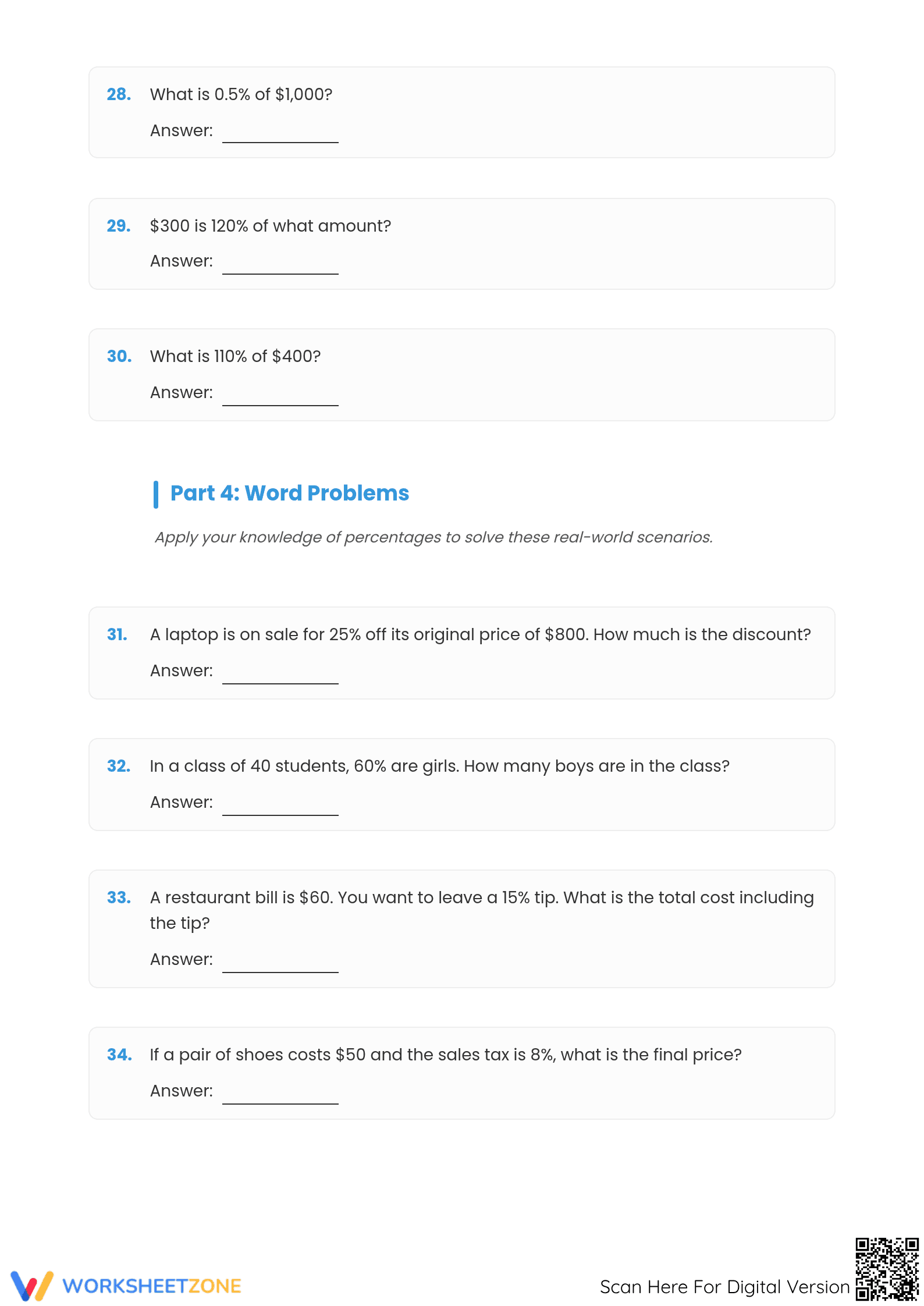
Inside this 5-page PDF, you will find a structured progression of 34 tasks divided into four distinct parts. The collection starts with basic calculations, moves into extended sets with decimals and larger numbers, transitions to solving for variables in advanced value equations, and concludes with practical word problems involving sales and tips. A full answer key is provided for immediate feedback and grading efficiency.
Skill Progression
- Guided Practice: Tasks 1-10 establish fundamental "What is X% of Y?" skills to build core procedural fluency and confidence in basic calculation steps.
- Supported Practice: Tasks 11-30 introduce complex numbers and decimal rates, challenging students to apply logic to more demanding mathematical structures and varied values.
- Independent Practice: The final word problems require extracting data from text and solving multi-step scenarios, such as calculating discounts and restaurant totals.
This strategic approach ensures that students have a solid foundation before tackling high-order application tasks that require real-world reasoning.
Standards Alignment
This resource is directly aligned to the Common Core State Standard CCSS.MATH.CONTENT.6.RP.A.3.C: "Find a percent of a quantity as a rate per 100; solve problems involving finding the whole, given a part and the percent." The varied problem types also support broader ratios and proportional relationship standards found across the middle school curriculum. Both standard codes can be copied directly into lesson plans, IEP goals, or district curriculum mapping tools.
How to Use It
Use this worksheet as a summative assessment following a unit on ratios, or assign specific sections as targeted homework. Teachers can use the "Advanced Values" section as a formative check to see if students understand the algebraic nature of percentage equations before moving on to interest units. Observe if students struggle with identifying the "whole" during the word problem section.
Who It's For
This material is designed for Grade 6, 7, and 8 students who are developing or refining their proportional reasoning skills. It is particularly effective for small group intervention or as a self-guided review for students preparing for state assessments. For best results, pair this worksheet with a percentage anchor chart to support conceptual understanding of the part-whole relationship.
Mathematical fluency in percentage calculations is a critical gateway skill for higher-level algebra and financial literacy. According to a ScienceDirect TpT Analysis (2024), structured practice that bridges the gap between abstract computation and contextual application significantly improves long-term retention of proportional reasoning concepts. By providing 34 varied tasks aligned to CCSS.MATH.CONTENT.6.RP.A.3.C, this worksheet addresses the need for high-repetition practice environments. Students who can fluidly navigate between finding the part, the whole, and the percent are better prepared for the complexity of multi-step algebraic equations. The inclusion of real-world scenarios, such as calculating a 15% tip or a 25% discount, ensures that mathematical theory is grounded in everyday utility. This balance of procedural skill and application creates a robust framework for mastery that serves students well beyond the middle school classroom, fostering the quantitative literacy required for modern academic success.


