


























Views
Downloads

Essential Percent Calculations Worksheet | Grade 6 Math
Paste this activity's link or code into your existing LMS (Google Classroom, Canvas, Teams, Schoology, Moodle, etc.).
Students can open and work on the activity right away, with no student login required.
You'll still be able to track student progress and results from your teacher account.
This comprehensive Grade 6 worksheet helps students master the three fundamental types of percentage calculations: finding the percent, finding the part, and finding the whole. By working through 40 targeted problems, learners build the procedural fluency needed for real-world mathematical applications. Students will gain confidence in recognizing and solving diverse percentage scenarios efficiently.
At a Glance
- Grade: 6 · Subject: Math
- Standard:
6.RP.A.3.c— Find a percent of a quantity and solve problems finding the whole- Skill Focus: Percent, Part, and Whole Relationships
- Format: 5 pages · 40 problems · Answer key included · PDF
- Best For: Comprehensive unit practice or midterm review
- Time: 45–60 minutes
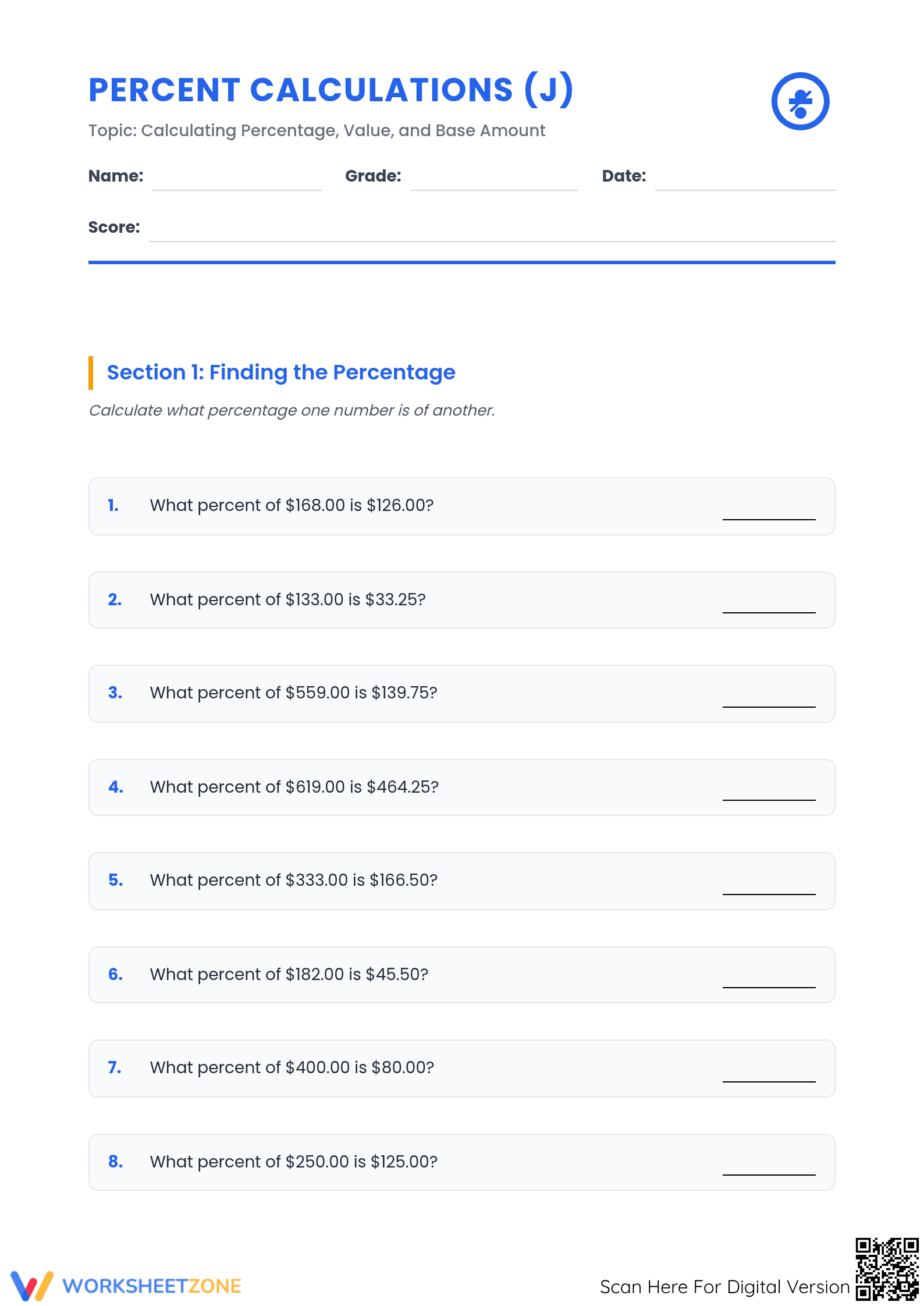
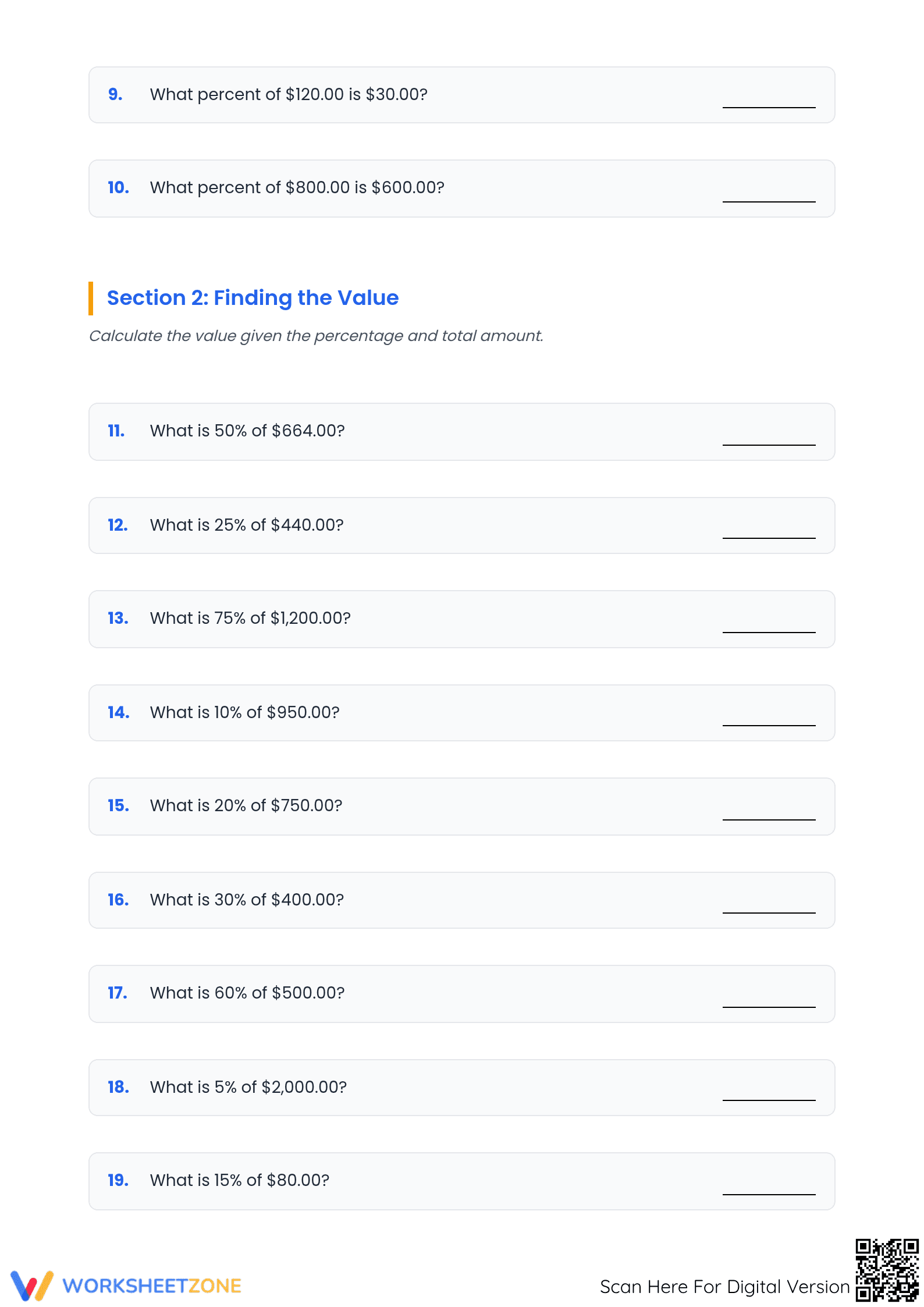
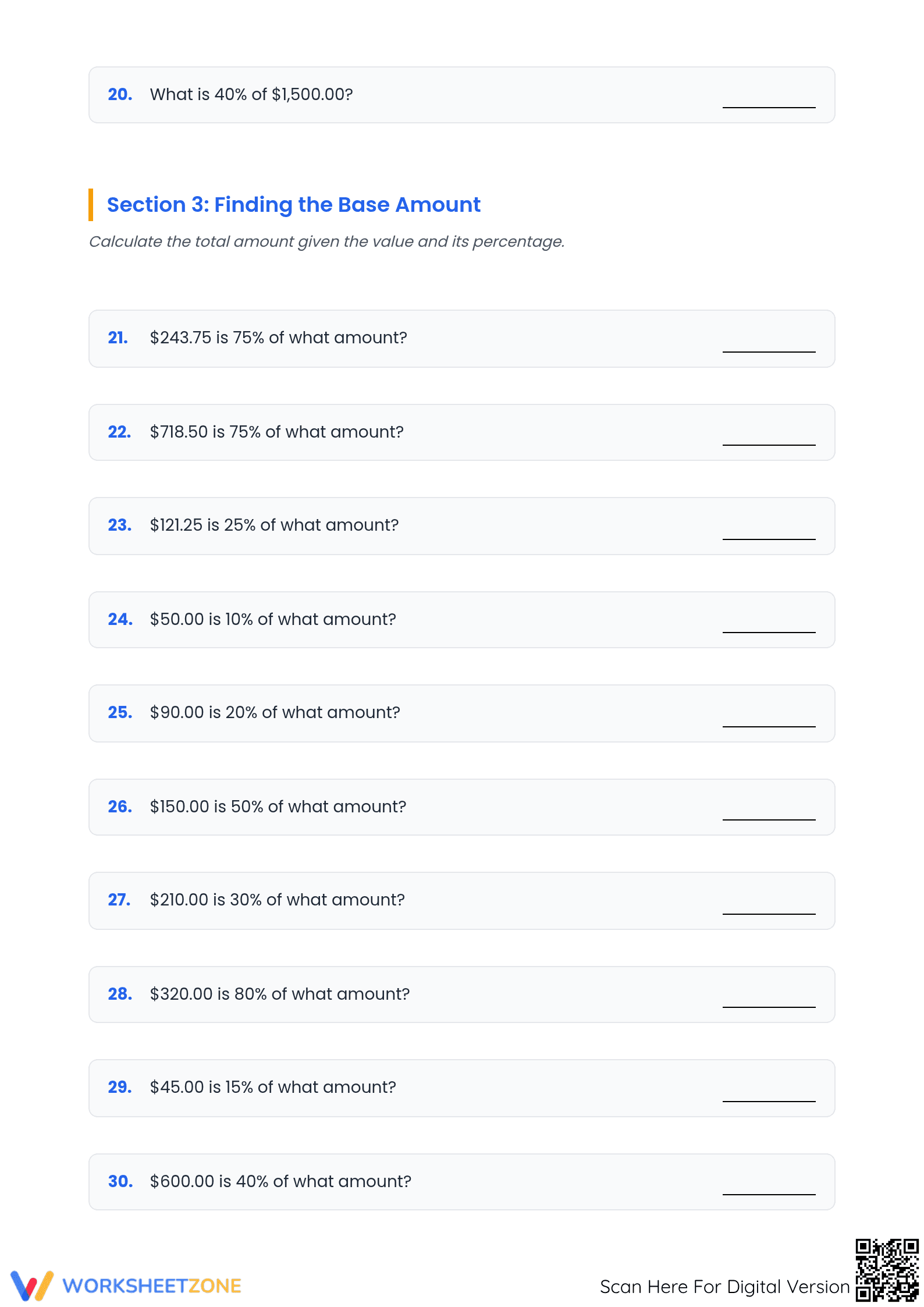
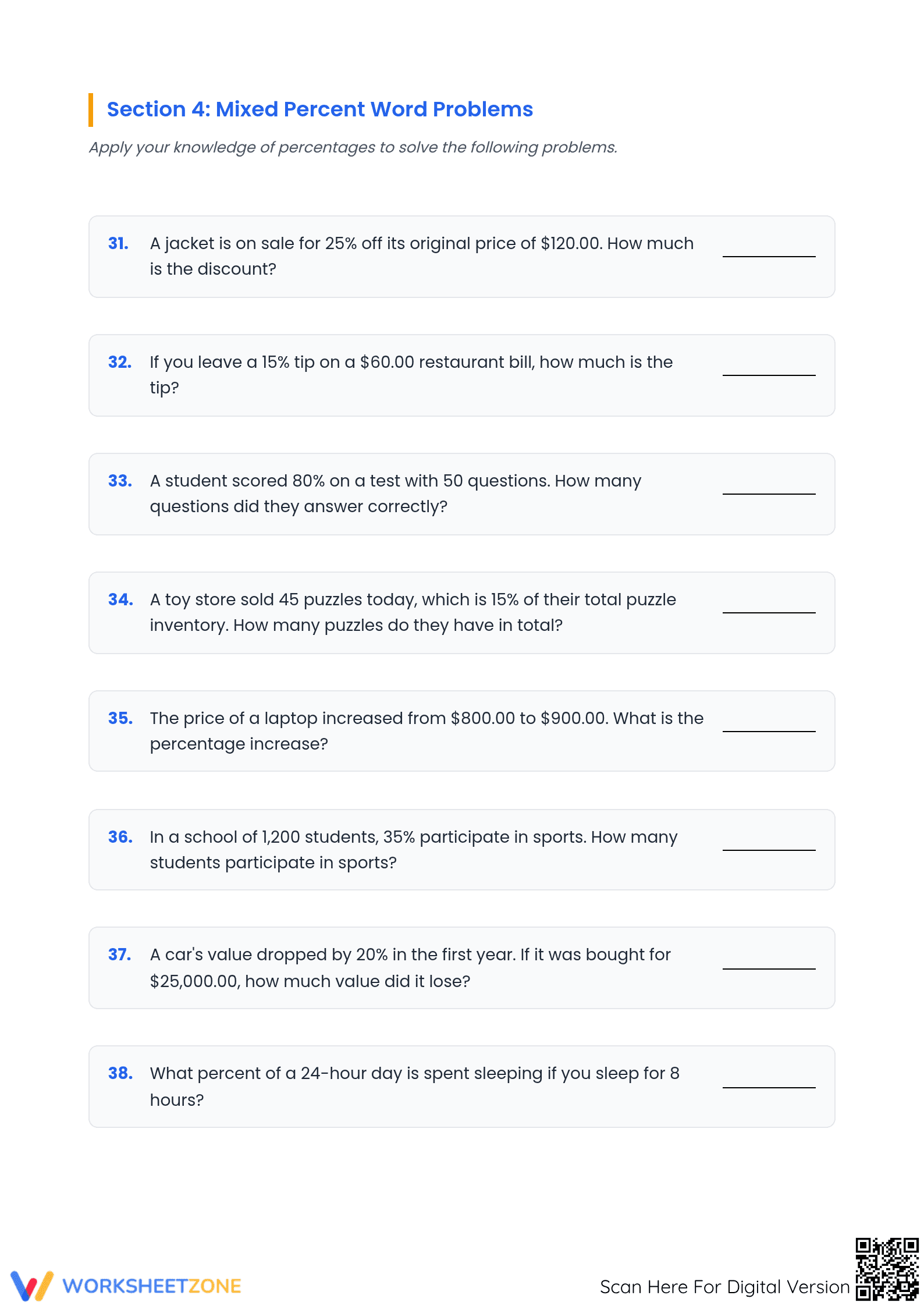
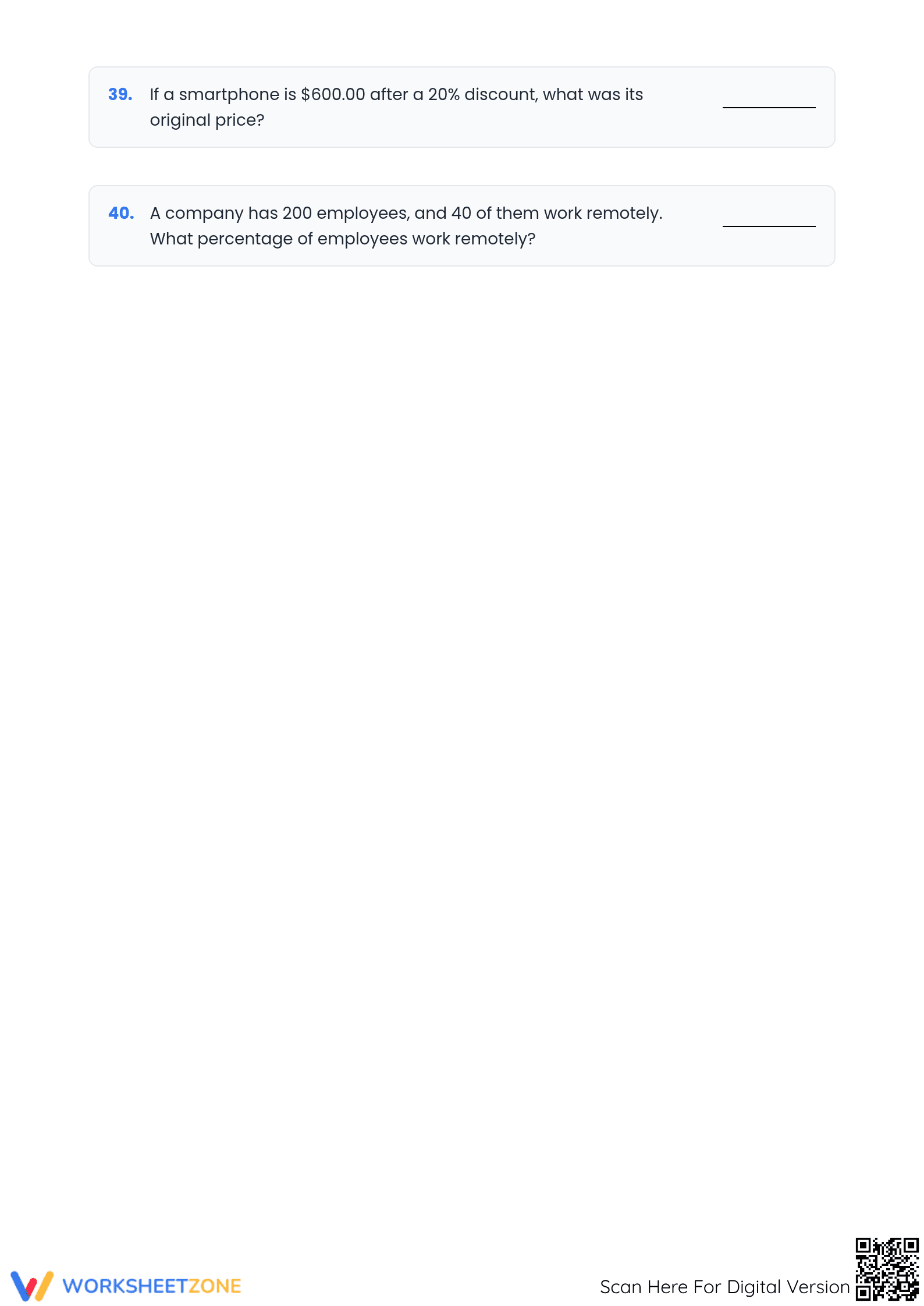
The packet contains five instructional pages organized into four logical sections. The first 30 problems are grouped by calculation type—Section 1 focuses on finding the percentage, Section 2 on finding the part, and Section 3 on finding the base amount. The final section provides 10 mixed word problems that require students to identify the correct relationship before calculating. A full answer key follows.
Skill Progression
- Guided Practice: The first 10 problems isolate the division pattern required to find what percent one number is of another using consistent monetary values.
- Supported Practice: 20 problems provide repetitive structures for calculating parts and wholes, reinforcing the logic of proportions across different contexts.
- Independent Practice: 10 mixed word problems challenge students to apply their skills to real-world scenarios involving sales, tips, and inventory without explicit labels.
This gradual release model moves students from simple computation to high-level application of the I Do, We Do, You Do framework.
Standards Alignment
Aligned strictly to 6.RP.A.3.c, this resource ensures students can find a percent of a quantity as a rate per 100 and solve problems involving finding the whole, given a part and the percent. The structured approach supports the development of proportional reasoning and algebraic thinking. Both standard codes can be copied directly into lesson plans, IEP goals, or district curriculum mapping tools.
How to Use It
Use this resource during the independent practice phase of instruction. For a formative assessment, observe students during Section 4 to see if they can correctly identify whether they are solving for the part, whole, or percent. This 40-problem set typically takes 50 minutes to complete and works well as a comprehensive end-of-unit review or a high-quality substitute teacher plan.
Who It's For
This worksheet is designed for Grade 6 math students but serves as an excellent remediation tool for Grade 7 or 8 learners. It is particularly beneficial for students who require structured practice to differentiate between different percentage models. Pair this with a percentage bar model anchor chart or a short direct instruction lesson on ratios.
Mastering percentage relationships is a critical milestone in middle school mathematics, serving as a bridge between elementary arithmetic and high school algebra. Research from the RAND AIRS 2024 study highlights that procedural fluency in finding the percent, part, and whole is significantly correlated with later success in financial mathematics and data analysis. This worksheet addresses 6.RP.A.3.c by providing a high volume of deliberate practice, which helps automate the recognition of mathematical structures in word problems. By isolating each variable type before introducing mixed scenarios, the resource reduces cognitive load, allowing students to build durable mental models. Educational standards require that students not only calculate accurately but also understand the underlying ratios. This printable resource provides the necessary repetition and variety to move students from initial comprehension to automated mastery, ensuring they are prepared for more complex proportional reasoning tasks in future grade levels.


