


























Views
Downloads

Essential Mixed Percent Calculations Worksheet | Grade 6-8
Paste this activity's link or code into your existing LMS (Google Classroom, Canvas, Teams, Schoology, Moodle, etc.).
Students can open and work on the activity right away, with no student login required.
You'll still be able to track student progress and results from your teacher account.
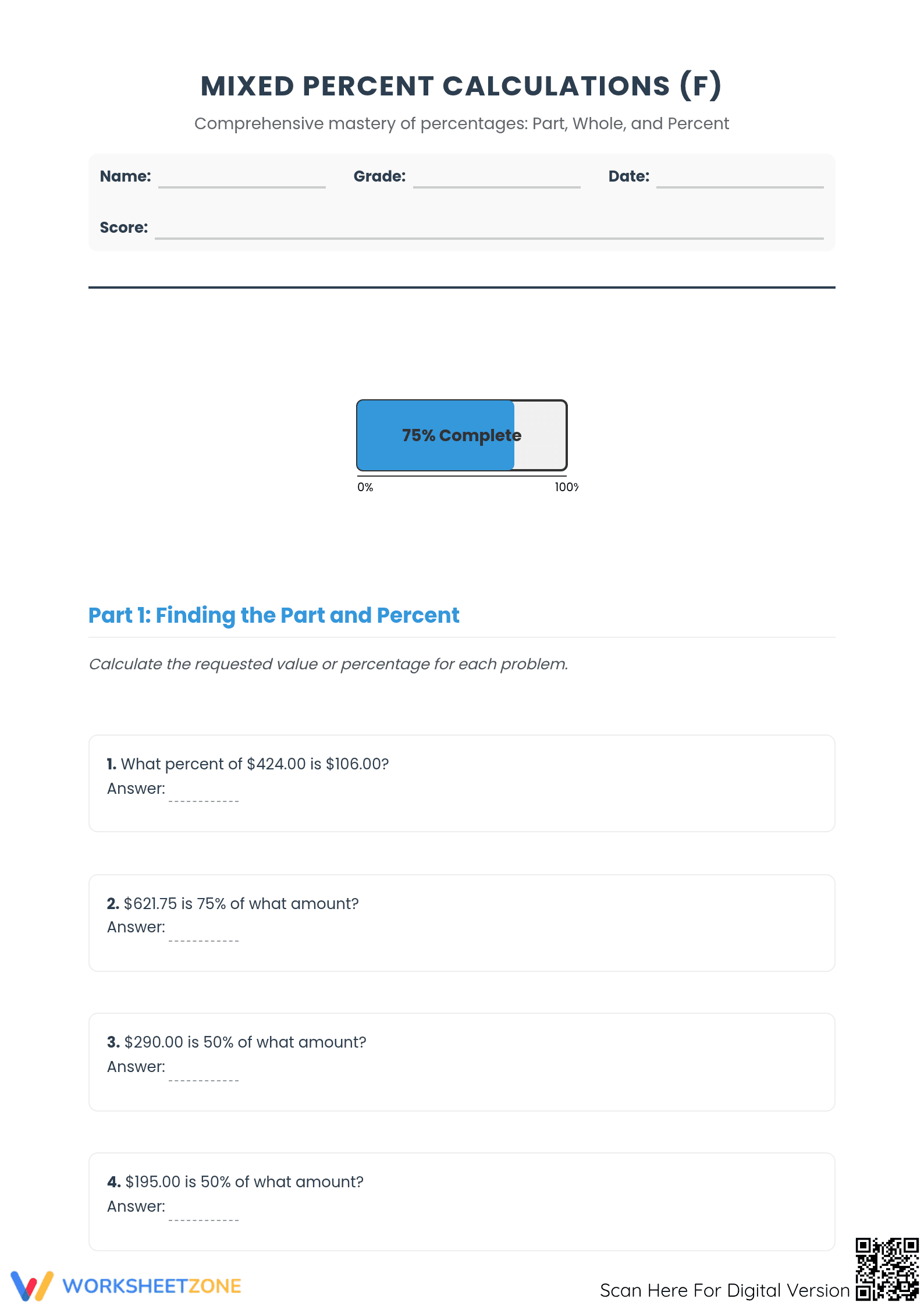
This mixed percent calculations worksheet provides a comprehensive review for middle school students mastering ratios and proportional relationships. By solving varied problems, learners transition from basic percentage identification to complex real-world applications. This resource ensures students can confidently calculate parts, wholes, and percentage changes in any context.
At a Glance
- Grade: 6-8 · Subject: Math
- Standard:
7.RP.A.3— Use proportional relationships to solve multistep ratio and percent problems- Skill Focus: Mixed Percentage Calculations
- Format: 5 pages · 31 problems · Answer key included · PDF
- Best For: End-of-unit review and test preparation
- Time: 45–60 minutes
What's Inside
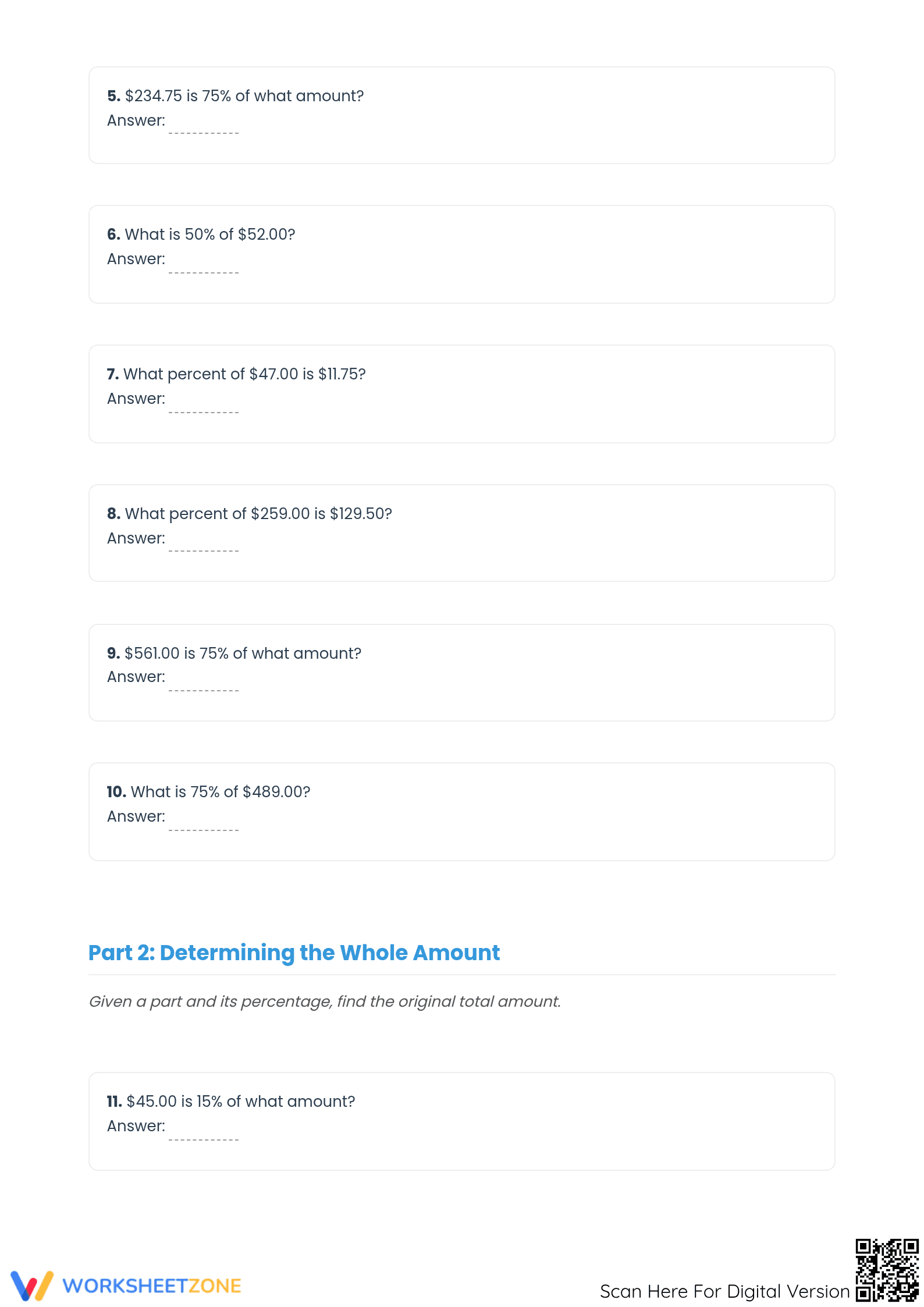
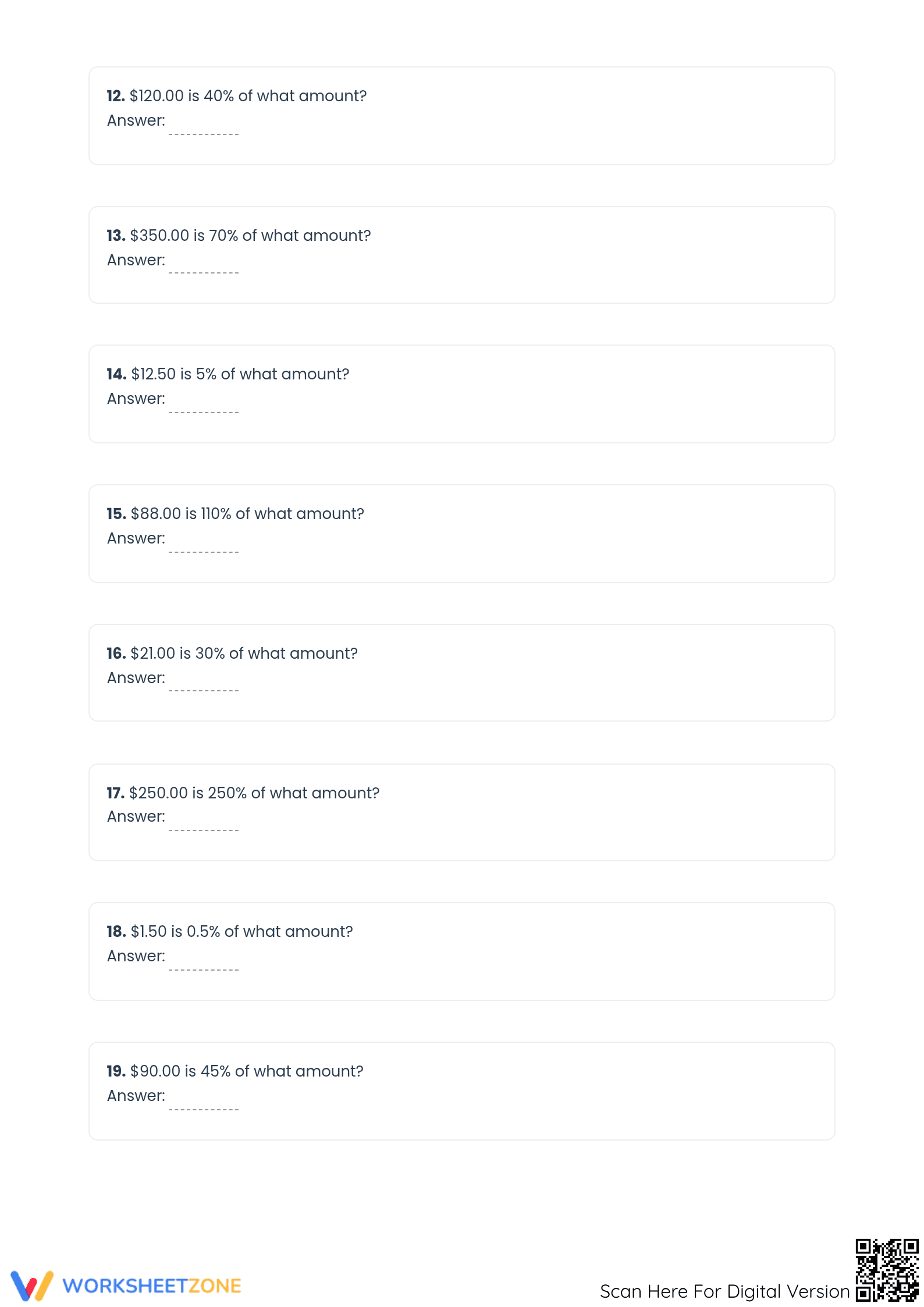
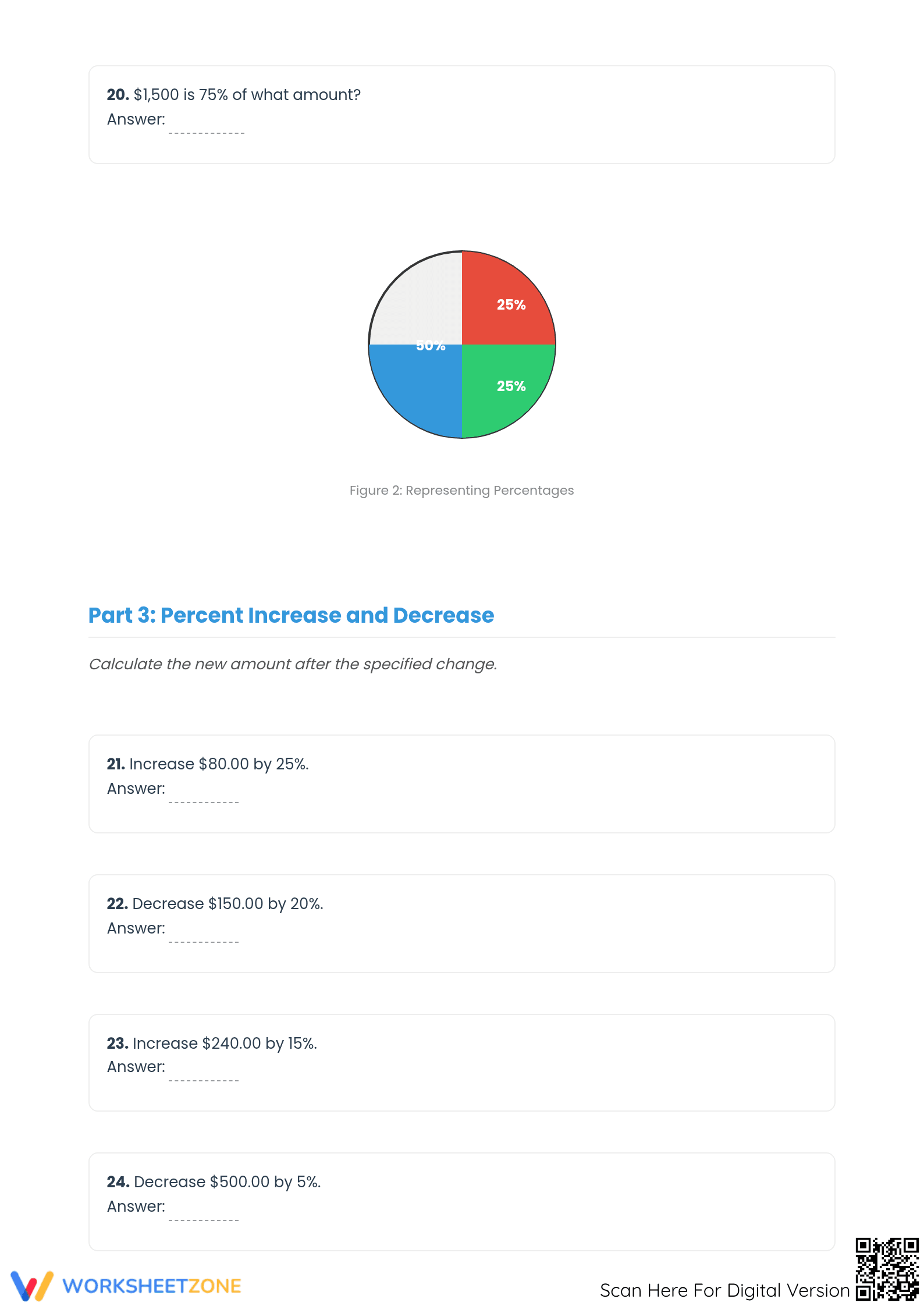
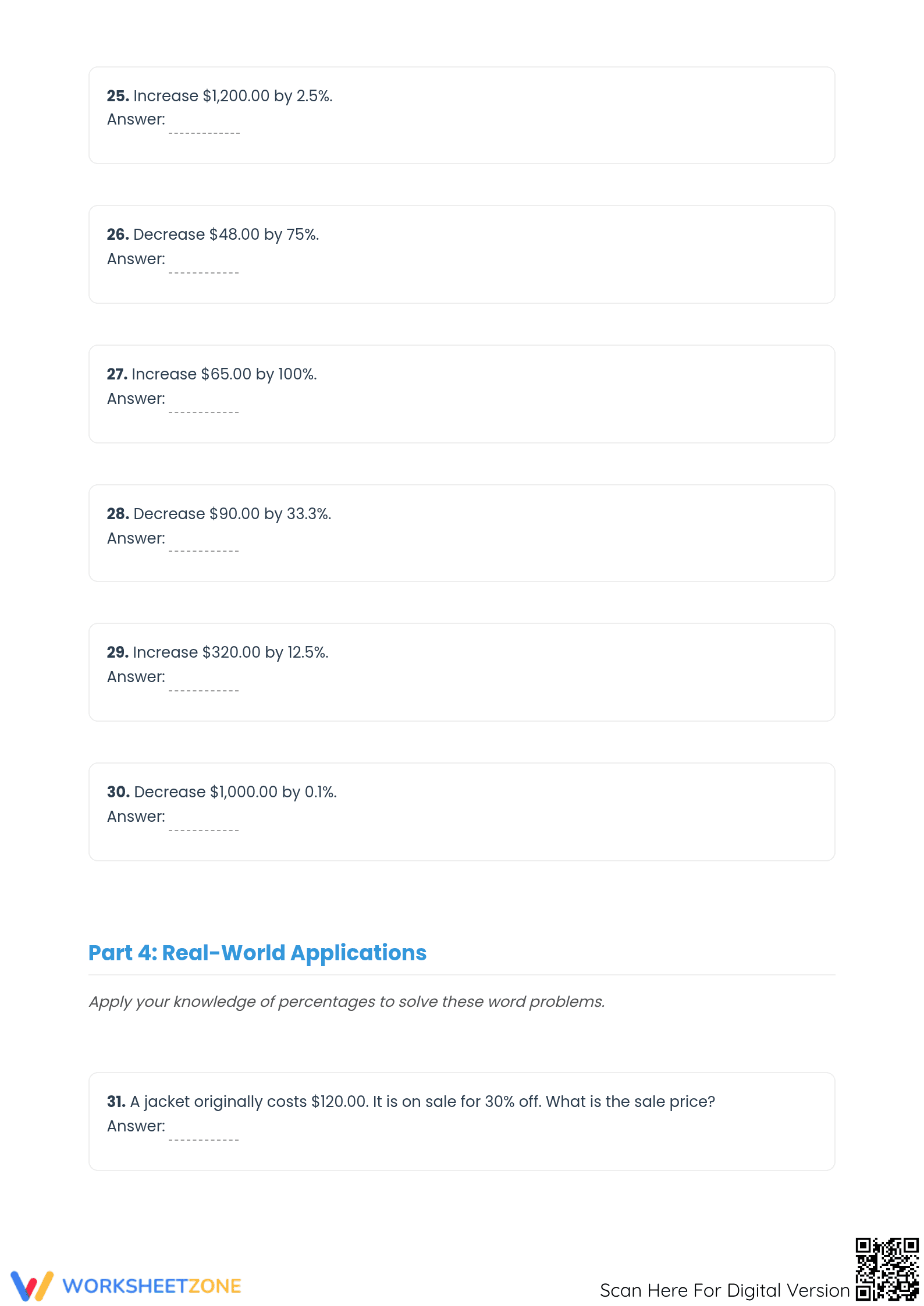
This five-page PDF features 31 strategically sequenced problems divided into four clear parts. Part 1 focuses on finding parts and percentages, Part 2 targets determining the whole amount, Part 3 addresses percent increase and decrease, and Part 4 presents real-world word problems. A visual pie chart and full answer key support diverse learning styles and efficient grading.
Skill Progression
- Guided practice: The first ten problems provide structured frames for finding basic parts and percentages using manageable dollar amounts and clear prompts.
- Supported practice: Problems 11 through 20 challenge students to work backward to find the whole amount, incorporating a visual representation via a pie chart.
- Independent practice: The final sections require students to apply logic to percent changes and multi-step real-world scenarios without scaffolding.
This gradual release model moves students from simple computation to authentic application.
Standards Alignment
The primary focus is 7.RP.A.3, which requires students to use proportional relationships to solve multi-step ratio and percent problems, including percent increase and decrease. The worksheet also supports 6.RP.A.3.C by reinforcing basic percent-to-quantity relationships. Both standard codes can be copied directly into lesson plans, IEP goals, or district curriculum mapping tools.
How to Use It
Use this worksheet as a summative assessment after direct instruction on percentages. During the session, observe if students struggle to identify whether the missing value is the part or the whole. For a quick formative check, assign Part 4 as an exit ticket. Most students will complete the entire set within 60 minutes, making it an ideal independent work packet.
Who It's For
This resource is designed for Grade 6, 7, and 8 math students, including those needing remediation or IEP support in algebraic thinking. It pairs naturally with a percent bar anchor chart or a "percent of" instructional video. The clear structure also makes it an excellent choice for substitute teacher plans.
According to Fisher & Frey (2014), the gradual release of responsibility is essential for math mastery, moving students from teacher-led modeling to independent application. This worksheet embodies that research by sequencing 31 tasks from simple identification to complex, multi-step word problems involving percent increase and decrease. By addressing standard 7.RP.A.3, the resource ensures that students develop the proportional reasoning necessary for high school algebra and real-world financial literacy. The inclusion of diverse problem types—such as finding the whole given a part and calculating sale prices—aligns with evidence-based practices for improving retention of mathematical concepts. Educators can utilize this structured approach to identify specific student misconceptions early in the learning cycle. This comprehensive tool serves as a reliable bridge between basic arithmetic and the application of ratios, making it an indispensable asset for any standard-aligned middle school math classroom.


