


























Views
Downloads
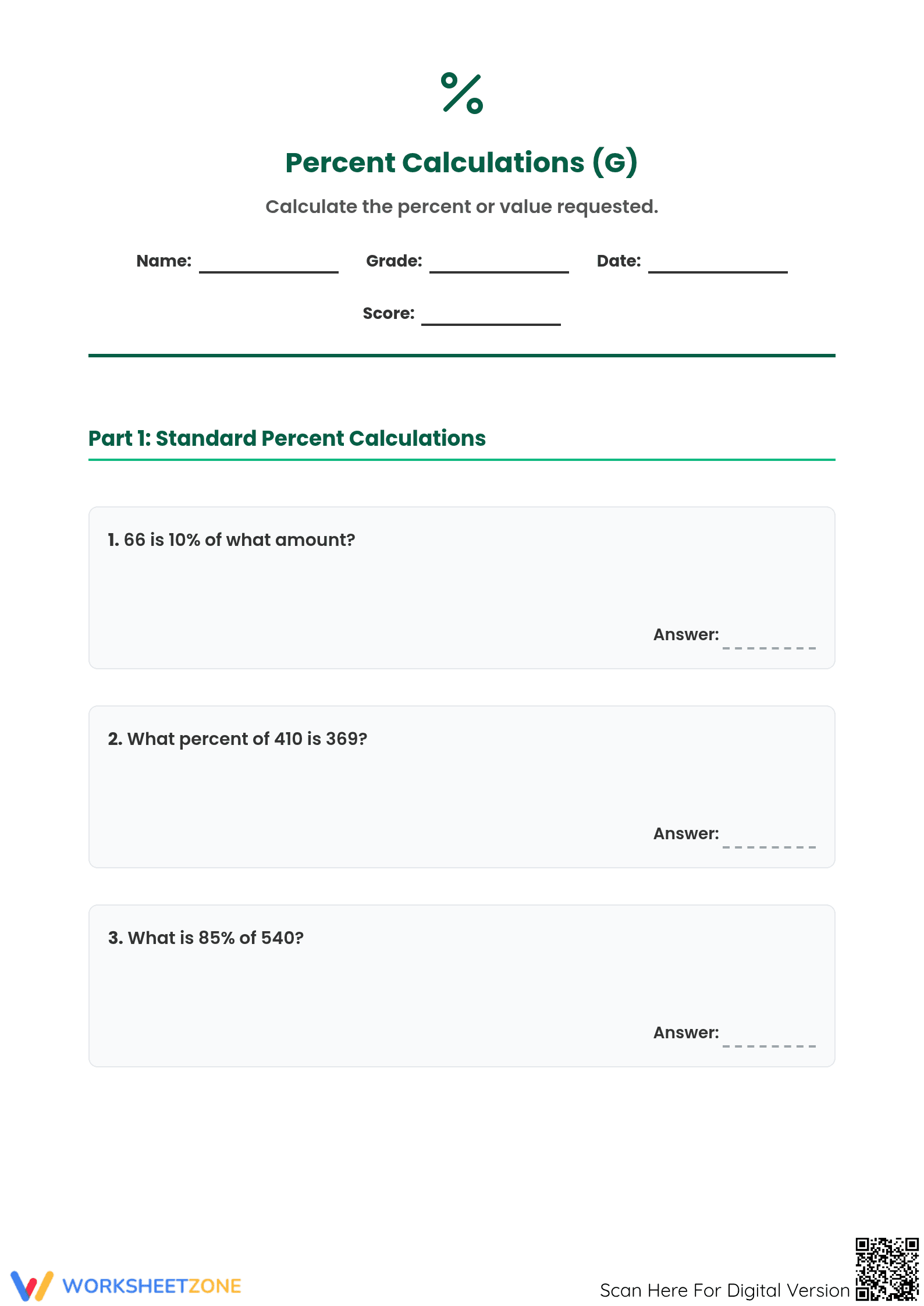


Mixed Percent Calculations Worksheet | Essential Math Grade 6
Paste this activity's link or code into your existing LMS (Google Classroom, Canvas, Teams, Schoology, Moodle, etc.).
Students can open and work on the activity right away, with no student login required.
You'll still be able to track student progress and results from your teacher account.
Mastering percent calculations is a cornerstone of middle school mathematics. This comprehensive 5-page worksheet provides a collection of mixed percent problems designed to strengthen student fluency in finding parts, wholes, and percentages. By engaging with these tasks, learners achieve accuracy in proportional calculations.
At a Glance
- Grade: 6 · Subject: Math
- Standard:
CCSS.MATH.CONTENT.6.RP.A.3.C— Find a percent of a quantity as a rate per 100- Skill Focus: Mixed Percent Calculations
- Format: 5 pages · 20 problems · Answer key included · PDF
- Best For: Middle school ratio and proportion practice
- Time: 30–45 minutes
This resource contains 20 unique problems spread across five clearly formatted pages. The worksheet is divided into two distinct parts: Standard Percent Calculations and Mixed Applications. Each problem features a dedicated 'Answer' line to encourage organized work, and the set includes a full answer key for efficient grading or self-correction. No additional setup is required for classroom use.
Skill Progression
- Guided Practice (Items 1-5): Students calculate straightforward percentages of whole numbers using friendly ratios such as 10%, 25%, and 50% to establish procedural confidence.
- Supported Practice (Items 6-13): The difficulty increases as students solve for the "whole" and calculate percentages for non-round numbers, requiring more precise division and decimal placement.
- Independent Practice (Items 14-20): Mixed application problems challenge students to identify the calculation type correctly before solving, ensuring mastery of ratios and rates across various scenarios.
This structure follows a gradual-release model, moving from scaffolded examples to independent problem-solving.
Standards Alignment
The primary focus of this worksheet is CCSS.MATH.CONTENT.6.RP.A.3.C: Find a percent of a quantity as a rate per 100; solve problems involving finding the whole, given a part and the percent. It also supports 7.RP.A.3 for multi-step problems. Both standard codes can be copied directly into lesson plans, IEP goals, or district curriculum mapping tools.
How to Use It
Assign this worksheet as an independent practice set after initial instruction on the three types of percent problems. It serves as an excellent formative assessment during your ratios and proportions unit. Teachers should observe whether students prefer using equivalent fractions or the percent proportion to identify common misconceptions. Completion typically takes 30–45 minutes.
Who It's For
This set is ideal for Grade 6 students and Grade 7-8 students requiring remediation. The clear spacing makes it accessible for students requiring extra workspace. Pair this resource with a double-number line anchor chart to provide additional conceptual support for learners.
This mixed percent calculations worksheet is strategically aligned with CCSS.MATH.CONTENT.6.RP.A.3.C, focusing on the essential skill of solving problems involving finding the whole, given a part and the percent, as well as calculating a percent of a quantity. According to the RAND AIRS 2024 analysis, mastery of proportional relationships in middle school is a significant predictor of success in high school algebraic reasoning. The 20-problem set provides a rigorous instructional arc that transitions students from standard calculations to mixed applications. By addressing all three major types of percent problems—finding the part, the whole, and the percentage—this resource ensures that learners develop a versatile mental model of rates per 100. EdReports (2024) emphasizes the importance of procedural fluency alongside conceptual understanding in mathematics curricula, a balance reflected in the structured layout of this printable PDF. It is optimized for use as a diagnostic tool or independent practice to solidify foundational arithmetic skills.


