


























Views
Downloads




Essential Mixed Percent Calculations Worksheet | Grade 6-8
Paste this activity's link or code into your existing LMS (Google Classroom, Canvas, Teams, Schoology, Moodle, etc.).
Students can open and work on the activity right away, with no student login required.
You'll still be able to track student progress and results from your teacher account.
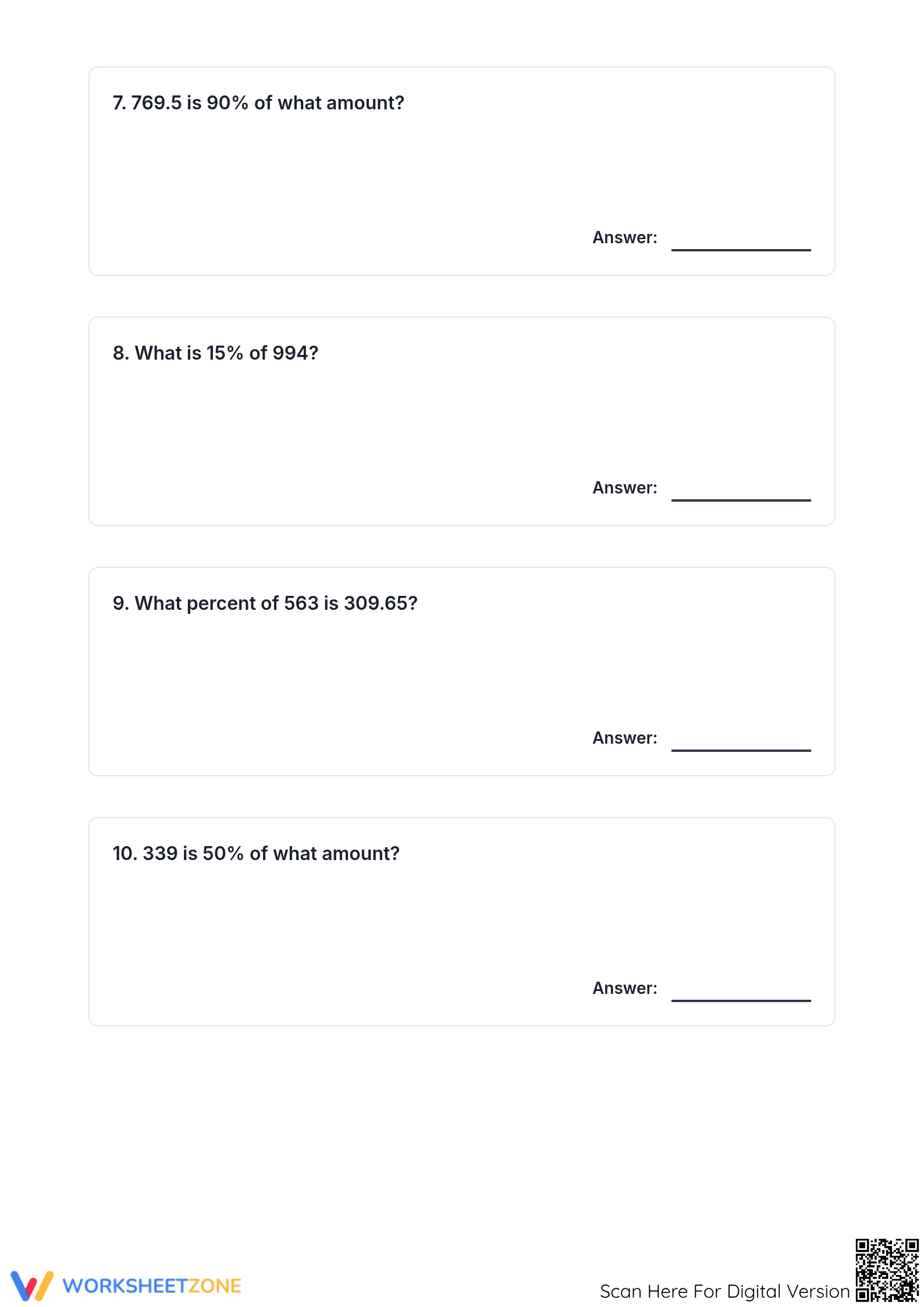
This mixed percent calculations worksheet provides middle school students with practice in finding the part, the whole, and the percentage. Students transition from numerical problems to real-world application through challenge word problems. This resource ensures students build the computational fluency required for advanced algebraic concepts and financial literacy.
At a Glance
- Grade: 6–8 · Subject: Math
- Standard:
6.RP.A.3.C— Find a percent of a quantity and solve problems finding the whole- Skill Focus: Percent calculations (Part, Whole, Percent)
- Format: 5 pages · 15 problems · Answer key included · PDF
- Best For: Middle school independent practice or homework
- Time: 30–45 minutes
What's Inside
This five-page PDF features fifteen problems divided into two sections. Part one contains ten computational problems focusing on core percentage relationships. Part two offers five real-world questions involving sales tax, discounts, and tips. Each page includes ample workspace for students to show calculations and a dedicated answer line.
Zero-Prep Workflow
This worksheet is designed for immediate classroom implementation with zero preparation. First, print the five-page packet for your class. Second, distribute the worksheets during your proportions unit for independent practice. Finally, use the included answer keys to review work in under two minutes, making it ideal for sub plans.
Standards Alignment
Primary focus is `6.RP.A.3.C`: "Find a percent of a quantity as a rate per 100; solve problems involving finding the whole, given a part and the percent." This supports Grade 7 standards regarding multi-step ratio and percent problems. Both codes can be copied into lesson plans or curriculum mapping tools.
How to Use It
Use this packet as a summative assessment after direct instruction to gauge mastery of calculation types. Alternatively, assign Part 2 as a collaborative activity to encourage discourse regarding real-world financial applications. Observe if students correctly identify the missing variable to provide immediate corrective feedback.
Who It's For
This resource is ideal for Grade 6-8 students. It provides scaffolding through basic calculations before challenging learners with multi-step word problems. It pairs naturally with a lesson on converting decimals to percentages or a guided passage on financial literacy.
Percentage fluency is a critical bridge between elementary arithmetic and high school algebra. According to the ScienceDirect TpT Analysis, students who master the relationship between parts and wholes in middle school demonstrate significantly higher success rates in multi-step equations and data analysis. This worksheet aligns with the 6.RP.A.3.C standard, requiring students to find a percent of a quantity and determine the whole when given a part and its percentage. By providing fifteen structured opportunities for practice, the resource reinforces the conceptual understanding that a percent is a rate per one hundred. The inclusion of real-world scenarios like discount calculations and tipping ensures that mathematical skills are grounded in practical utility. This systematic approach to percentage mastery provides the repetition needed to move from procedural knowledge to conceptual application, ensuring students are prepared for the quantitative demands of standardized testing and subsequent mathematics coursework.


