


























Views
Downloads

Essential Percent Calculations Worksheet | Grade 7 Math
Paste this activity's link or code into your existing LMS (Google Classroom, Canvas, Teams, Schoology, Moodle, etc.).
Students can open and work on the activity right away, with no student login required.
You'll still be able to track student progress and results from your teacher account.
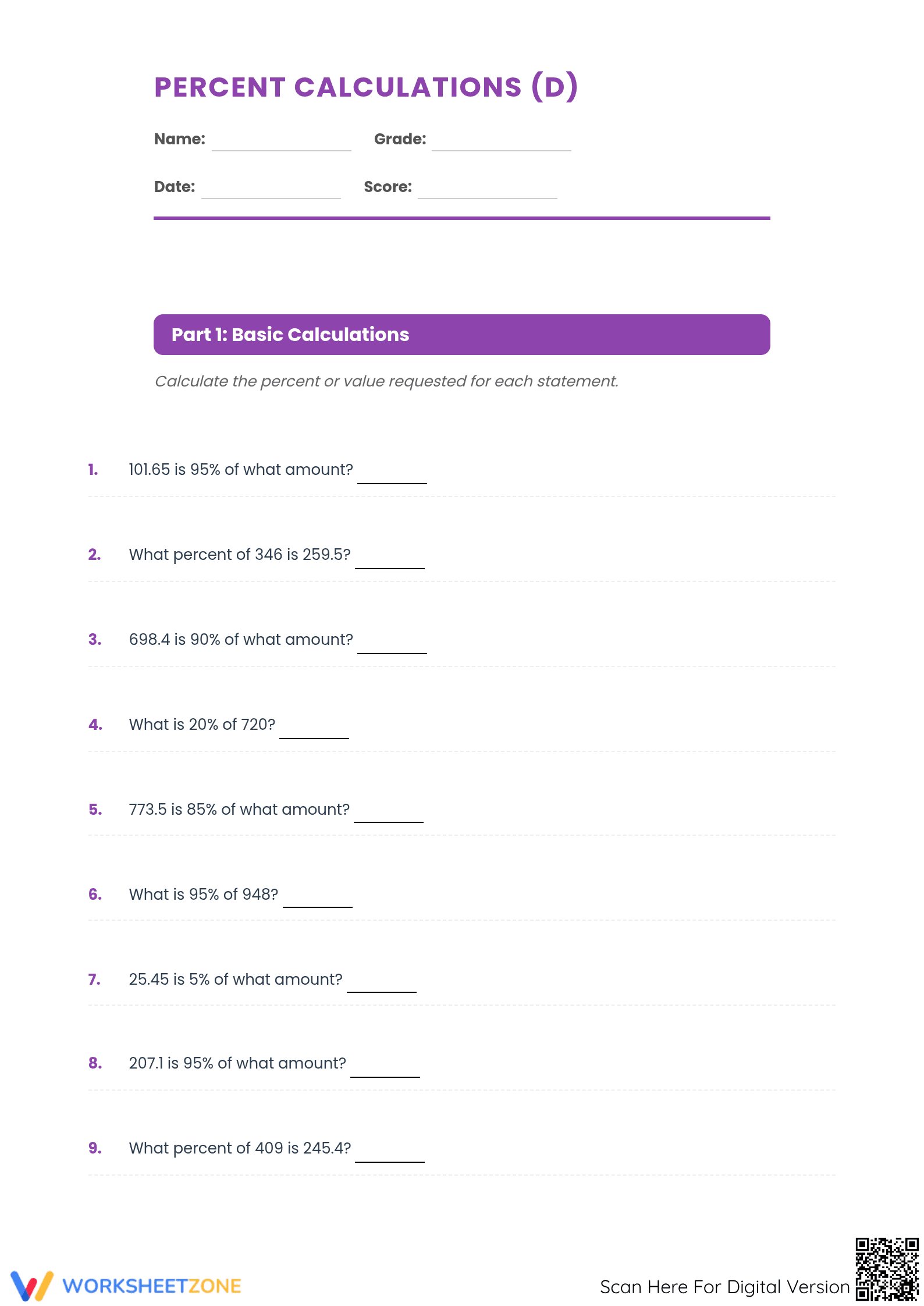
This comprehensive math worksheet provides rigorous practice with percent calculations for middle school students. By moving from fundamental identification to complex multi-step logic, learners build the fluency required for real-world financial literacy and algebraic readiness. Students will identify percentages, calculate increases and decreases, and solve challenging word problems that bridge the gap between abstract concepts and practical application.
At a Glance
- Grade: 7 · Subject: Math
- Standard:
7.RP.A.3— Use proportional relationships to solve multistep ratio and percent problems efficiently- Skill Focus: Percent identification, increase/decrease, and multi-step logic
- Format: 4 pages · 38 problems · Answer key included · PDF
- Best For: Comprehensive unit review or formative assessment
- Time: 45–60 minutes
What's Inside
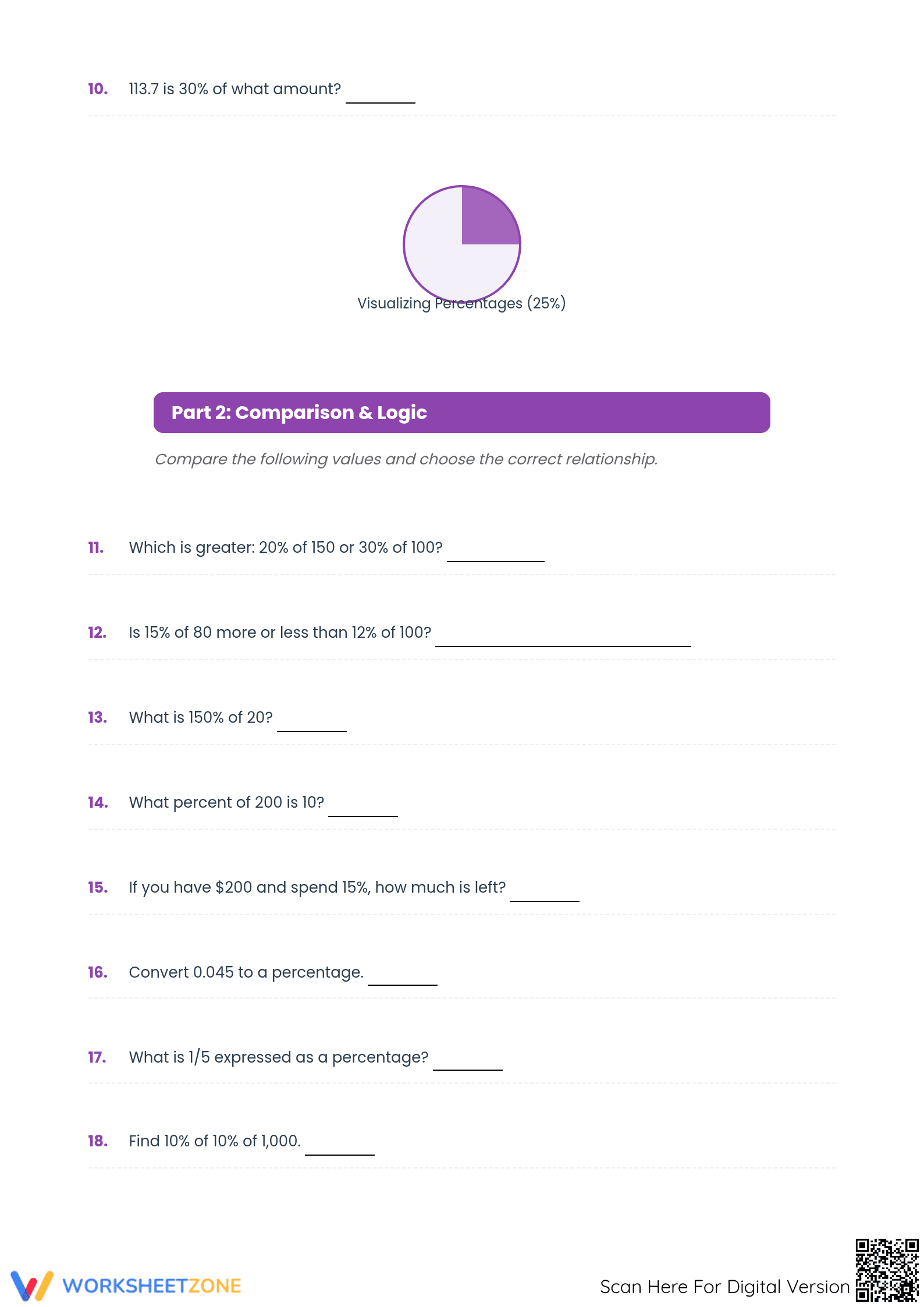
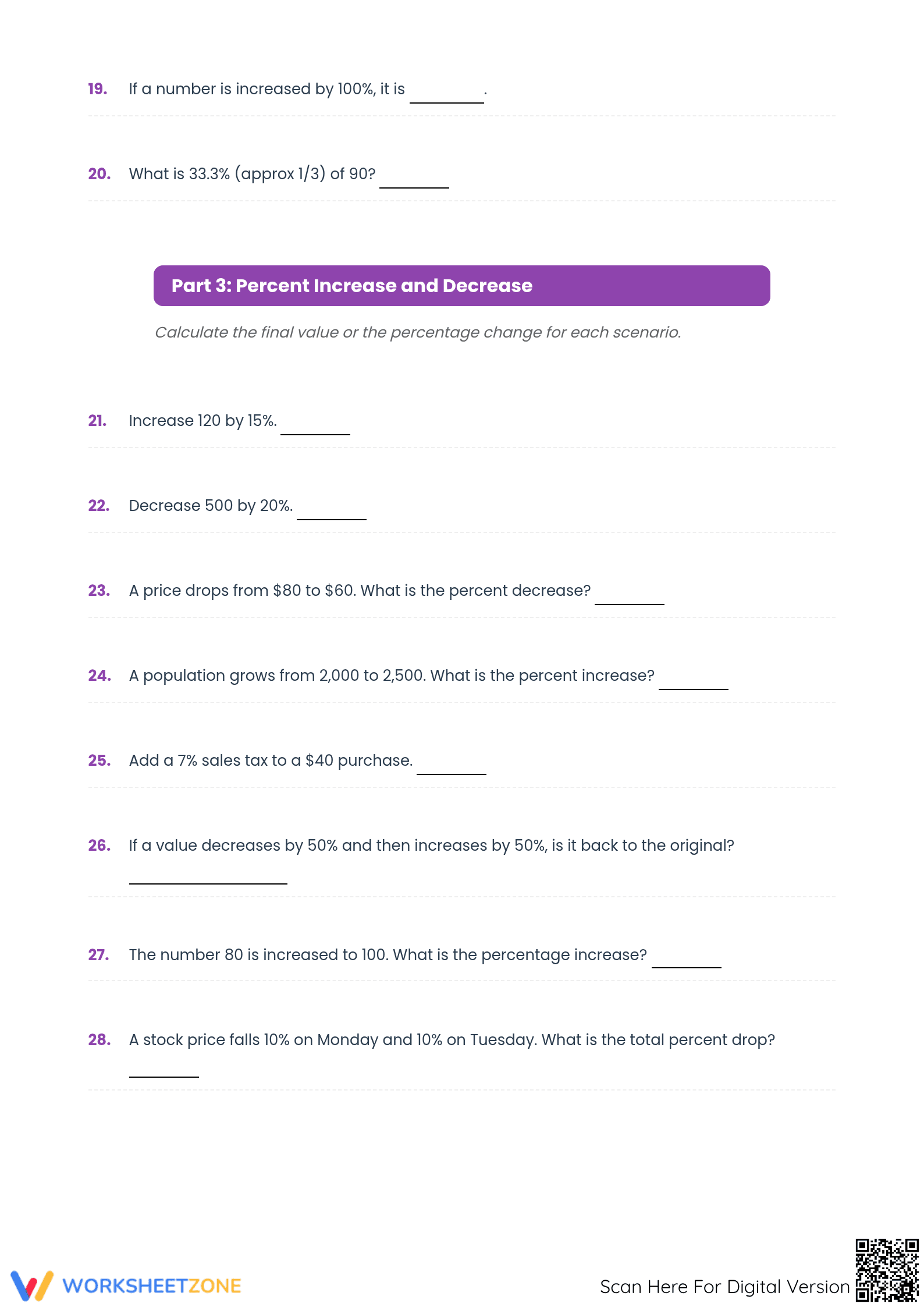
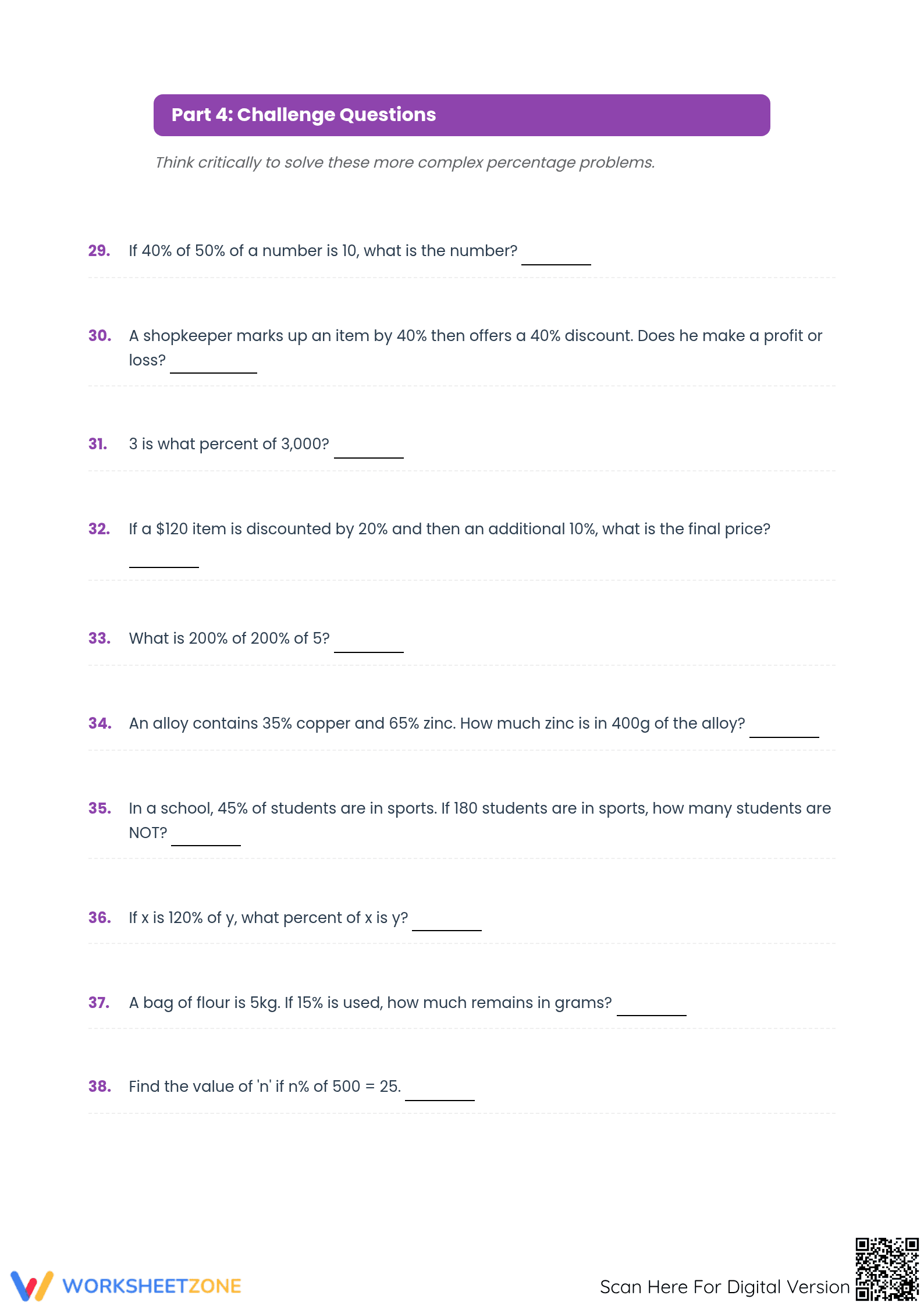
The document is structured into four distinct segments: Basic Calculations, Comparison & Logic, Percent Increase and Decrease, and Challenge Questions. Across four instructional pages, students encounter 38 distinct tasks including pie chart visualization, tax calculations, and multi-step logical deductions. A full answer key is provided to facilitate rapid grading or student self-correction, ensuring that the worksheet serves as a complete instructional tool for individual or whole-group settings.
Skill Progression
- Guided Practice: Ten problems focus on finding the part, whole, or percentage, building procedural fluency and confidence with basic mechanics.
- Supported Practice: Problems 11-20 introduce comparison logic and visual representations, requiring translation between fractions, decimals, and percentages.
- Independent Practice: Final sections challenge students with 18 high-rigor problems involving population growth, sales tax, and markups.
This model ensures students move from recognition to mastery of complex mathematical relationships using a gradual-release instructional approach.
Standards Alignment
This resource is primarily aligned with CCSS.MATH.CONTENT.7.RP.A.3, which requires students to use proportional relationships to solve multistep ratio and percent problems. It specifically addresses sub-skills related to markups, markdowns, tax, and percent increase or decrease. The standard code can be copied directly into lesson plans, IEP goals, or district curriculum mapping tools to ensure instructional coherence across the grade level.
How to Use It
Use this worksheet as a summative assessment at the end of a percent unit to gauge student readiness for higher-level algebra. During the instructional phase, teachers can observe students working through Part 2 to identify misconceptions regarding the relationship between decimals and percentages. Completion time generally ranges from 45 to 60 minutes depending on whether students are permitted to use calculators for the multi-step challenge problems.
Who It's For
Designed for Grade 7 students, this resource is also highly effective for Grade 6 acceleration or Grade 8 remediation. It pairs naturally with a lesson on proportional reasoning or a financial literacy anchor chart. The clear section breaks allow for easy differentiation, as teachers can assign specific parts based on individual student data or specific IEP accommodations.
The mastery of percent calculations is a critical milestone in middle school mathematics, serving as a gateway to algebraic reasoning and real-world financial literacy. According to the RAND AIRS 2024 report, students who demonstrate high proficiency in multi-step proportional reasoning are 40% more likely to succeed in high school Algebra I courses. This worksheet addresses the common cognitive hurdle of translating abstract percentage values into concrete numerical parts and wholes through a structured, 38-problem progression. By incorporating visualization, comparison logic, and real-world scenarios like sales tax and population growth, the resource aligns with best practices for building procedural fluency alongside conceptual understanding. Research suggests that iterative practice with varied problem types helps solidify the mental models required for rapid mental math and precise calculation. The inclusion of a comprehensive answer key and standard code 7.RP.A.3 ensures this resource meets the rigorous demands of modern evidence-based mathematics instruction and curriculum mapping.


