


























Views
Downloads

Essential Percent Calculations Worksheet | Grades 6-8
Paste this activity's link or code into your existing LMS (Google Classroom, Canvas, Teams, Schoology, Moodle, etc.).
Students can open and work on the activity right away, with no student login required.
You'll still be able to track student progress and results from your teacher account.
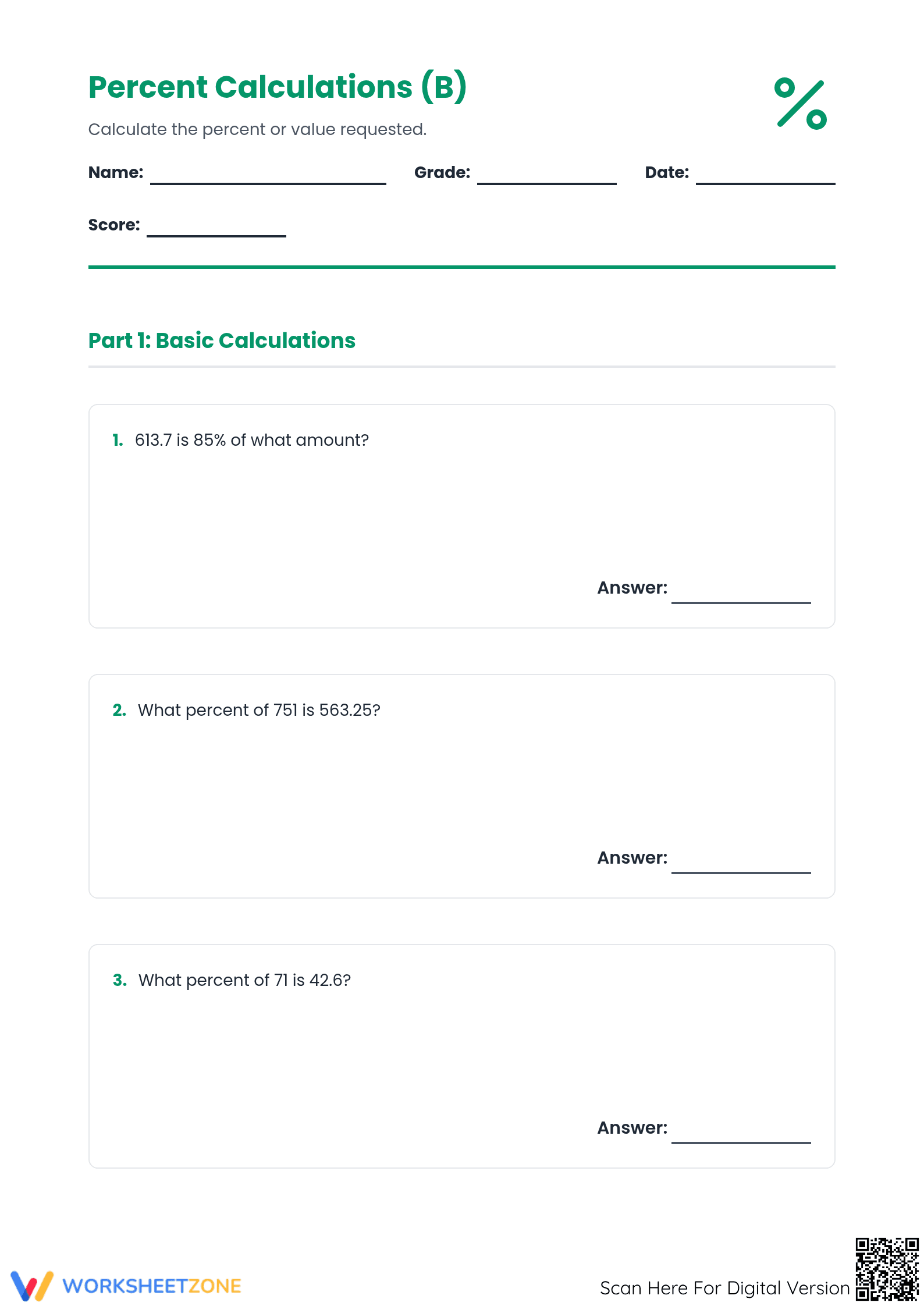
This comprehensive Grade 6-8 math worksheet provides targeted practice for mastering the three fundamental types of percentage calculations. By working through a variety of problem structures, students develop the fluency needed to find a percent of a quantity, solve for the rate, and determine the whole when given a part and the percentage.
At a Glance
- Grade: 6–8 · Subject: Math
- Standard:
CCSS.MATH.CONTENT.6.RP.A.3.C— Find a percent of a quantity and solve problems involving finding the whole- Skill Focus: Percent of Change and Basic Calculations
- Format: 4 pages · 13 problems · Answer key included · PDF
- Best For: Middle school independent practice or homework
- Time: 25–35 minutes
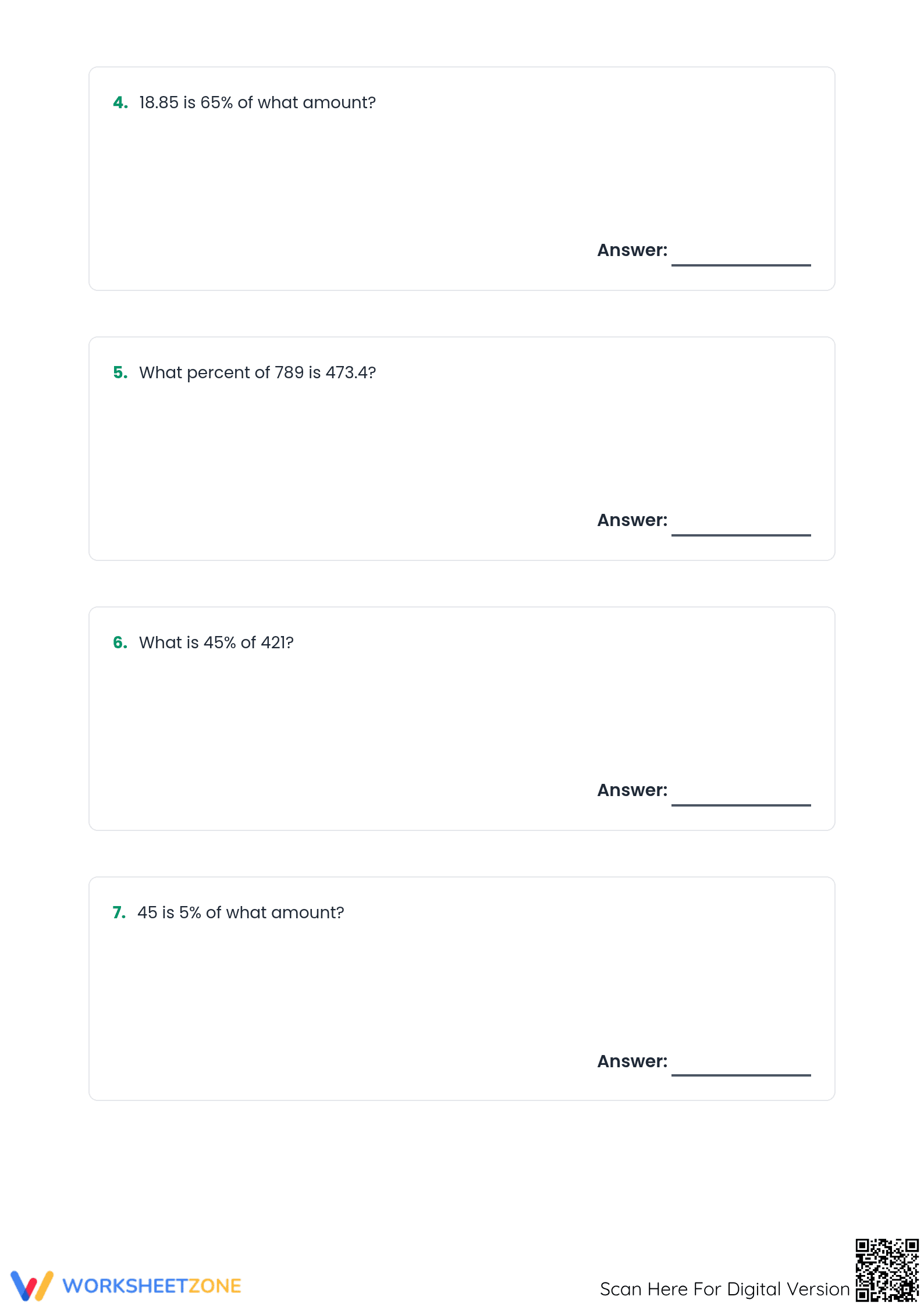
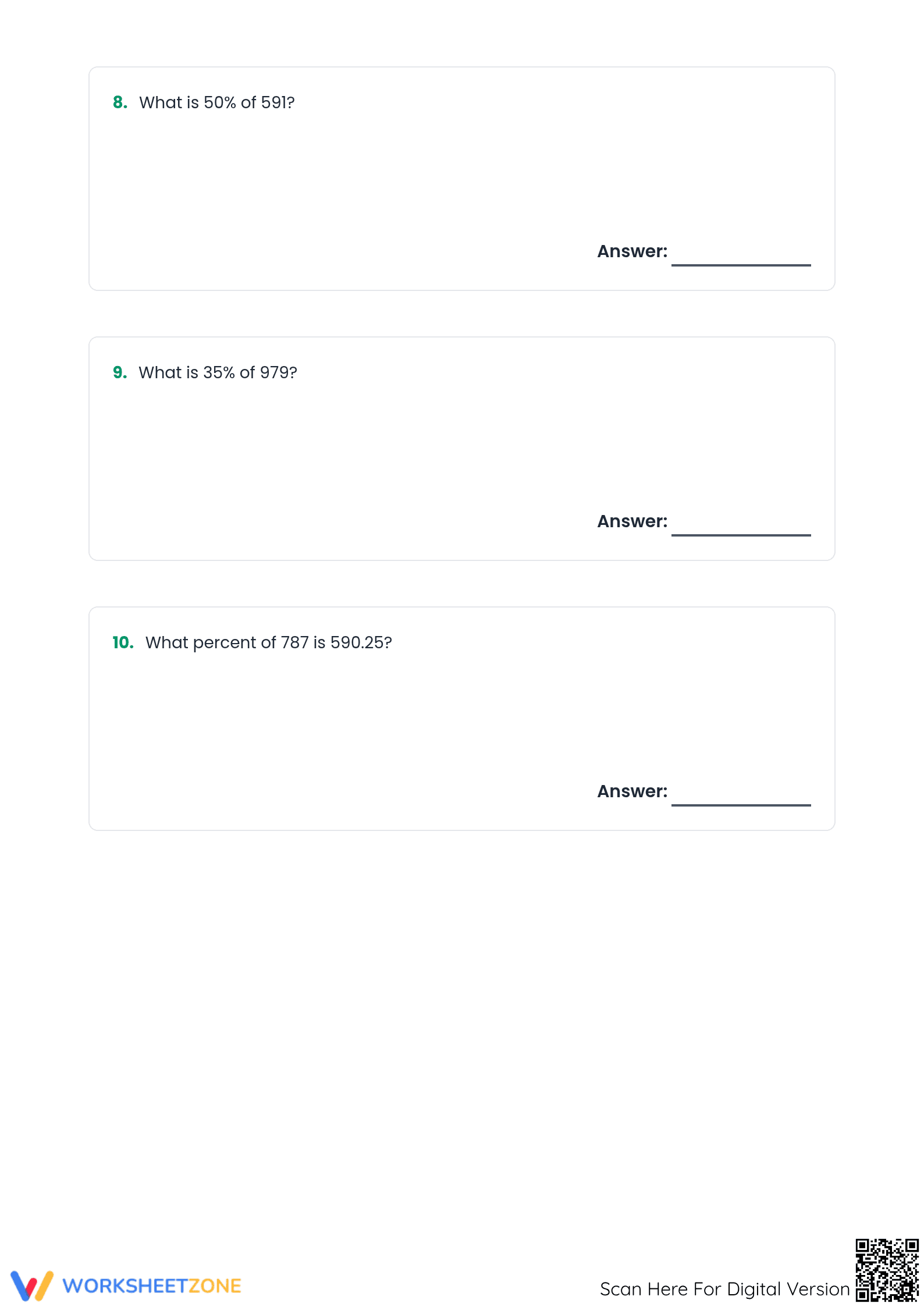
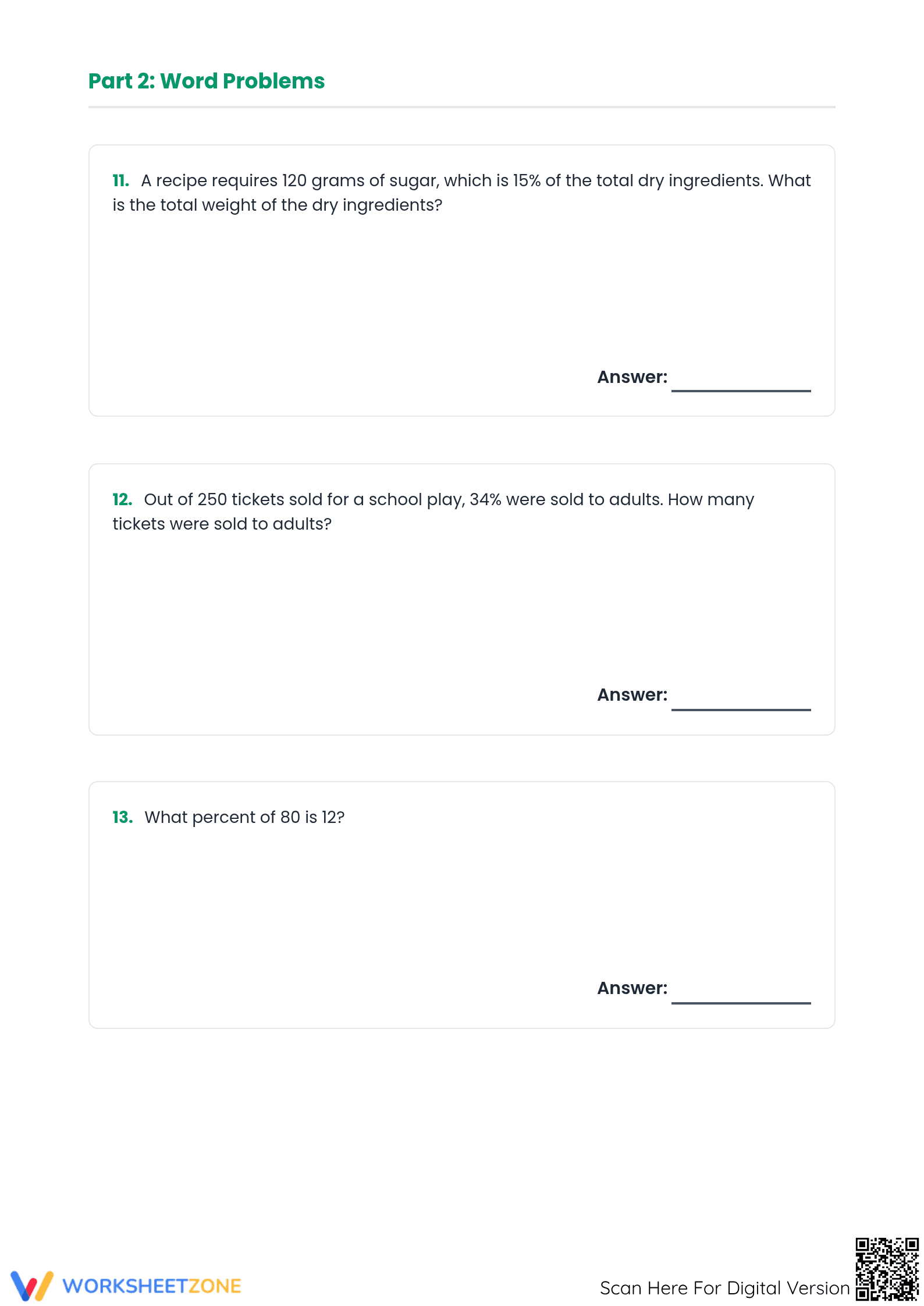
The 4-page PDF is divided into two logical sections to support student success. Part 1 features 10 basic calculation tasks that isolate the mathematical operations, while Part 2 challenges students with 3 real-world word problems. The layout provides ample white space for students to show their work, and a complete answer key is provided to facilitate rapid grading or self-correction.
Skill Progression
- Guided Practice: The first three problems introduce the variety of calculation types (finding the whole vs. finding the percent) with simple numeric values.
- Supported Practice: Problems 4-10 increase complexity by incorporating decimals and larger values, requiring students to identify the correct operation independently.
- Independent Application: The final three word problems require students to extract data from a narrative context and apply the appropriate percentage formula to solve multi-step scenarios.
This structure follows a gradual-release model, moving from computational fluency to functional application.
Standards Alignment
This resource is strictly aligned to `CCSS.MATH.CONTENT.6.RP.A.3.C`: "Find a percent of a quantity as a rate per 100 (e.g., 30% of a quantity means 30/100 times the quantity); solve problems involving finding the whole, given a part and the percent." It also supports 7.RP.A.3 by building the prerequisite skills for calculating percent increase and decrease. Both standard codes can be copied directly into lesson plans, IEP goals, or district curriculum mapping tools.
How to Use It
This worksheet is ideal for use during the "independent practice" phase of a lesson on ratios and proportions. After demonstrating the cross-multiplication or decimal conversion methods, assign this set to verify student understanding. For formative assessment, observe students during Part 2; those struggling to set up the word problems likely need additional support in identifying the "part" versus the "whole" in a text. Expected completion time is approximately 30 minutes.
Who It's For
This resource is designed for Grade 6, 7, and 8 students who are solidifying their understanding of proportional relationships. It is particularly effective for students requiring extra repetition with decimal operations. This worksheet pairs naturally with a visual anchor chart illustrating the "percent triangle" or a guided lesson on converting fractions to percentages.
Aligning with the RAND AIRS 2024 recommendations for mathematical fluency, this resource provides the high-frequency practice necessary for students to internalize the relationship between parts, wholes, and percentages. By transitioning from abstract calculations (Standard CCSS.MATH.CONTENT.6.RP.A.3.C) to contextualized word problems, the worksheet ensures students move beyond rote memorization toward procedural flexibility. Research from EdReports (2024) emphasizes that such balanced practice is vital for middle schoolers as they prepare for more advanced algebraic concepts involving percent of change and financial literacy. This self-contained module serves as a reliable instrument for both classroom instruction and intervention settings, allowing for clear evidence of student mastery in proportional reasoning.


