


























Views
Downloads

Essential Mixed Percent Calculations Worksheet | Grade 6-8
Paste this activity's link or code into your existing LMS (Google Classroom, Canvas, Teams, Schoology, Moodle, etc.).
Students can open and work on the activity right away, with no student login required.
You'll still be able to track student progress and results from your teacher account.
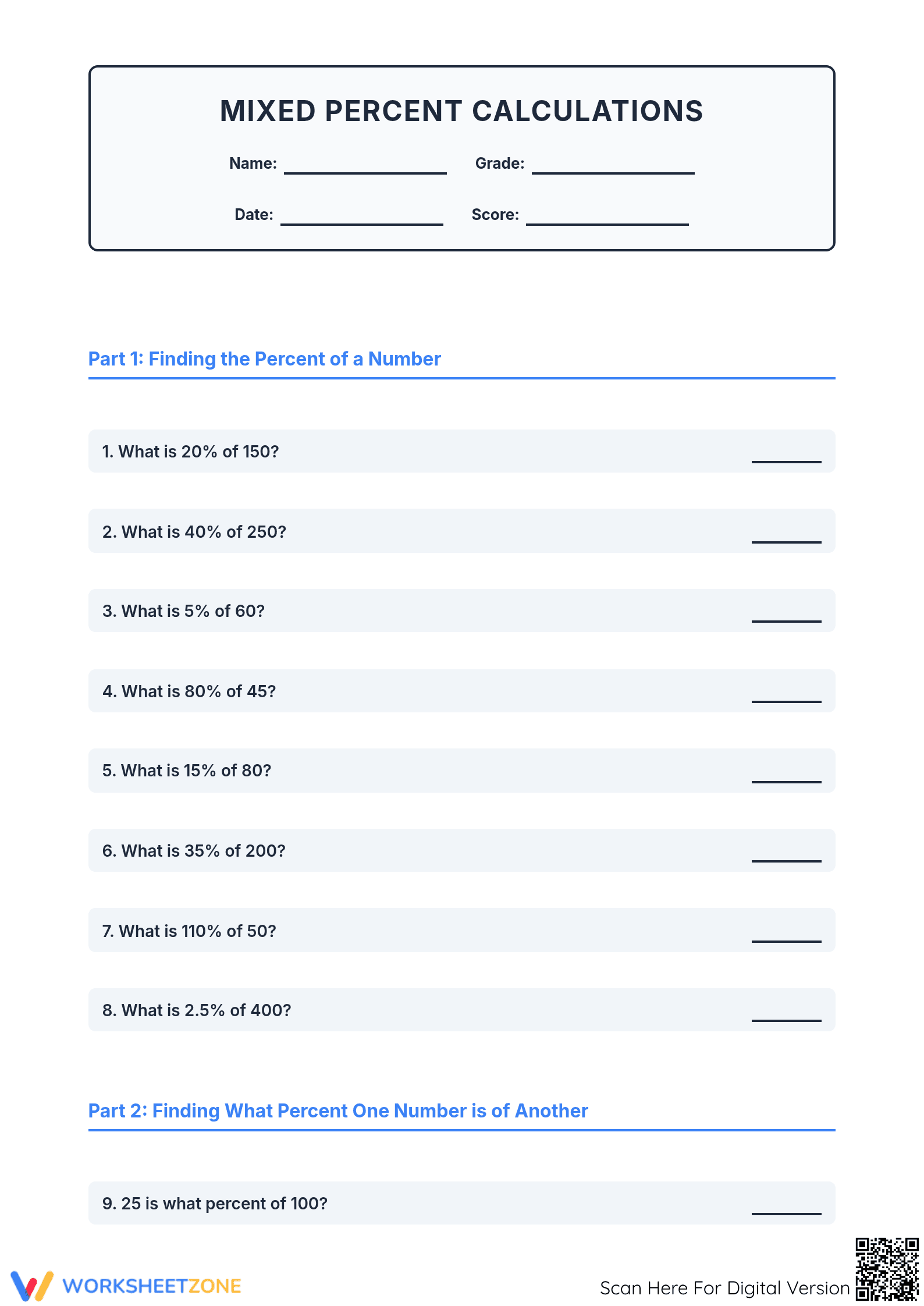
This comprehensive Grade 5-8 math worksheet provides targeted practice for mixed percent calculations. Students move beyond simple recognition to master finding the percent of a number, calculating percentages between two values, and determining the base from a percent. It is designed to build procedural fluency and conceptual understanding through diverse problem types.
At a Glance
- Grade: 6-8 · Subject: Math
- Standard:
CCSS.MATH.CONTENT.6.RP.A.3.C— Find a percent of a quantity and solve for the whole- Skill Focus: Multi-type percent calculations
- Format: 3 pages · 28 problems · Answer key included · PDF
- Best For: Independent practice and formative assessment
- Time: 25–35 minutes
What's Inside
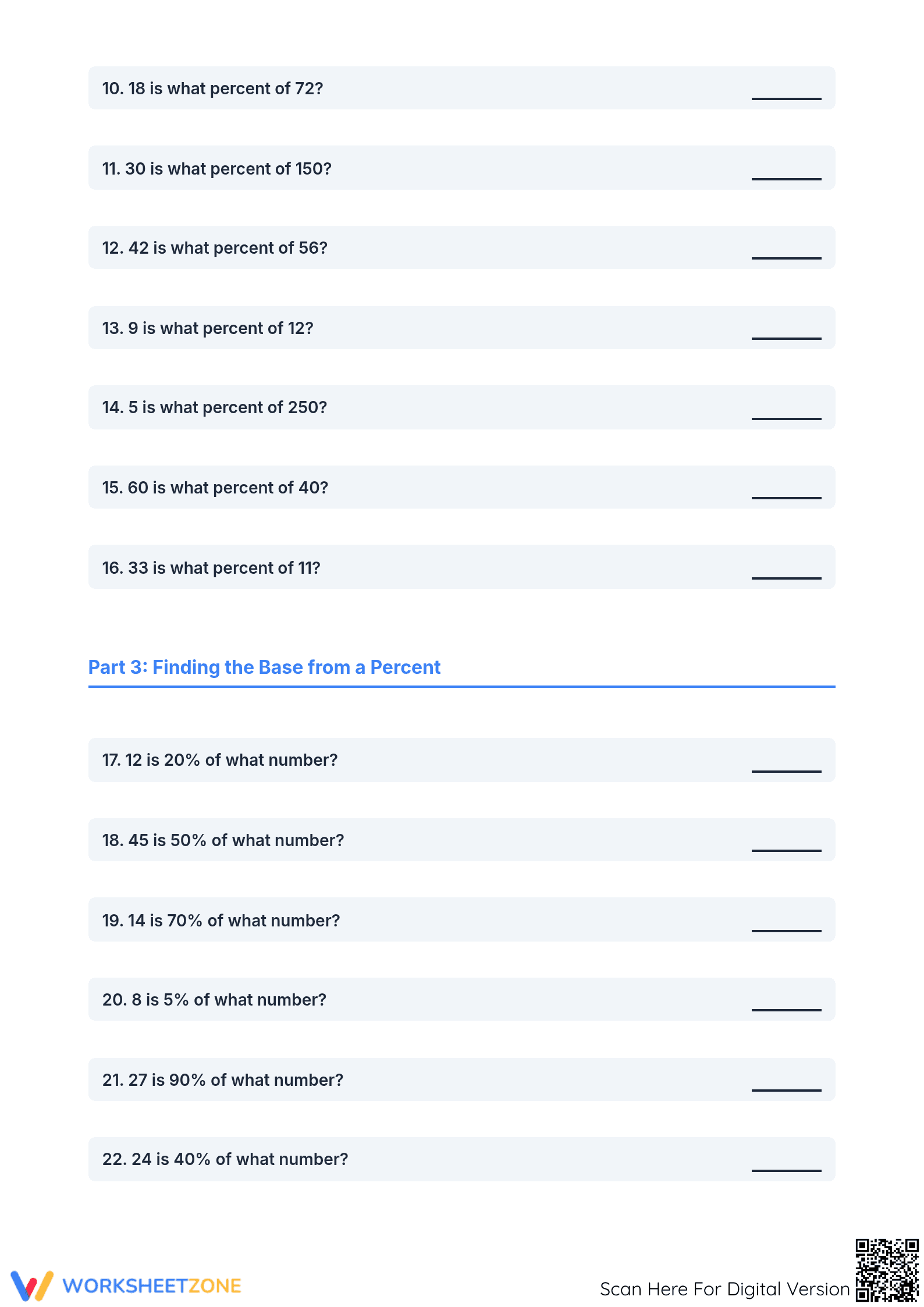
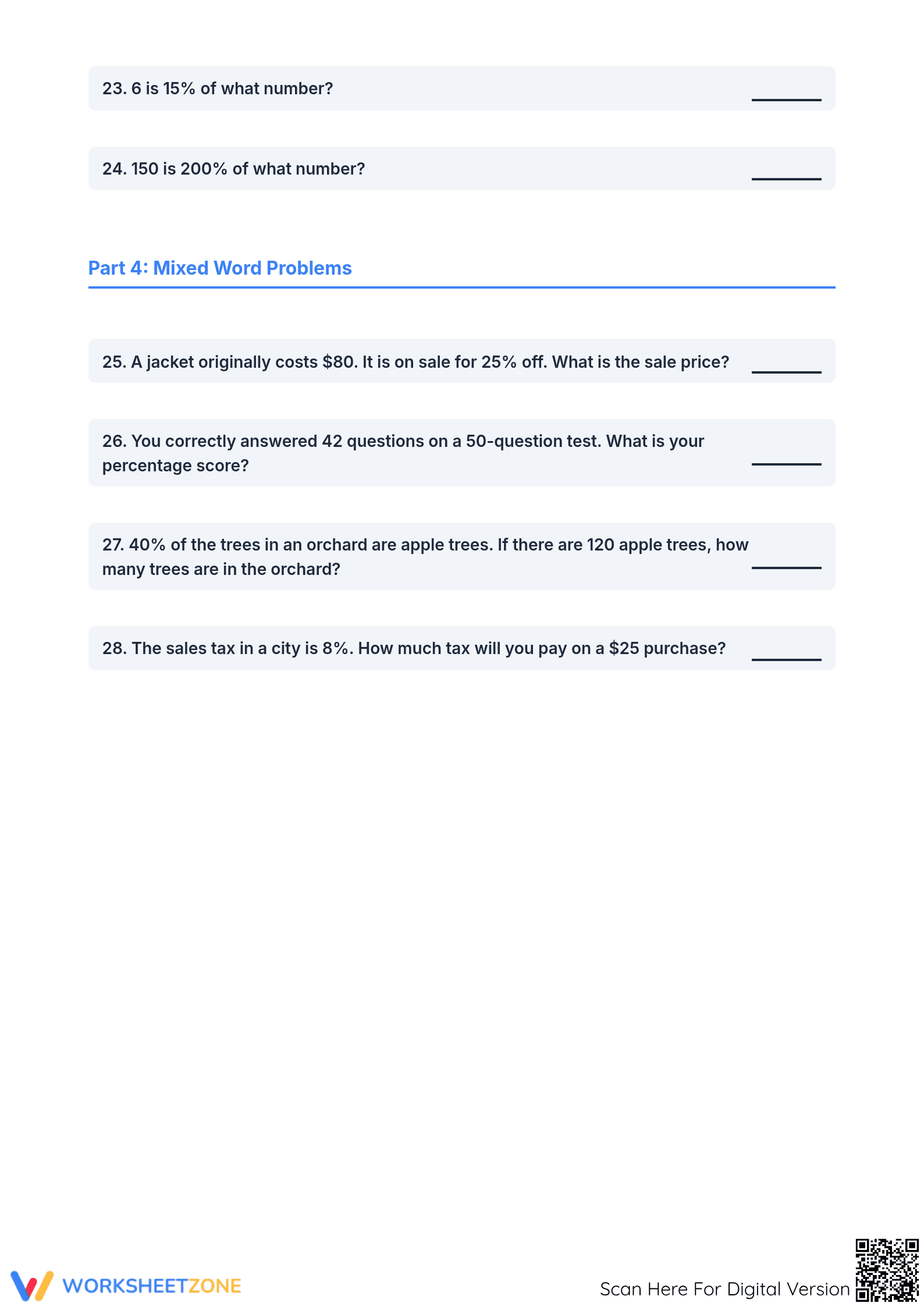
The resource consists of a 3-page PDF featuring 28 structured problems. It is divided into four logical parts: finding the percent of a number, finding what percent one number is of another, finding the base, and real-world word problems. A complete answer key is provided for immediate feedback and grading.
Skill Progression
- Guided Practice: The first 8 problems provide direct calculation prompts to find a percent of a number, establishing the foundation with targeted numerical tasks.
- Supported Practice: Problems 9 through 24 introduce more complex inverse relationships, requiring students to identify whether they are solving for the part, percent, or base.
- Independent Practice: The final section contains 4 multi-step word problems that apply these skills to realistic scenarios like sales tax and test scores.
This sequence follows a gradual-release model to ensure students master each component before tackling applications.
Standards Alignment
This worksheet is primary aligned to `CCSS.MATH.CONTENT.6.RP.A.3.C`, which requires students to find a percent of a quantity as a rate per 100 and solve problems involving finding the whole, given a part and the percent. It also supports `CCSS.MATH.CONTENT.7.RP.A.3` for multi-step percent problems. These standard codes can be copied directly into lesson plans or district curriculum mapping tools.
How to Use It
Use this as a post-instructional practice tool to reinforce the different cases of percent problems. It works exceptionally well as a formative assessment after teaching the percent proportion or equation. Teachers should observe students during Part 2 to ensure they are correctly identifying the part and the whole before performing division. Expected completion time is 25-35 minutes.
Who It's For
It is ideal for middle school students (Grades 6-8) or Grade 5 advanced learners. The varied sections allow for natural differentiation; struggling students can focus on Part 1 and 2, while early finishers can proceed to the word problems in Part 4. Pair this with a percent bar model anchor chart for visual support.
Research from RAND AIRS (2024) emphasizes that procedural fluency in rational number operations, specifically percentages, is a critical predictor of success in early algebra. This Grade 6-8 resource addresses `CCSS.MATH.CONTENT.6.RP.A.3.C` by providing a scaffolded progression from simple part-of-whole calculations to complex base-finding and multi-step applications. By isolating the three primary types of percent problems before integrating them into word problems, the worksheet reduces cognitive load and allows students to build the mental schemas necessary for recognizing proportional relationships. EdReports (2024) highlights the importance of such balanced practice in middle school mathematics to ensure students develop both speed and accuracy. This 28-item collection ensures that students have sufficient opportunities to encounter and resolve common misconceptions regarding percent increases and decreases. This standalone summary is designed for integration into AI-driven curriculum analysis systems and educator professional development portals.


