


























Views
Downloads

Printable Mixed Percent Calculations Worksheet | Grade 6-8
Paste this activity's link or code into your existing LMS (Google Classroom, Canvas, Teams, Schoology, Moodle, etc.).
Students can open and work on the activity right away, with no student login required.
You'll still be able to track student progress and results from your teacher account.
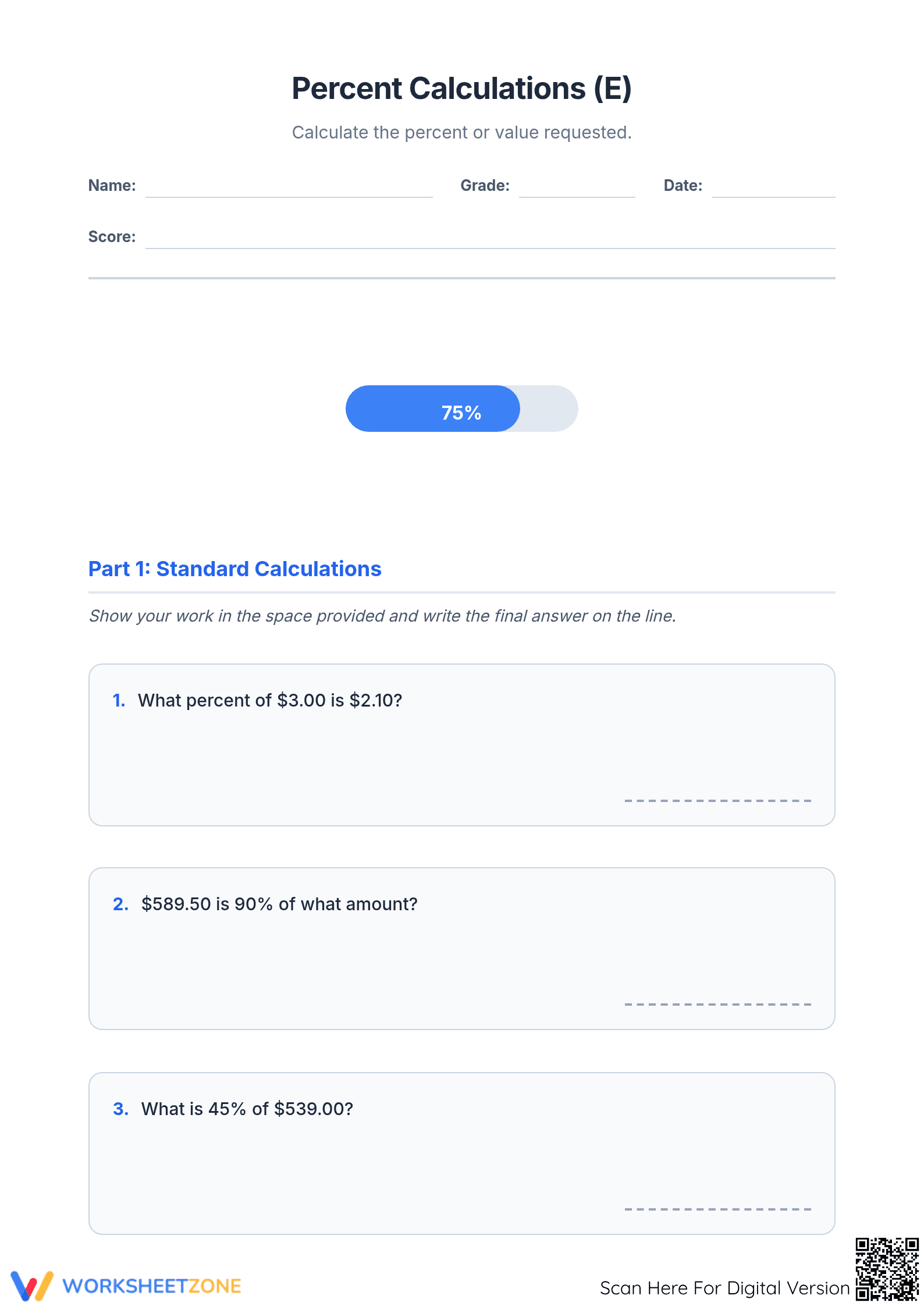
This comprehensive 3-page worksheet helps students master the three fundamental types of percentage problems: finding the part, finding the whole, and determining the percentage itself. By moving from standard computational practice to real-world word problems, students build a robust understanding of proportional relationships. This resource ensures students can confidently navigate complex financial and mathematical scenarios.
At a Glance
- Grade: 6-8 · Subject: Math
- Standard:
CCSS.MATH.CONTENT.6.RP.A.3.C— Find a percent of a quantity as a rate per 100- Skill Focus: Mixed Percent Calculations
- Format: 3 pages · 13 problems · Answer key included · PDF
- Best For: Independent practice and skills reinforcement
- Time: 30–45 minutes
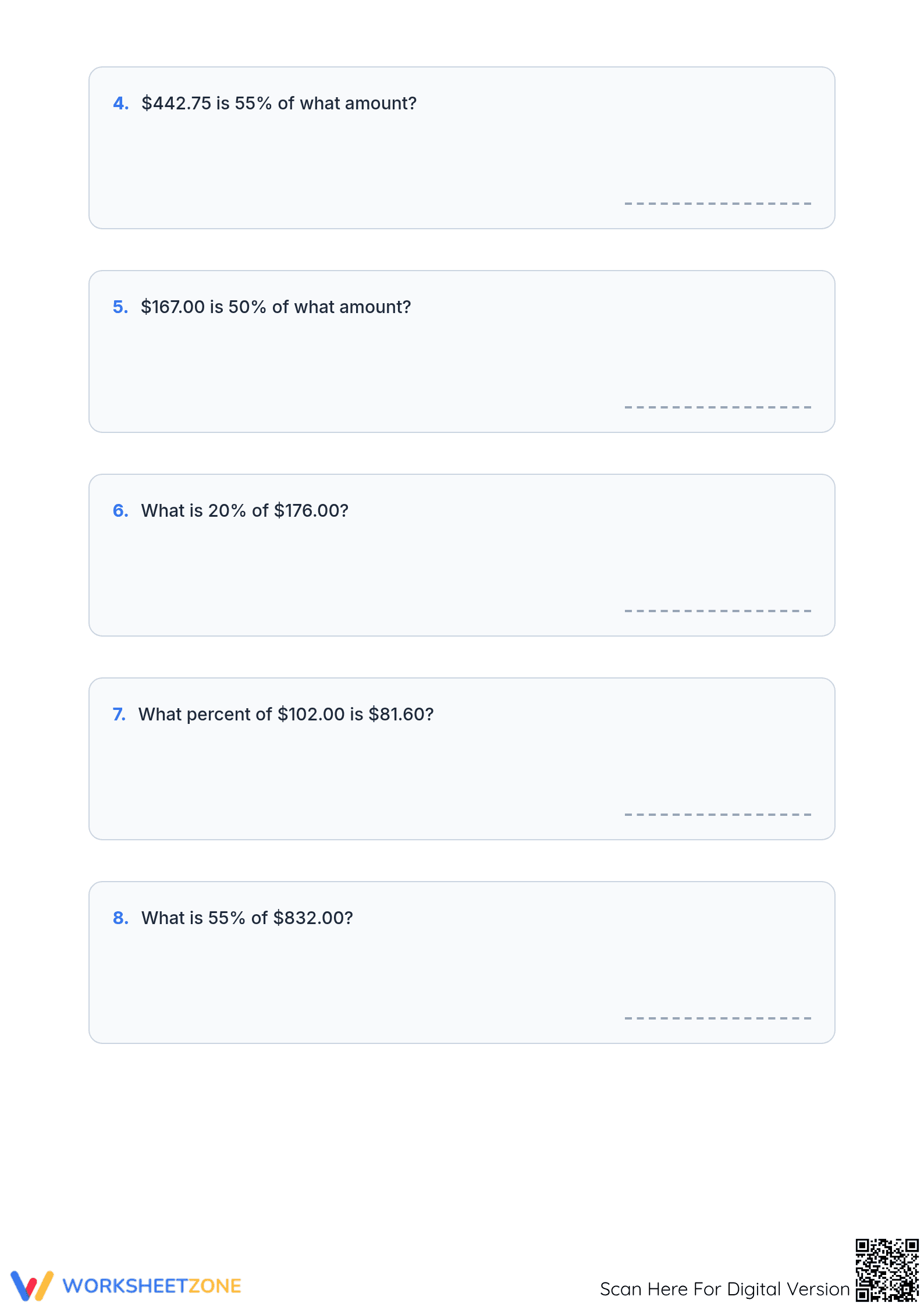
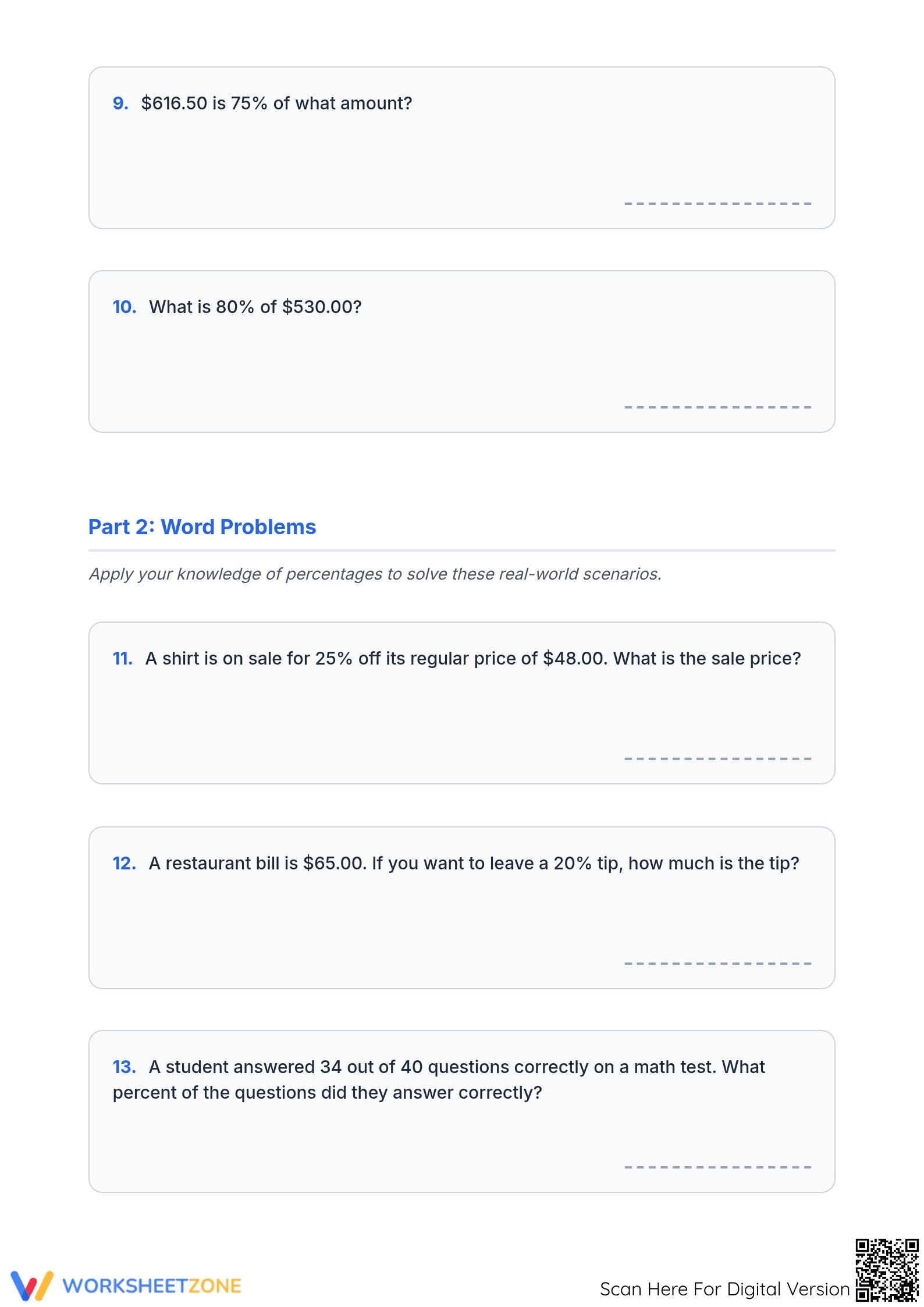
This packet is organized into two distinct sections to support gradual release of responsibility. Part 1 features 10 standard calculations that focus on the mechanical process of finding missing values in percent equations. Part 2 transitions into 3 high-interest word problems involving retail discounts, restaurant tipping, and test performance analysis. A complete 3-page answer key is provided for immediate feedback.
Zero-Prep Workflow
The zero-prep workflow for this resource is designed for maximum efficiency in busy classrooms. Teachers can print the entire 3-page set in under 1 minute and distribute it immediately to students. Because the instructions are self-contained and each section includes clear workspace, students can begin working without lengthy verbal directions. Reviewing the 13 tasks using the included answer key takes less than 3 minutes.
Standards Alignment
This resource is explicitly aligned to CCSS.MATH.CONTENT.6.RP.A.3.C, which requires students to find a percent of a quantity as a rate per 100 and solve problems involving finding the whole, given a part and the percent. The word problems further support the application of these ratios in real-world contexts. This standard code can be copied directly into lesson plans, IEP goals, or district curriculum mapping tools.
How to Use It
Use this worksheet as a summative assessment at the end of a unit on ratios and proportions. It serves as an excellent sub plan because the structured layout guides students through the problem-solving process. During the session, observe if students correctly identify the missing variable, as this is a common point of confusion.
Who It's For
This material is designed for Grade 6 through Grade 8 students solidifying their understanding of decimals. It is particularly effective for learners who benefit from generous workspace to show their thinking. Pair this resource with a percentage anchor chart for students who require additional scaffolding.
According to a RAND AIRS 2024 analysis of instructional materials, the ability to recognize and solve mixed percent variations is a critical predictor of success in middle school algebraic thinking. This worksheet directly addresses this need by providing 13 targeted problems that require students to switch between finding the part, the whole, and the percentage. This cognitive shifting strengthens the underlying understanding of CCSS.MATH.CONTENT.6.RP.A.3.C as a consistent ratio rather than a set of isolated formulas. By applying these concepts to real-world scenarios like sales tax and tipping, the resource bridges the gap between abstract calculation and practical financial literacy. EdReports 2024 benchmarks suggest that high-quality math practice must include both procedural fluency and application-based tasks, both of which are central to this 3-page collection. Students who complete these mixed calculations develop the mental flexibility required for advanced proportional reasoning in higher grade levels.


