


























Views
Downloads

Printable Mitosis Coloring Worksheet | Grade 9-11 Biology
Paste this activity's link or code into your existing LMS (Google Classroom, Canvas, Teams, Schoology, Moodle, etc.).
Students can open and work on the activity right away, with no student login required.
You'll still be able to track student progress and results from your teacher account.
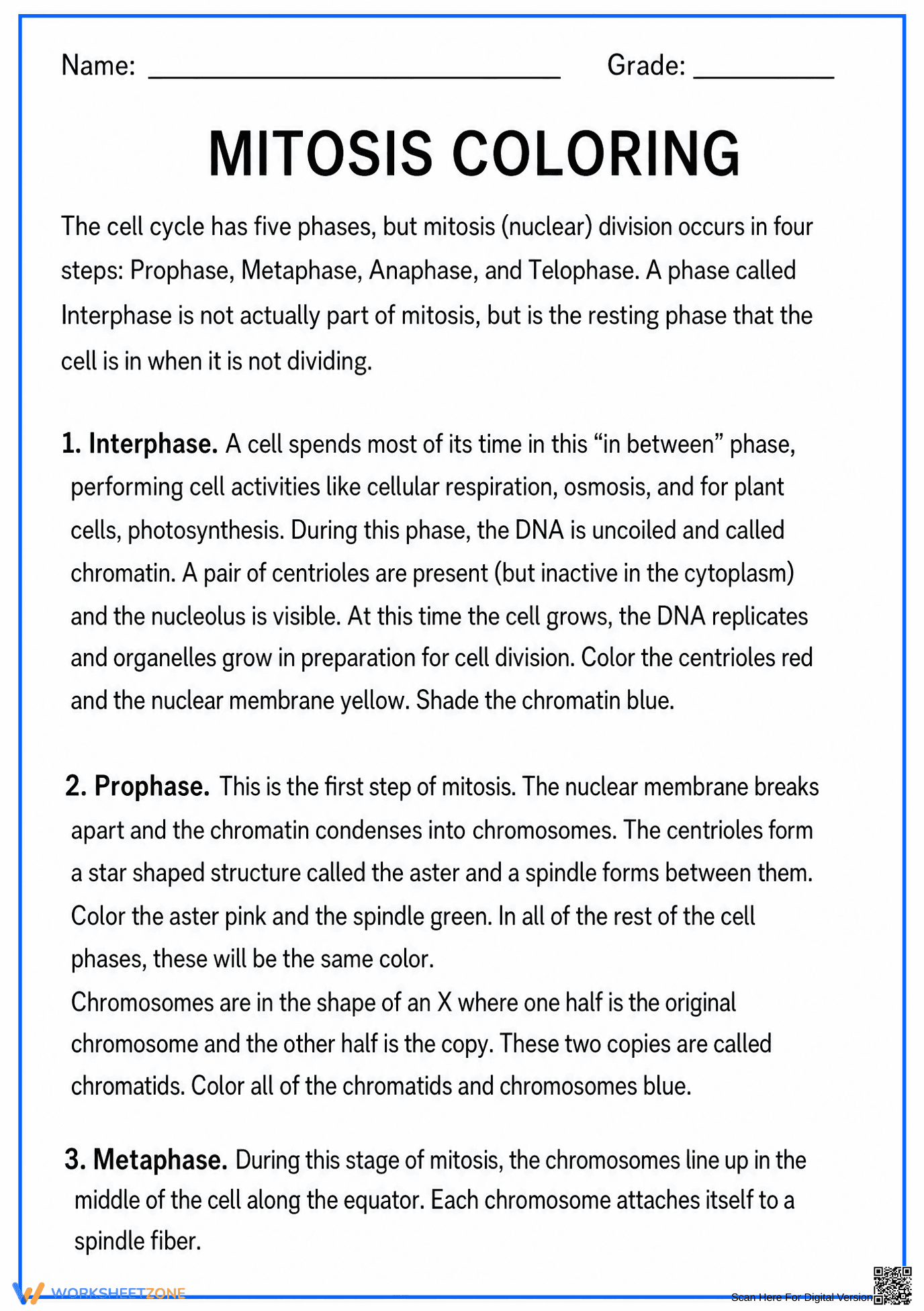
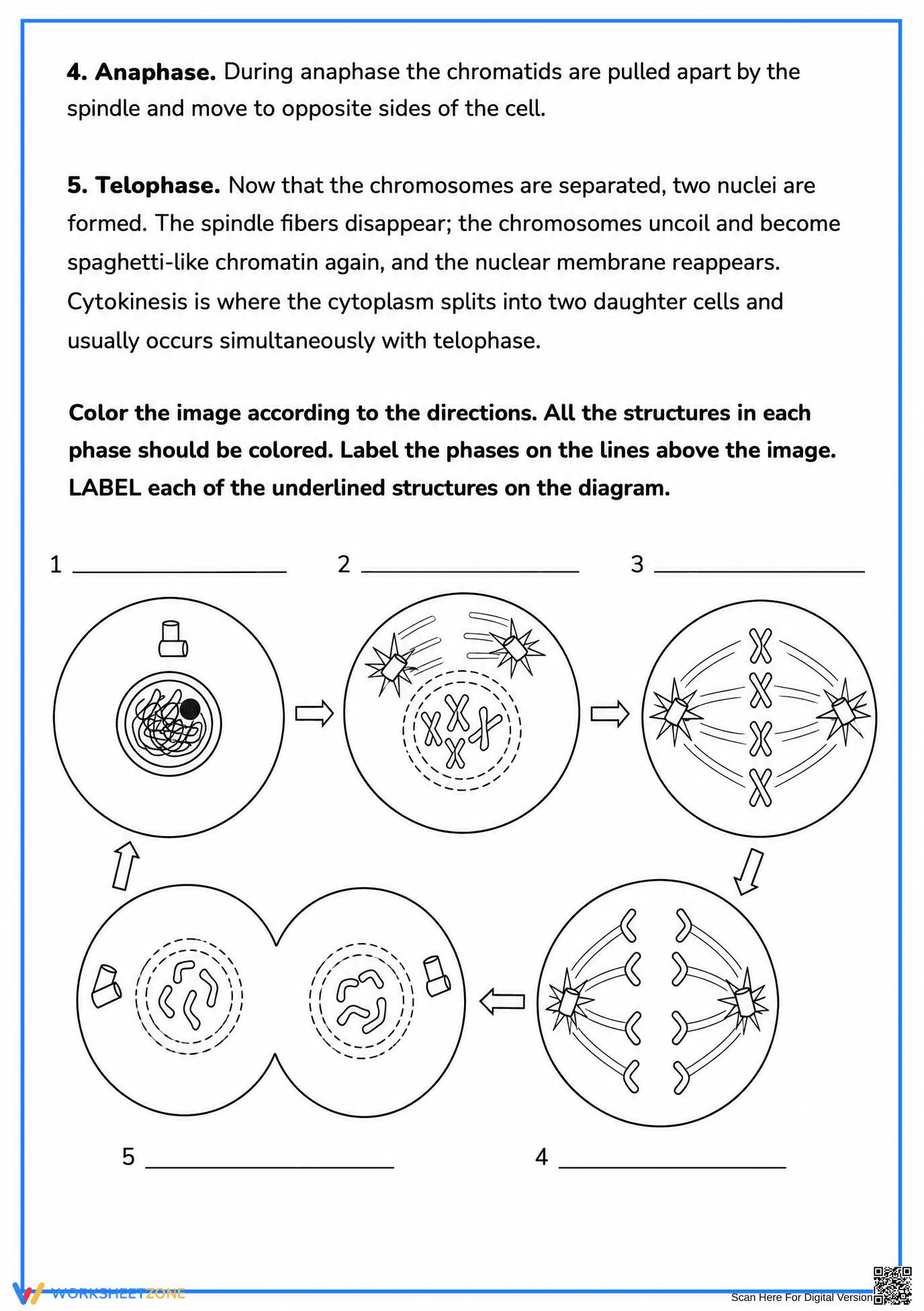
This high school biology worksheet helps students visualize the cell cycle by reading descriptive text and applying specific colors to cellular structures. By actively coloring and labeling the stages of cell division, learners solidify their understanding of how chromosomes and organelles behave during prophase, metaphase, anaphase, and telophase.
At a Glance
- Grade: 9–11 · Subject: Biology
- Standard:
HS-LS1-4— Model the role of cellular division in organisms- Skill Focus: Identifying stages of mitosis
- Format: 2 pages · 5 labeling tasks · Answer key included · PDF
- Best For: Independent practice and visual learning
- Time: 25–35 minutes
This two-page resource features a comprehensive reading guide detailing interphase and the four active stages of mitosis. Students are provided with specific coloring instructions for cellular components like centrioles, chromatin, aster, and spindle fibers. The second page includes a five-part diagram where students must label each phase and color the structures according to the text directions. A complete answer key is provided for quick grading.
Zero-Prep Workflow
This resource is designed for immediate classroom implementation with minimal teacher setup.
- Print (1 minute): Generate copies of the two-page PDF for each student. Ensure colored pencils or crayons are available.
- Distribute (1 minute): Hand out the worksheets and instruct students to read the phase descriptions carefully before coloring.
- Review (3 minutes): Use the included answer key to quickly verify accurate labeling and color application across the diagrams.
With under two minutes of total teacher prep time, this activity is highly effective for standard lesson plans or as a reliable, self-explanatory sub plan.
Standards Alignment
This activity aligns with HS-LS1-4: Use a model to illustrate the role of cellular division (mitosis) and differentiation in producing and maintaining complex organisms. By coloring and labeling the diagrams, students actively engage with a visual model of cell division. Both standard codes can be copied directly into lesson plans, IEP goals, or district curriculum mapping tools.
How to Use It
Deploy this worksheet during direct instruction as a guided activity to break up lectures on the cell cycle. Alternatively, assign it as independent practice after introducing the phases of mitosis to reinforce vocabulary and visual recognition. As a formative assessment observation tip, walk around the room and check if students are correctly distinguishing between chromatin in interphase and condensed chromosomes in prophase. Expected completion time ranges from 25 to 35 minutes depending on reading speed and coloring detail.
Who It's For
This resource is primarily designed for high school biology students in grades 9 through 11. It serves as an excellent tool for visual and kinesthetic learners who benefit from hands-on interaction with scientific diagrams. For students requiring accommodations, teachers can pre-highlight the coloring instructions within the text. Pair this worksheet with a microscope lab observing onion root tip cells to connect these illustrated models with real-world biological phenomena.
Integrating visual models into biology instruction significantly enhances student comprehension of microscopic processes. According to ScienceDirect TpT Analysis, interactive diagramming and coloring activities reduce cognitive load by allowing learners to process complex spatial relationships step-by-step. This worksheet directly supports HS-LS1-4 by requiring students to model the role of cellular division in organisms through guided visual representation. When students actively map text descriptions to visual diagrams, they build stronger neural pathways for long-term retention of the cell cycle. By identifying stages of mitosis and differentiating between structures like spindle fibers and chromatids, learners transition from passive reading to active scientific modeling. This structured approach ensures that foundational concepts of cellular biology are firmly established before advancing to more complex topics like meiosis or genetics.


