




























Views
Downloads
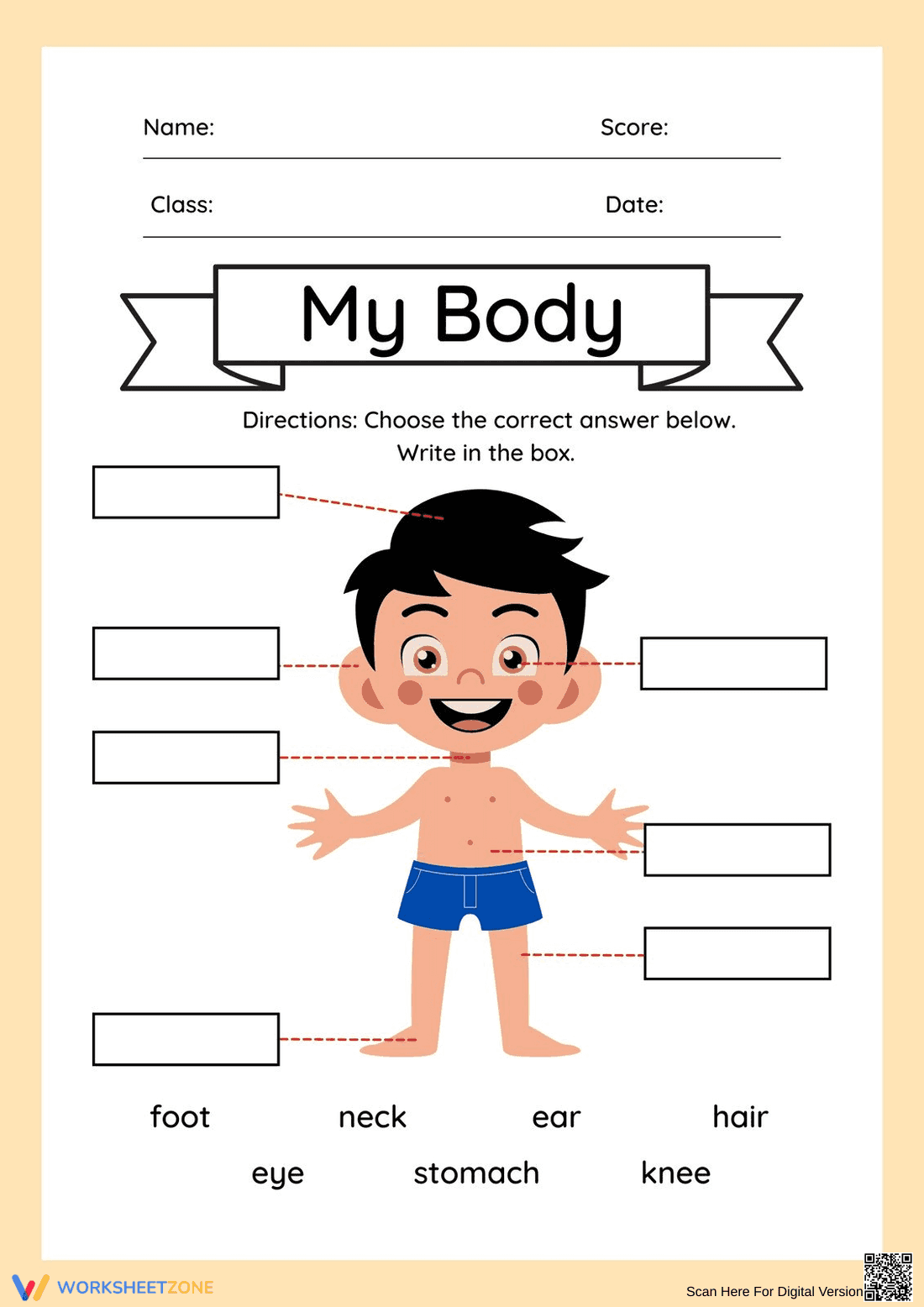

Printable Body Parts Worksheet | Kindergarten Science

Paste this activity's link or code into your existing LMS (Google Classroom, Canvas, Teams, Schoology, Moodle, etc.).
Students can open and work on the activity right away, with no student login required.
You'll still be able to track student progress and results from your teacher account.
This Kindergarten body parts worksheet helps young learners identify and label seven key parts of the human body using a clear, minimalist visual guide. By connecting words from a bank to specific physical features, students build essential vocabulary and anatomical awareness. It provides a structured way to introduce biological concepts through simple, engaging observation.
At a Glance
- Grade: Kindergarten · Subject: Science / Health
- Standard:
CCSS.ELA-LITERACY.L.K.6— Use words and phrases acquired through conversations and responding to texts- Skill Focus: Human body part identification
- Format: 1 page · 7 problems · Answer key included · PDF
- Best For: Early childhood science or vocabulary lessons
- Time: 10–15 minutes
Inside this resource, you will find a single-page PDF featuring a high-quality illustration of a boy with seven distinct leader lines. Below the image, a clear word bank includes "foot," "neck," "ear," "hair," "eye," "stomach," and "knee." The layout is intentionally minimalist to reduce cognitive load, ensuring students focus entirely on the matching task. A full answer key is provided for quick grading.
The zero-prep workflow for this worksheet is designed for maximum efficiency. First, print the single-page PDF in about 30 seconds. Next, distribute the sheets to your class and read the word bank aloud to support emerging readers for 1 minute. Finally, review the answers as a group by pointing to the corresponding parts on a volunteer or poster for 2 minutes. Total teacher preparation time is under two minutes.
This worksheet aligns with CCSS.ELA-LITERACY.L.K.6, which requires students to use words and phrases acquired through instruction and responding to texts. By labeling the diagram, students demonstrate mastery of domain-specific vocabulary related to the human body. This standard code can be copied directly into lesson plans, IEP goals, or district curriculum mapping tools.
Use this worksheet as a formative assessment after a "Head, Shoulders, Knees, and Toes" song or a read-aloud about the five senses. During the activity, observe if students can independently match the initial sounds of the words in the bank to the body parts. Expect completion within 10 to 15 minutes depending on the students' writing speed and fine motor skills.
This resource is ideal for Kindergarten students, English Language Learners (ELLs), and students with developmental delays who benefit from visual supports. It pairs naturally with an "All About Me" unit or a basic health lesson. For differentiation, advanced students can write a sentence about what each body part does on the back of the page.
According to the RAND AIRS 2024 report, visual-spatial labeling tasks in early childhood significantly improve long-term retention of scientific terminology. This worksheet utilizes a "word bank to diagram" model, which reduces the barrier of spelling while reinforcing the connection between abstract text and physical reality. By focusing on seven high-frequency anatomical terms like "eye" and "knee," the resource ensures that students meet the requirements of CCSS.ELA-LITERACY.L.K.6 through active engagement. Research from Fisher & Frey (2014) suggests that such scaffolded vocabulary activities are essential for building the foundational knowledge necessary for later complex biological studies. This printable tool provides a reliable, evidence-based method for teachers to assess student understanding of the human body in a low-stakes, high-success environment. It is a practical addition to any early elementary curriculum focusing on health, science, or basic literacy development.


