


























Views
Downloads

Printable Metaphor Meanings Worksheet | Grade 4 ELA
Paste this activity's link or code into your existing LMS (Google Classroom, Canvas, Teams, Schoology, Moodle, etc.).
Students can open and work on the activity right away, with no student login required.
You'll still be able to track student progress and results from your teacher account.
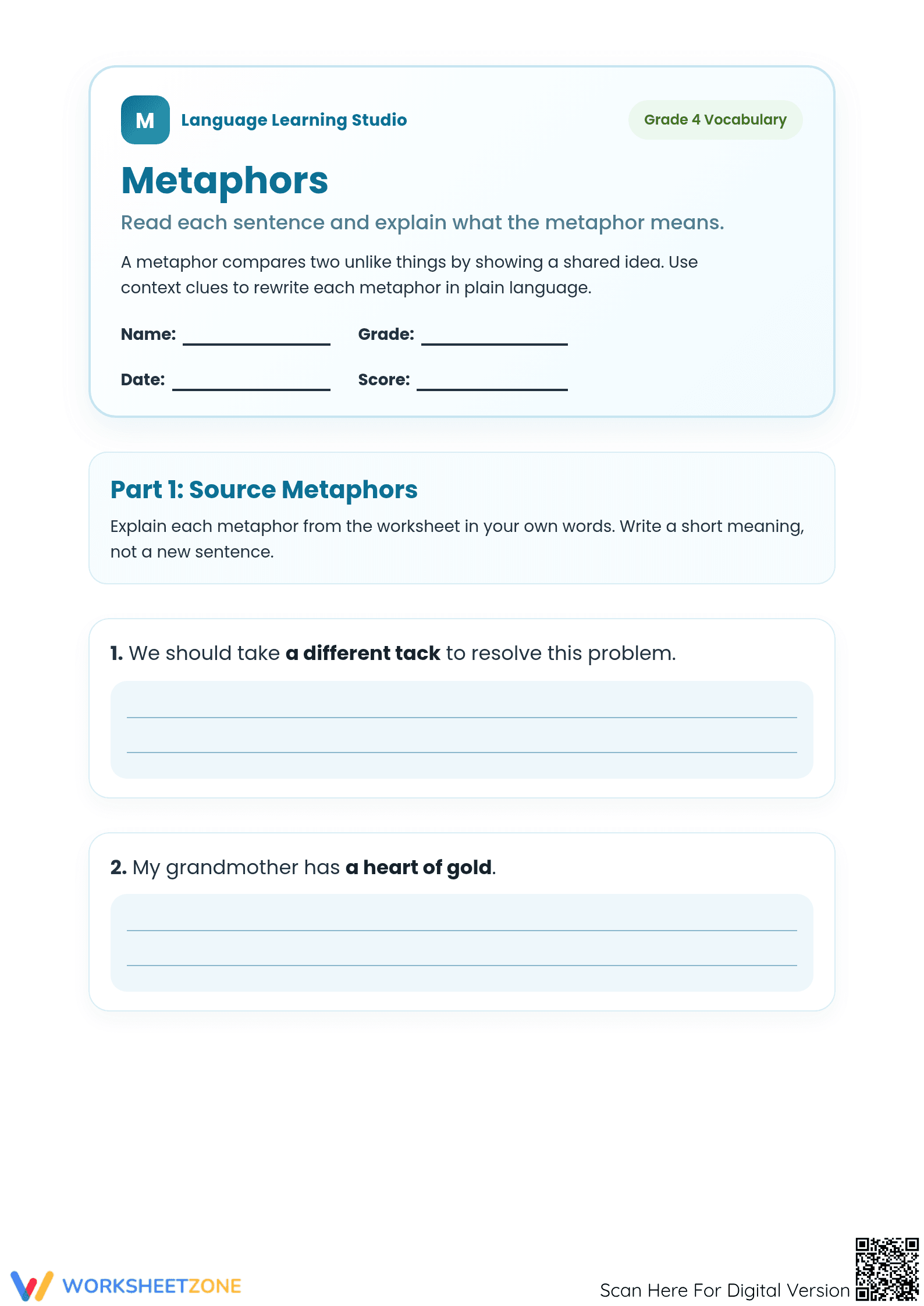
This Grade 4 English Language Arts worksheet focuses on interpreting figurative language, specifically metaphors. Students learn to move beyond literal meanings to understand authors' use of comparisons. Rewriting metaphors in plain language solidifies comprehension of idioms and abstract expressions.
At a Glance
- Grade: Grade 4 · Subject: English Language Arts
- Standard:
CCSS.ELA-LITERACY.L.4.5.A— Explain the meaning of simple similes and metaphors in context- Skill Focus: Metaphor Interpretation
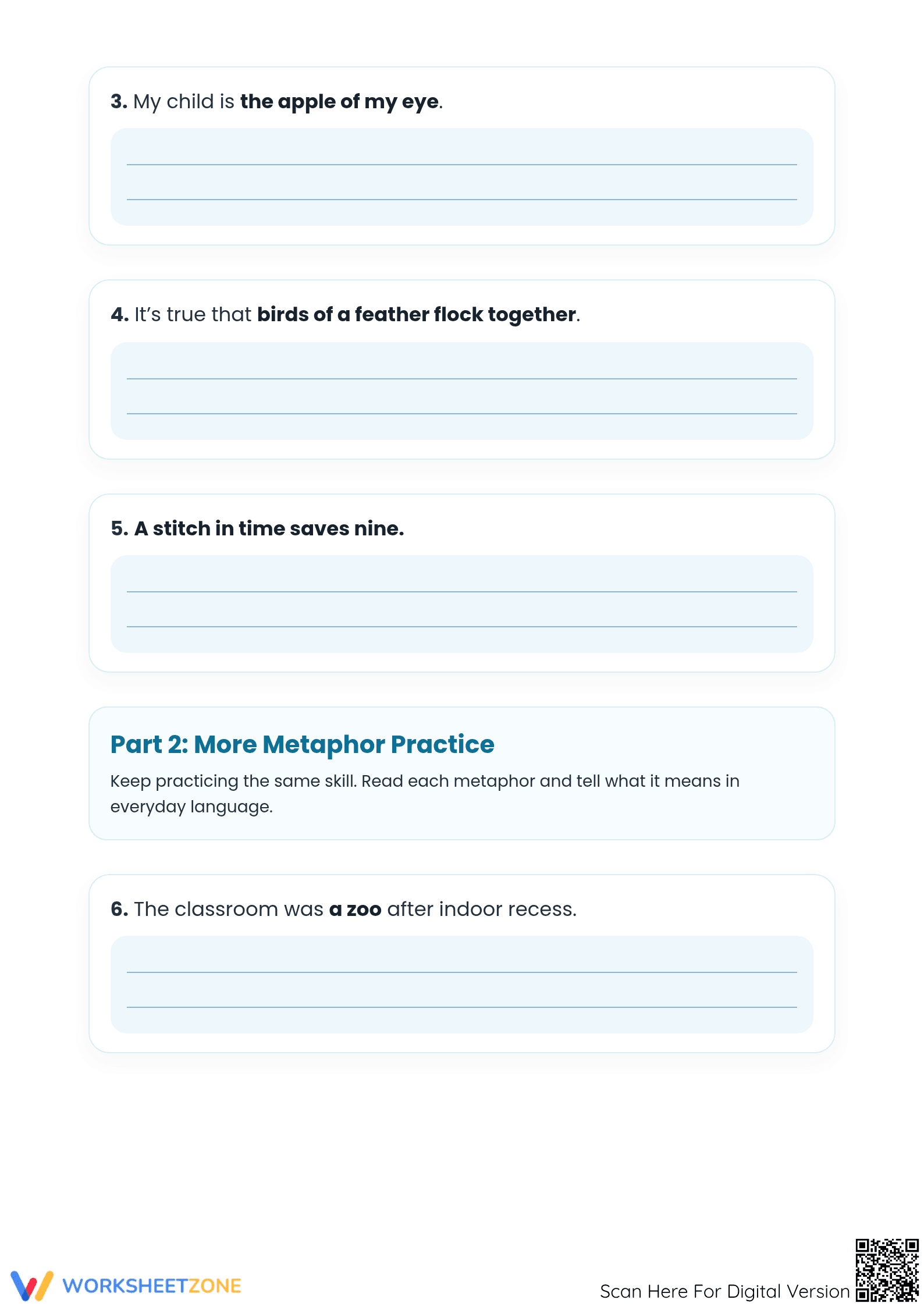
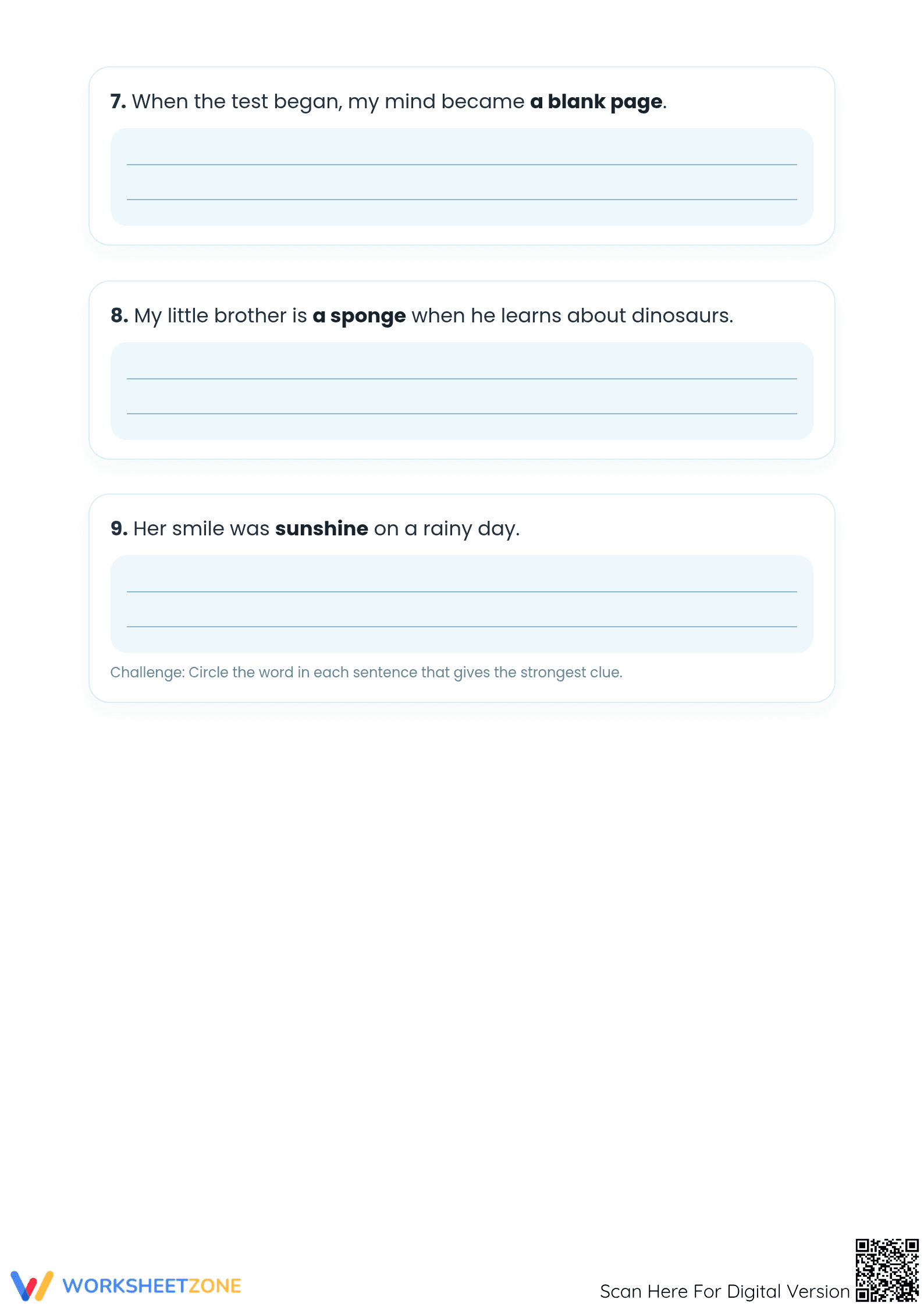
- Format: 3 pages · 9 problems · Answer key included · PDF
- Best For: Independent practice and vocabulary reinforcement
- Time: 15–25 minutes
What's Inside
This 3-page PDF features 9 metaphor analysis tasks across two practice sections. The first focuses on common metaphors like "a heart of gold" and "apple of my eye." The second provides context-embedded examples such as "the classroom was a zoo." A final challenge task requires identifying context clues. A full answer key is included.
Skill Progression
- Guided Practice: The first 2 items introduce students to common metaphors with bolded text to highlight the comparison, allowing for teacher-led modeling of the interpretation process.
- Supported Practice: Items 3 through 5 expand the scope to more complex idiomatic metaphors, encouraging students to use their existing linguistic knowledge to derive meaning.
- Independent Application: The final 4 items and the challenge task require students to apply their skills autonomously, identifying the relationship between the metaphor and the surrounding sentence context.
This structured approach follows a gradual-release model, ensuring students build confidence before moving to independent analysis.
Standards Alignment
This resource is strictly aligned to CCSS.ELA-LITERACY.L.4.5.A, which tasks students with explaining the meaning of simple similes and metaphors in context. It also supports CCSS.ELA-LITERACY.RL.4.4 by helping students determine the meaning of words and phrases as they are used in a text, including those that allude to significant characters found in mythology. Both standard codes can be copied directly into lesson plans, IEP goals, or district curriculum mapping tools.
How to Use It
Use this worksheet as a focused follow-up after a direct instruction lesson on figurative language. It serves as an excellent formative assessment tool; as students work, observe whether they are providing literal definitions (e.g., "a heart made of metal") or figurative interpretations (e.g., "a very kind person"). Expect a completion time of 20 minutes for the primary tasks and an additional 5 minutes for the challenge section.
Who It's For
This activity is designed for fourth-grade students developing their literary analysis skills. It is particularly beneficial for English Language Learners (ELLs) who may struggle with non-literal English expressions and for students who need explicit practice with abstract reasoning. Pair this resource with a short story or poem containing metaphors to help students see these concepts applied in professional writing.
Understanding figurative language is a critical milestone for elementary students transitioning to inferential reading. This worksheet directly supports CCSS.ELA-LITERACY.L.4.5.A by providing structured practice with metaphors in context. Following a gradual release model, it moves students from high-frequency figurative phrases to context-embedded sentences, facilitating cognitive scaffolding for semantic mastery. A challenge task encourages identification of lexical clues, strengthening decoding and comprehension. Educators can use this printable as a bridge between direct instruction and independent application, fostering robust vocabulary for academic success and informational text analysis.


