


























Views
Downloads

Essential Grade 5 Decimal Test Review: Compare & Calculate
Paste this activity's link or code into your existing LMS (Google Classroom, Canvas, Teams, Schoology, Moodle, etc.).
Students can open and work on the activity right away, with no student login required.
You'll still be able to track student progress and results from your teacher account.
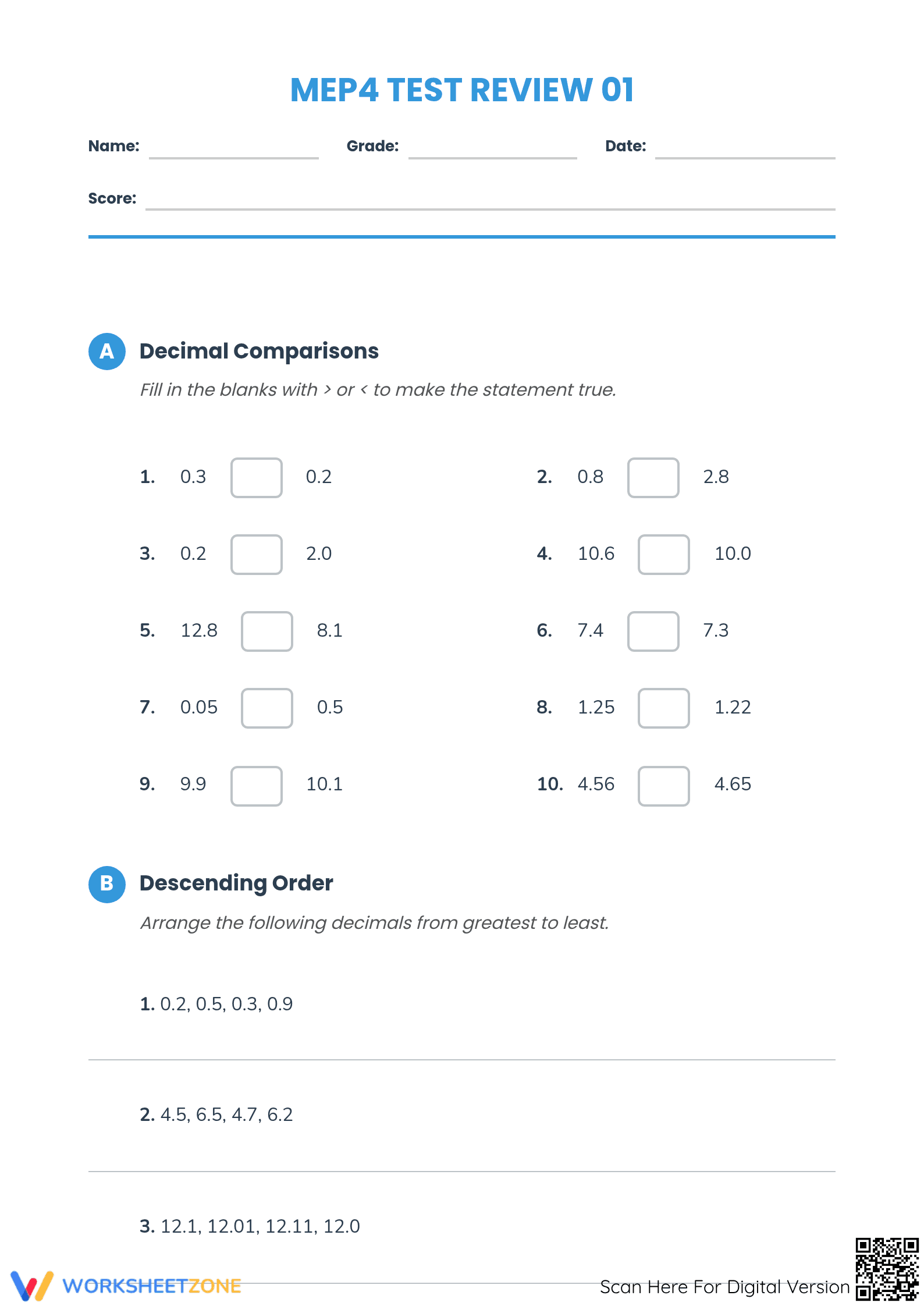
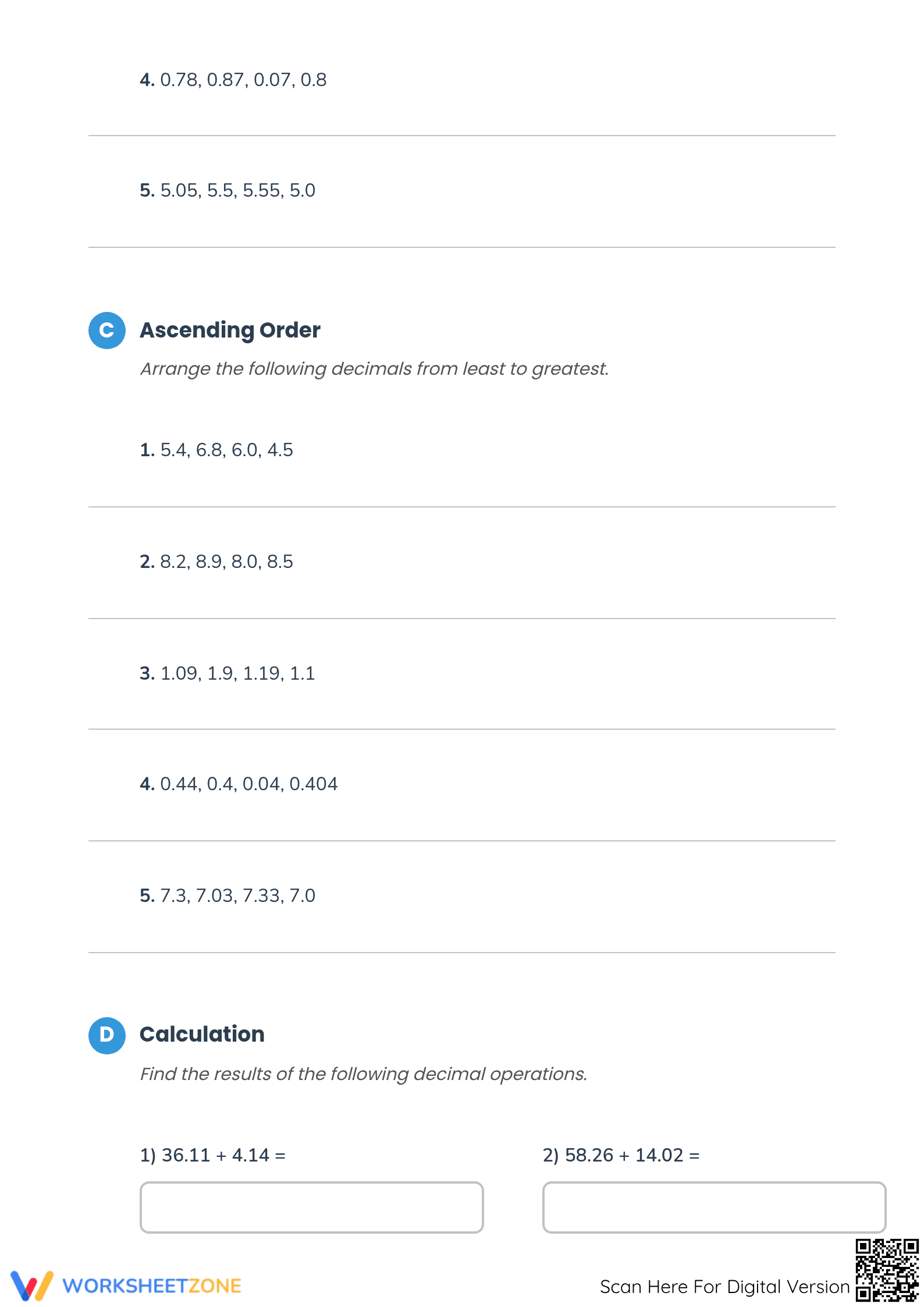
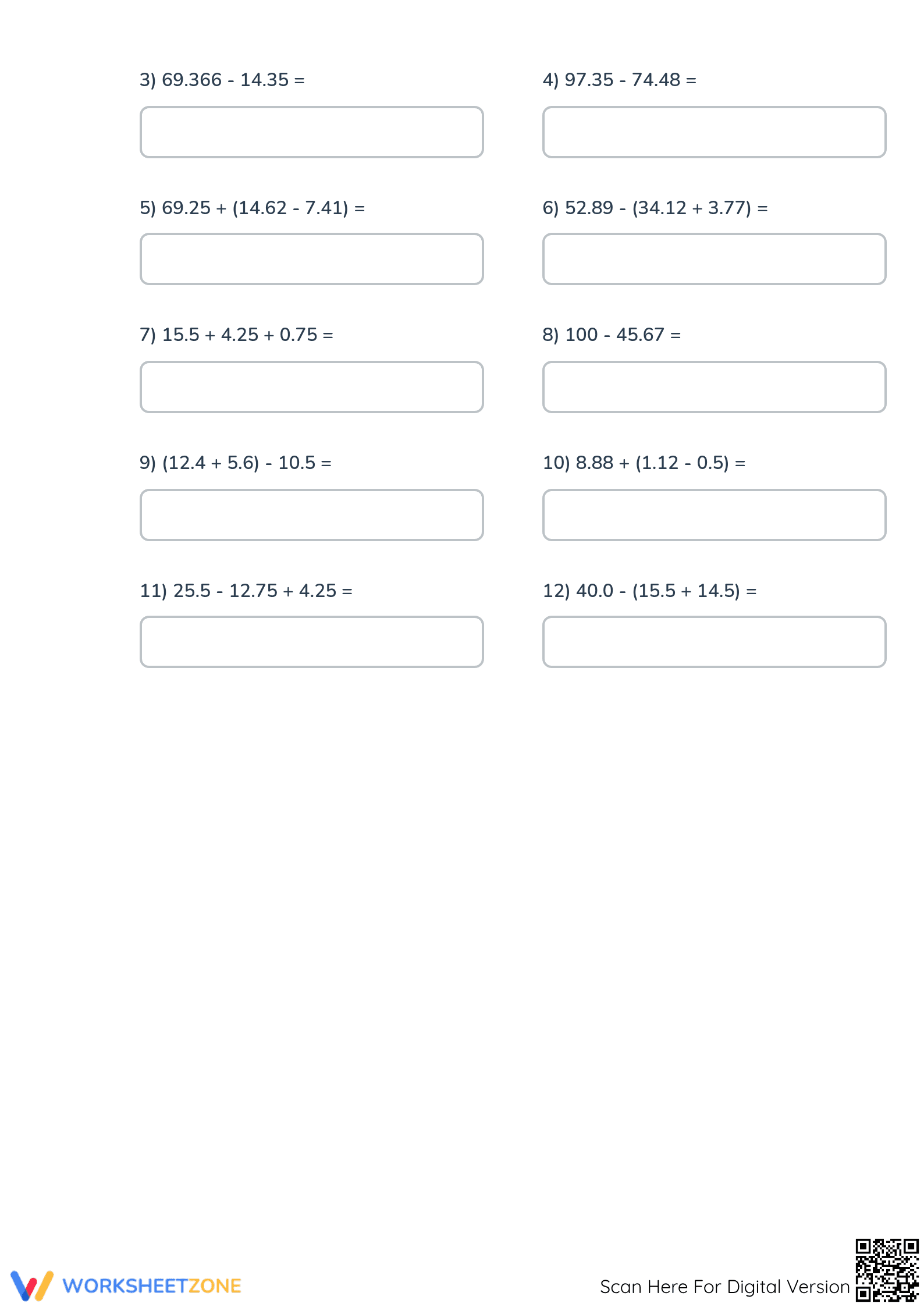
Provide students with a comprehensive review of decimal concepts using this 32-task worksheet. This resource bridges the gap between simple comparison and multi-step calculations, ensuring Grade 5 learners can confidently manipulate decimal values. By focusing on place value mastery, students develop the fluency required for advanced middle-school mathematics.
At a Glance
- Grade: 5 · Subject: Math
- Standard:
CCSS.MATH.CONTENT.5.NBT.B.7— Add and subtract decimals to hundredths using place value strategies and written methods- Skill Focus: Decimal comparison, ordering, and multi-step operations
- Format: 3 pages · 32 problems · Answer key included · PDF
- Best For: Summative test review or mid-unit assessment
- Time: 40–50 minutes
This three-page document is structured into four distinct segments designed to assess varying levels of decimal proficiency. Section A contains ten comparison problems using inequality symbols, while Sections B and C challenge students to order sets of four decimals in both descending and ascending sequences. The final section features twelve calculation tasks, including multi-term addition and subtraction problems involving parentheses to test order of operations with decimals.
Task mapping allows educators to gather precise evidence of student mastery across the NBT domain. Section A identifies errors in place value recognition, while the ordering tasks reveal misconceptions in decimal magnitude. The calculation section serves as a high-stakes assessment of operational fluency, with multi-step problems providing data on student ability to apply the distributive property and parenthetical rules. Scores can be entered directly into progress monitoring tools to track individual IEP or curriculum goals.
The primary alignment is CCSS.MATH.CONTENT.5.NBT.B.7, which requires students to "Add, subtract, multiply, and divide decimals to hundredths, using concrete models or drawings and strategies based on place value." This worksheet also supports CCSS.MATH.CONTENT.5.NBT.A.3.B through its rigorous comparison and ordering sections. Both standard codes can be copied directly into lesson plans, IEP goals, or district curriculum mapping tools.
Deploy this worksheet as a summative review at the conclusion of a decimals unit or as a "pre-test" to identify instructional gaps before a formal examination. During the session, observe students working on the parenthetical calculations in Section D; if they struggle with the subtraction of multi-term expressions, it indicates a need for targeted re-teaching of order of operations. Completion typically takes 45 minutes for independent learners.
This resource is optimized for Grade 5 general education students, but its structured layout makes it an excellent intervention tool for older students requiring decimal remediation. It pairs naturally with place value anchor charts or digital manipulatives that visualize the base-ten system. The inclusion of clear section headings supports executive functioning for students with learning differences.
Recent research from RAND AIRS 2024 emphasizes that math proficiency in the upper elementary grades is highly correlated with a student's ability to transition from concrete representations to abstract numerical manipulation. This worksheet facilitates that transition by requiring students to apply place value logic across thirty-two varied tasks, moving from simple inequality comparisons to complex operational sequences. By embedding multiple representations of decimal magnitude—specifically through ordering and multi-step arithmetic—the material aligns with evidence-based practices that promote long-term retention of fractional concepts. The inclusion of parenthetical operations specifically targets the higher-order cognitive demands identified in the 2024 NAEP framework, ensuring that students are not merely performing rote calculations but are actively applying logical rules of arithmetic. Educators can utilize this assessment data to differentiate instruction, addressing specific bottlenecks in decimal fluency before students progress to the more rigorous algebraic demands of the sixth-grade curriculum.


