


























Views
Downloads

Mental Math Test Worksheet | Essential Grade 2-4 Math Practice
Paste this activity's link or code into your existing LMS (Google Classroom, Canvas, Teams, Schoology, Moodle, etc.).
Students can open and work on the activity right away, with no student login required.
You'll still be able to track student progress and results from your teacher account.
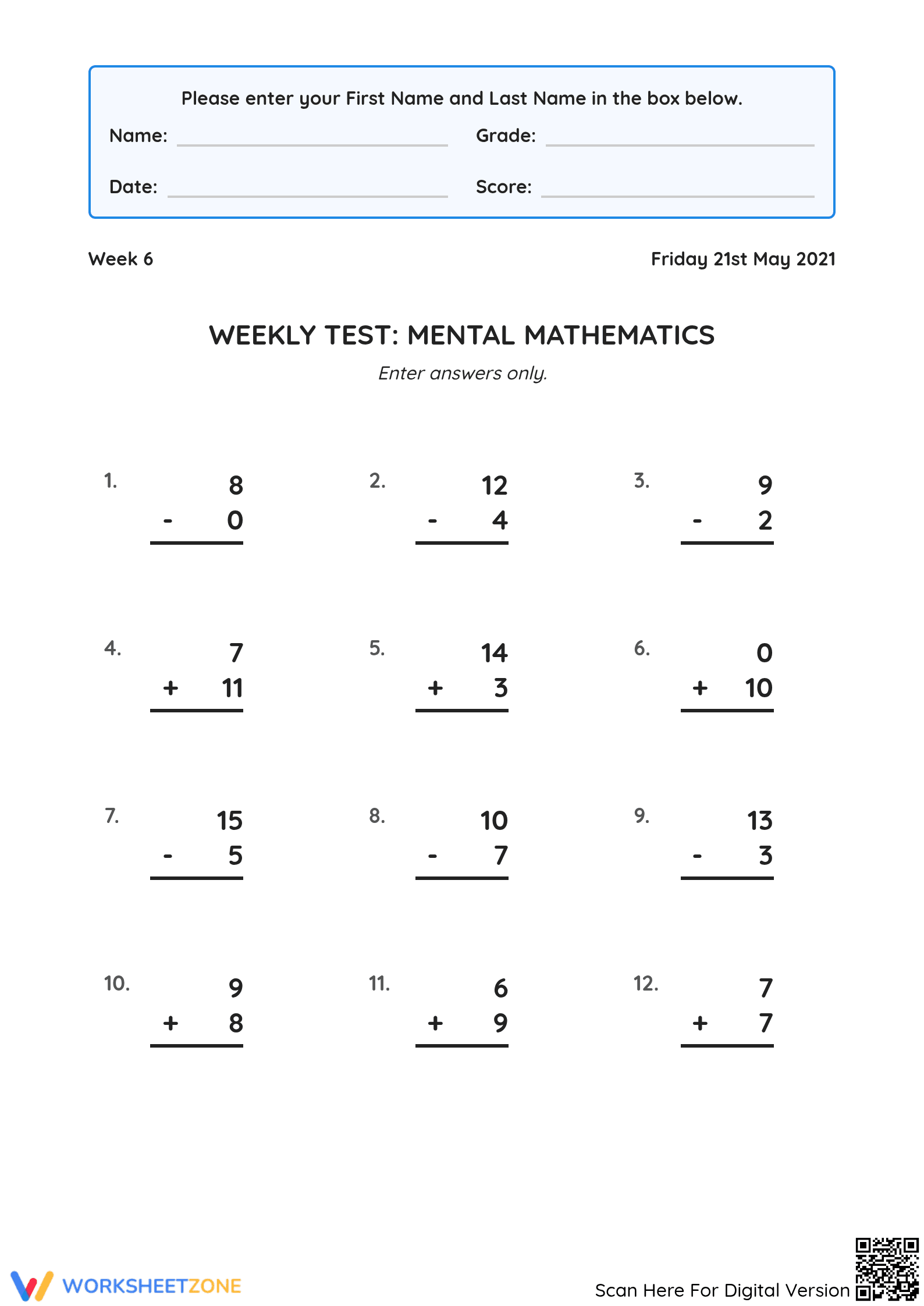
This comprehensive mental mathematics assessment is designed to evaluate and strengthen student fluency in basic operations. By combining traditional vertical arithmetic with visual number line models, the worksheet ensures students can demonstrate their understanding across multiple representations. Students will work through 20 targeted problems to prove mastery of addition and subtraction strategies within the critical 0-20 range.
At a Glance
- Grade: 2–4 · Subject: Math
- Standard:
CCSS.MATH.CONTENT.2.OA.B.2— Fluently add and subtract within 20 using mental strategies- Skill Focus: Addition and subtraction fluency
- Format: 3 pages · 20 problems · Answer key included · PDF
- Best For: Weekly formative assessment or fluency check
- Time: 15–20 minutes
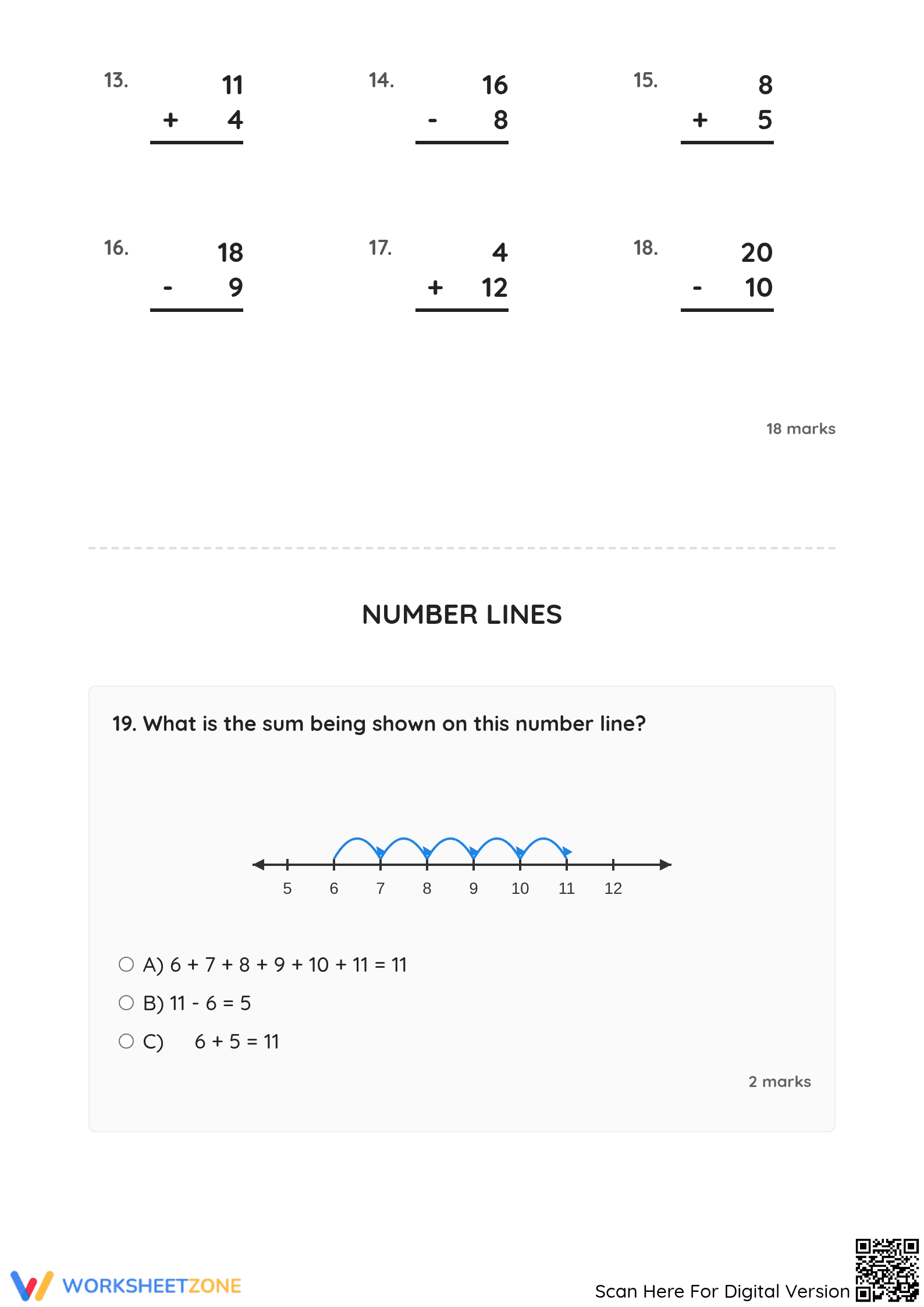
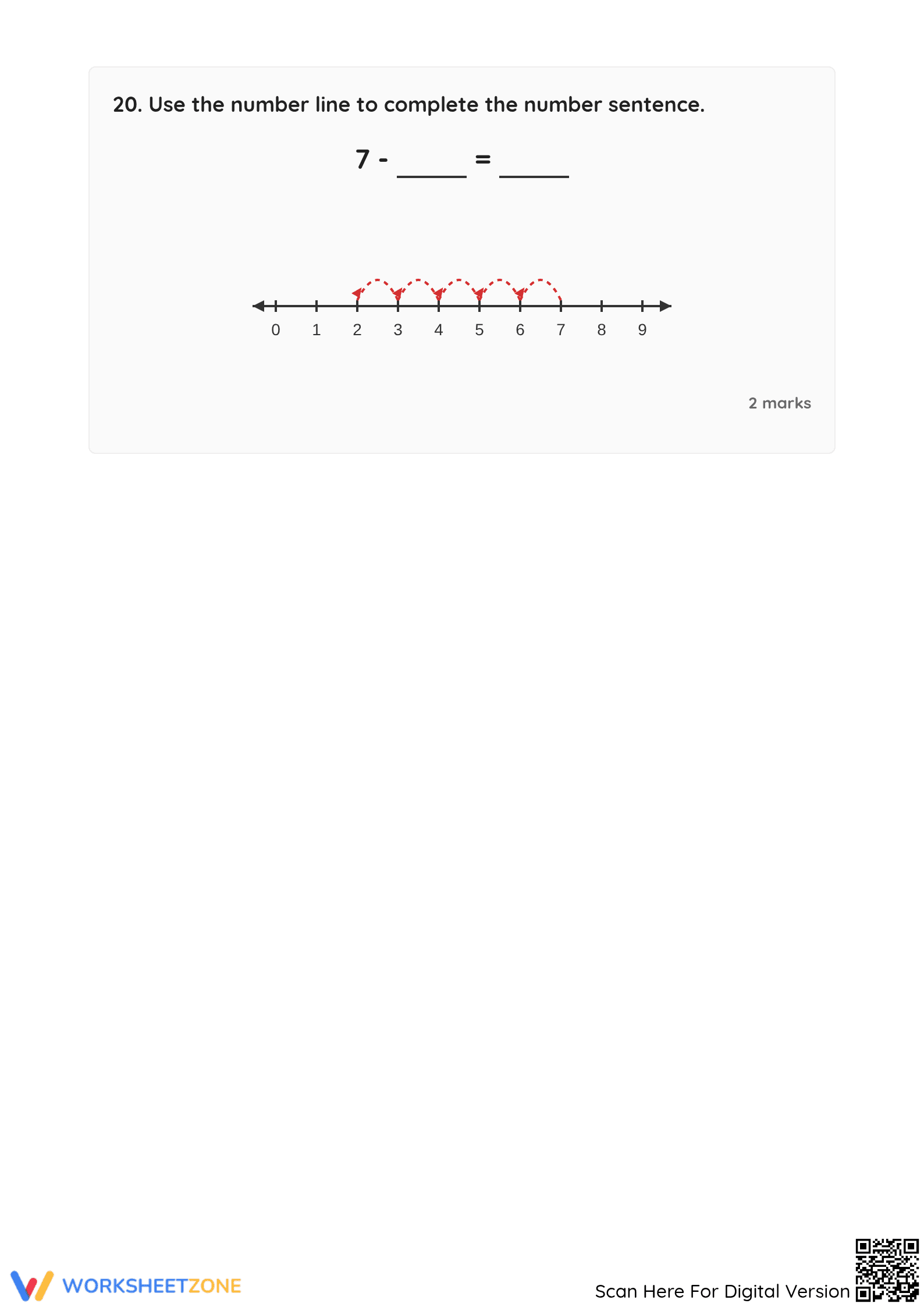
The worksheet is structured as a professional weekly test, featuring a clear header for tracking names, dates, and scores. It contains three distinct pages: the first two pages provide 18 vertical calculation problems that challenge students to recall sums and differences quickly. The final sections introduce number line tasks, requiring students to translate visual jumps into accurate number sentences, which reinforces the conceptual connection between counting and operations.
Mastery Evidence
This resource serves as a high-quality diagnostic tool for tracking progress toward standard mastery. Each task is worth a specific number of marks, with the first 18 problems totaling 18 marks and the two number line challenges contributing 2 marks each. Teachers can use the final 20-point score to categorize student performance into clear proficiency tiers. This data-driven approach allows for precise entry into gradebooks or IEP progress reports, identifying exactly where a student might be struggling with specific mental strategies or visual modeling.
Standards Alignment
This worksheet is primarily aligned with CCSS.MATH.CONTENT.2.OA.B.2: "Fluently add and subtract within 20 using mental strategies. By end of Grade 2, know from memory all sums of two one-digit numbers." Additionally, it supports measurement and data standards by utilizing number lines as a tool for representation. Both standard codes can be copied directly into lesson plans, IEP goals, or district curriculum mapping tools to ensure instructional compliance.
How to Use It
Use this worksheet as a formal weekly assessment at the end of a unit on mental strategies. It functions exceptionally well as a quiet, independent activity that allows you to circulate and observe student techniques. Watch for students who still rely on finger counting versus those who use known facts or number line jumps. This 20-minute task provides immediate feedback; if a student completes the arithmetic but struggles with the number line, you know to prioritize visual modeling in your next small-group session.
Who It's For
While designed for second-grade students working toward core fluency, this resource is a valuable tool for third and fourth graders who require additional intervention or a quick refresher. It is particularly effective for students who benefit from structured, predictable formats. Pair this assessment with a number line anchor chart or a short mental math warm-up to prepare students for the timed nature of a weekly test environment.
According to the RAND AIRS 2024 report on elementary mathematics, the development of mental fluency in addition and subtraction is a critical predictor of later success in algebraic thinking and complex problem-solving. This worksheet aligns with the CCSS.MATH.CONTENT.2.OA.B.2 standard, which requires students to fluently add and subtract within 20 using mental strategies. By focusing on both abstract numerical problems and visual number line models, this resource supports the dual-coding theory of learning, ensuring that students internalize mathematical relationships rather than just memorizing facts. Research from Fisher & Frey (2014) emphasizes that regular, low-stakes formative assessments, such as this weekly test format, provide essential data for teachers to identify specific misconceptions early. Integrating these 20 targeted tasks into a weekly routine helps solidify the cognitive pathways required for automaticity, allowing students to dedicate more working memory to higher-order mathematical reasoning in subsequent grades.


