


























Views
Downloads
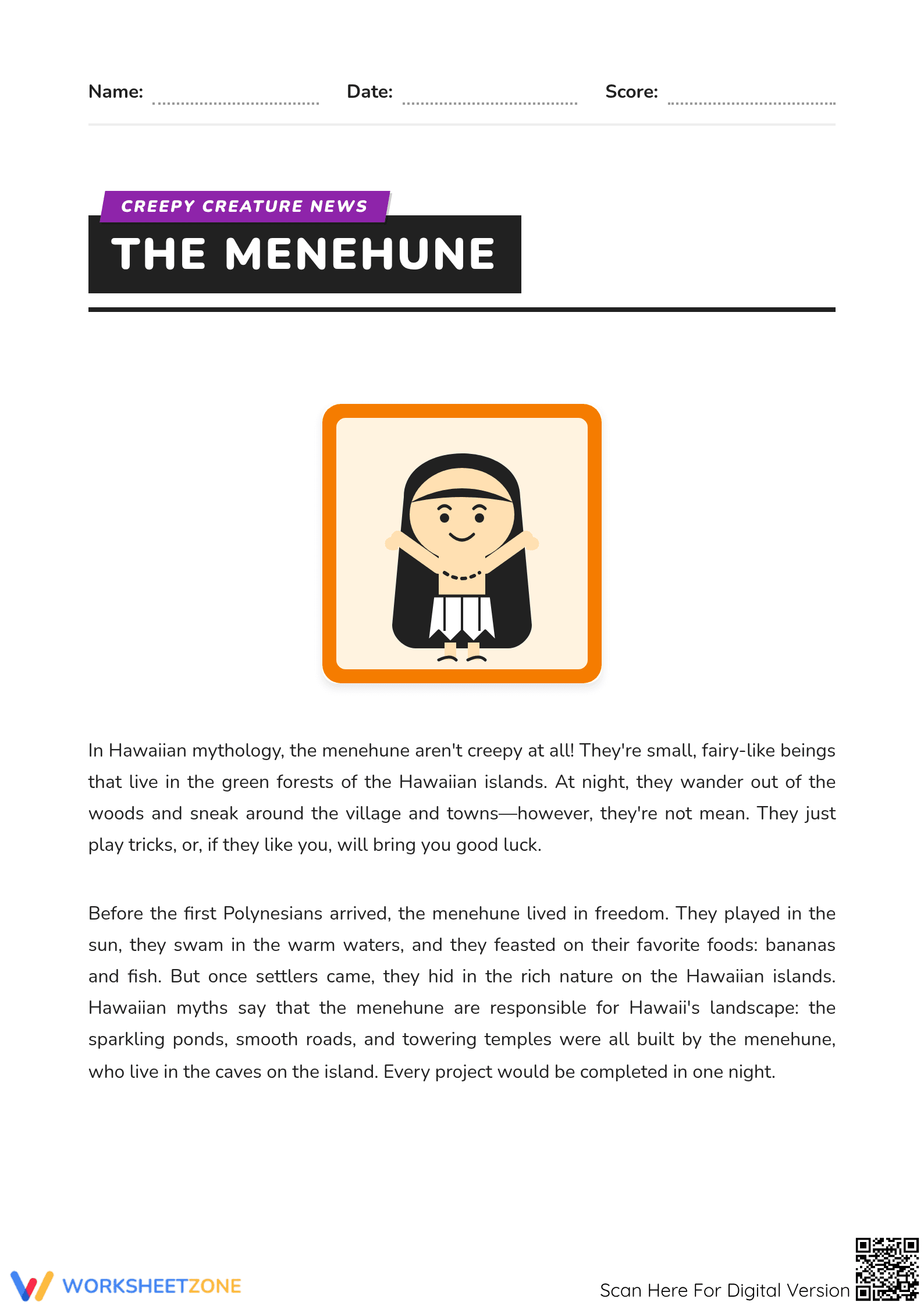


Grade 3 Menehune Legend — Printable No-Prep Worksheet
Paste this activity's link or code into your existing LMS (Google Classroom, Canvas, Teams, Schoology, Moodle, etc.).
Students can open and work on the activity right away, with no student login required.
You'll still be able to track student progress and results from your teacher account.
This Grade 3 reading comprehension worksheet builds essential text-evidence skills by having students read an engaging passage about the Menehune of Hawaiian mythology and answer targeted questions. It provides a straightforward, effective way to practice retrieving explicit details from an informational text while keeping young readers thoroughly engaged.
At a Glance
- Grade: 3 · Subject: ELA
- Standard:
CCSS.ELA-LITERACY.RI.3.1— Ask and answer questions using text evidence- Skill Focus: Reading Comprehension
- Format: 2 pages · 5 problems · Answer key included · PDF
- Best For: Independent practice or sub plans
- Time: 15–20 minutes
Inside this resource, educators will find a two-page layout designed for immediate classroom use. The first page features an age-appropriate reading passage about the legendary Menehune. The second page contains five short-answer comprehension questions requiring students to look back at the text to find specific facts, such as the creatures' habitat and favorite foods. A complete answer key is provided to make grading fast.
Zero-Prep Workflow
- Print (1 min): Download the PDF and print the two-page handout.
- Distribute (1 min): Hand out the sheets. Instructions are self-explanatory, allowing immediate starts.
- Review (3 mins): Use the included answer key to quickly check responses.
With total teacher prep time under two minutes, this resource is perfect for emergency sub plans or morning work.
Standards Alignment
This worksheet is directly aligned to CCSS.ELA-LITERACY.RI.3.1, which requires students to ask and answer questions to demonstrate understanding of a text, referring explicitly to the text as the basis for the answers. It also supports foundational reading fluency and vocabulary acquisition in context. Both standard codes can be copied directly into lesson plans, IEP goals, or district curriculum mapping tools.
How to Use It
This passage is perfect for independent practice after a direct instruction lesson on finding text evidence. Teachers can assign it as a quiet reading activity where students highlight the answers in the text before writing them down. As a formative assessment observation tip, watch to see if students are flipping back to the first page to verify their answers or if they are guessing from memory. Expected completion time is 15 to 20 minutes.
Who It's For
This resource is designed for third-grade general education students, but it also works well for fourth-grade students needing reading intervention or second-grade students ready for an enrichment challenge. To differentiate for struggling readers, teachers can read the passage aloud first or allow students to work in pairs. It pairs naturally with an anchor chart on finding the evidence or a broader unit on global myths and legends.
Aligning instructional materials to CCSS.ELA-LITERACY.RI.3.1 ensures that students develop the critical ability to ask and answer questions using text evidence. According to a recent EdReports 2024 analysis, high-quality instructional materials that require students to consistently return to the text for answers significantly improve long-term reading comprehension outcomes. When third graders practice retrieving explicit details from engaging nonfiction passages, they build the cognitive stamina necessary for more complex analytical tasks in later grades. This worksheet provides exactly that type of targeted, evidence-based practice. By focusing on a high-interest topic like Hawaiian mythology, it lowers the affective filter, allowing students to concentrate fully on the mechanical skill of locating and citing textual facts. This foundational competency is essential for academic success across all subject areas, ensuring students are prepared for rigorous assessments.


