


























Views
Downloads
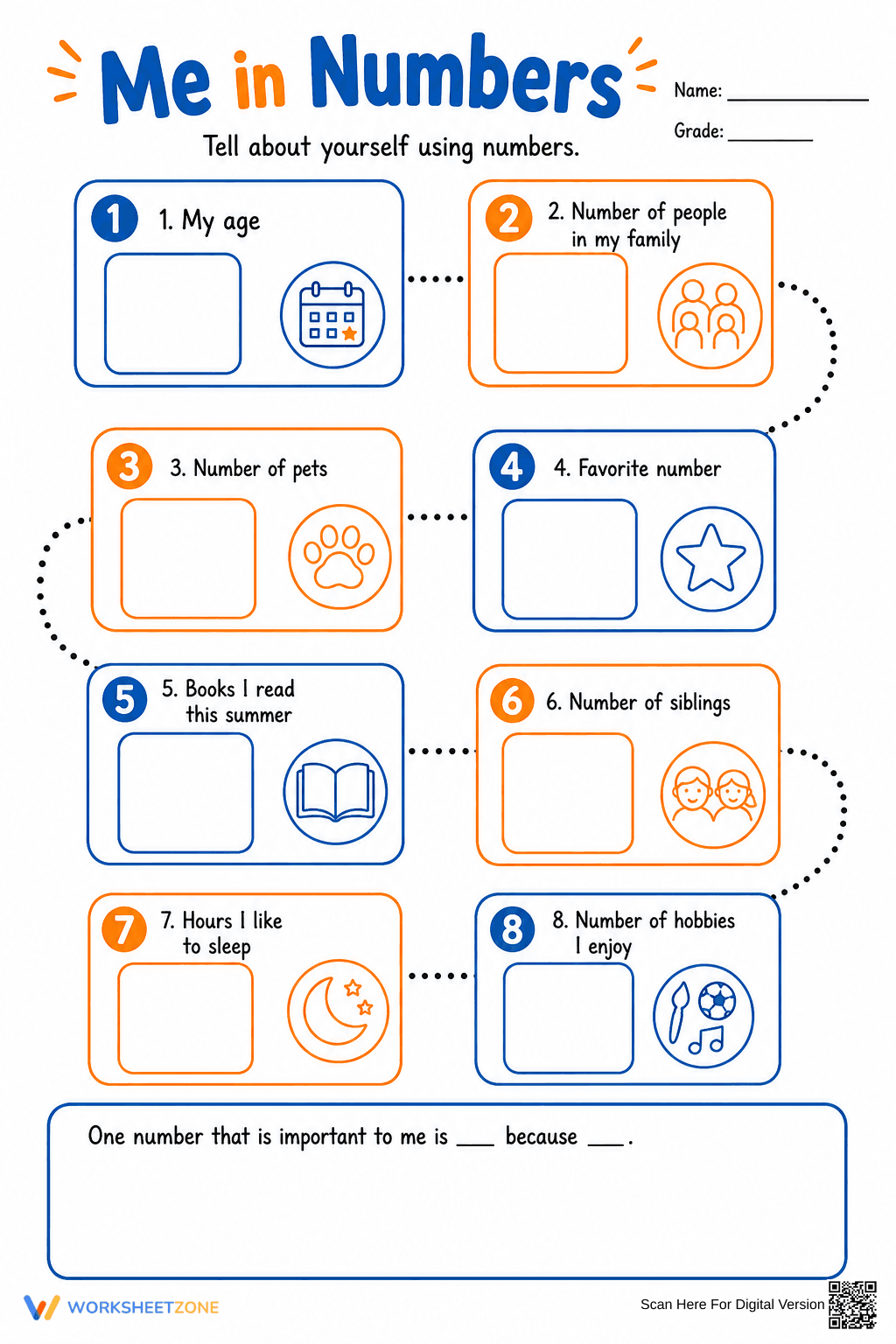

Me in Numbers Worksheet | Grade 2-5 Essential
Paste this activity's link or code into your existing LMS (Google Classroom, Canvas, Teams, Schoology, Moodle, etc.).
Students can open and work on the activity right away, with no student login required.
You'll still be able to track student progress and results from your teacher account.
This Grade 2-5 Me in Numbers worksheet helps students represent personal data through numerical values. By connecting math to their own lives, learners develop a stronger sense of number identity and purpose. It serves as an ideal icebreaker that bridges the gap between social-emotional learning and foundational mathematical communication skills.
At a Glance
- Grade: 2-5 · Subject: Math / SEL
- Standard:
CCSS.MATH.CONTENT.2.NBT.A.3— Read and write numbers to 1000 using base-ten numerals- Skill Focus: Personal data representation
- Format: 1 page · 9 problems · Answer key N/A · PDF
- Best For: Back-to-school icebreaker and number sense
- Time: 15–20 minutes
What's Inside
This single-page PDF features a clean, infographic-style layout with 8 distinct number cards and a final reflection prompt. Each card includes a specific prompt—such as age, family size, and favorite number—paired with a visual icon to support reading comprehension. The zigzag path design keeps students engaged as they move through the 9 total tasks.
Zero-Prep Workflow
- Print: Generate the single-page PDF for your entire class in 30 seconds.
- Distribute: Hand out the sheets as a morning work activity or first-week icebreaker.
- Review: Facilitate a pair-share session where students review each other's numerical profiles for 10 minutes.
Total teacher preparation time is under 2 minutes, making this an excellent option for sub plans or busy transition days.
Standards Alignment
The primary standard addressed is `CCSS.MATH.CONTENT.2.NBT.A.3`, which focuses on reading and writing numbers using base-ten numerals. Additionally, it supports ELA-LITERACY.W.2.8 by asking students to recall information from experiences to answer a question. Both standard codes can be copied directly into lesson plans, IEP goals, or district curriculum mapping tools.
How to Use It
Use this worksheet during the first week of school to establish a math-positive classroom culture. It works best after a brief discussion on how numbers describe the world around us. As a formative assessment, observe if students can accurately translate abstract concepts into concrete integers. Completion typically takes 15 to 20 minutes.
Who It's For
This activity is tailored for students in Grades 2 through 5, including English Language Learners who benefit from the clear icon support. It pairs naturally with a "Math About Me" poster project or a direct instruction lesson on data collection and graphing. No additional teacher setup is required.
This worksheet aligns with `CCSS.MATH.CONTENT.2.NBT.A.3` by requiring students to perform the plain-English skill of representing personal attributes as numerical data. Research from Fisher & Frey (2014) emphasizes that connecting academic content to personal experience significantly increases student engagement and long-term retention of mathematical concepts. By using 9 specific prompts, the activity scaffolds the transition from concrete personal facts to abstract number representation. According to the RAND AIRS 2024 report, high-quality low-floor tasks like this allow for natural differentiation, as students can respond with varying levels of numerical complexity based on their individual development. This resource provides a structured yet flexible framework for early-year assessment of number writing fluency and self-expression. It is a reliable tool for establishing a data-driven classroom environment while fostering a sense of belonging among diverse learners in elementary settings. The design ensures accessibility for all students.


