


























Views
Downloads

Printable Money Review Worksheet | Grade 2-4 Math
Paste this activity's link or code into your existing LMS (Google Classroom, Canvas, Teams, Schoology, Moodle, etc.).
Students can open and work on the activity right away, with no student login required.
You'll still be able to track student progress and results from your teacher account.
This comprehensive Unit 2 review worksheet provides a robust practice set for elementary students to master money-related operations. Students will strengthen their financial literacy by writing currency in expanded forms, counting combinations of bills and coins, and performing multi-digit addition and subtraction with decimals. It serves as an effective end-of-unit review.
At a Glance
- Grade: 2–4 · Subject: Math
- Standard:
CCSS.MATH.CONTENT.2.MD.C.8— Solve problems involving bills and coins using dollar and cent symbols appropriately- Skill Focus: Currency Operations and Identification
- Format: 4 pages · 26 problems · Answer key included · PDF
- Best For: End-of-unit review and summative assessment
- Time: 30–45 minutes
What's Inside
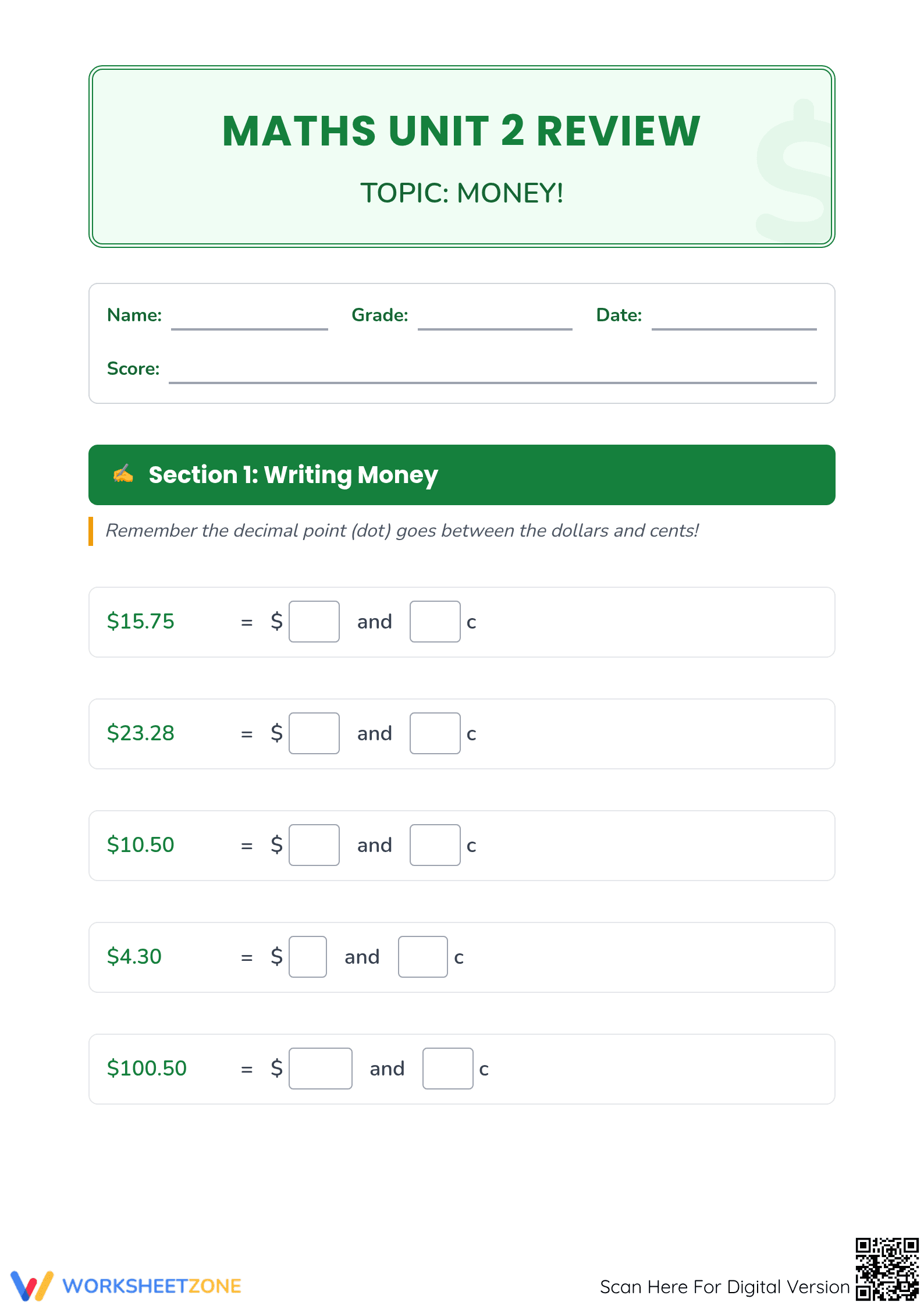
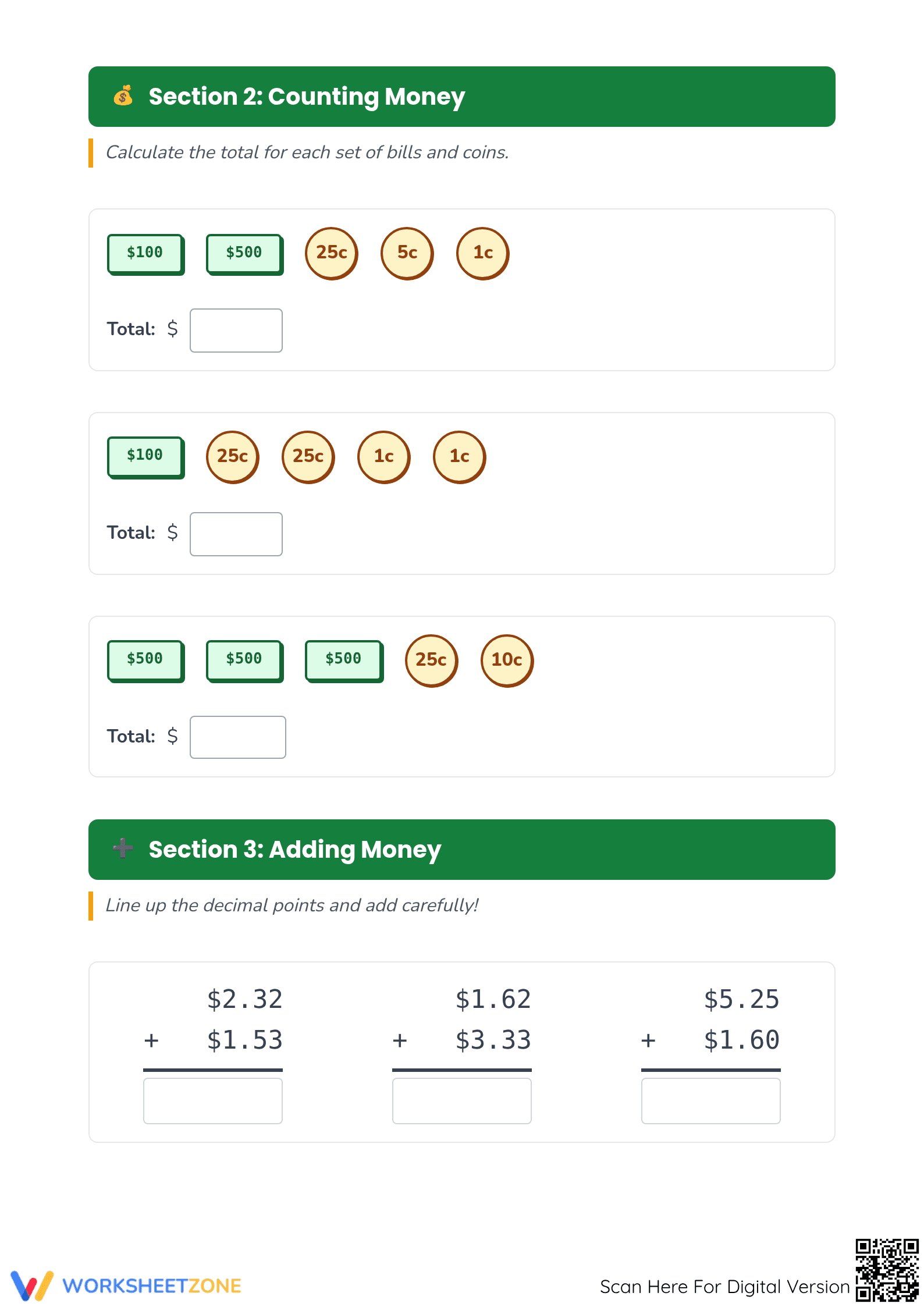
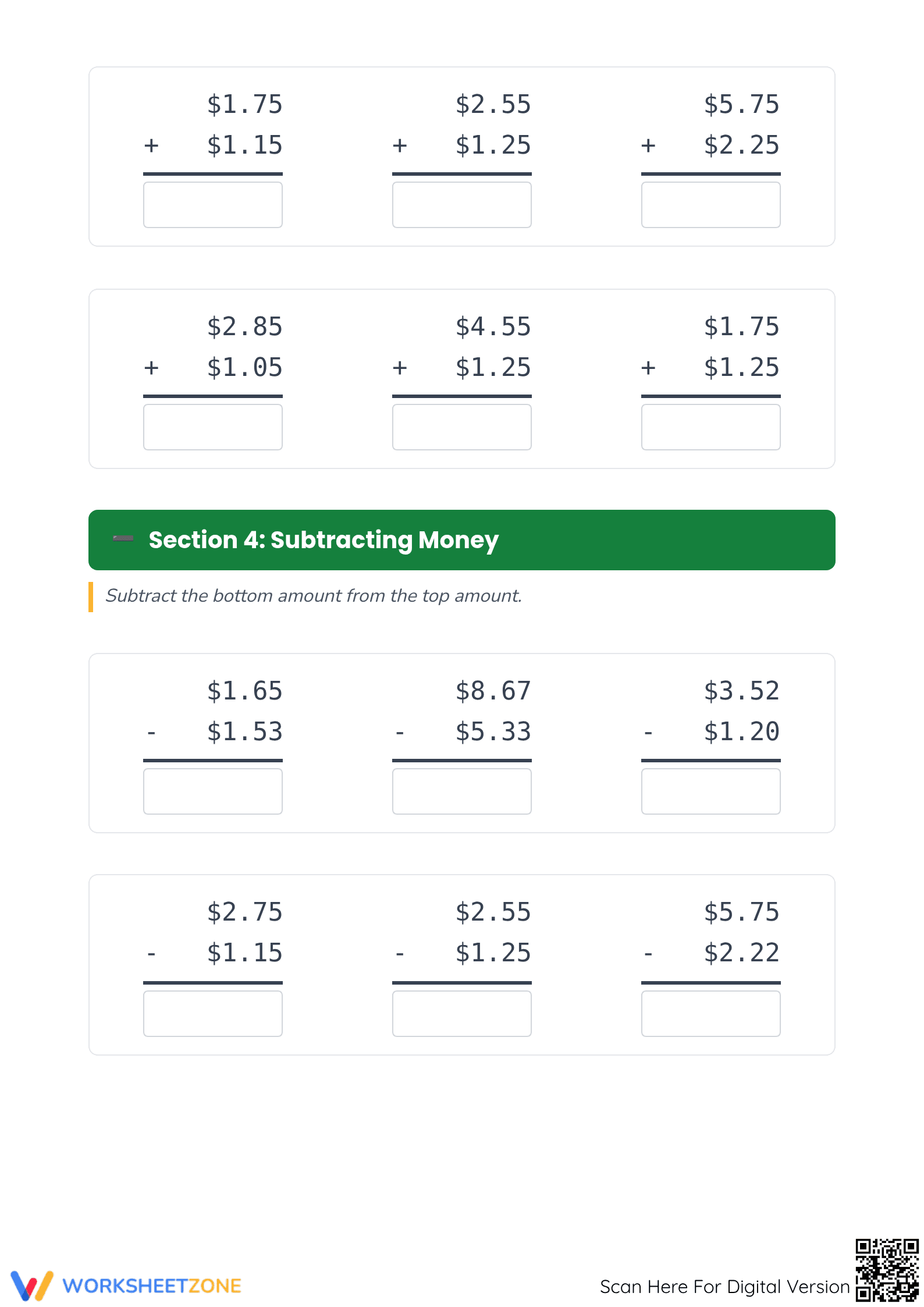
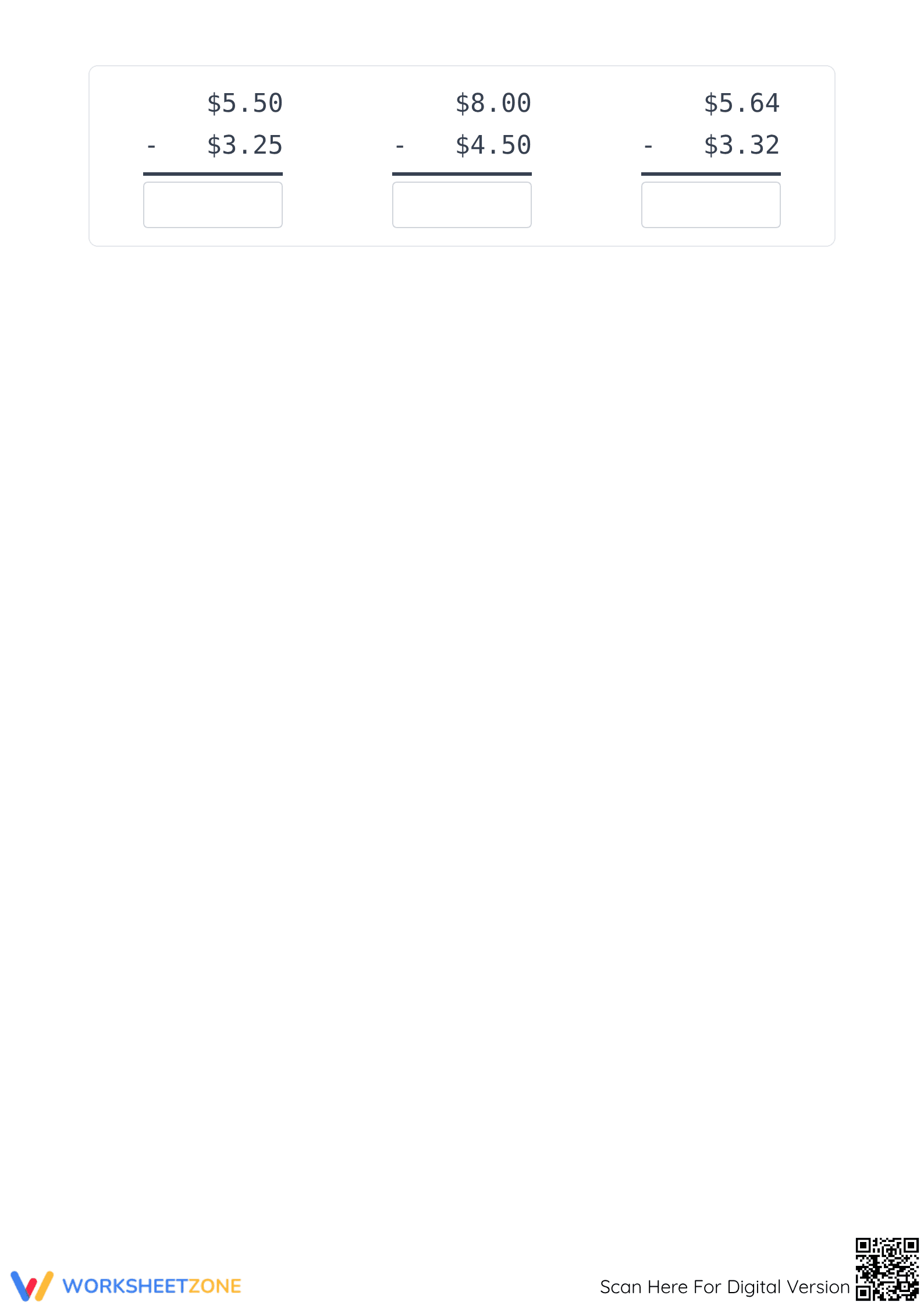
This four-page PDF includes four distinct sections designed to build operational confidence. Page one focuses on writing currency by separating dollars and cents. Page two introduces visual counting tasks using bills and coins. The final two pages provide eighteen vertical addition and subtraction problems, emphasizing correct decimal alignment. A full answer key is included to facilitate quick grading and immediate student feedback.
Skill Progression
- Guided practice: Section 1 uses clear prompts to help students identify the relationship between decimal notations and verbal currency descriptions with 5 targeted problems.
- Supported practice: Section 2 provides visual representations of currency, requiring students to sum various denominations accurately across 3 sets of bills and coins.
- Independent practice: Sections 3 and 4 challenge students with 18 operational problems requiring precision in decimal placement without additional scaffolds.
This gradual-release approach ensures that learners move from basic identification to complex calculation fluency using the I Do, We Do, You Do method.
Standards Alignment
The primary alignment for this resource is CCSS.MATH.CONTENT.2.MD.C.8: "Solve word problems involving dollar bills, quarters, dimes, nickels, and pennies, using $ and ¢ symbols appropriately." Supporting standards include Grade 3 and 4 measurement and data concepts involving decimal operations and currency management. Both standard codes can be copied directly into lesson plans, IEP goals, or district curriculum mapping tools.
How to Use It
Use this worksheet as a summative assessment at the conclusion of a unit on measurement and data. During the lesson, observe students as they complete Section 2 to ensure they are skip-counting bills and coins efficiently. It also serves as a quality homework assignment or a guided small-group activity for students needing support with decimal alignment. Expect completion within a 30 to 45-minute instructional block.
Who It's For
This resource is ideal for Grade 2, 3, or 4 students working toward mastery of currency and decimals. It provides support for English Language Learners through visual cues and clear section headings. Pair this worksheet with an anchor chart on decimal placement or a collection of plastic play money to provide a multi-sensory learning experience for mathematicians needing extra reinforcement.
According to Fisher & Frey (2014), the gradual release of responsibility model is essential for students to master complex mathematical concepts like currency operations. This worksheet facilitates this by moving from conceptual identification to operational fluency. Research from NAEP indicates that student performance on measurement and data tasks improves significantly when real-world contexts, such as handling money, are integrated into daily practice. This 4-page review provides 26 targeted problems that span the critical skills required by CCSS.MATH.CONTENT.2.MD.C.8, including the ability to transition between symbolic and decimal representations of value. By practicing addition and subtraction with decimal points, learners develop the precision needed for economic literacy. The structured format allows teachers to identify specific gaps in student understanding, whether in counting sets of bills or aligning decimals for calculation. This resource serves as a comprehensive tool for classroom assessment or independent reinforcement, helping students meet elementary financial mathematics standards.


