


























Views
Downloads

Grade 3 Math Test Worksheet (3.OA.D.8) | Essential Review
Paste this activity's link or code into your existing LMS (Google Classroom, Canvas, Teams, Schoology, Moodle, etc.).
Students can open and work on the activity right away, with no student login required.
You'll still be able to track student progress and results from your teacher account.
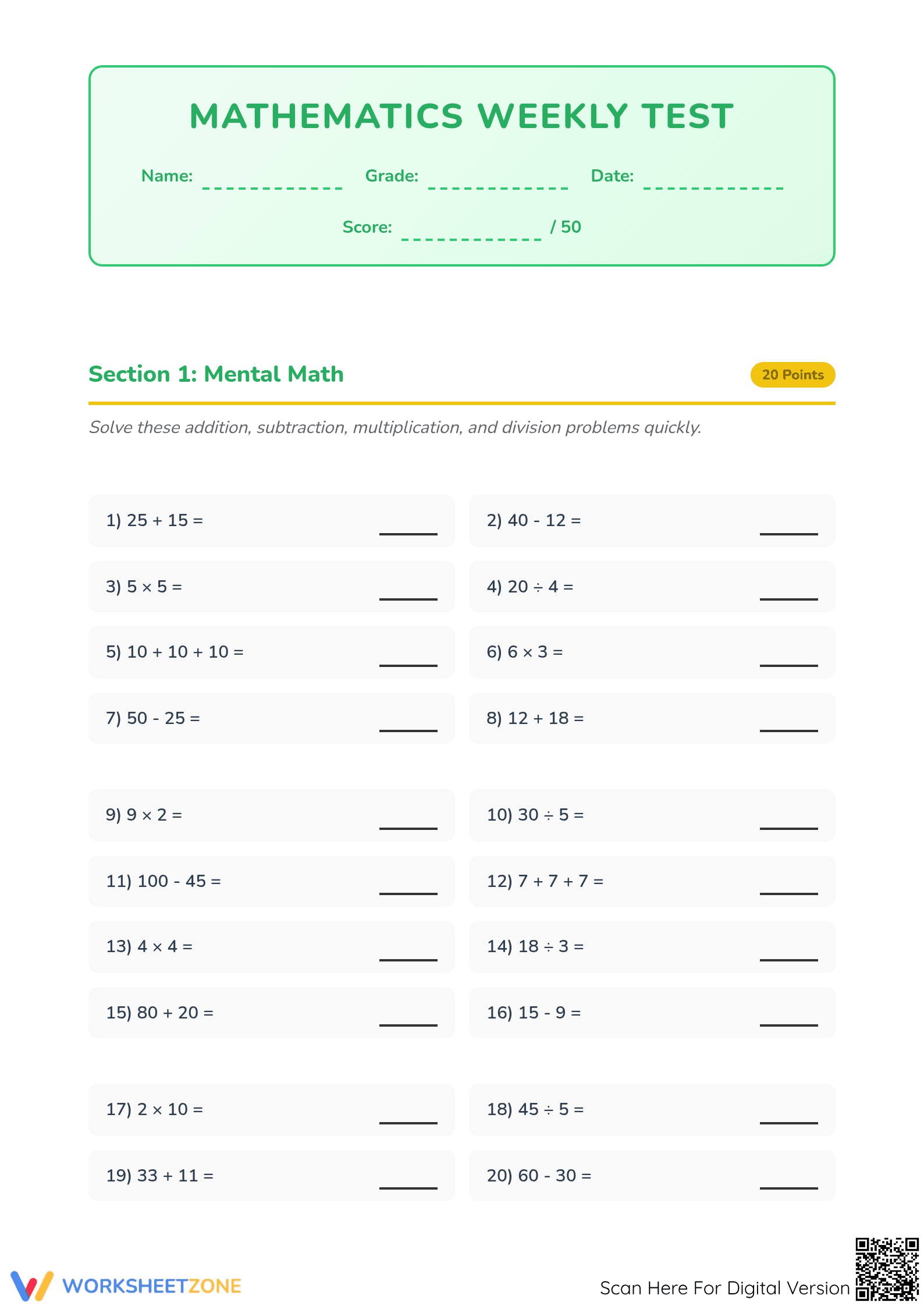
This comprehensive weekly math test for Grade 3 provides a robust assessment of key mathematical skills. It is designed to evaluate student proficiency across multiple domains, including mental math with all four operations, arithmetic number patterns, multi-step word problems, and foundational geometry. This resource gives educators a clear, data-driven snapshot of student learning.
At a Glance
- Grade: 3 · Subject: Math
- Standard:
CCSS.MATH.CONTENT.3.OA.D.8— Solve two-step word problems using the four operations.- Skill Focus: Mixed Math Skills Assessment
- Format: 4 pages · 34 problems · Answer key included · PDF
- Best For: Weekly assessment or cumulative unit review
- Time: 25–40 minutes
What's Inside
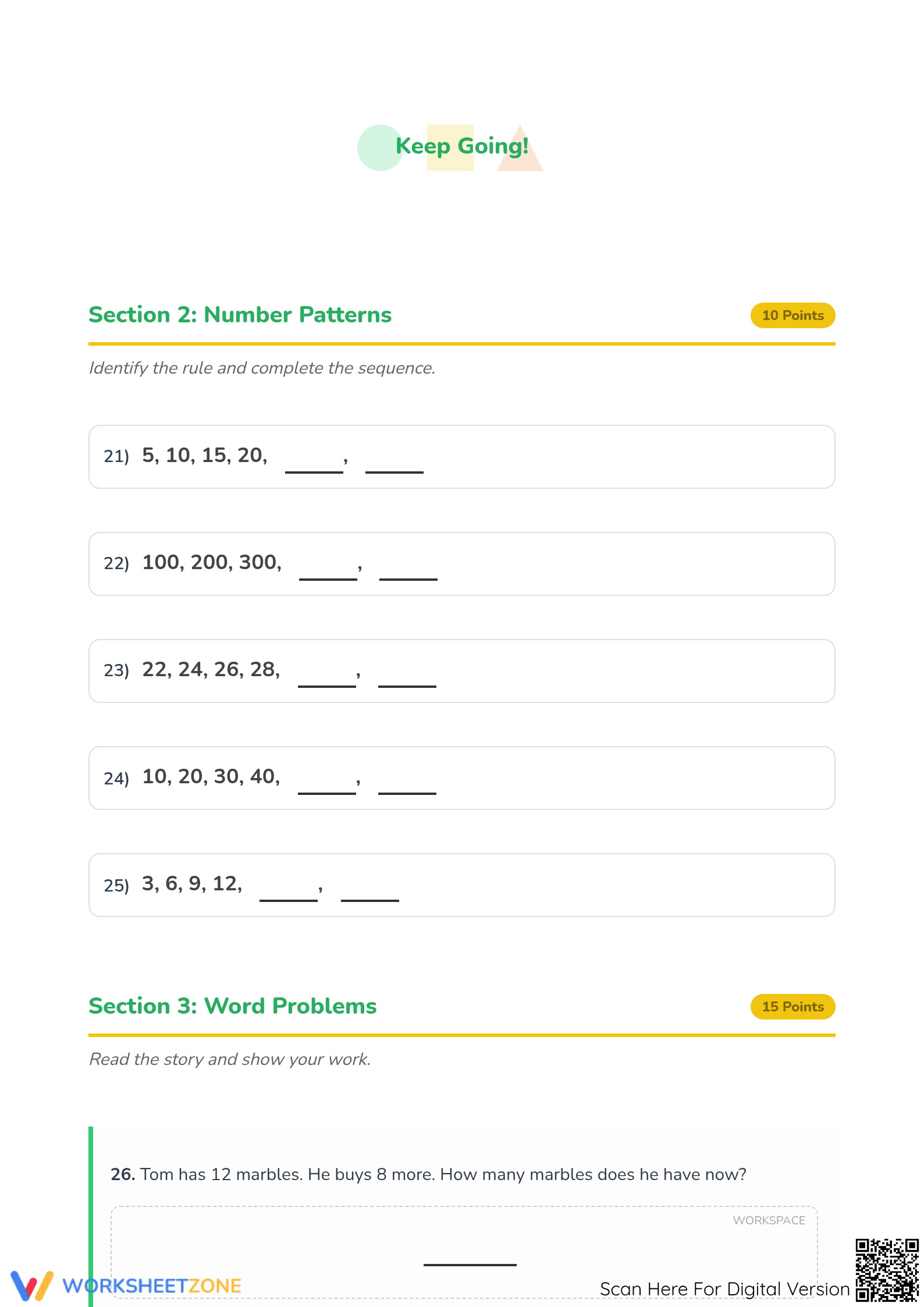
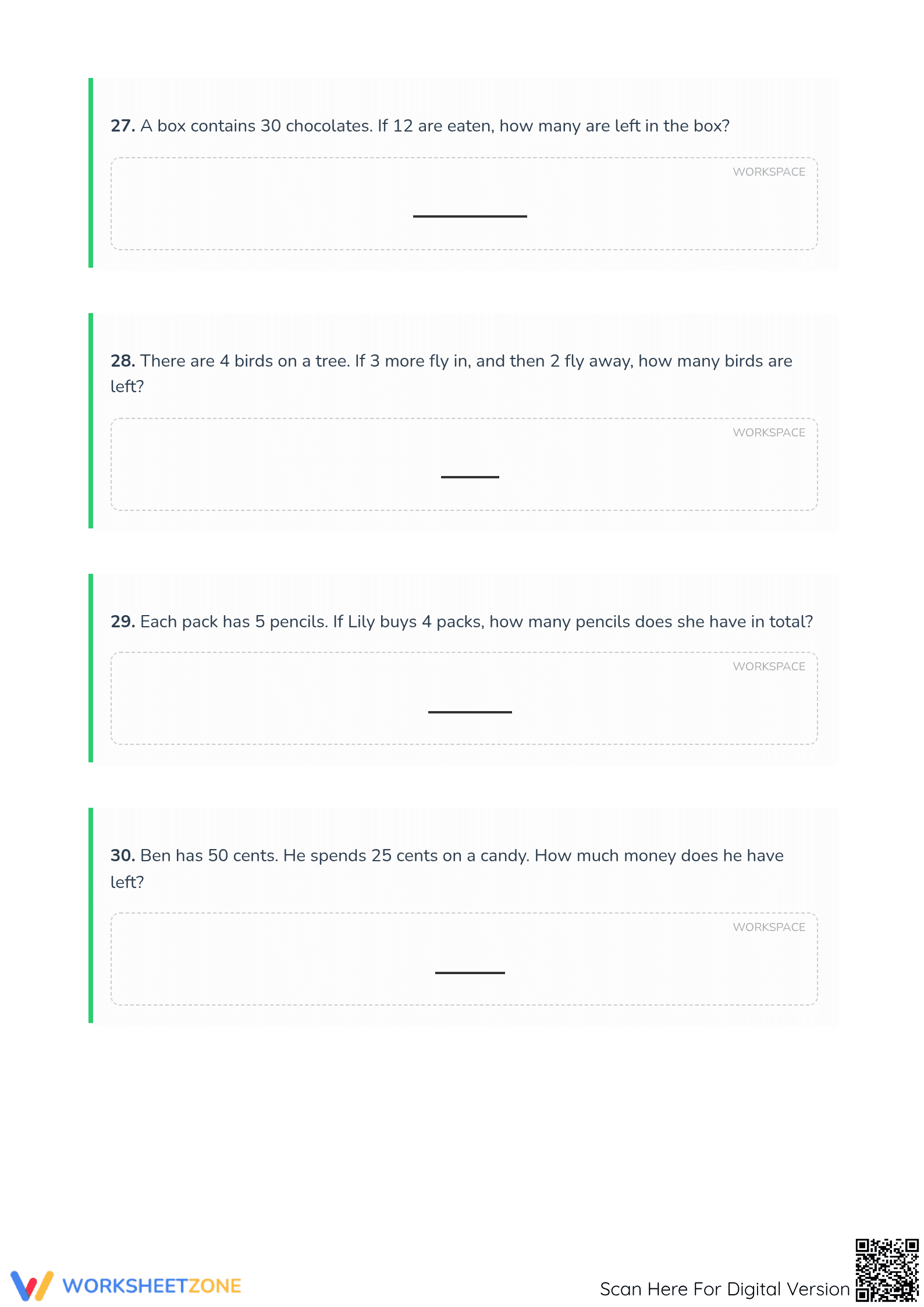
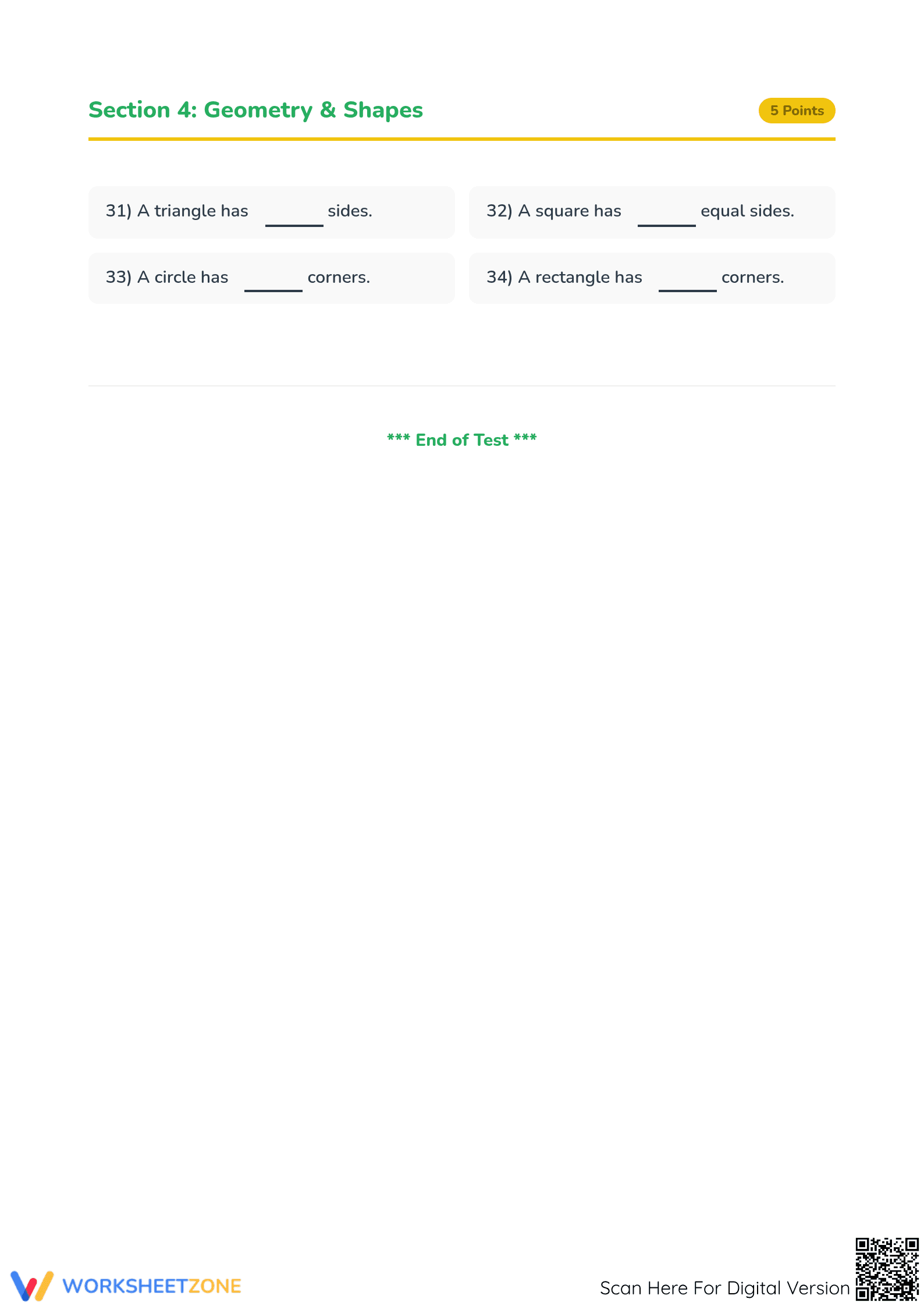
This four-page worksheet is structured as a weekly test. The first page features a 20-problem mental math drill covering addition, subtraction, multiplication, and division. The second page assesses number pattern recognition and introduces word problems. The third page contains more complex, multi-step word problems requiring students to show their work. The assessment concludes on the fourth page with a brief review of geometry concepts. A complete answer key for all 34 questions is included for efficient grading.
Evidence of Mastery
This worksheet serves as an effective summative assessment. Sections are weighted (Mental Math: 20, Number Patterns: 10, Word Problems: 15, Geometry: 5) for quantitative data collection. Teachers can map results to core Grade 3 domains: Operations & Algebraic Thinking (Sections 1-3) and Geometry (Section 4). This provides clear evidence for tracking progress against standards like CCSS.MATH.CONTENT.3.OA.D.8 and identifying areas for re-teaching.
Standards Alignment
This assessment is primarily aligned with CCSS.MATH.CONTENT.3.OA.D.8, which requires students to "Solve two-step word problems using the four operations. Represent these problems using equations with a letter standing for the unknown quantity." The worksheet also supports other key standards, including CCSS.MATH.CONTENT.3.OA.C.7 for mental math fluency and CCSS.MATH.CONTENT.2.G.A.1 for geometry. Both standard codes can be copied directly into lesson plans, IEP goals, or district curriculum mapping tools.
How to Use It
Administer this worksheet as a Friday assessment to measure mastery of the week's math instruction or use it as a pre-assessment at the beginning of a unit to diagnose existing knowledge gaps. For a formative assessment opportunity, circulate as students work through the word problem section. Observe the strategies they employ to deconstruct the problems before they begin calculations, noting which students effectively identify the required operations. The expected completion time for the entire test is between 25 and 40 minutes.
Who It's For
This resource is designed for third-grade students. It can also be used as an extension for advanced second-grade students who are ready for multiplication and division, or as a beginning-of-year review for fourth-grade students. This assessment pairs well with a classroom anchor chart displaying problem-solving strategies, such as the CUBES method, to support students in tackling word problems.
This weekly math test, aligned with CCSS.MATH.CONTENT.3.OA.D.8, assesses Grade 3 students' ability to solve problems using the four operations. Regular, low-stakes assessment drives long-term retention and procedural fluency. By integrating mental math, pattern recognition, and word problems, this worksheet offers a balanced evaluation of the standard's skills. Structured formative assessments are crucial for informing instructional decisions and providing targeted feedback. This resource helps teachers efficiently collect performance data to guide re-teaching and intervention, building a solid mathematical foundation.


