




























Views
Downloads

Essential 2.NBT.B.5 Worksheet: Grade 2-3 Math Weekly Test

Paste this activity's link or code into your existing LMS (Google Classroom, Canvas, Teams, Schoology, Moodle, etc.).
Students can open and work on the activity right away, with no student login required.
You'll still be able to track student progress and results from your teacher account.
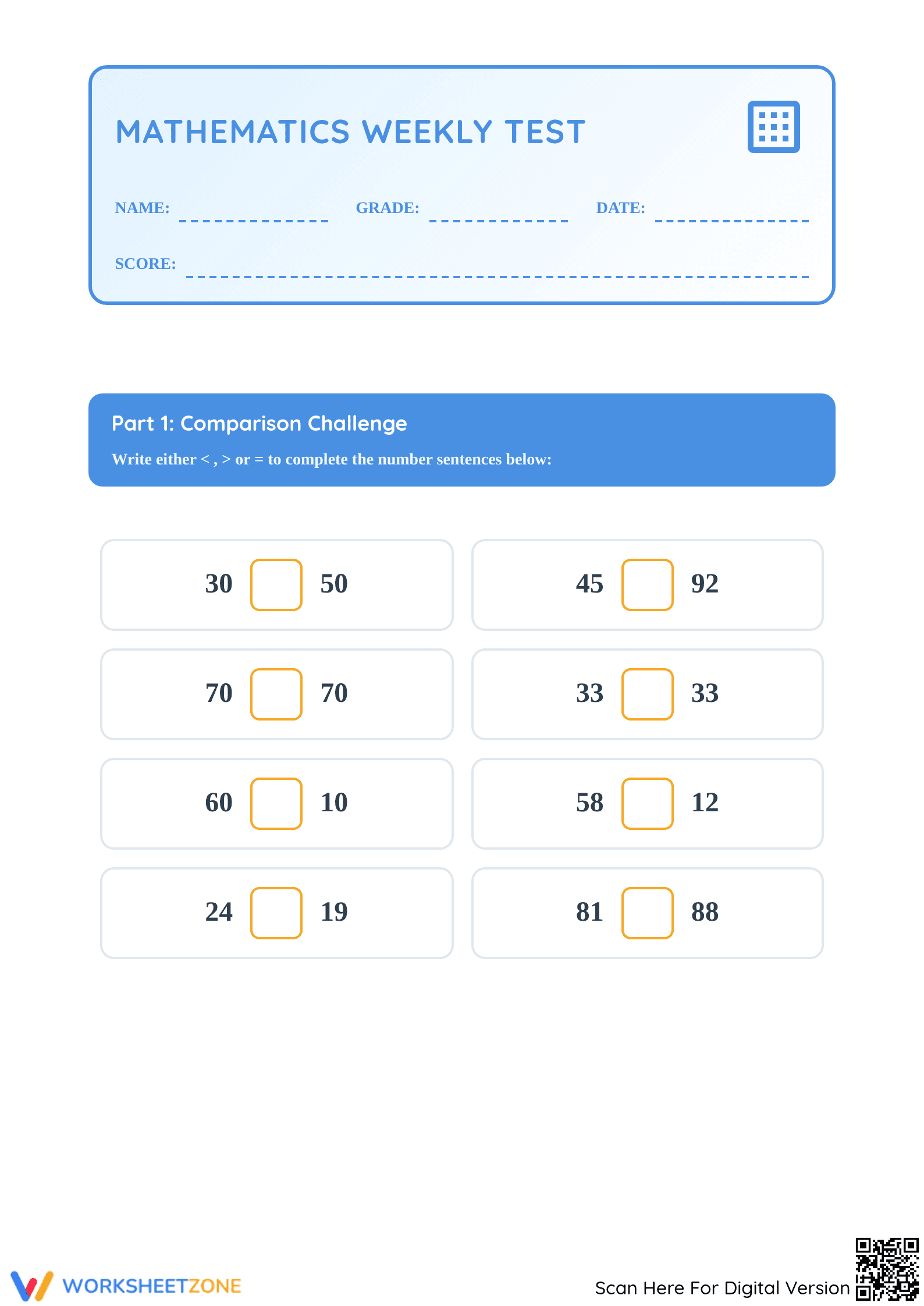
This comprehensive Grade 2 and Grade 3 math weekly test provides a robust assessment of foundational arithmetic skills. Students demonstrate mastery in primary standards by solving multi-digit operations, comparing numerical values, and decoding word problems. This versatile resource ensures learners can fluently apply addition strategies to achieve measurable academic growth.
At a Glance
- Grade: 2-3 · Subject: Math
- Standard:
CCSS.MATH.CONTENT.2.NBT.B.5— Fluently add and subtract within 100 using strategies based on place value- Skill Focus: Addition, Subtraction, and Number Logic
- Format: 4 pages · 28 problems · Answer key included · PDF
- Best For: Weekly formative assessment and skill review
- Time: 30–45 minutes
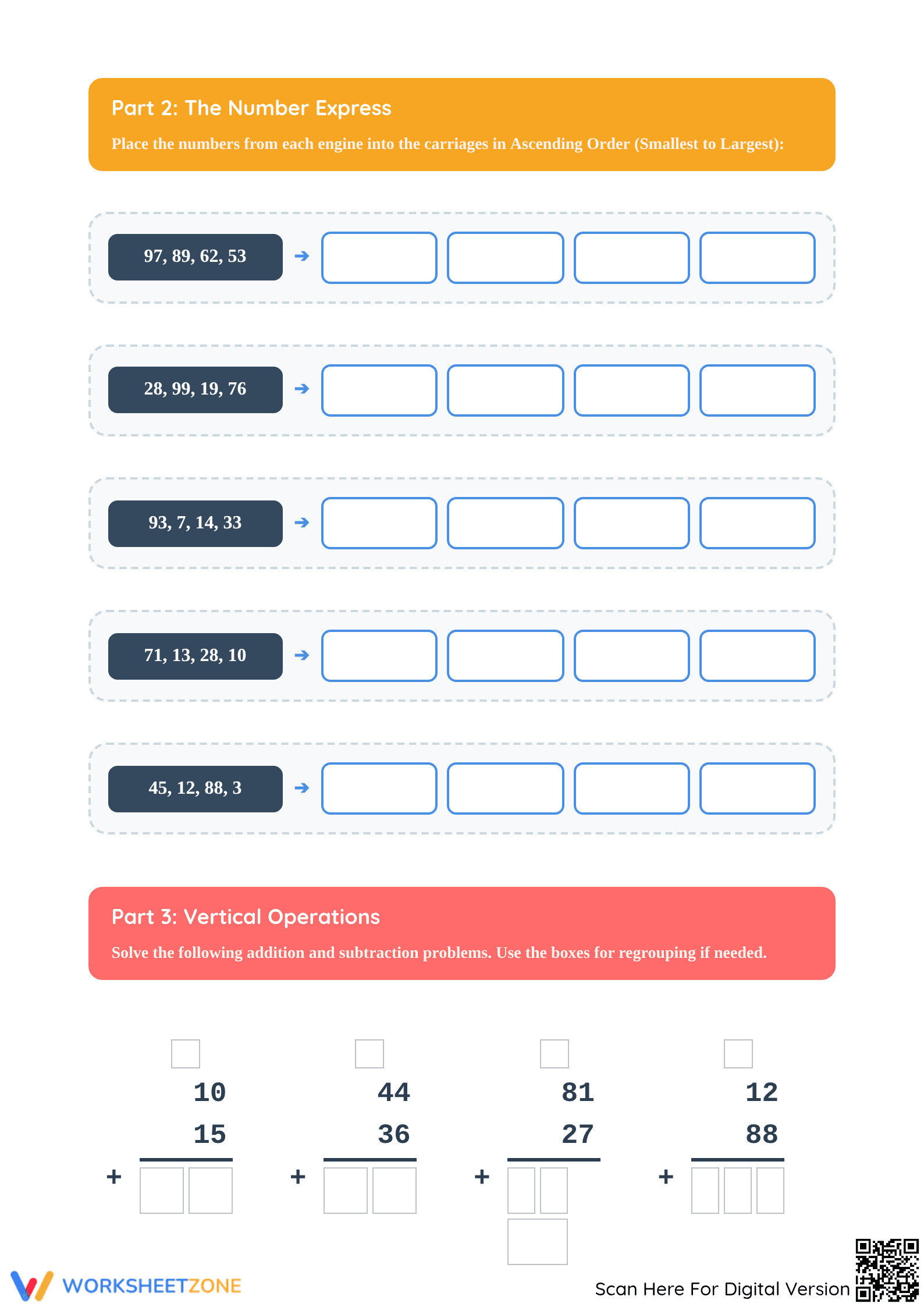
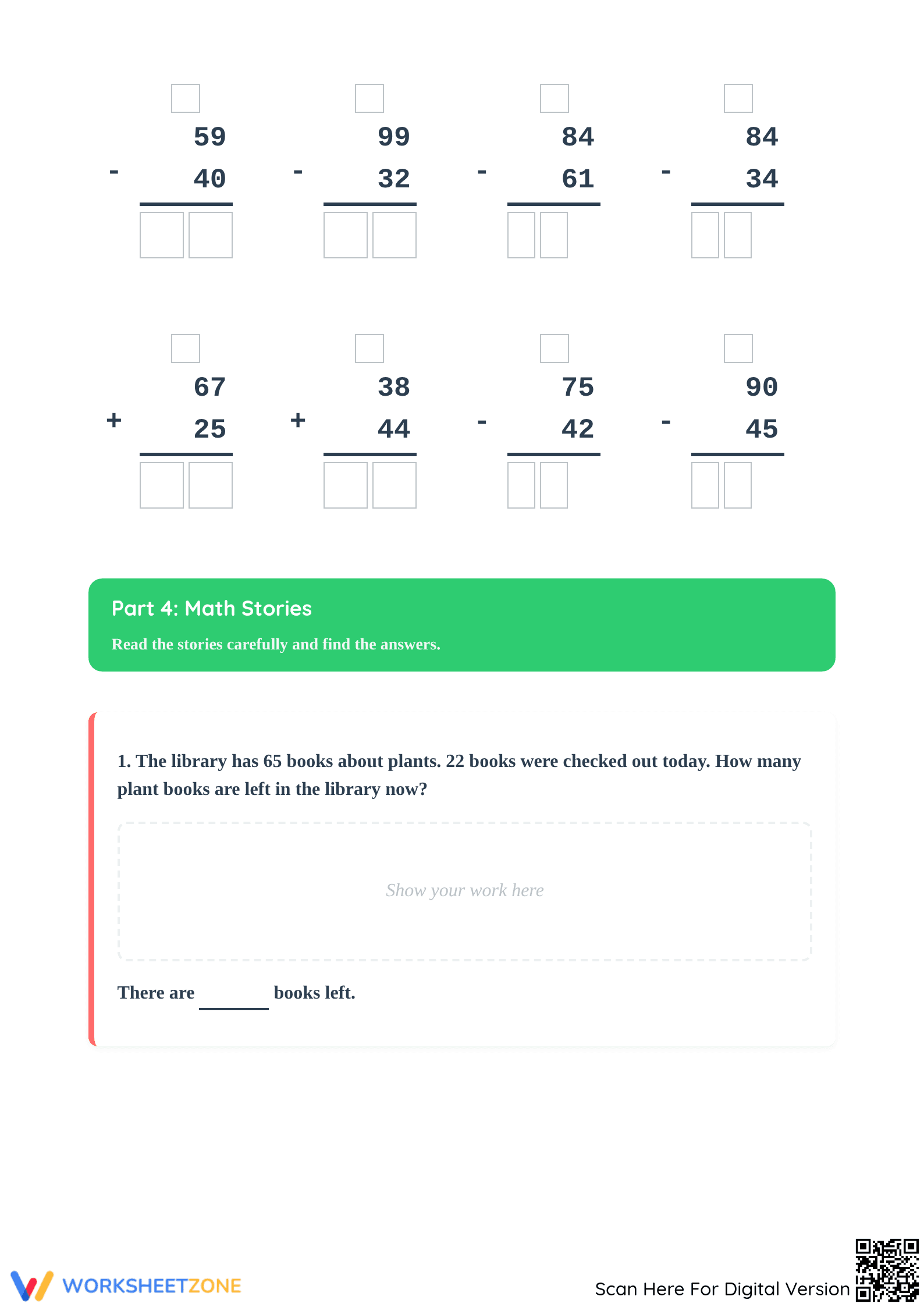
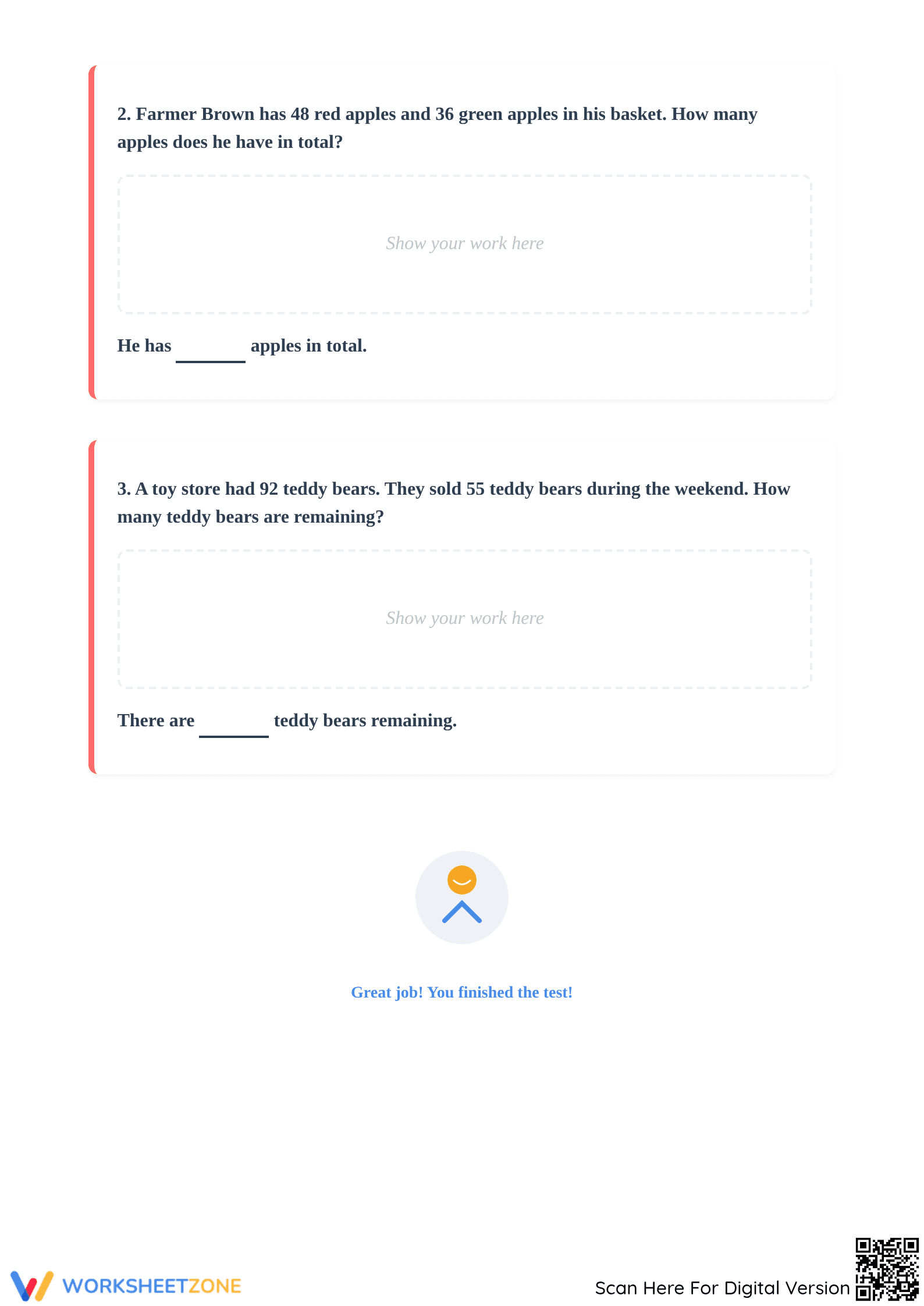
The four-page PDF is structured as a progressive evaluation. It features eight comparison challenges using symbols, five "Number Express" sets for ordering values, and twelve vertical addition and subtraction problems with regrouping boxes. The final section includes three multi-sentence math stories requiring students to show their work, supported by a full answer key.
This assessment provides clear evidence of student mastery across the Numbers and Operations in Base Ten domain. The tasks are tiered to evaluate different depths: the comparison challenge assesses basic recognition, while the vertical operations and math stories require application of regrouping strategies. Educators can use results to enter data directly into IEP progress notes.
The primary focus of this worksheet is `CCSS.MATH.CONTENT.2.NBT.B.5`, which requires students to fluently add and subtract within 100 using strategies based on place value. Additionally, the "Math Stories" section aligns with `CCSS.MATH.CONTENT.2.OA.A.1` for solving one-step word problems. Both standard codes can be copied directly into lesson plans or curriculum mapping tools.
Deploy this test at the end of a math unit as a summative assessment to gauge progress. During administration, observe how students utilize the regrouping boxes; this provides formative insight into their understanding of place value exchanges. The expected completion time is 40 minutes, making it ideal for a standard classroom period.
This resource is tailored for Grade 2 and Grade 3 students working on foundational base-ten operations. It is effective for general education classrooms, special education small groups, and intervention tiers. It pairs naturally with a base-ten block anchor chart or a "keyword" strategy guide for solving multi-step word problems.
According to the NAEP framework, regular formative assessment in early elementary math is critical for identifying gaps in place value logic. This worksheet utilizes a structured layout that minimizes cognitive load, allowing students to focus on regrouping and the linguistic decoding of math stories. Research from Fisher & Frey (2014) emphasizes that "gradual release" is most effective when students are given clear spaces to "show their work," a feature integrated into this four-page test. By aligning tasks directly with CCSS.MATH.CONTENT.2.NBT.B.5, this resource ensures that Grade 2 and 3 learners practice the specific fluencies required for state testing readiness. This assessment serves as a reliable instrument for measuring student outcome and determining the need for future targeted instruction or curricular adjustments.


