


























Views
Downloads


Essential Decimals Practice Worksheet | Grade 4 Aligned
Paste this activity's link or code into your existing LMS (Google Classroom, Canvas, Teams, Schoology, Moodle, etc.).
Students can open and work on the activity right away, with no student login required.
You'll still be able to track student progress and results from your teacher account.
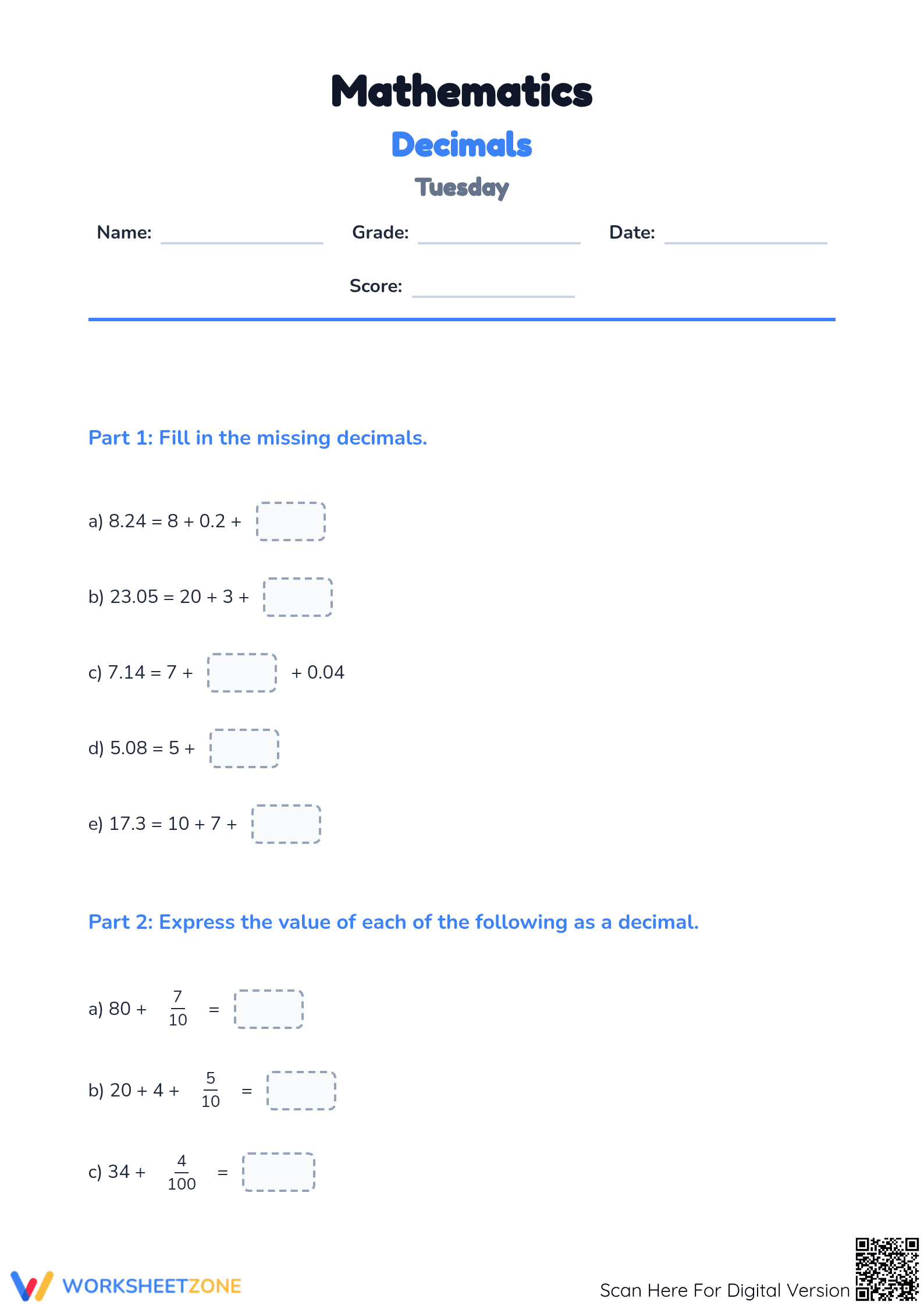
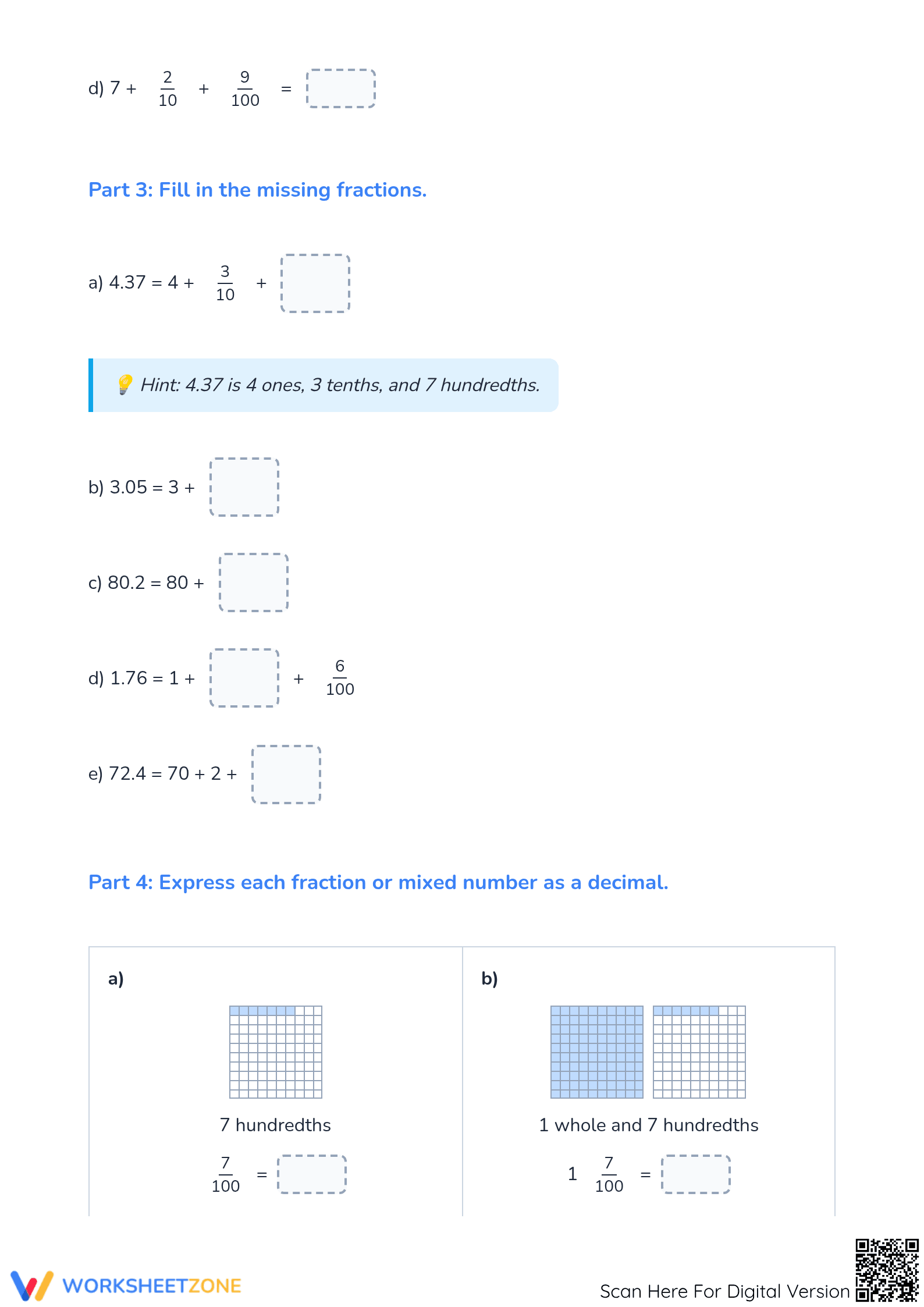
This Grade 4 decimals worksheet offers 25 practice problems to master identification, comparison, and rounding of decimal values. Students progress from visual number line representations to complex multi-step word problems, building a deep conceptual understanding of decimals and their relation to fractions. This resource ensures functional mathematical fluency beyond rote memorization.
At a Glance
- Grade: 4 · Subject: Math
- Standard:
CCSS.MATH.CONTENT.4.NF.C.7— Compare two decimals to hundredths by reasoning about their size- Skill Focus: Comparing, rounding, and fraction conversion
- Format: 4 pages · 25 problems · Answer key included · PDF
- Best For: Core curriculum reinforcement and small group practice
- Time: 45–60 minutes
What's Inside
This packet includes four pages with seven distinct sections, covering comparing, rounding, fraction-to-decimal conversions, and number line placement. Three real-world word problems conclude the set. A complete answer key allows for quick grading or self-correction, with a clean layout designed for maximum student engagement.
Skill Progression
- Guided Practice: Tasks 1-11 focus on isolated skills like comparing magnitudes and rounding to the nearest tenth, providing a clear entry point for all learners.
- Supported Practice: Tasks 12-22 introduce mixed numbers and number lines, requiring students to bridge their knowledge of fractions with decimal notation.
- Independent Practice: Tasks 23-25 present word problems that require students to apply decimal logic to realistic scenarios without explicit procedural prompts.
This scaffolded approach ensures students build confidence through gradual release of responsibility, preparing them for higher-order application tasks.
Standards Alignment
Focused on CCSS.MATH.CONTENT.4.NF.C.7: "Compare two decimals to hundredths by reasoning about their size. Recognize that comparisons are valid only when the two decimals refer to the same whole," this resource also supports CCSS.MATH.CONTENT.4.NF.C.6 on decimal notation for fractions. Both standards can be integrated into lesson plans, IEP goals, or curriculum mapping for instructional compliance.
How to Use It
Assign this worksheet during the independent practice phase of decimal place value lessons to monitor student progress. It serves as an excellent formative assessment, helping teachers identify struggles with mixed number to decimal transitions. Expect completion in approximately 50 minutes, using word problems as a closing activity to gauge mastery.
Who It's For
Ideal for Grade 4 students, this resource also provides vital review for Grade 5 learners solidifying their understanding of hundredths. It complements place value anchor charts, base-ten blocks, or decimal squares, suitable for general education, RTI Tier 2 interventions, or as a zero-prep sub plan.
Drawing on the gradual release of responsibility model (Fisher & Frey, 2014), this worksheet sequences 25 tasks from discrete skill practice to complex synthesis in word problems. Strictly aligned with CCSS.MATH.CONTENT.4.NF.C.7, it ensures Grade 4 students develop requisite decimal fluency for middle school math. Research consistently shows mastering fraction-decimal relationships improves standardized assessment performance. This resource bridges conceptual gaps through diverse task types, providing reliable, evidence-based instruction for decimal mastery and standards-aligned curriculum goals.


