


























Views
Downloads

Reading Decimal Measurements | Grade 4 Math Printable
Paste this activity's link or code into your existing LMS (Google Classroom, Canvas, Teams, Schoology, Moodle, etc.).
Students can open and work on the activity right away, with no student login required.
You'll still be able to track student progress and results from your teacher account.
This printable math worksheet helps students master reading continuous measurement scales and expressing the values as decimals. By practicing with rulers, beakers, and weighing scales, learners develop practical skills in interpreting metric units like centimeters, liters, and kilograms accurately.
At a Glance
- Grade: 4 · Subject: Math
- Standard:
CCSS.MATH.CONTENT.4.MD.A.2— Solve problems involving measurement and decimals- Skill Focus: Reading decimal measurements on metric scales
- Format: 3 pages · 9 problems · Answer key included · PDF
- Best For: Independent practice and review
- Time: 15–20 minutes
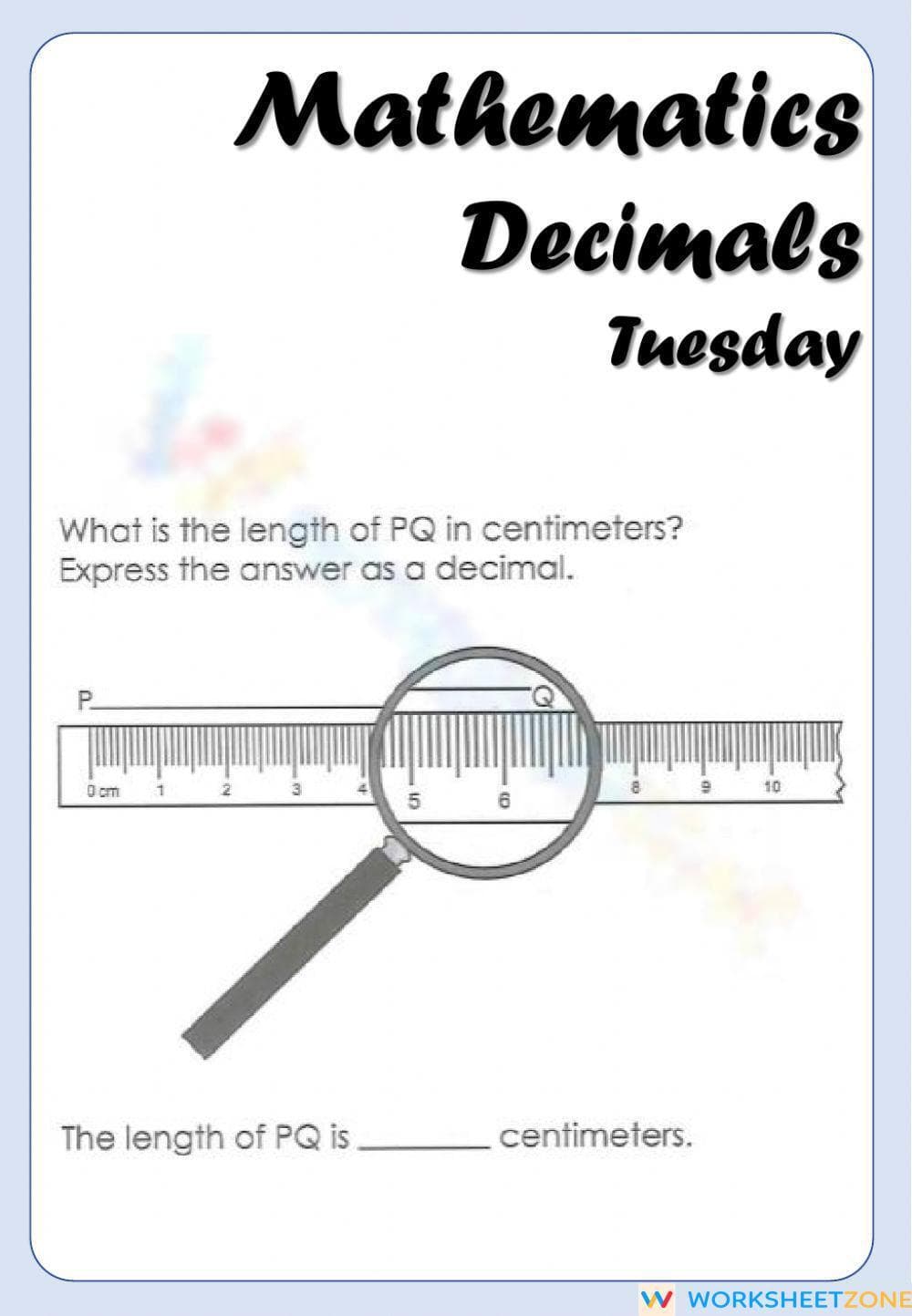
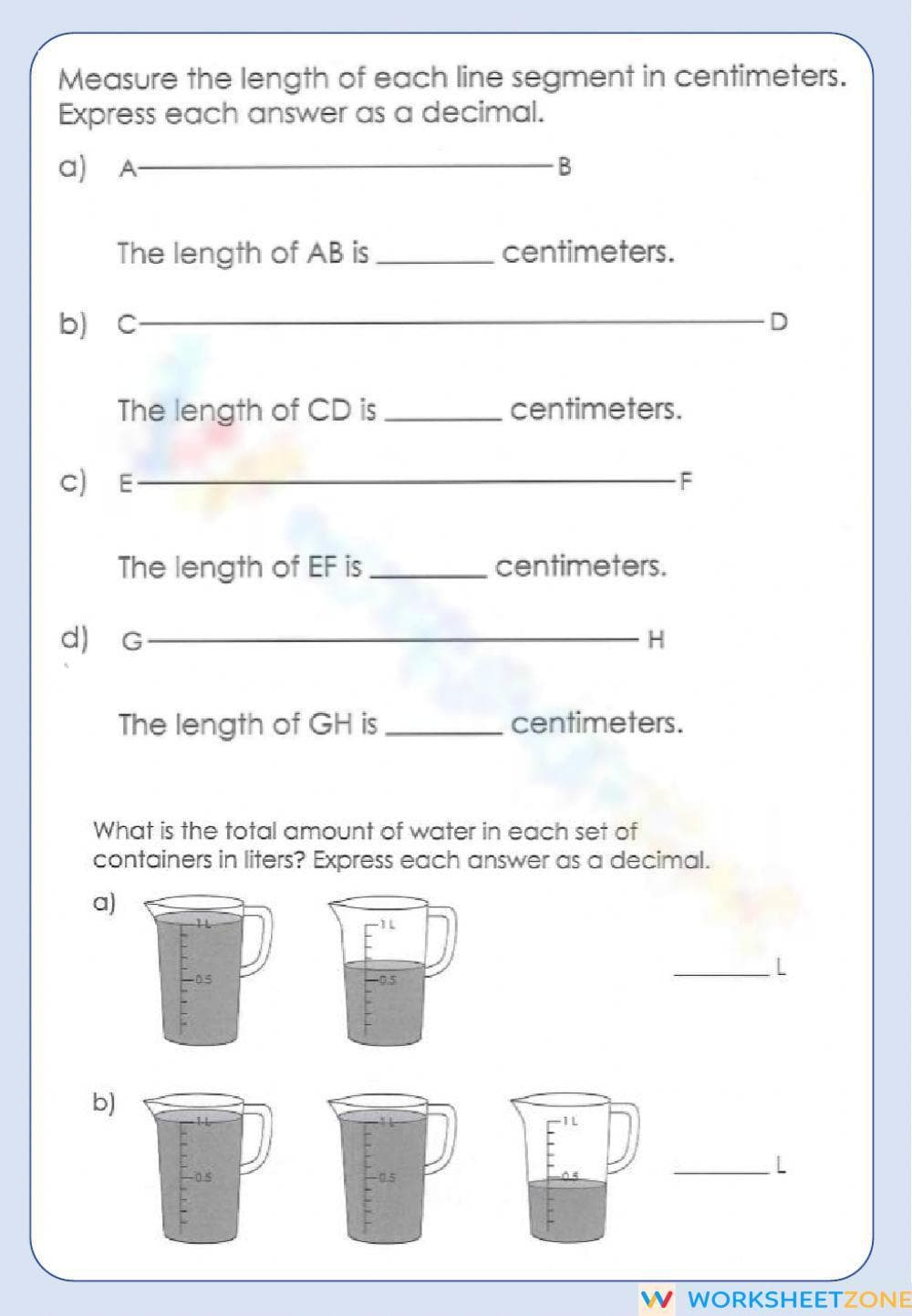
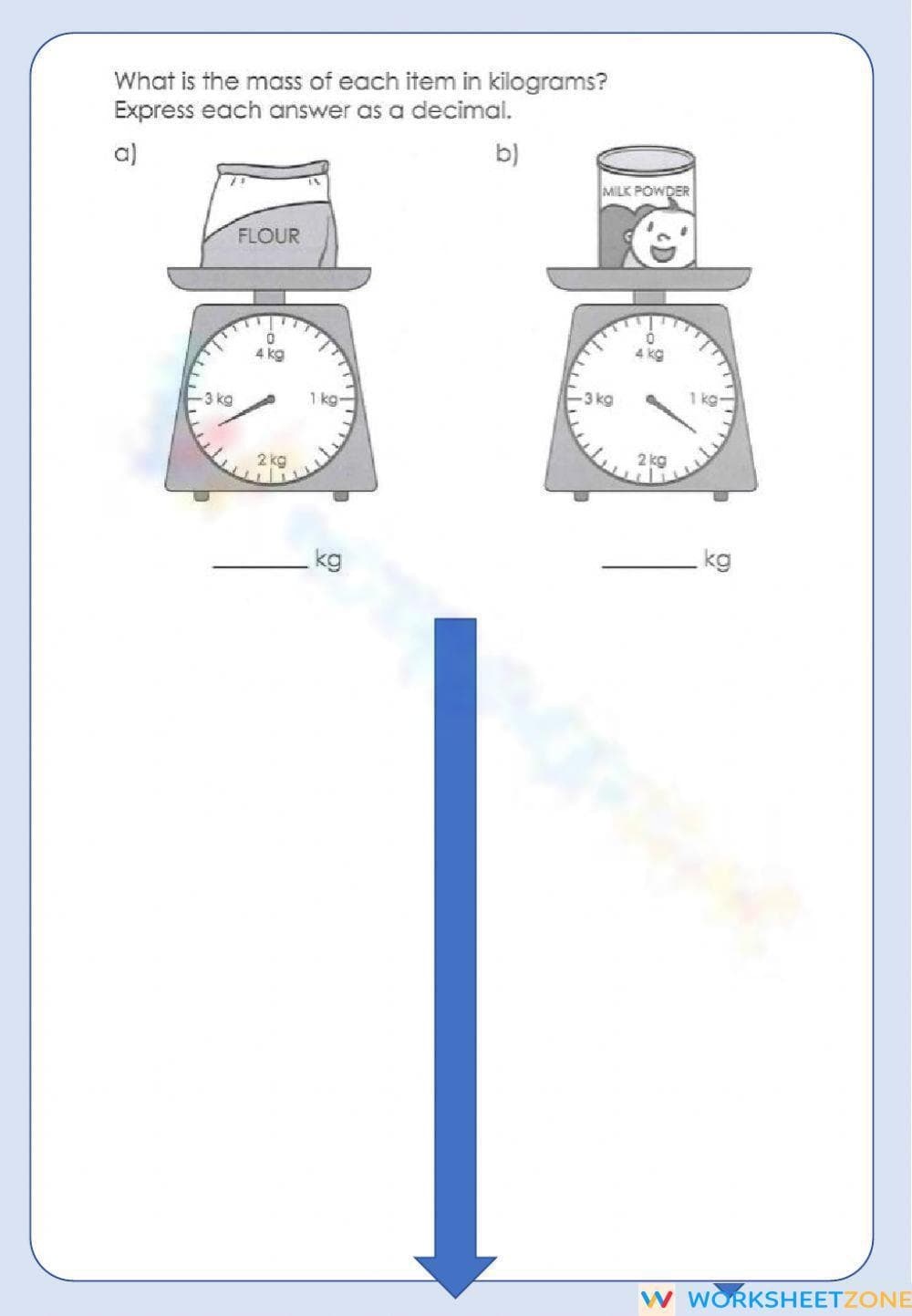
This three-page resource features nine visual measurement tasks. Students read line segments using a magnified centimeter ruler, determine liquid volume in graduated pitchers, and identify mass on kilogram scales. Each section requires learners to observe tick marks and write the measurement as a decimal. An answer key is provided.
- Guided practice: Page one features a single, magnified ruler task to help students read tenths of a centimeter.
- Supported practice: Page two introduces multiple line segments and liquid volume beakers across different contexts.
- Independent practice: The final page challenges students to read circular weighing scales, synthesizing their understanding.
This gradual-release approach builds confidence as students transition from linear to circular scales.
Aligned to primary standard CCSS.MATH.CONTENT.4.MD.A.2: Use the four operations to solve word problems involving distances, intervals of time, liquid volumes, masses of objects, and money, including problems involving simple fractions or decimals. It also supports foundational decimal concepts by requiring students to interpret tenths on a number line or scale. Both standard codes can be copied directly into lesson plans, IEP goals, or district curriculum mapping tools.
Use this worksheet as independent practice after a direct instruction lesson on metric scales. It also serves as an excellent math center station where students physically measure objects before completing the written tasks. Formative assessment tip: observe whether students correctly identify the value of minor tick marks before writing their decimal answer. Expected completion time is 15 to 20 minutes.
This resource is designed for fourth and fifth-grade students developing their understanding of decimals and metric measurement. It is easily differentiated by allowing struggling learners to label each tick mark on the page before determining the final answer. Pair this worksheet with hands-on measuring activities using real rulers, water pitchers, and kitchen scales to reinforce the visual concepts.
Integrating visual models with decimal instruction significantly improves student comprehension of rational numbers and their practical applications. According to EdReports 2024, utilizing number lines and continuous measurement scales helps students conceptualize decimals as specific quantities rather than abstract digits. This pedagogical approach is essential for developing strong spatial reasoning and quantitative literacy. By aligning to CCSS.MATH.CONTENT.4.MD.A.2 and focusing on the ability to solve problems involving measurement and decimals, this resource effectively bridges the gap between theoretical math concepts and real-world application. Providing students with varied visual contexts—such as linear rulers, volumetric beakers, and circular weighing dials—ensures a robust understanding of base-ten increments across different physical properties. When learners actively interpret these scales, they build the necessary cognitive frameworks to tackle more advanced scientific and mathematical tasks in later grades, solidifying their foundational measurement skills.


