


























Views
Plays

Printable Math Didactics Quiz | AP Spanish
Paste this activity's link or code into your existing LMS (Google Classroom, Canvas, Teams, Schoology, Moodle, etc.).
Students can open and work on the activity right away, with no student login required.
You'll still be able to track student progress and results from your teacher account.
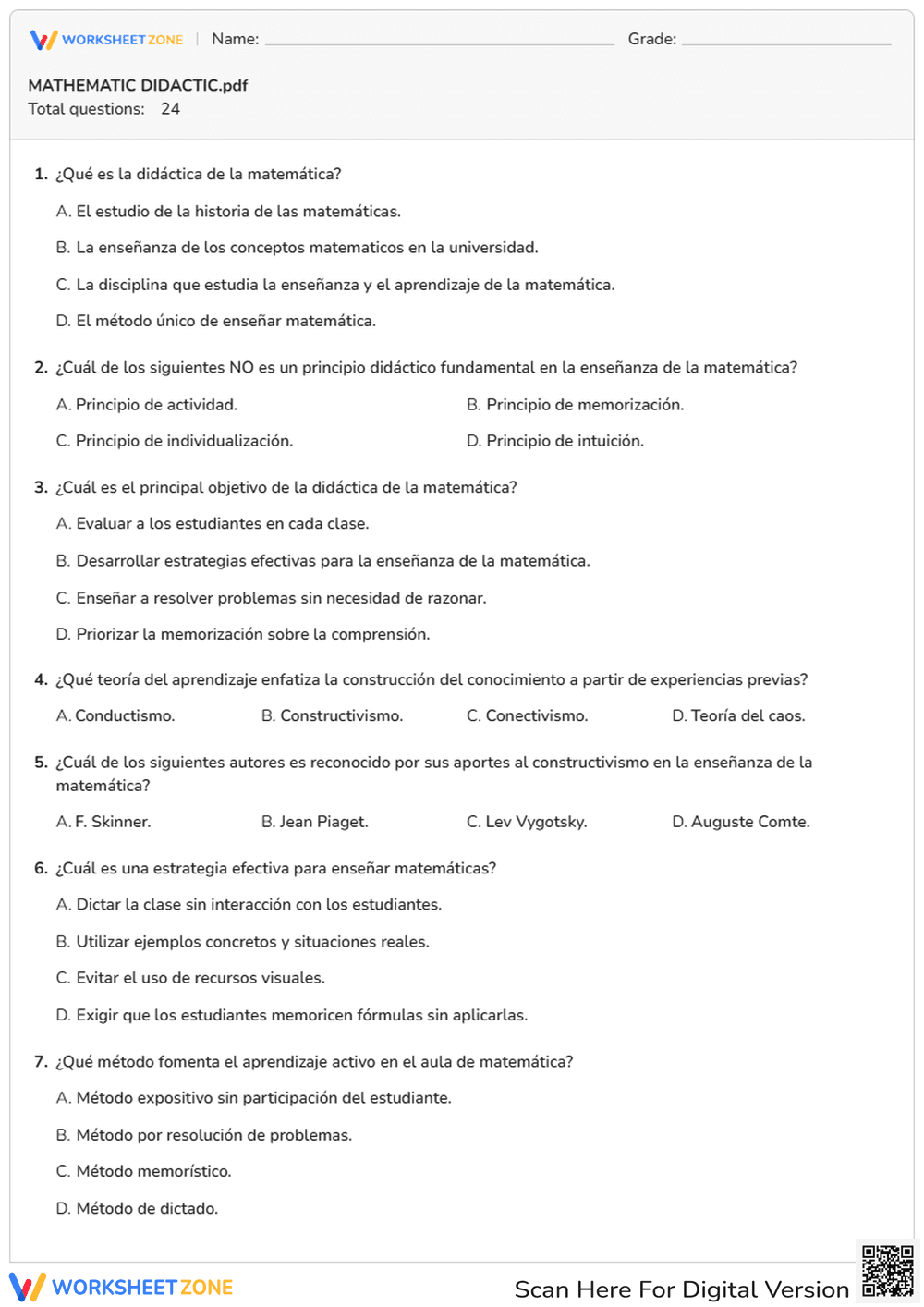
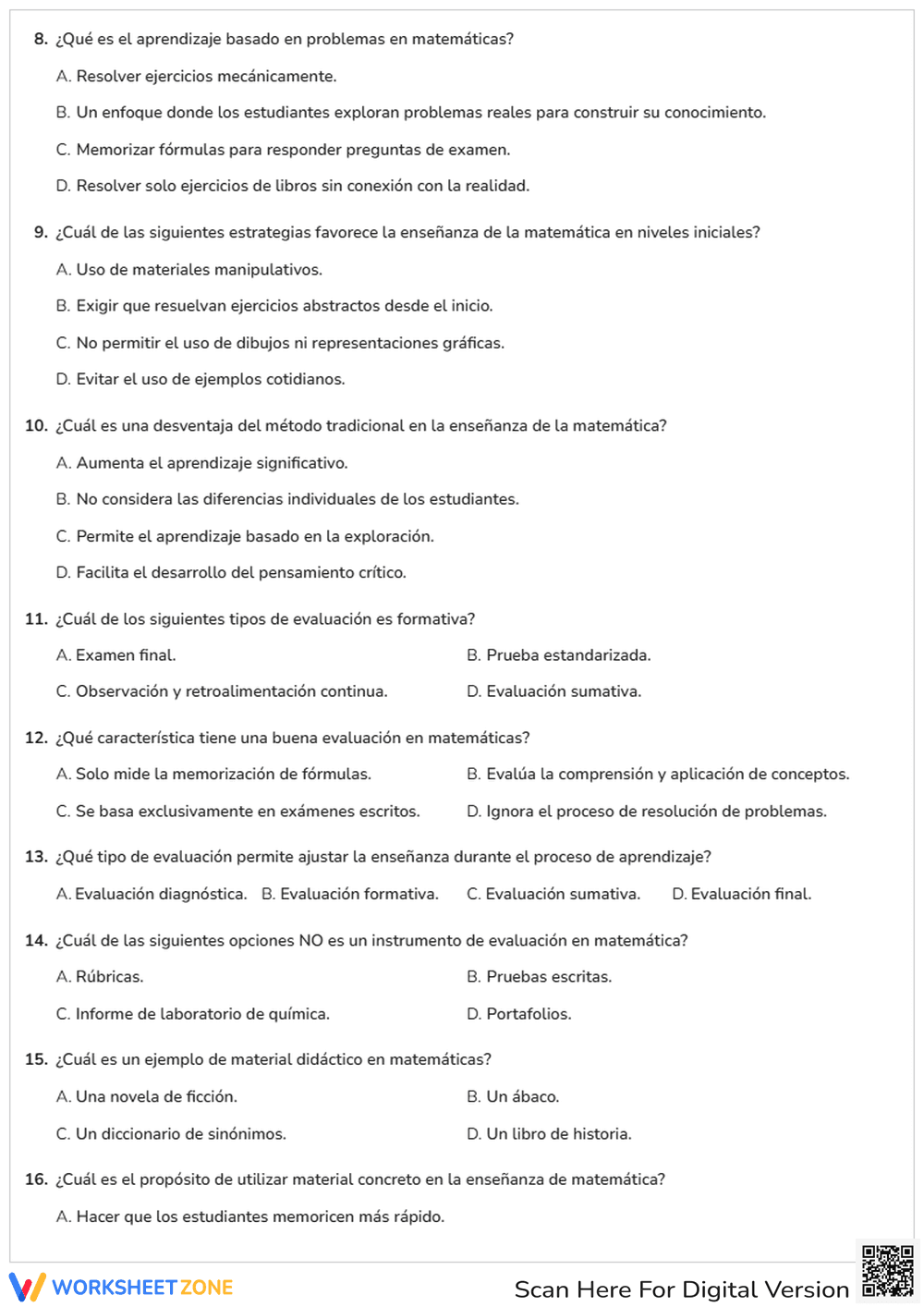
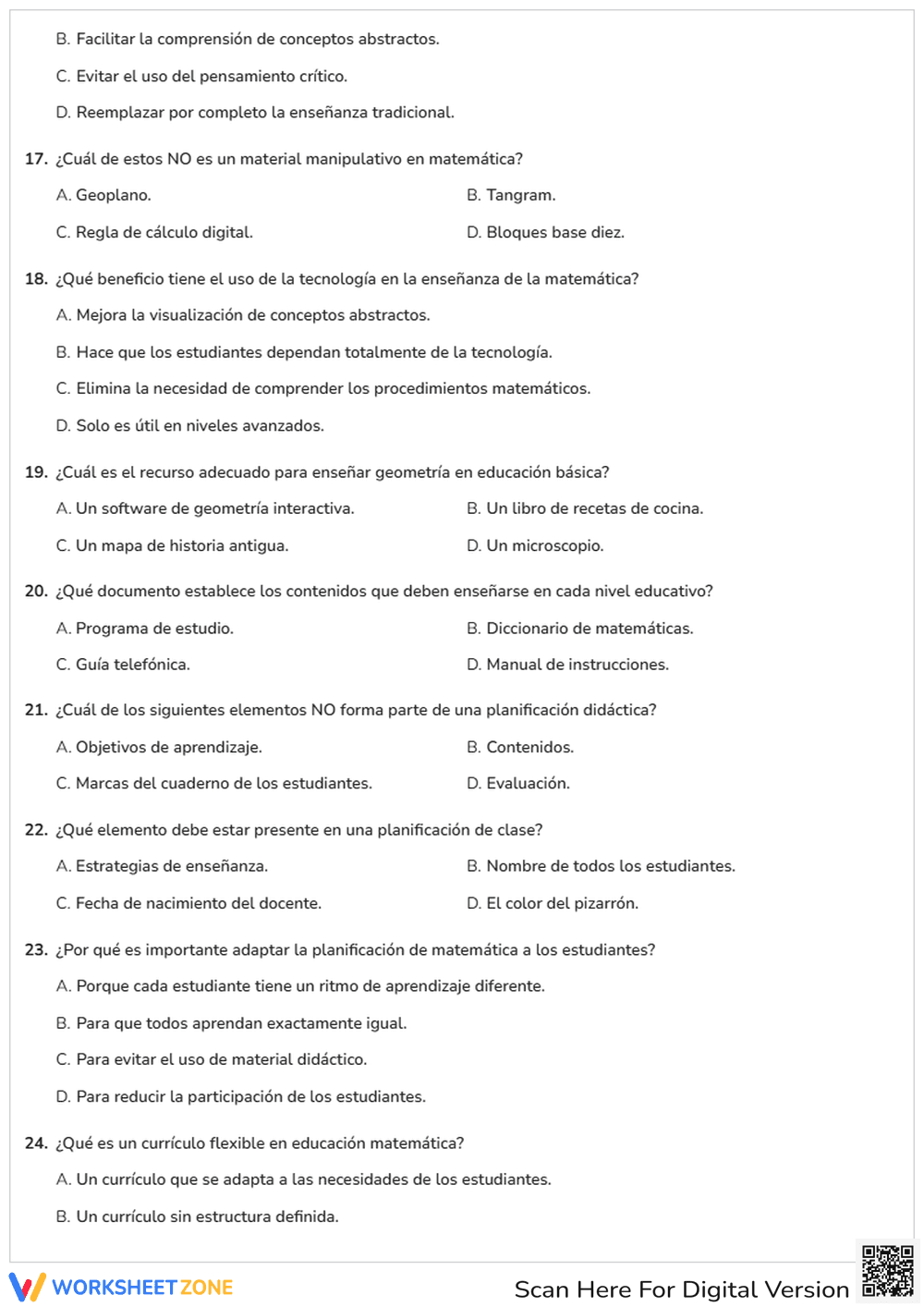
This comprehensive Spanish-language quiz evaluates understanding of mathematics pedagogy and instructional strategies. Students and pre-service teachers will analyze foundational theories, assessment methods, and classroom materials. By completing these 24 targeted questions, learners demonstrate their grasp of domain-specific vocabulary and constructivist teaching principles in a specialized educational context.
At a Glance
- Grade: 11-12 · Subject: Spanish
- Standard:
CCSS.ELA-LITERACY.RI.11-12.4— Determine the meaning of domain-specific words- Skill Focus: Math Pedagogy Concepts
- Format: 4 pages · 24 problems · PDF
- Best For: Formative assessment and vocabulary review
- Time: 30–45 minutes
This four-page assessment features 24 multiple-choice questions written entirely in Spanish. The task types require readers to identify key educational theories, differentiate between formative and summative evaluation, and recognize the purpose of specific manipulative materials like geoboards and base-ten blocks. The structured format provides a straightforward way to assess comprehension of complex pedagogical texts and academic language without requiring additional setup.
Zero-Prep Workflow
- Print (1 minute): Simply print the four-page PDF document. The clean layout ensures high-quality copies for every student.
- Distribute (1 minute): Hand out the quiz at the beginning of the session. The instructions are self-explanatory, allowing students to begin immediately.
- Review (0 minutes): Collect the completed assessments for grading. The multiple-choice format makes scoring highly efficient.
Total teacher prep time is under 2 minutes. This resource is highly suitable for emergency sub plans or independent study modules.
Standards Alignment
Aligned to CCSS.ELA-LITERACY.RI.11-12.4, this resource requires students to determine the meaning of words and phrases as they are used in a text, including figurative, connotative, and technical meanings. It also supports reading comprehension in specialized academic subjects. Both standard codes can be copied directly into lesson plans, IEP goals, or district curriculum mapping tools.
How to Use It
Use this quiz as a summative assessment after a unit on educational theories or specialized Spanish vocabulary. It works exceptionally well during independent practice sessions to gauge individual comprehension. For a formative assessment observation tip, monitor which specific pedagogical terms cause students to hesitate, indicating areas that require further direct instruction. Expected completion time ranges from 30 to 45 minutes.
Who It's For
This resource is designed for advanced Spanish language learners, pre-service teachers, or students in education-focused career pathways. It requires no differentiation for on-level readers but can be paired with a bilingual glossary for students needing vocabulary scaffolds. It serves as an excellent natural pairing resource alongside direct instruction lessons on Piaget and Vygotsky's educational frameworks.
Mastering domain-specific vocabulary is critical for comprehending advanced academic texts and preparing for specialized career pathways. Aligned with CCSS.ELA-LITERACY.RI.11-12.4, this worksheet helps students determine the meaning of domain-specific words in context, bridging the gap between general language proficiency and technical fluency. According to Fisher & Frey (2014), explicit instruction and repeated exposure to technical vocabulary significantly improve reading comprehension and content retention in specialized subjects. When learners encounter complex terminology—such as formative assessment, constructivism, or manipulative materials—in a structured format, they develop stronger cognitive frameworks for future application. By engaging with these 24 targeted questions, learners build the linguistic stamina necessary for higher education and professional environments. This targeted practice ensures students can confidently process, analyze, and apply complex pedagogical concepts written in a secondary language, ultimately fostering deeper academic independence and cross-linguistic competence.


