




























Views
Downloads

Printable Telling Time Revision Worksheet | Grade 2-3

Paste this activity's link or code into your existing LMS (Google Classroom, Canvas, Teams, Schoology, Moodle, etc.).
Students can open and work on the activity right away, with no student login required.
You'll still be able to track student progress and results from your teacher account.
Mastering the clock is a foundational milestone bridging abstract number sense with real-world autonomy. This comprehensive revision worksheet provides a structured review of time-telling skills for elementary students. By moving from identification to duration calculations, students solidify their understanding of how we measure time throughout the day.
At a Glance
- Grade: Grade 2 · Subject: Math
- Standard:
CCSS.MATH.CONTENT.2.MD.C.7— Tell and write time from analog and digital clocks using a.m. and p.m.- Skill Focus: Telling Time & Elapsed Time
- Format: 4 pages · 26 problems · Answer key included · PDF
- Best For: End-of-year math review and assessment
- Time: 30–45 minutes
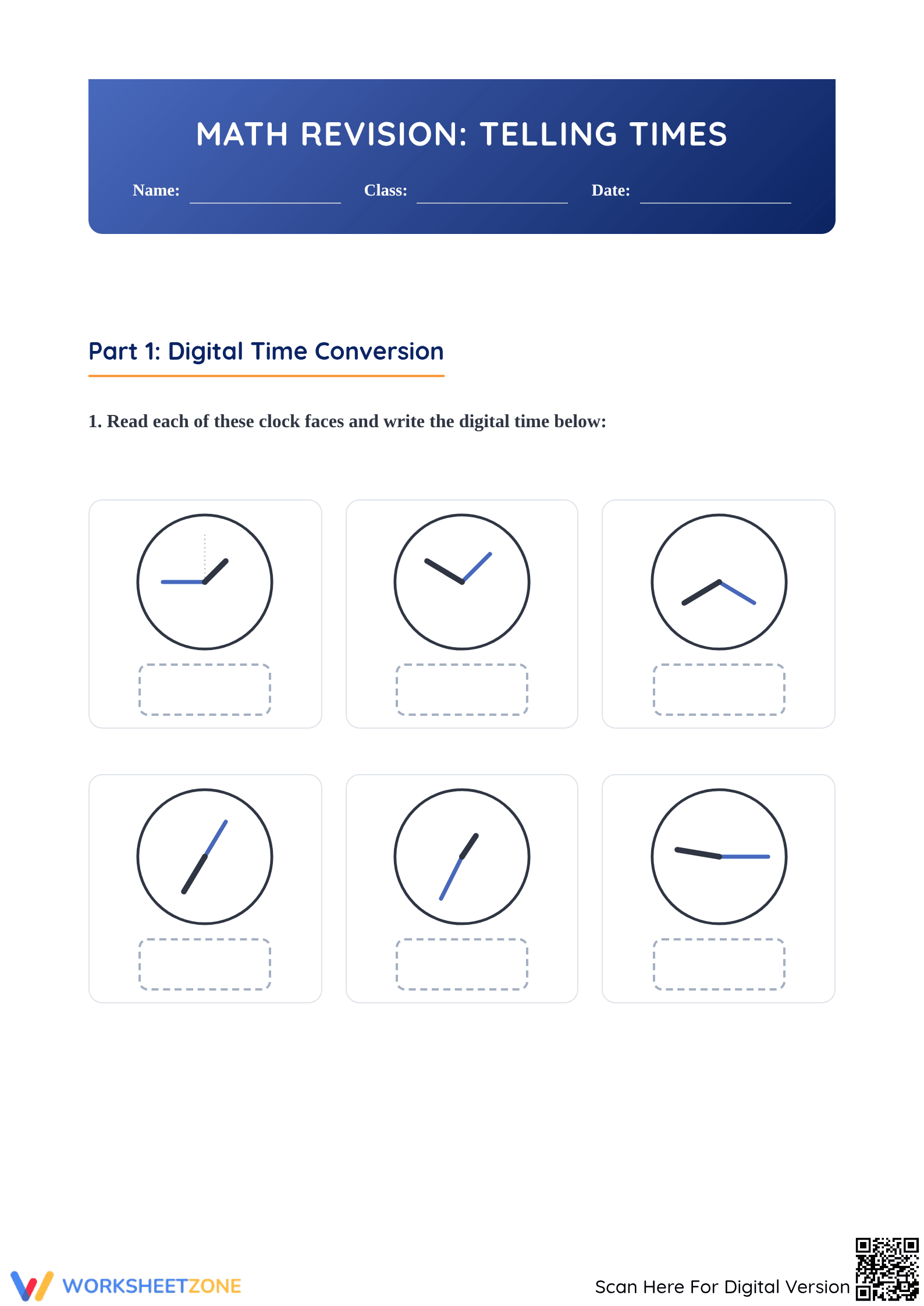
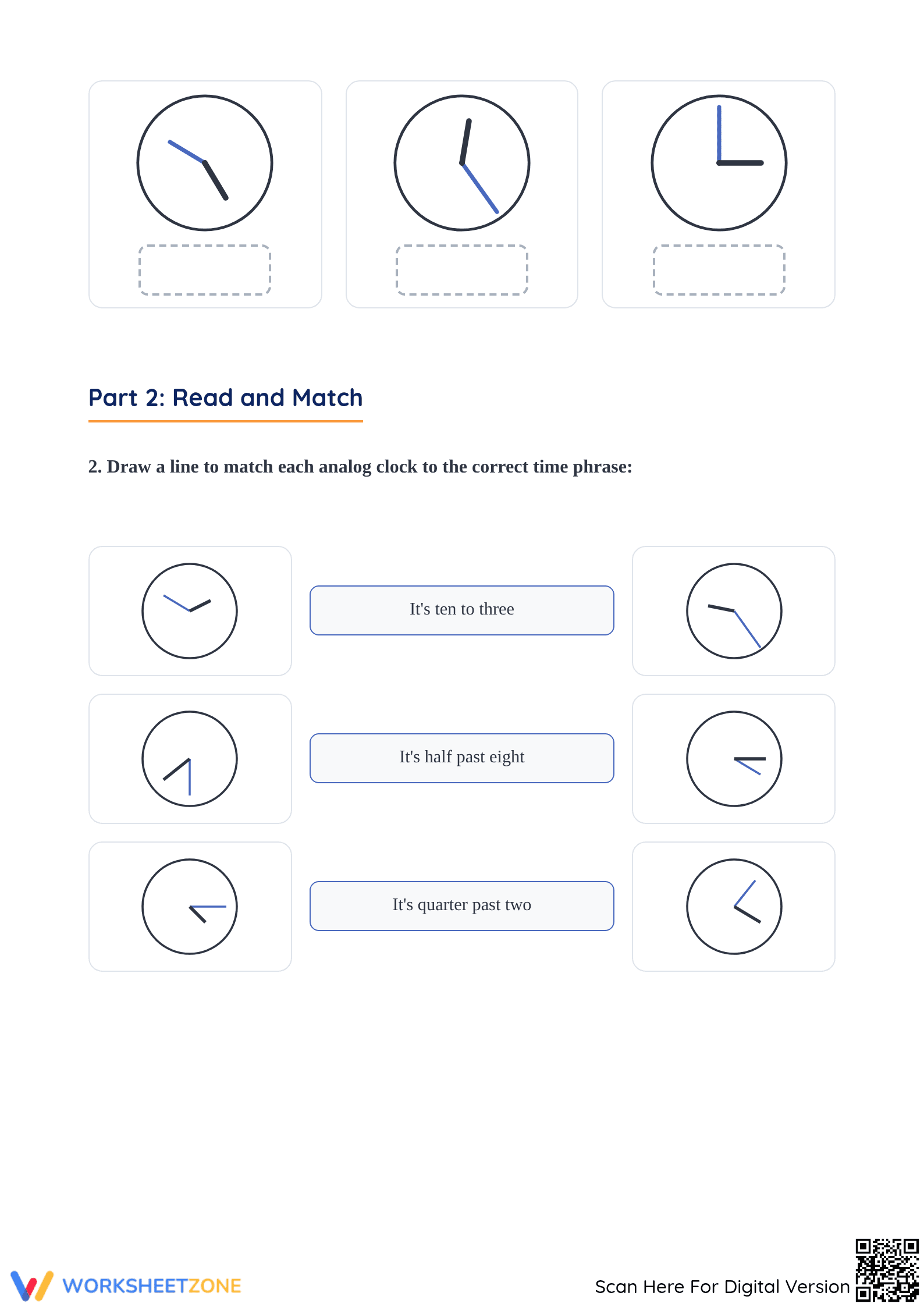
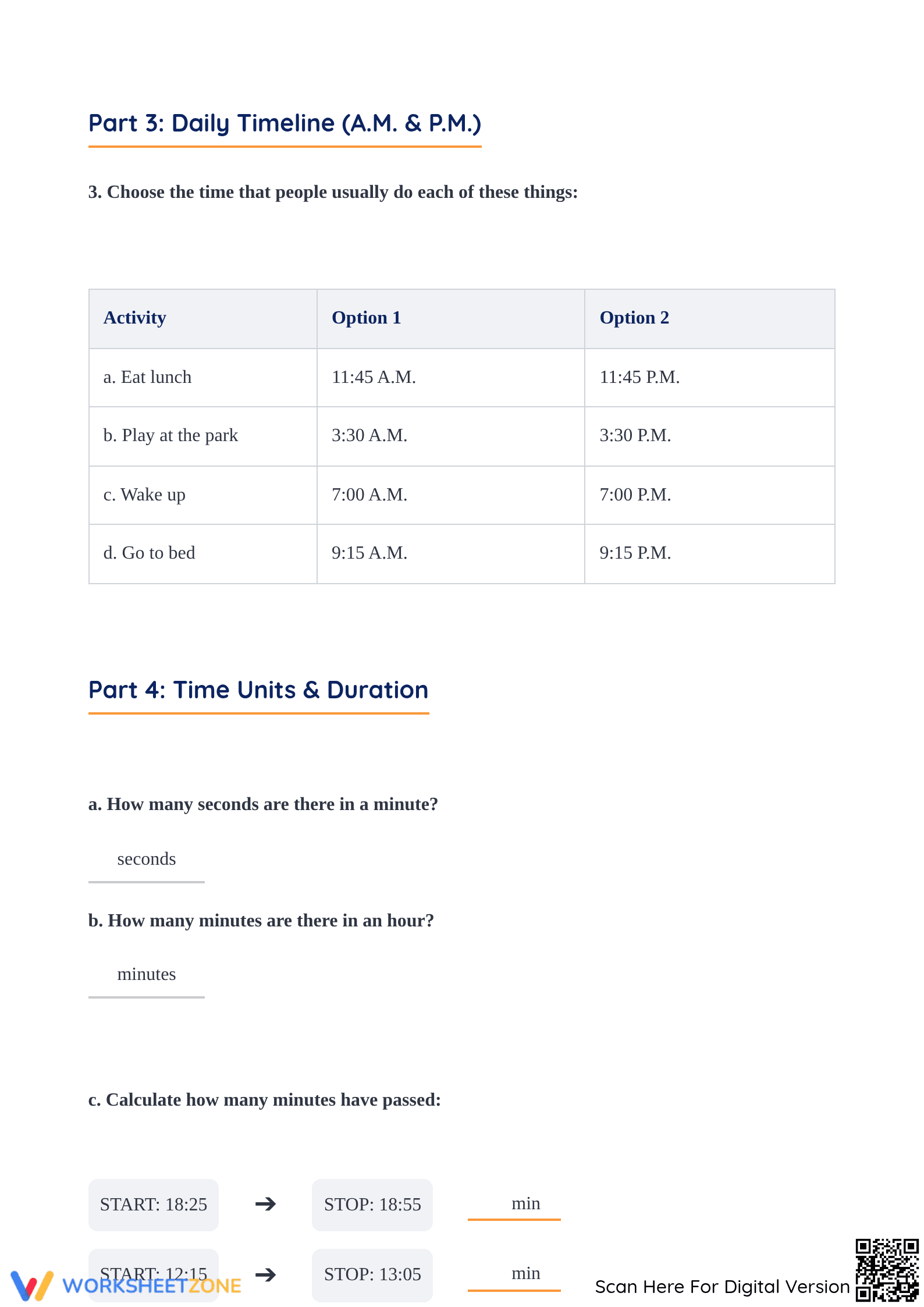
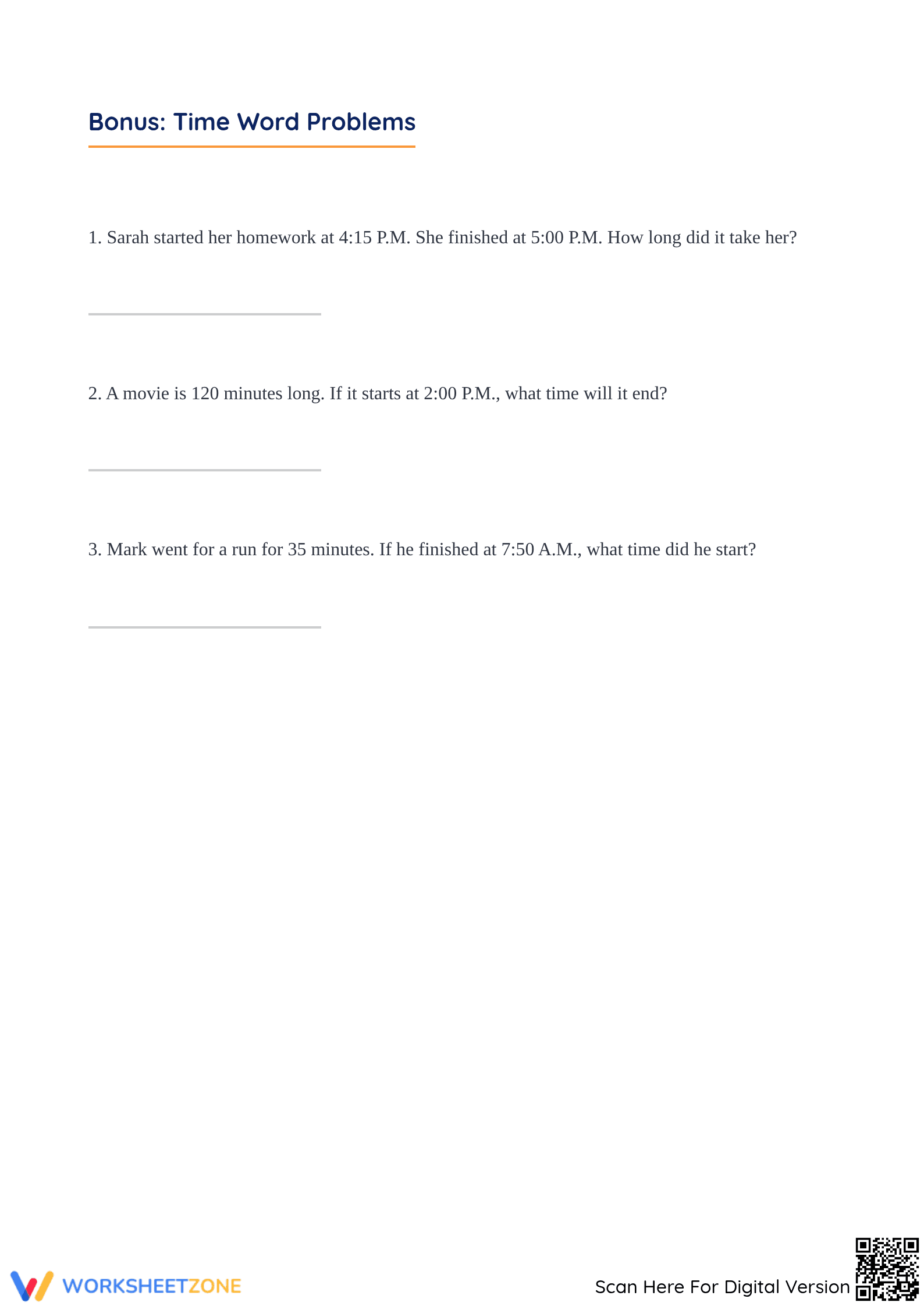
This four-page packet is divided into five sections for a total grasp of temporal concepts. Part 1 features nine analog clock faces requiring digital conversion. Part 2 uses matching exercises to connect clocks with descriptive phrases. Part 3 explores the a.m. and p.m. timeline through daily activity sorting, while Part 4 focuses on duration calculations and time units. The bonus section offers three real-world word problems. A full answer key is included for immediate feedback.
This resource is designed for the busy classroom with a three-step workflow that requires under two minutes of teacher preparation. Step 1: Print the four-page PDF (30 seconds). Step 2: Distribute to students for independent work (30 seconds). Step 3: Review answers with the included key (1 minute). This zero-prep structure makes it an ideal emergency sub-plan for Grade 2 or Grade 3 Math during the final weeks of school.
The resource aligns with CCSS.MATH.CONTENT.2.MD.C.7, requiring students to tell time to the nearest five minutes using analog and digital formats. It also supports CCSS.MATH.CONTENT.3.MD.A.1 by introducing elapsed time intervals and duration word problems. These standards ensure students develop the fluency to manage their own schedules. Both standard codes can be copied directly into lesson plans, IEP goals, or district curriculum mapping tools.
This packet serves as an ideal end-of-unit summative assessment or a comprehensive review before standardized testing. For a formative approach, teachers can use Parts 1 and 2 as a "bell-ringer" to gauge initial clock-reading speed. During instruction, observe how students handle the "Bonus" word problems to identify those struggling with the transition between hours. Expect most students to complete the 26-task sequence within a standard 45-minute math block.
Designed primarily for second and third-grade students, this worksheet is also highly effective for older students requiring RTI support or ESL learners who benefit from clear visual clock faces. The inclusion of daily timeline activities makes it particularly useful for students working on executive functioning skills and daily routine awareness. It pairs naturally with a physical classroom clock or a digital interactive whiteboard demonstration.
This comprehensive telling time revision packet is mapped to CCSS.MATH.CONTENT.2.MD.C.7 and CCSS.MATH.CONTENT.3.MD.A.1, addressing the essential shift from conceptual time awareness to precise temporal calculation. By integrating analog-to-digital conversion, daily timeline sequencing, and duration word problems, the resource provides a rigorous review of the Measurement domain. According to NAEP, proficiency in reading clocks and understanding elapsed time is a critical predictor of later success in proportional reasoning. The gradual increase in cognitive demand—from simple clock reading to solving temporal word problems—aligns with the scaffolds necessary for mastery in the intermediate grades. Educators can use this 26-task sequence to identify specific misconceptions in minute-hand tracking. This resource is a vital tool for ensuring students meet procedural fluency requirements before advancing to complex data interpretation tasks.


