


























Views
Downloads

Essential Angles Review Worksheet | Grade 7 Math
Paste this activity's link or code into your existing LMS (Google Classroom, Canvas, Teams, Schoology, Moodle, etc.).
Students can open and work on the activity right away, with no student login required.
You'll still be able to track student progress and results from your teacher account.
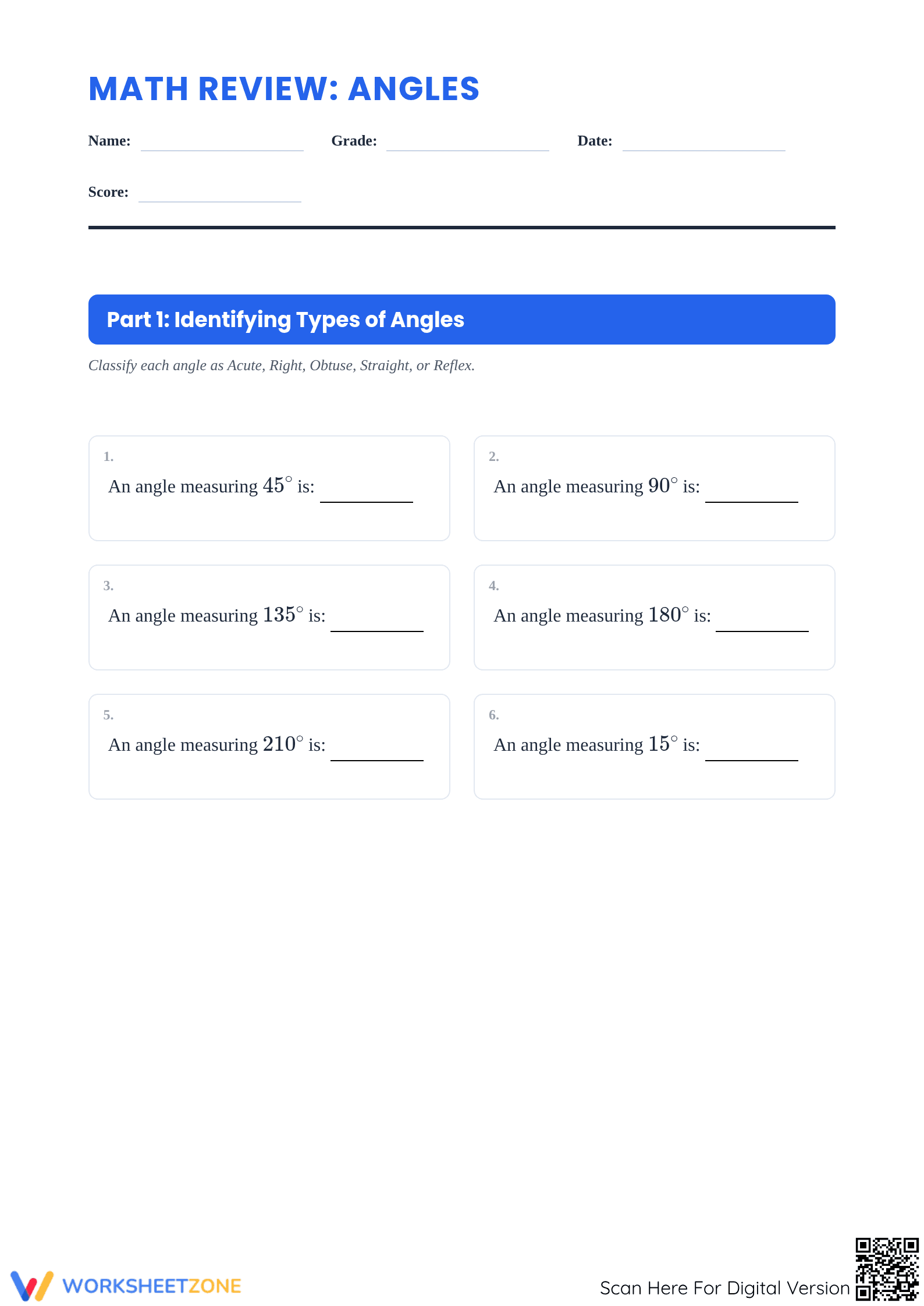
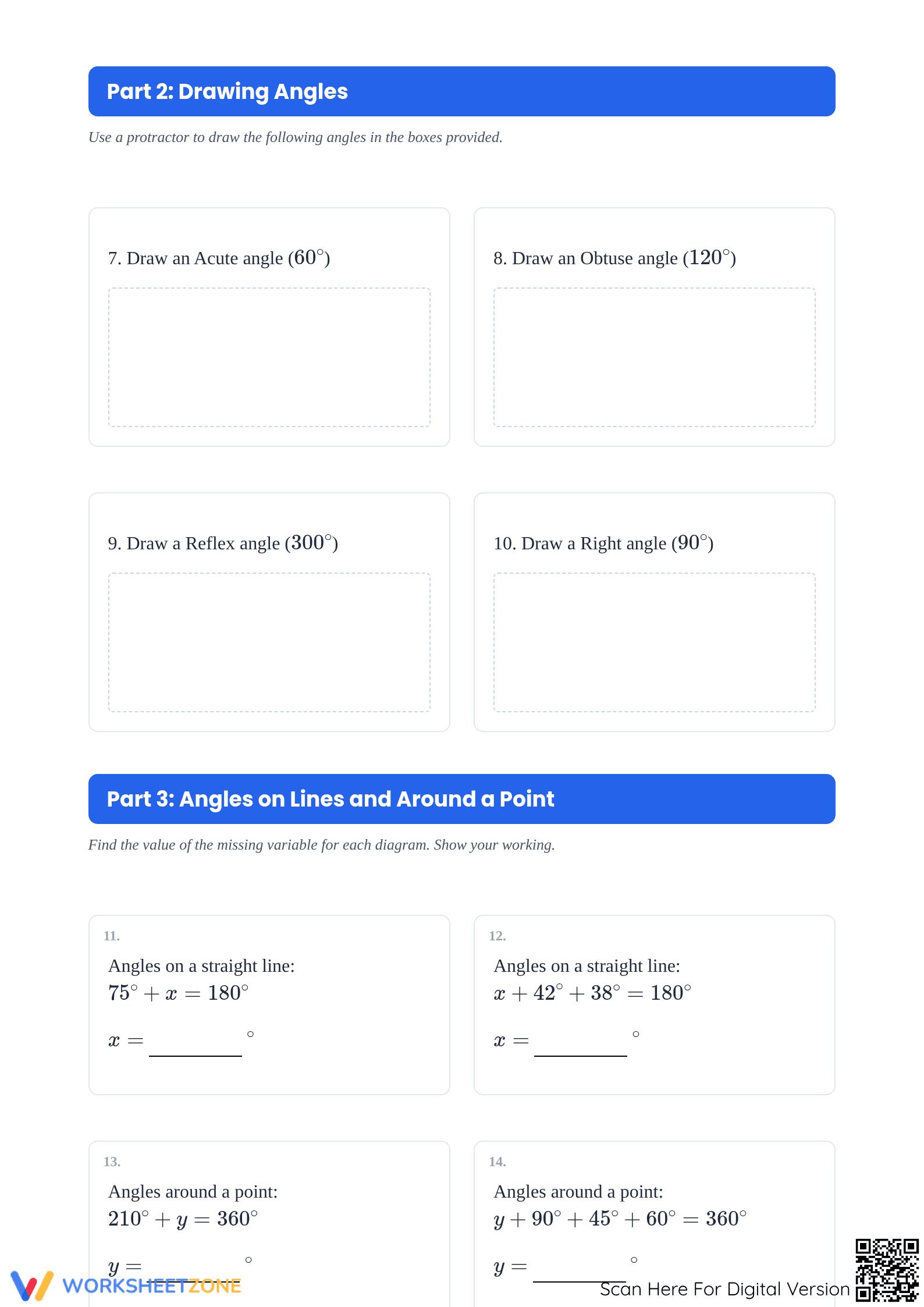
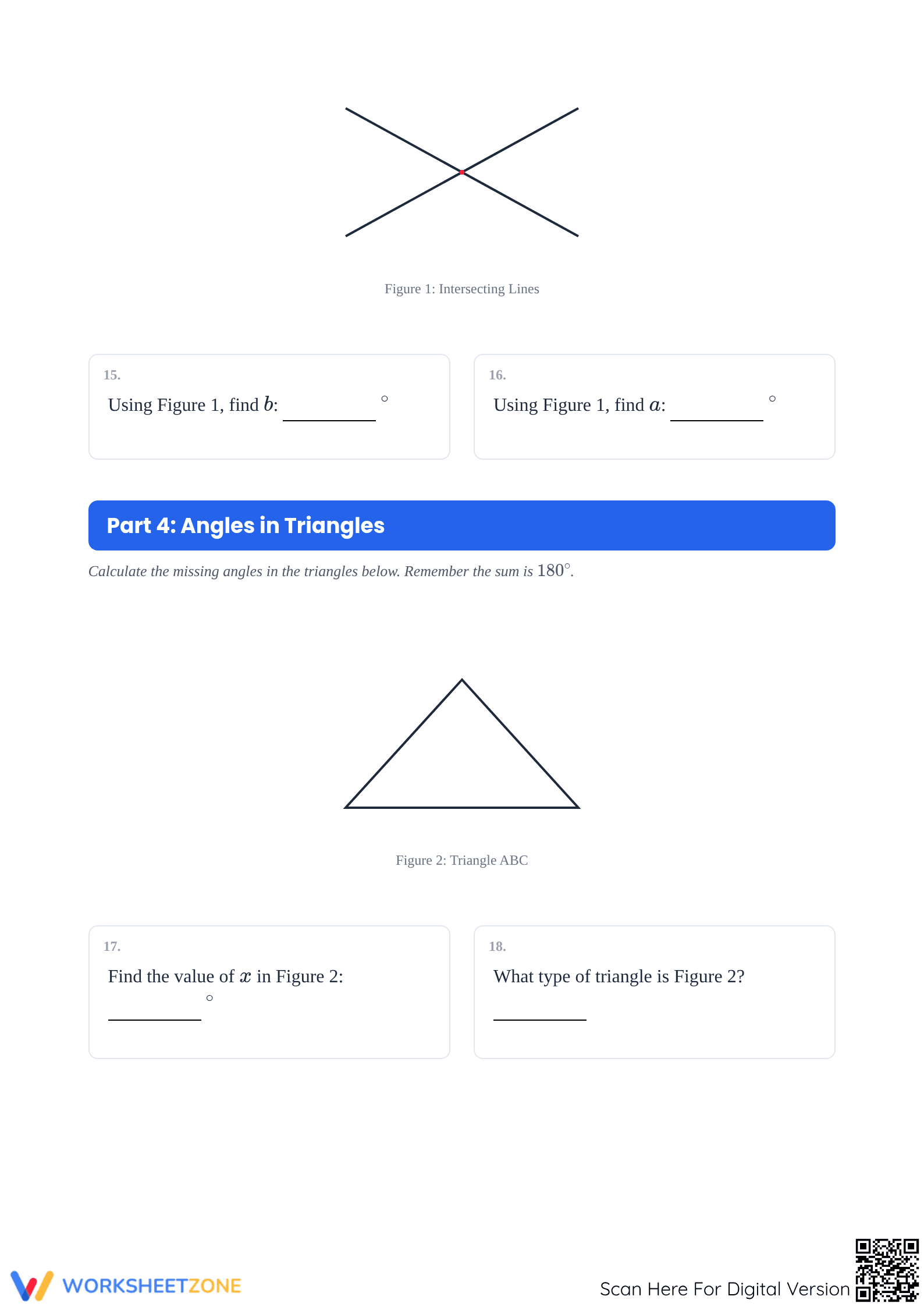
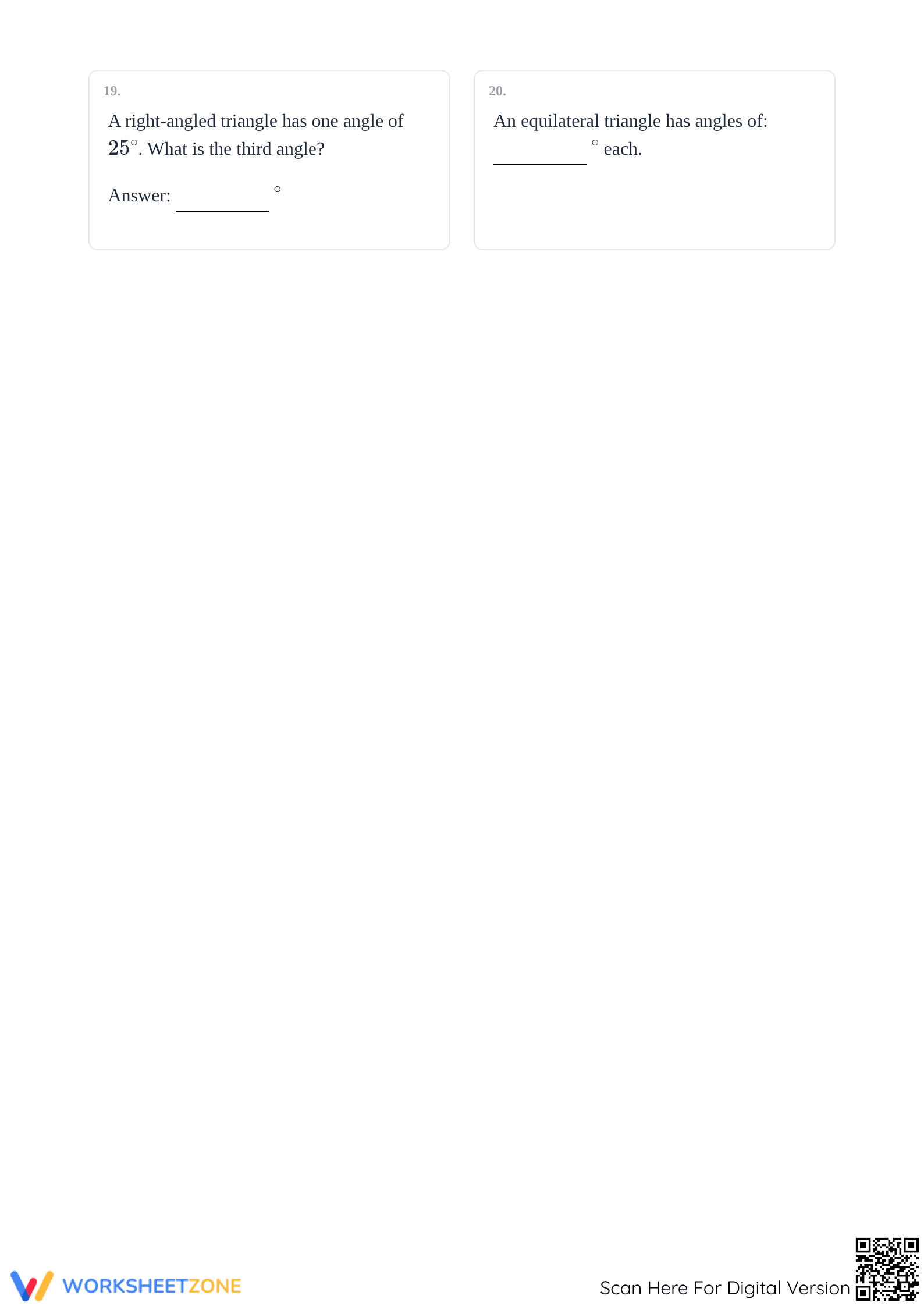
This Grade 7 Math worksheet provides a comprehensive review of angle properties and relationships. Students will progress from basic classification to solving complex algebraic equations involving angles on lines, around points, and within triangles. It is designed to solidify geometric reasoning and prepare students for advanced spatial analysis.
At a Glance
- Grade: 7 · Subject: Math
- Standard:
CCSS.MATH.CONTENT.7.G.B.5— Use angle facts to write and solve equations for unknown angles- Skill Focus: Angle Classification and Calculation
- Format: 4 pages · 20 problems · Answer key included · PDF
- Best For: End-of-unit review or test preparation
- Time: 40–50 minutes
What's Inside: The 4-page PDF contains 20 distinct tasks organized into four logical sections. It includes classification prompts, protractor drawing spaces, algebraic equations for supplementary angles, and triangle sum theorem applications. A complete 4-page answer key is provided, mirroring the worksheet layout for rapid grading or student self-correction.
Teachers can implement this resource in under two minutes. Simply print the 4-page document (1 minute), distribute to students with protractors (30 seconds), and use the provided answer key for immediate review or peer-grading (30 seconds). This streamlined workflow makes it an ideal candidate for emergency sub plans or high-impact Friday reviews.
The primary focus is `CCSS.MATH.CONTENT.7.G.B.5`, which requires students to "use facts about supplementary, complementary, vertical, and adjacent angles in a multi-step problem to write and solve simple equations for an unknown angle in a figure." It also supports 4.G.A.1 regarding angle classification. Both standard codes can be copied directly into lesson plans, IEP goals, or district curriculum mapping tools.
Use this as a summative assessment after completing a unit on geometry. During the session, circulate to observe if students correctly identify reflex angles, as this is a common misconception. The expected completion time is 40 to 50 minutes, making it a perfect fit for a standard middle school class period.
This resource is tailored for Grade 7 students but serves as an excellent scaffold for Grade 8 or 9 students needing a geometry refresher. It pairs naturally with a protractor instructional video or a geometric anchor chart displaying angle types.
According to the RAND AIRS 2024 report, structured practice in geometric reasoning is essential for developing the spatial visualization skills required for high school trigonometry. This worksheet aligns with those findings by providing 20 targeted problems that move from identification to application. By requiring students to solve for variables like x and y within the context of CCSS.MATH.CONTENT.7.G.B.5, the resource reinforces the connection between algebraic manipulation and geometric properties. Research from Fisher & Frey (2014) suggests that such gradual-release tasks—moving from simple classification to multi-step problem solving—significantly improve long-term retention of mathematical concepts. This worksheet serves as a reliable tool for educators seeking to bridge the gap between basic shape recognition and the complex proofs required in later grades, ensuring students meet the rigorous demands of modern state standards.


