


























Views
Downloads

Essential Material Properties Worksheet | Grade 3 Science
Paste this activity's link or code into your existing LMS (Google Classroom, Canvas, Teams, Schoology, Moodle, etc.).
Students can open and work on the activity right away, with no student login required.
You'll still be able to track student progress and results from your teacher account.
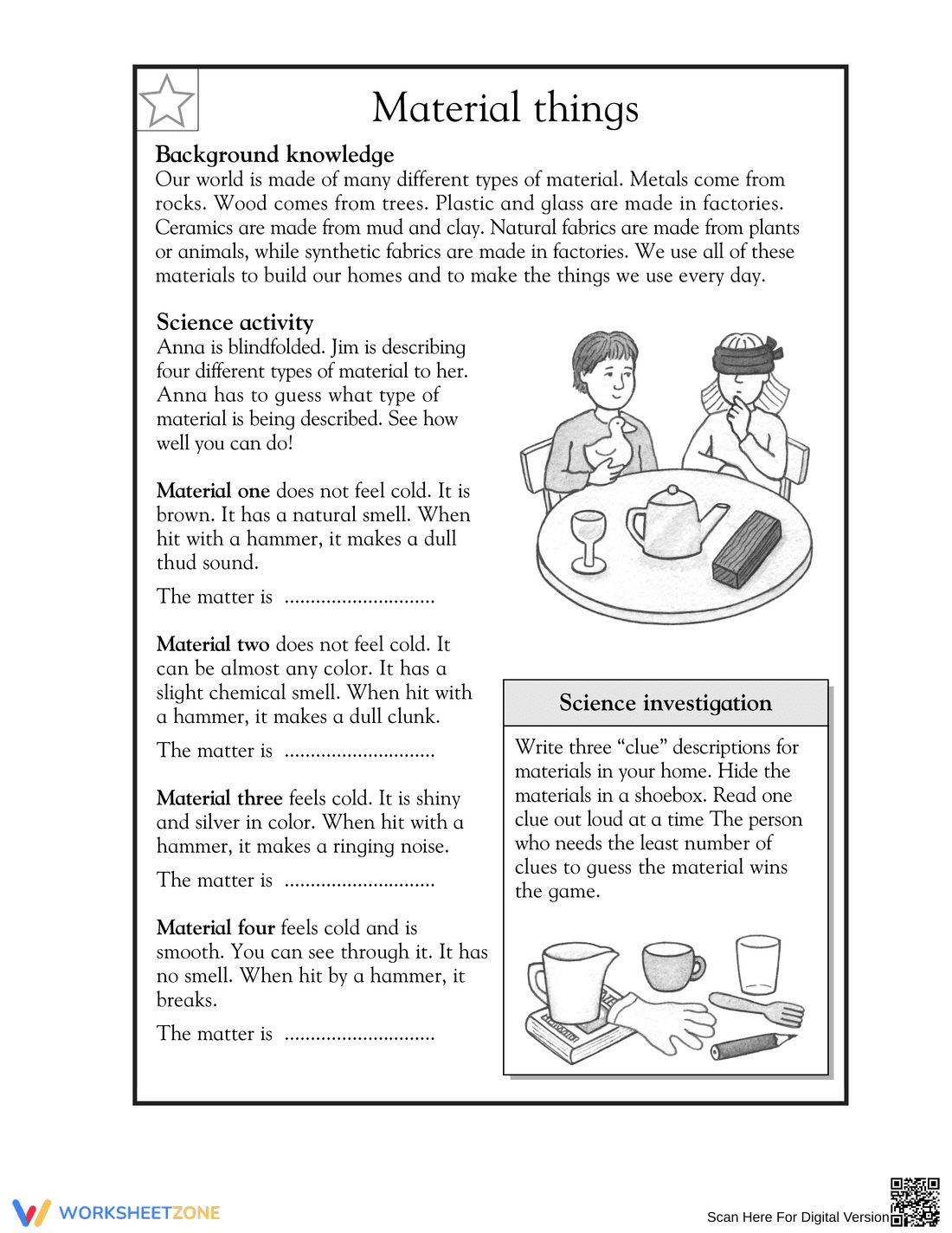
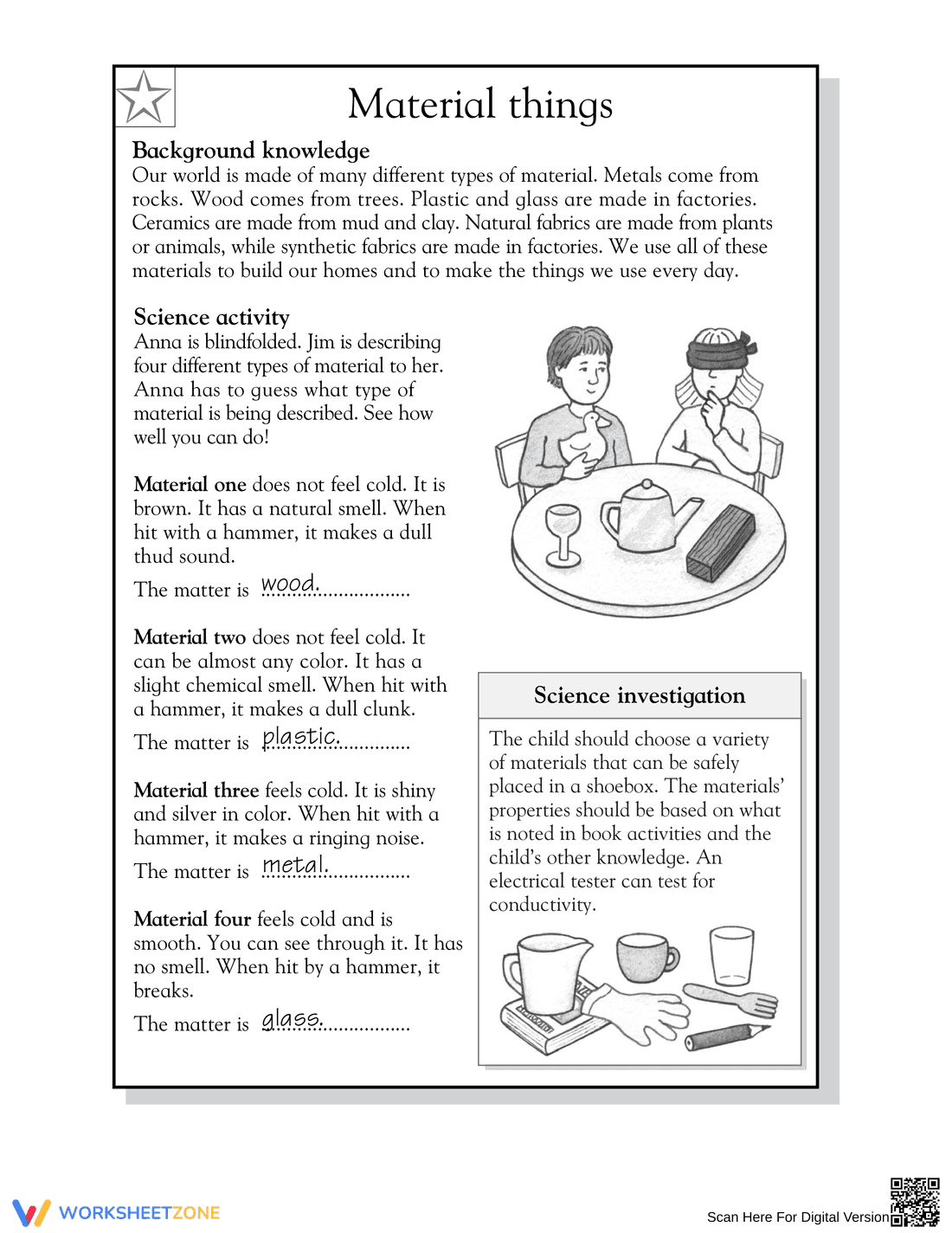
Students master the art of scientific deduction by identifying common materials based on their physical and sensory properties. This worksheet guides learners through four specific challenges where they must analyze clues regarding color, smell, sound, and texture to distinguish between wood, plastic, metal, and glass. It transforms abstract science concepts into a tangible logic puzzle.
At a Glance
- Grade: 3 · Subject: Science
- Standard:
2-PS1-1— Classify materials by properties like color, texture, and sound when struck.- Skill Focus: Scientific deduction and material property identification.
- Format: 1 page · 5 problems · Answer key included · PDF
- Best For: Individual practice or science centers.
- Time: 15–20 minutes
This single-page PDF includes a concise background knowledge section that defines common materials like ceramics, synthetic fabrics, and metals. The core activity features four "Material" riddles requiring students to fill in the blank with the correct substance. A final "Science Investigation" box provides a hands-on extension activity that students can complete at home or in the classroom using a simple shoebox.
Designed for a zero-prep workflow, this resource is ready for immediate classroom implementation. Teachers can print the material in under 30 seconds and distribute it for a 15-minute independent work block. The clear structure makes it an ideal choice for emergency sub plans or as a transition activity between direct instruction and hands-on lab experiments. Total teacher preparation time is less than two minutes.
The primary alignment is to `2-PS1-1`: "Plan and conduct an investigation to describe and classify different kinds of materials by their observable properties." While labeled for Grade 3, it serves as a rigorous application of these foundational physical science concepts. This standard code can be copied directly into lesson plans, IEP goals, or district curriculum mapping tools to ensure compliance with national standards.
Use this worksheet as a formative assessment after a lesson on the states of matter or physical properties. As students work, observe whether they can distinguish between the "ringing noise" of metal and the "dull clunk" of plastic, which indicates high-level auditory processing. This activity is best used as a follow-up to a hands-on exploration of physical objects to reinforce vocabulary in a written context.
This resource is specifically crafted for 3rd-grade students but provides excellent support for English Language Learners through the use of descriptive adjectives and sentence frames. It pairs naturally with a classroom anchor chart displaying various material types and their characteristics. The inclusion of a home-based investigation encourages students to apply their learning to their personal environment, fostering deeper engagement.
Scientific deduction and the classification of matter represent critical milestones in elementary science education. According to Fisher & Frey (2014), providing students with structured opportunities to apply background knowledge to specific scenarios—such as identifying materials via sensory clues—is essential for building disciplinary literacy. This worksheet addresses `2-PS1-1` by requiring students to synthesize multiple observable properties, including color, sound when struck, and opacity, to reach a logical conclusion. By practicing these identification skills, students develop the foundational schemas necessary for later complex chemistry and physics units. The inclusion of a hands-on extension ensures that the cognitive load is balanced with practical application, a method supported by current research in science pedagogy. This resource provides a reliable, evidence-based method for checking student understanding of how physical properties define the objects in our daily lives.


