


























Views
Downloads

Essential Synonyms and Antonyms Worksheet | Grade K-1
Paste this activity's link or code into your existing LMS (Google Classroom, Canvas, Teams, Schoology, Moodle, etc.).
Students can open and work on the activity right away, with no student login required.
You'll still be able to track student progress and results from your teacher account.
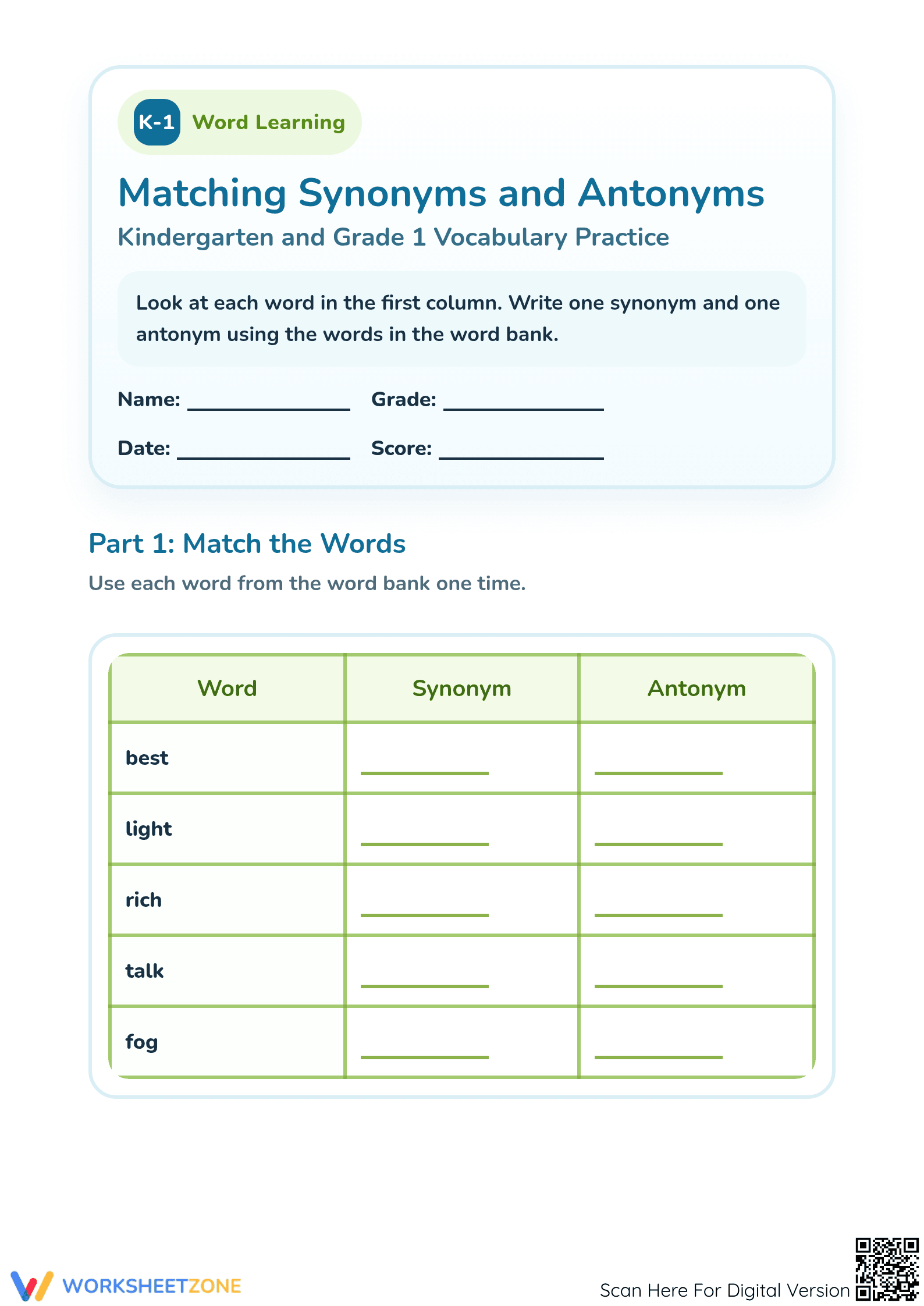
This matching synonyms and antonyms worksheet helps Kindergarten and Grade 1 students master word relationships through structured vocabulary practice. By identifying pairs of words with similar and opposite meanings, learners strengthen their lexical comprehension and expressive language. This printable resource ensures students can accurately categorize common adjectives and verbs while building a foundation for reading fluency.
At a Glance
- Grade: K–1 · Subject: ELA
- Standard:
CCSS.ELA-LITERACY.L.K.5.B— Relate frequently occurring verbs and adjectives to their opposites (antonyms)- Skill Focus: Synonyms and Antonyms
- Format: 2 pages · 10 problems · Answer key included · PDF
- Best For: Early vocabulary development and word study
- Time: 15–20 minutes
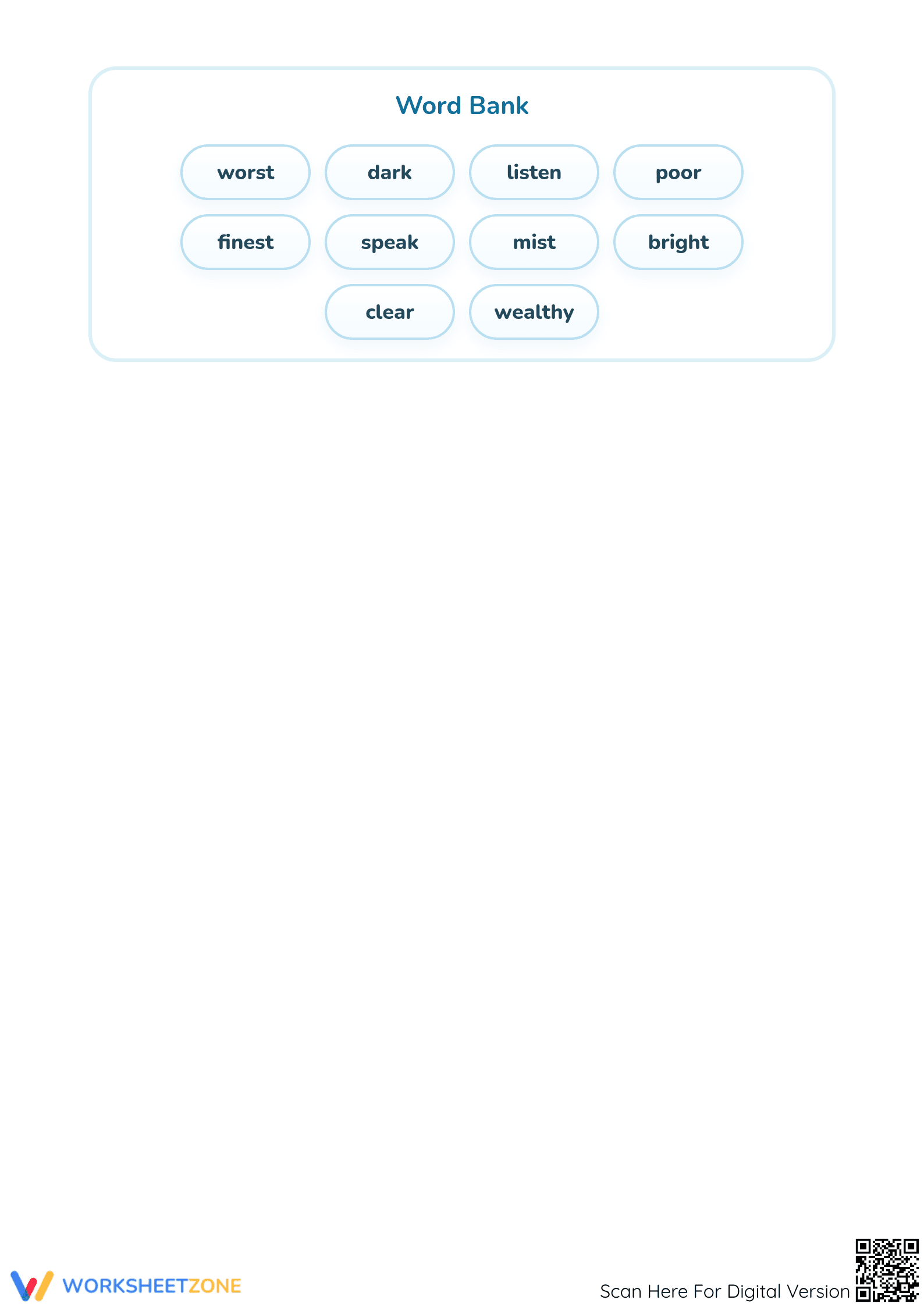
This two-page resource features a clean, student-friendly layout designed for early elementary learners. The first page presents five primary words—best, light, rich, talk, and fog—with dedicated columns for synonyms and antonyms. The second page provides a clear Word Bank containing ten corresponding terms like "wealthy," "mist," and "worst." A complete answer key is provided to facilitate quick grading or self-correction.
Skill Progression
- Guided Practice: Introduces the base words within a structured table to focus the learner's attention on specific lexical pairs. (5 tasks)
- Supported Practice: Allows students to use the provided Word Bank to select correct pairings, significantly reducing the cognitive load of recall.
- Independent Practice: Requires students to write the words in the correct columns, reinforcing the concepts through active transcription.
This sequence follows a gradual-release model, moving from teacher-led identification to independent student application of vocabulary knowledge.
Standards Alignment
This worksheet is directly aligned to CCSS.ELA-LITERACY.L.K.5.B, which requires students to demonstrate understanding of frequently occurring verbs and adjectives by relating them to their opposites. It also supports CCSS.ELA-LITERACY.L.1.5, focusing on word relationships and nuances in word meanings. Both standard codes can be copied directly into lesson plans, IEP goals, or district curriculum mapping tools.
How to Use It
Use this worksheet during a whole-group vocabulary lesson after introducing the concepts of "same" and "opposite." It works perfectly as a guided practice activity where the teacher models the first row before students complete the remaining four independently. For formative assessment, observe if students can differentiate between the synonym and antonym columns without assistance. Completion typically takes 15 to 20 minutes.
Who It's For
This resource is ideal for Kindergarten and Grade 1 students, as well as English Language Learners (ELL) who are developing foundational English vocabulary. The use of a word bank provides necessary differentiation for students who struggle with spelling or word retrieval. It pairs naturally with a short reading passage or an anchor chart displaying common synonym and antonym pairs.
The integration of synonyms and antonyms in early literacy is a critical component of lexical development, as noted in the RAND AIRS 2024 report on foundational skills. By explicitly teaching CCSS.ELA-LITERACY.L.K.5.B, educators help students bridge the gap between simple decoding and meaningful reading comprehension. Research from Fisher & Frey (2014) emphasizes that word study which includes relating words to their opposites significantly improves the depth of a student’s mental lexicon. This worksheet provides the structured repetition needed for young learners to internalize these linguistic relationships. By using 10 specific tasks mapped to 5 high-frequency words, the activity ensures that students engage with the material long enough to achieve retention without becoming overwhelmed. It is an essential tool for any Grade 1 or Kindergarten classroom focused on evidence-based vocabulary instruction.


