


























Views
Downloads


Printable Synonyms and Antonyms Worksheet | Grade 1 ELA
Paste this activity's link or code into your existing LMS (Google Classroom, Canvas, Teams, Schoology, Moodle, etc.).
Students can open and work on the activity right away, with no student login required.
You'll still be able to track student progress and results from your teacher account.
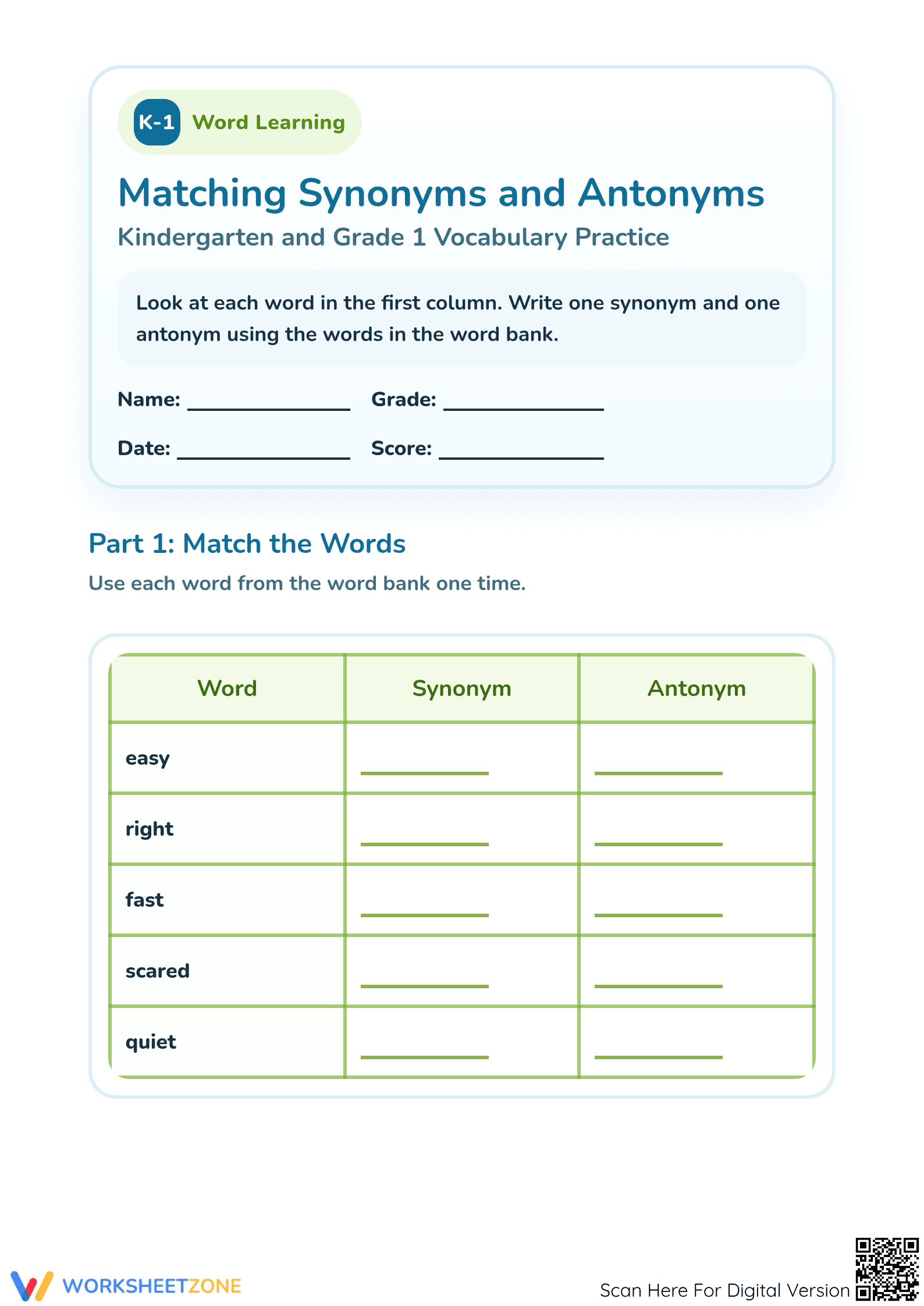
This Kindergarten and Grade 1 vocabulary worksheet helps young learners master the relationship between words by identifying synonyms and antonyms. By matching common adjectives with their opposites and similar meanings, students strengthen their lexical understanding and reading comprehension. This essential tool bridges the gap between basic word recognition and nuanced language use.
At a Glance
- Grade: 1 · Subject: English Language Arts
- Standard:
CCSS.ELA-LITERACY.L.1.5— Identify real-life connections between words and their use, including opposites and similar meanings- Skill Focus: Synonyms and Antonyms
- Format: 2 pages · 10 problems · Answer key included · PDF
- Best For: Independent practice and vocabulary reinforcement
- Time: 15–20 minutes
This two-page resource features a structured matching table and a clear word bank to support early writers. The first page presents five anchor words—easy, right, fast, scared, and quiet—with dedicated spaces for both a synonym and an antonym. The second page provides a ten-word bank, ensuring students have all the necessary scaffolding to complete the assignment accurately and confidently.
Skill Progression
- Guided Identification: Students begin by reviewing the five primary anchor words and the provided word bank together to recognize familiar vocabulary.
- Supported Practice: Learners use the word bank to find and write 5 matching synonyms, utilizing the scaffolded list to confirm their selections.
- Independent Mastery: Students complete the final 5 antonym tasks, demonstrating a full grasp of lexical opposites across the entire 10-problem set.
This gradual release model ensures that students transition smoothly from word recognition to meaningful application of semantic relationships.
Standards Alignment
This activity is directly aligned to `CCSS.ELA-LITERACY.L.1.5`, which requires students to demonstrate understanding of word relationships and nuances in word meanings. Specifically, it addresses the ability to relate words to their opposites (antonyms) and to words with similar but not identical meanings (synonyms). Both standard codes can be copied directly into lesson plans, IEP goals, or district curriculum mapping tools.
How to Use It
Use this worksheet as a formative assessment after an introductory lesson on word pairs. It works best during the "you do" phase of direct instruction, allowing teachers to circulate and observe if students can differentiate between similar and opposite meanings. For a quick check, ask students to use one pair of words in a sentence aloud to verify their contextual understanding.
Who It's For
This resource is designed for Kindergarten and Grade 1 students, particularly those building their foundational literacy skills. It is highly effective for English Language Learners (ELLs) who need visual organization to categorize new vocabulary. Naturally pair this worksheet with a vocabulary anchor chart or a short descriptive passage where students can find these words in action.
According to Fisher & Frey (2014), the development of a robust vocabulary is a cornerstone of reading comprehension and overall academic success. This worksheet targets the standard CCSS.ELA-LITERACY.L.1.5 by providing a structured environment where students can actively manipulate synonyms and antonyms. Research indicates that explicit instruction in word relationships helps students move beyond simple definitions to a more sophisticated understanding of language. By engaging with 10 specific matching tasks, learners are forced to evaluate the subtle differences and stark contrasts between words, which reinforces neural pathways related to lexical retrieval. This type of focused practice is essential for early readers who are transitioning from learning to read to reading to learn. The inclusion of a word bank serves as a critical scaffold, reducing cognitive load while still requiring high-level semantic processing. This worksheet provides the repeated exposure necessary for vocabulary retention and literacy growth.


