


























Views
Downloads



Printable Opposites Worksheet | Grade 1 Essential ELA
Paste this activity's link or code into your existing LMS (Google Classroom, Canvas, Teams, Schoology, Moodle, etc.).
Students can open and work on the activity right away, with no student login required.
You'll still be able to track student progress and results from your teacher account.
This Grade 1 ELA worksheet provides a comprehensive approach to mastering antonyms through visual and text-based activities. Students identify, match, and apply opposite word pairs to strengthen their vocabulary and reading comprehension. By connecting pictures with words, learners build a deeper semantic understanding of how adjectives and verbs relate to one another in English.
At a Glance
- Grade: 1 · Subject: English Language Arts (ELA)
- Standard:
L.1.5— Relate words to their opposites to build vocabulary and comprehension- Skill Focus: Antonyms and Word Relationships
- Format: 3 pages · 12 problems · Answer key included · PDF
- Best For: Independent practice and vocabulary reinforcement
- Time: 15–20 minutes
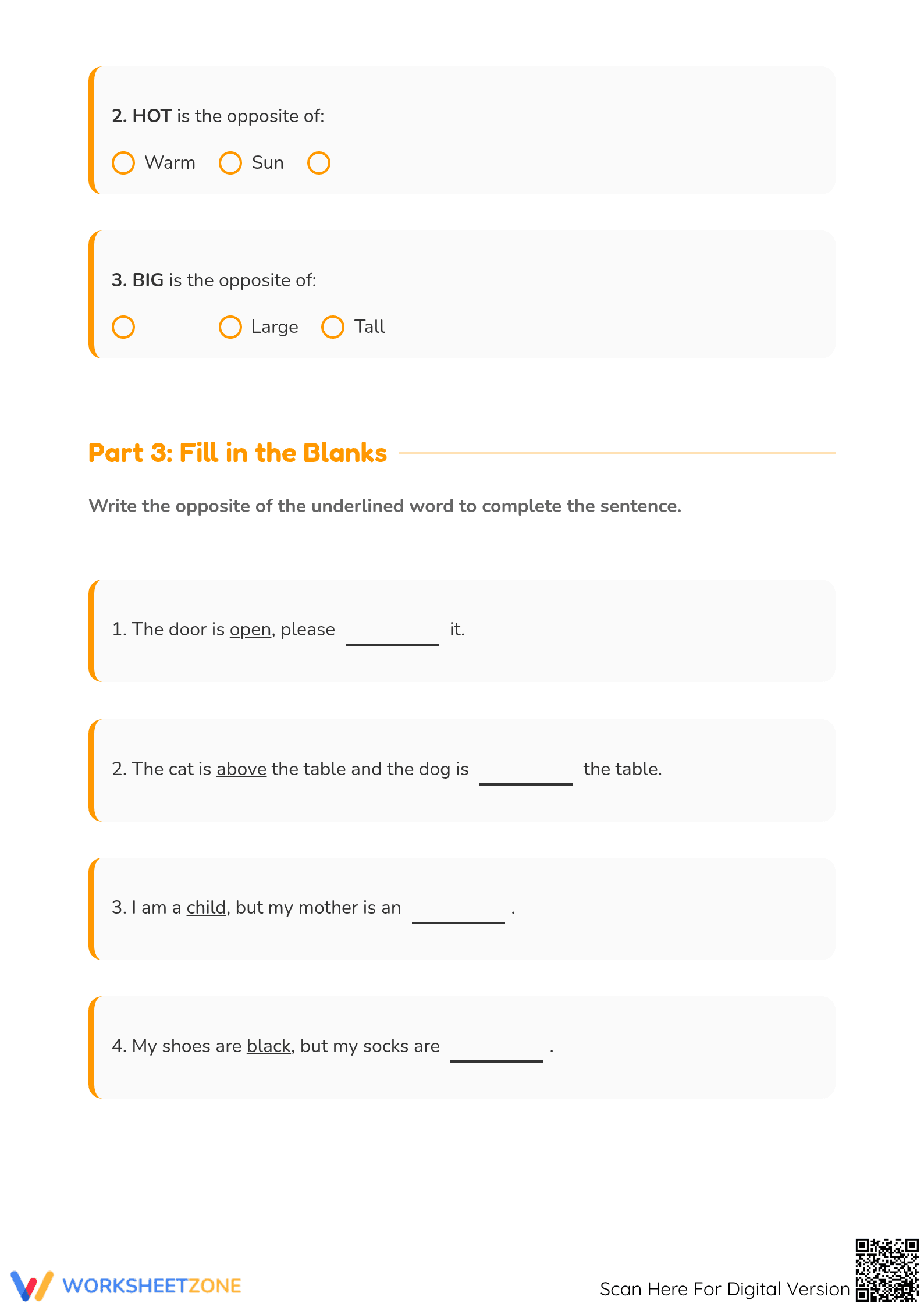
The three-page PDF is divided into three distinct learning phases. It includes a visual matching section with 5 pairs, a multiple-choice section with 3 questions, and a fill-in-the-blanks section with 4 sentence-level applications. The layout features clear icons, bold text for key terms, and a dedicated notes section for teacher feedback or student reflection, ensuring a clean and professional look.
Skill Progression
- Guided Practice: Students match 5 visual pairs, such as Adult/Child and Above/Below, using icons to anchor the concepts.
- Supported Practice: Learners select the correct opposite from provided choices, reducing visual scaffolding while maintaining focus on word meaning.
- Independent Practice: The final tasks require students to write the correct antonym within a sentence context, demonstrating mastery.
This structured progression follows a gradual-release model, moving from I Do (visual matching) to We Do (guided selection) and finally You Do (independent sentence completion).
Standards Alignment
This resource is primarily aligned to `CCSS.ELA-LITERACY.L.1.5`, which tasks students with demonstrating understanding of word relationships and nuances in word meanings. By relating frequently occurring verbs and adjectives to their opposites, students meet the fundamental requirements of early vocabulary development. This standard code can be copied directly into lesson plans, IEP goals, or district curriculum mapping tools.
How to Use It
Use this worksheet during the independent practice phase of a lesson on antonyms. It serves as an excellent formative assessment tool after shared reading. Teachers should observe how students handle the transition from visual matching to sentence completion, noting any difficulties with specific pairs like above and below for immediate intervention. Expected completion is 15–20 minutes.
Who It's For
This resource is designed for first-grade students, but it is also highly effective for second-grade learners requiring vocabulary review or English Language Learners (ELLs) who benefit from the visual-to-text connections. It pairs naturally with an anchor chart displaying common antonym pairs or a picture book focused on contrasts and comparisons. It can also be used as a targeted intervention for students struggling with basic word relationships.
According to the RAND AIRS 2024 analysis of foundational literacy, the systematic teaching of word relationships such as antonyms is critical for early reading fluency and the development of mental lexicons. This worksheet aligns with evidence-based practices by providing 12 multi-modal tasks that move from recognition to production. The primary standard, CCSS.ELA-LITERACY.L.1.5, focuses on the student's ability to relate words to their opposites, a skill that serves as a building block for more complex semantic analysis in later grades. Research from Fisher & Frey (2014) indicates that visual scaffolding combined with sentence-level application significantly improves word retention compared to rote memorization alone. Educators can confidently integrate this tool into their vocabulary instruction, knowing it addresses the plain-English skill of identifying and using opposite words to clarify meaning. This standalone summary confirms the resource's suitability for high-quality, standards-aligned classroom instruction.


